

![[Earnings Deep Dive] LIFEDRINK COMPANY (2585) Q1 FY2027: A High-Growth Story Driven by Production Expansion and Efficiency](https://news-images.stock-club.net/market_news/images/2585/140120260813519289/slide_eyecatch_en_5d63cd21.webp)
[Earnings Deep Dive] LIFEDRINK COMPANY (2585) Q1 FY2027: A High-Growth Story Driven by Production Expansion and Efficiency

StockClub
Published: Aug 13, 2026, 10:06 AM
Sentiment Analysis
1. Q1 FY2027 Earnings Summary
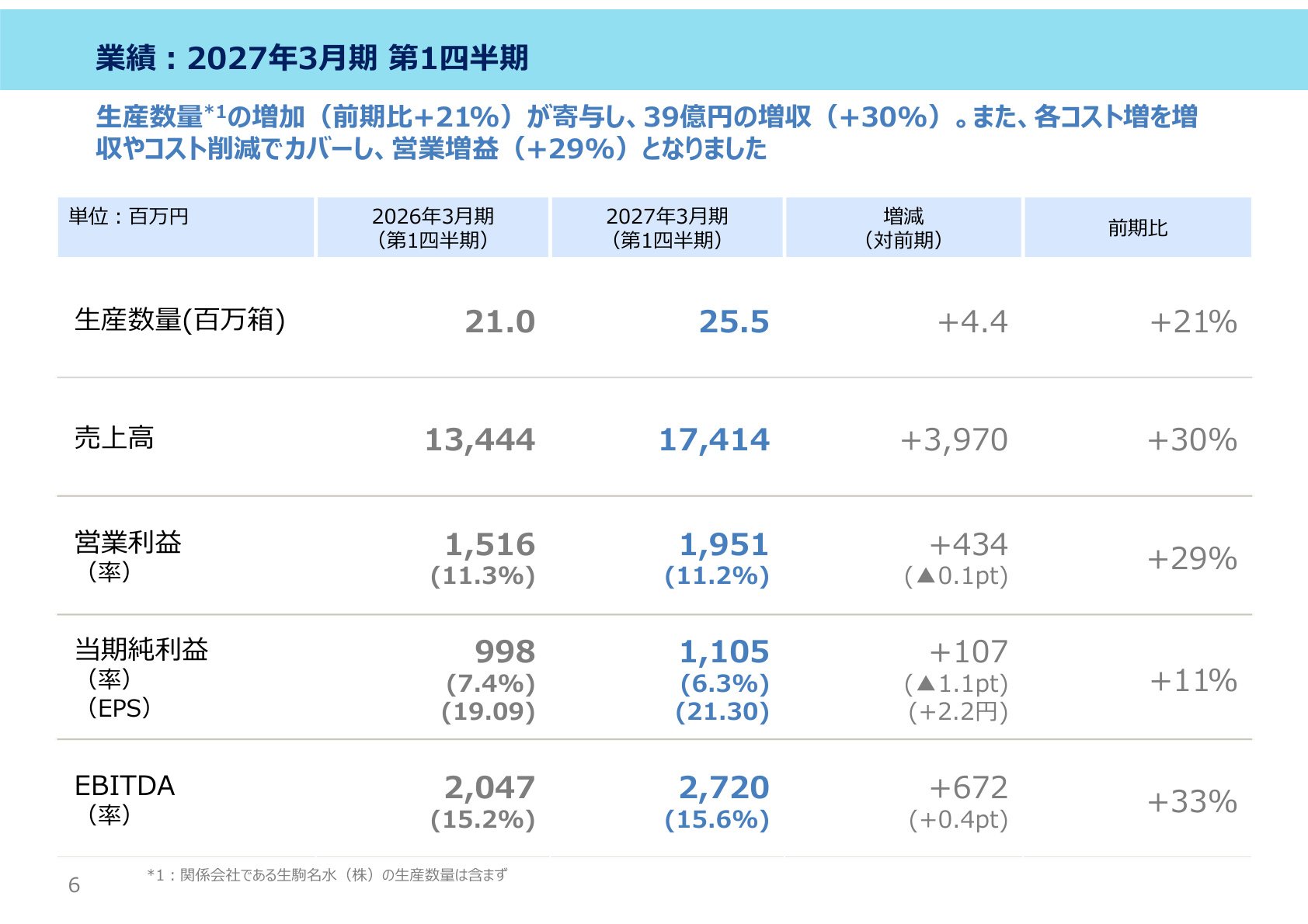
LIFEDRINK COMPANY (Securities Code: 2585) delivered a strong start to the fiscal year, with significant year-on-year growth in both revenue and profit at all levels for the first quarter of the fiscal year ending March 2027 .
Key Performance Highlights (YoY):
- Net Sales: 17,414 million JPY ( +30.0% YoY)
- Operating Profit: 1,951 million JPY ( +29.0% YoY)
- Net Profit: 1,105 million JPY ( +11.0% YoY)
- EBITDA: 2,720 million JPY ( +33.0% YoY)
- Production Volume: 25.5 million cases ( +21.0% YoY)
[Analysis] Why this slide (PAGE 5) is important
This slide serves as the fundamental earnings summary, providing an at-a-glance view of the company's comprehensive financial performance and production status for the first quarter. It quantitatively validates that the company's core growth strategy—"expansion of production capacity"—is successfully translating into "increased production volume," which in turn creates a virtuous cycle of "significant growth in net sales and operating profit."
Notably, the steady increase in production volume to 25.5 million cases (+21% YoY) is the primary driver behind the expansion of the top line (+30.0%) and EBITDA (+33.0%).
2. Analysis of Operating Profit Fluctuations
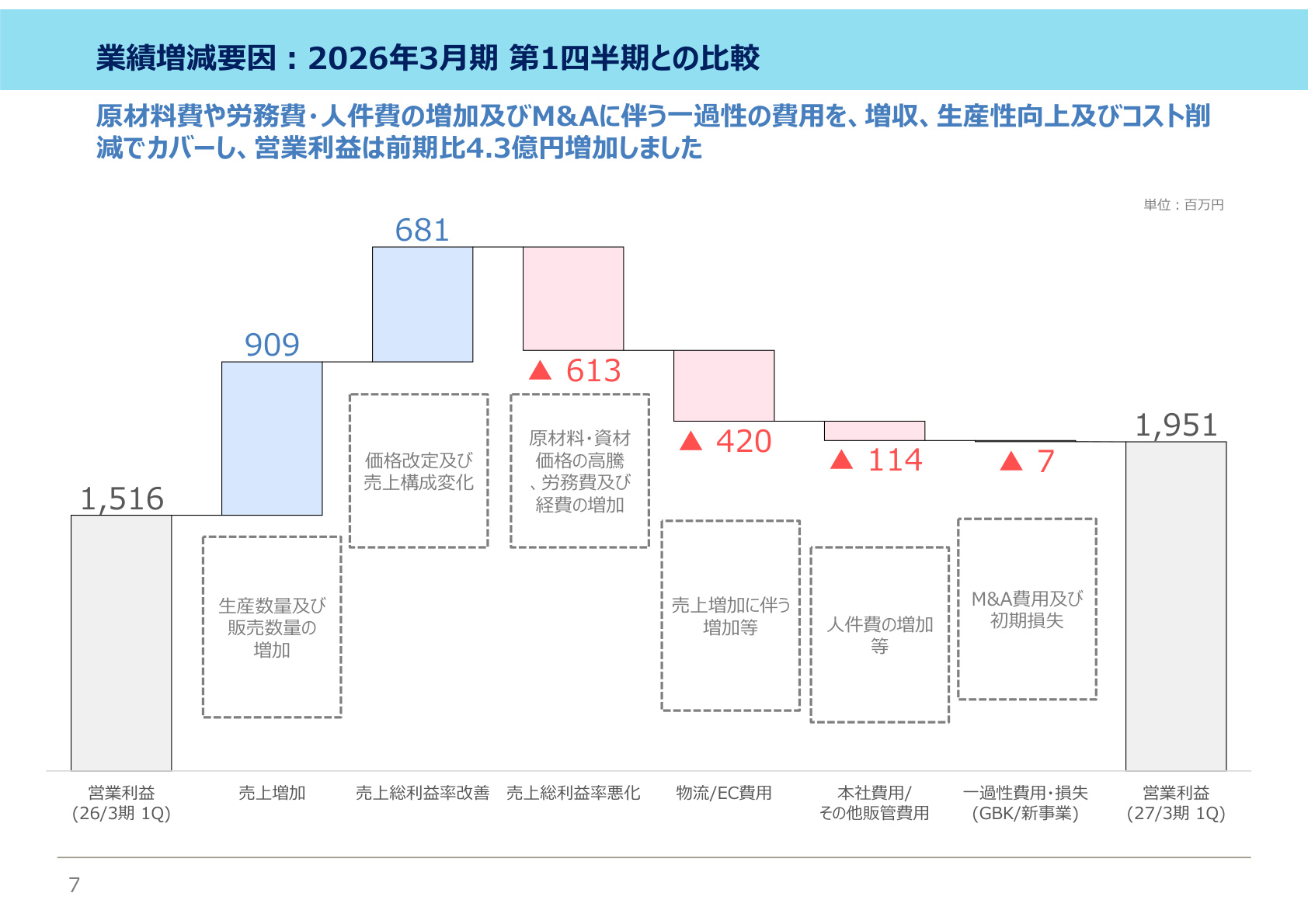
Operating profit increased by 434 million JPY (+29.0%) from 1,516 million JPY in the previous year to 1,951 million JPY. In an environment characterized by rising costs, the company’s profit structure clearly demonstrates its ability to offset these pressures through revenue growth and operational efficiency.
[Analysis] Why this slide (PAGE 6) is important
This slide (waterfall chart) is critical as it provides a detailed breakdown of the factors contributing to profit growth and highlights the company's resilience against cost-inflation pressures.
Breakdown of Profit Growth Factors:
-
Positive Factors (Profit Drivers):
- Impact of increased production and sales volume: +909 million JPY
- Price revisions and changes in sales composition (improved product mix, etc.): +681 million JPY
- Total positive factors reached +1,590 million JPY , forming a robust foundation for earnings expansion.
-
Negative Factors (Cost Pressures):
- Soaring raw material/packaging costs, and increases in labor and other expenses: -613 million JPY
- Increase in logistics and e-commerce related costs due to higher sales: -420 million JPY
- Increase in head office expenses and other SG&A (e.g., personnel costs): -114 million JPY
- M&A-related expenses and initial losses (one-time costs, etc.): -7 million JPY
Despite upward pressure from raw materials, logistics, and labor costs, as well as one-time M&A expenses (such as those related to the acquisition of the Sukima Department vending machine business), the company achieved operating profit growth by fully absorbing these costs through economies of scale from increased production and appropriate price revision strategies .
3. Progress Against Full-Year Forecasts and Quarterly Trends
The progress rates against the full-year earnings forecasts as of the first quarter are as follows, indicating a very high level of performance:
- Net Sales: 17.4 billion JPY / Full-year forecast 72.0 billion JPY ( 24% progress )
- Operating Profit: 1.9 billion JPY / Full-year forecast 6.5 billion JPY ( 30% progress )
- Net Profit: 1.1 billion JPY / Full-year forecast 4.2 billion JPY ( 26% progress )
- EBITDA: 2.7 billion JPY / Full-year forecast 10.0 billion JPY ( 27% progress )
The soft drink industry is highly seasonal, with the peak season occurring in the summer (Q2). Achieving a 30% progress rate in operating profit by the end of Q1 demonstrates an exceptionally strong start toward meeting the full-year plan.
4. Financial Position (B/S) and Interest-Bearing Debt Trends
The balance sheet is expanding in line with the acceleration of growth investments.
- Total Assets: 57,634 million JPY ( +10,570 million JPY from the end of the previous fiscal year)
- Fixed assets increased to 38,942 million JPY (+7,696 million JPY) due to capital expenditures at the Gotemba Plant and the acquisition of the Sukima Department vending machine business (including goodwill).
- Net Interest-Bearing Debt: With interest-bearing debt rising to 32,146 million JPY, net interest-bearing debt increased by 8.8 billion JPY from the end of the previous fiscal year.
- Net Debt/EBITDA Ratio: 3.4x (up 0.9pt from 2.5x at the end of the previous fiscal year).
The increase in interest-bearing debt is attributed to funding for aggressive capital investment and M&A, and is being managed in balance with the expanding EBITDA.
5. Growth Investments and New Business Topics
The company is pursuing multiple strategic investments to facilitate future production increases and the diversification of sales channels.
(1) Progress of Capital Investment at Plants
- Gotemba Plant: Construction of a new 500ml beverage line (8 million cases/year) is proceeding smoothly, with operations scheduled for the second half of FY2027.
- N Beverage: The 500ml beverage line expansion (3 million cases/year) has already transitioned to full-scale production . Construction of an automated warehouse is also underway, targeting operations in the second half.
- Iwate Plant: Planning a line upgrade (+8 million cases/year), aiming for operations in the second half of FY2028.
(2) Additional Investment in Gunma Beverage (GBK) and Use of Large-Scale Subsidies
The investment plan for the Gunma Beverage No. 2 line has been revised, with the total investment increased to 8.9 billion JPY .
- The plan has shifted from restarting a suspended line (hot-pack filling) to installing a new line (green aseptic filling) . This will achieve significant energy savings and cost reductions.
- The company plans to utilize the Large-Scale Growth Investment Subsidy (5th public offering) to receive up to 2.9 billion JPY in grants (net burden after deduction is approximately 6 billion JPY). Operations are scheduled for FY2028.
(3) Full-Scale Entry into the Vending Machine Channel (Strengthening Direct Sales)
Following the acquisition of the Sukima Department vending machine business in April 2026, the company plans to take over the Pokka Sapporo vending machine business in October 2026.
- Sukima Department: Commenced the introduction of in-house products (water, tea, sparkling water). Improving operational capabilities by strengthening the recruitment of route sales personnel.
- Pokka Sapporo Vending Machine Business: Established the successor company, "PS Bottlers." Currently formulating plans to convert vending machines into "mixed machines" (in-house PB products x manufacturer products).
(4) Growth of E-commerce Business and Expansion of In-House Brands
- The flagship product, " Strong Sparkling Water OZA SODA 500ml 48-pack ," won 1st place in the "Water/Soft Drink Category" of the Rakuten First-Half Ranking 2026 .
- The company continues to expand its online store lineup with new products such as "OZA SODA Peach" and "Ayacha Oolong Tea."
6. Mid-Term Management Plan and Business Model Strengths
[Analysis] Why this slide (PAGE 23) is important
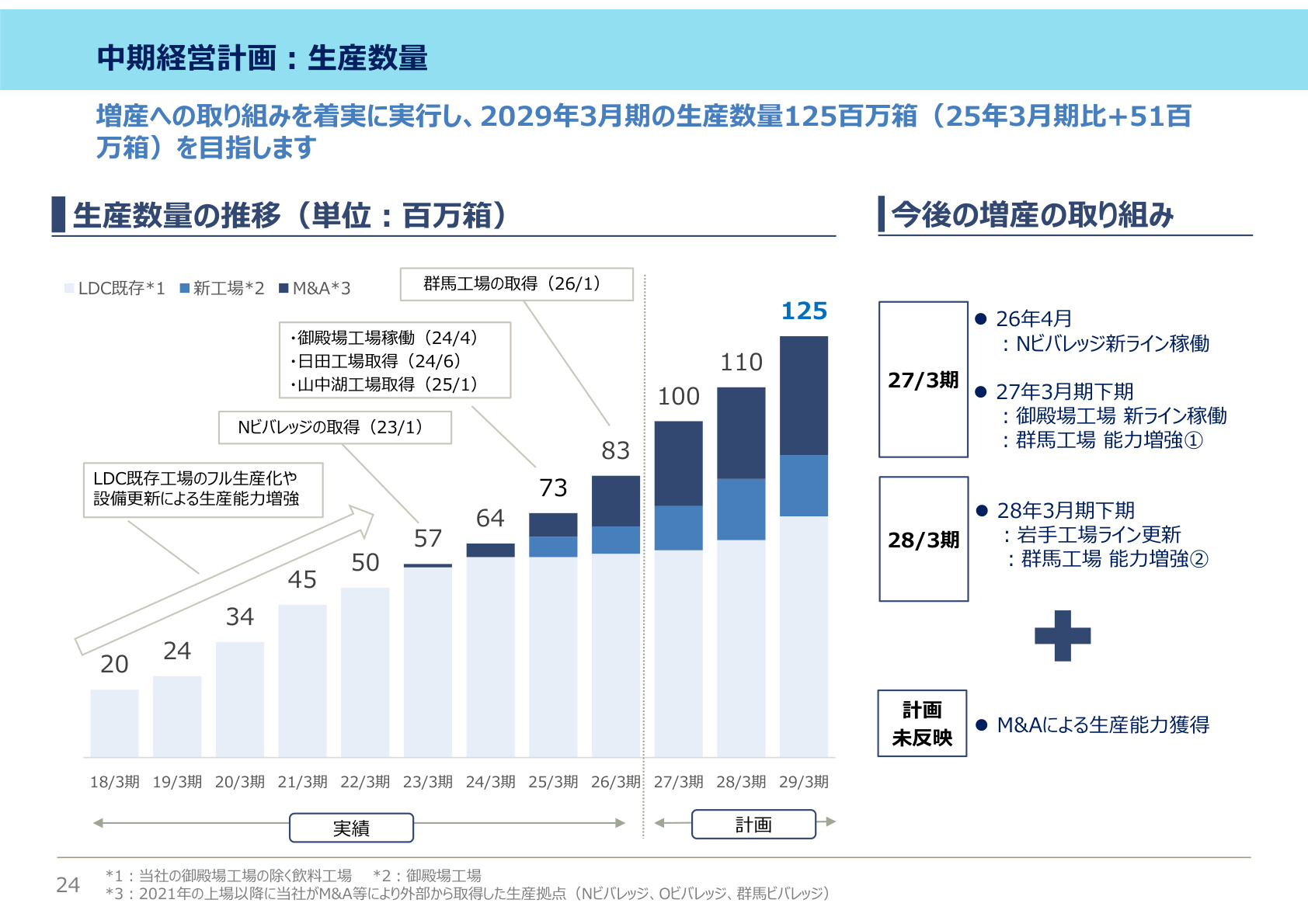
This slide is the most important, illustrating the full scope and roadmap of LIFEDRINK COMPANY's long-term growth story. Along with the historical production volume trend (rapid growth from 20 million cases in FY2018 to 83 million cases in FY2026), it sets a clear goal of achieving 125 million cases by the fiscal year ending March 2029 (+51 million cases compared to FY2025) .
The unique business model that enables the company to sustain high growth includes:
- High-Volume Production of Limited Varieties: Focusing on stable, staple categories such as water, tea, and sparkling water (2L and 500ml) to minimize production line changeover losses.
- In-house Production from Procurement to Sales: Establishing thorough cost advantages through vertical integration, such as in-house preform molding from resin.
- Nationwide Beverage Plant Network: By positioning 14 plants across the country, the company significantly reduces logistics costs for heavy beverages, enabling a low-price and stable supply system.
Furthermore, the 125 million case target shown in the plan does not include production capacity to be acquired through future unannounced M&As , meaning the plan has significant upside potential depending on the progress of M&A activities.
Conclusion
LIFEDRINK COMPANY's Q1 FY2027 earnings were robust, characterized by the ability to fully absorb rising costs in raw materials and logistics through revenue growth, driven by expanded production capacity and high operational efficiency. Moving forward, the commencement of operations at the Gotemba Plant and Gunma Beverage, as well as the progress of PMI (post-merger integration) for the newly acquired vending machine business, will be the key focal points for achieving the "125 million cases" mid-term management plan.
This content is not intended as investment advice or a recommendation. Any opinions expressed are solely the personal views of each article.