


Dive Group Inc. FY2026 Financial Results Report: Record-High Profits and Structural Evolution into a 'Tourism Platform'

StockClub
Published: Aug 13, 2026, 09:56 AM
Sentiment Analysis
Dive Group Inc. FY2026 Financial Results Report: Record-High Profits and Structural Evolution into a 'Tourism Platform'
Based on the full-year financial results and business plan materials for the fiscal year ending June 2026, this report provides a comprehensive analysis of Dive Group Inc. (Securities Code: 151A), covering its performance, key business KPIs, advanced initiatives for productivity improvement, and its mid-to-long-term growth strategy.
1. FY2026 Full-Year Financial Highlights and Plan Comparison
Overview of Record-High Performance
In the fiscal year ending June 2026, Dive Group achieved record highs across all profit lines—net sales, operating profit, ordinary profit, and net income —driven by the steady expansion of its core Tourism HR business and strong tailwinds in the tourism market, including robust inbound demand.
- Net Sales : 15,325 million JPY (+11.2% YoY)
- Gross Profit : 3,749 million JPY (+8.1% YoY)
- Operating Profit : 819 million JPY (+8.4% YoY)
- Ordinary Profit : 830 million JPY (+8.0% YoY)
- Net Income : 563 million JPY (+23.9% YoY)
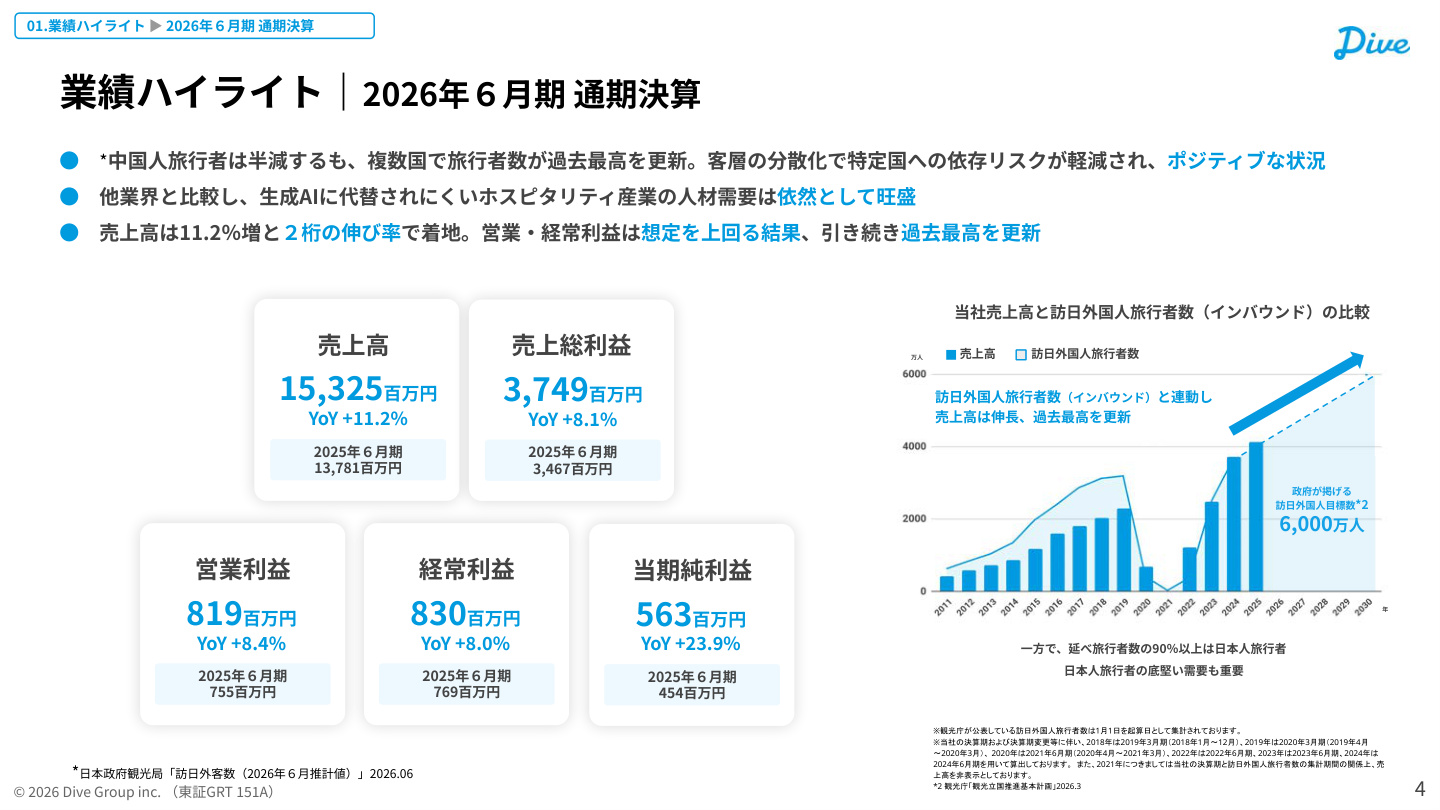
[Slide Commentary: Why this slide is important]
The slide above (Page 3) summarizes the key financial indicators for FY2026 and demonstrates how the company's performance is strongly correlated with the growth trend of inbound foreign travelers to Japan . Despite some uncertainty regarding specific regions, such as travel trends from China, the diversification of travelers from Western countries and other parts of Asia has kept demand for labor in the hospitality industry resilient. The company achieved double-digit growth in net sales (+11.2%) while steadily expanding profits at every level, clearly indicating that it is effectively capturing the recovery in macro tourism demand.
Comparison with Full-Year Budget
The progress and achievement rates against the initial full-year plan (budget) are as follows:
- Net Sales : 15,325 million JPY (Plan: 16,000 million JPY, Achievement: 95.8%)
- Operating Profit : 819 million JPY (Plan: 800 million JPY, Achievement: 102.4%)
- Ordinary Profit : 830 million JPY (Plan: 797 million JPY, Achievement: 104.1%)
- Net Income : 563 million JPY (Plan: 540 million JPY, Achievement: 104.2%)
Regarding net sales, the target was slightly missed (95.8%) due to factors such as the high proportion of placement services (where only gross profit is recorded as revenue) and lower-than-expected occupancy rates at some facilities in the regional revitalization business. However, in terms of profitability, the optimized management of advertising expenses and the adjustment of timing for upfront investments (period shifts) proved successful, allowing the company to exceed its initial plans for operating, ordinary, and net income .
2. Deep Dive into the Tourism HR Business and Key KPIs
Revenue Structure and Recent Performance
The core Tourism HR business provides specialized staffing services for resorts and tourist facilities nationwide. In FY2026, this segment generated 14.5 billion JPY in net sales and 1.35 billion JPY in operating profit (operating margin of 9.4% ), serving as the primary driver of the company's overall performance.
- Net Sales : 14.5 billion JPY (Previous: 12.97 billion JPY)
- Gross Profit : 3.08 billion JPY (Gross Margin: 21.3%)
- SG&A Expenses : 1.72 billion JPY (SG&A Ratio: 11.9%)
- Operating Profit : 1.35 billion JPY (Operating Margin: 9.4%)
Number of Workers and Revenue per Worker (LTM)
The fundamental KPIs of the business—the number of workers (total headcount) and the number of unique users (UU) —continue to reach record highs.
- Total Headcount : 55,945 (+9.3% YoY)
- Staffing: 52,086 (+10.2% YoY)
- Placement: 3,859 (-1.5% YoY)
- Unique Users (UU) : 15,726 (+8.0% YoY)
- Revenue per Worker (LTM) : 1.34 million JPY (-0.3% YoY)
The slight decline in revenue per worker (LTM) is attributed to exceptionally strong recruitment of new staff in the third quarter. Since new staff have shorter tenures immediately after starting, they temporarily lower the LTM average. However, as the base of active workers is steadily expanding , this is viewed as a healthy trend for the growth of the business foundation.
Structural Differences: Staffing vs. Placement Models
The company operates two models: "Staffing" and "Placement."
- Staffing : The full amount, including staff wages and social insurance premiums, is recorded as "Net Sales."
- Placement : Only the placement fee (= gross profit) is recorded as "Net Sales."
While the number of workers via placement is trending upward due to client needs, the nature of this model results in smaller revenue figures. This makes the top-line growth rate appear more moderate, but it contributes to stable profit margins as a high-margin business without associated cost of sales .
3. Marketing Enhancement and Company-wide AX (AI Transformation)
Multi-faceted Marketing to Capture Younger Demographics
The company is promoting advanced branding and alliances to increase awareness of its "Resort Baito" (resort part-time job) service and secure "top-of-mind" status.
- Official Resort Baito App Release : Launched the industry's first dedicated app, providing a seamless digital experience from viewing reviews (over 7,000) to checking pay slips and requesting advance payments.
- Brand Ambassador Appointment : Promoted by actress "Non," with the new brand movie exceeding 12 million views (+5,757% YoY).
- Cross-Industry Alliances : Partnered with major companies such as Trip.com, Sakai Moving Service, audiobook.jp, and U-NEXT to provide diverse benefits and services to job seekers.
Thorough Company-wide AX (AI Transformation)
To achieve a dramatic improvement in internal productivity, the company is aggressively promoting AI utilization (AX) across the entire organization.
- 100% AI Adoption Rate : Gemini and Claude are deployed and utilized company-wide.
- Integration with Personnel Evaluation : AI-driven operational efficiency initiatives have been added to personnel evaluation criteria.
- AX in Recruitment Processes :
- AI agent automation of job posting processes.
- Introduction of AI interviews targeting younger and student demographics.
- 24/7 automated job inquiries and FAQ responses.
Through these DX/AX initiatives, the company is simultaneously achieving higher matching accuracy, shorter lead times, and the suppression of operating costs and SG&A expenses.
4. FY2027 Consolidated Business Plan and Growth Outlook
Business Plan Targeting Double-Digit Revenue and Profit Growth
Dive Group plans to continue its sustainable growth trend in the fiscal year ending June 2027.
- Net Sales : 17,000 million JPY (+10.9% YoY)
- Operating Profit : 950 million JPY (+16.0% YoY)
- Net Income : 630 million JPY (+11.8% YoY)
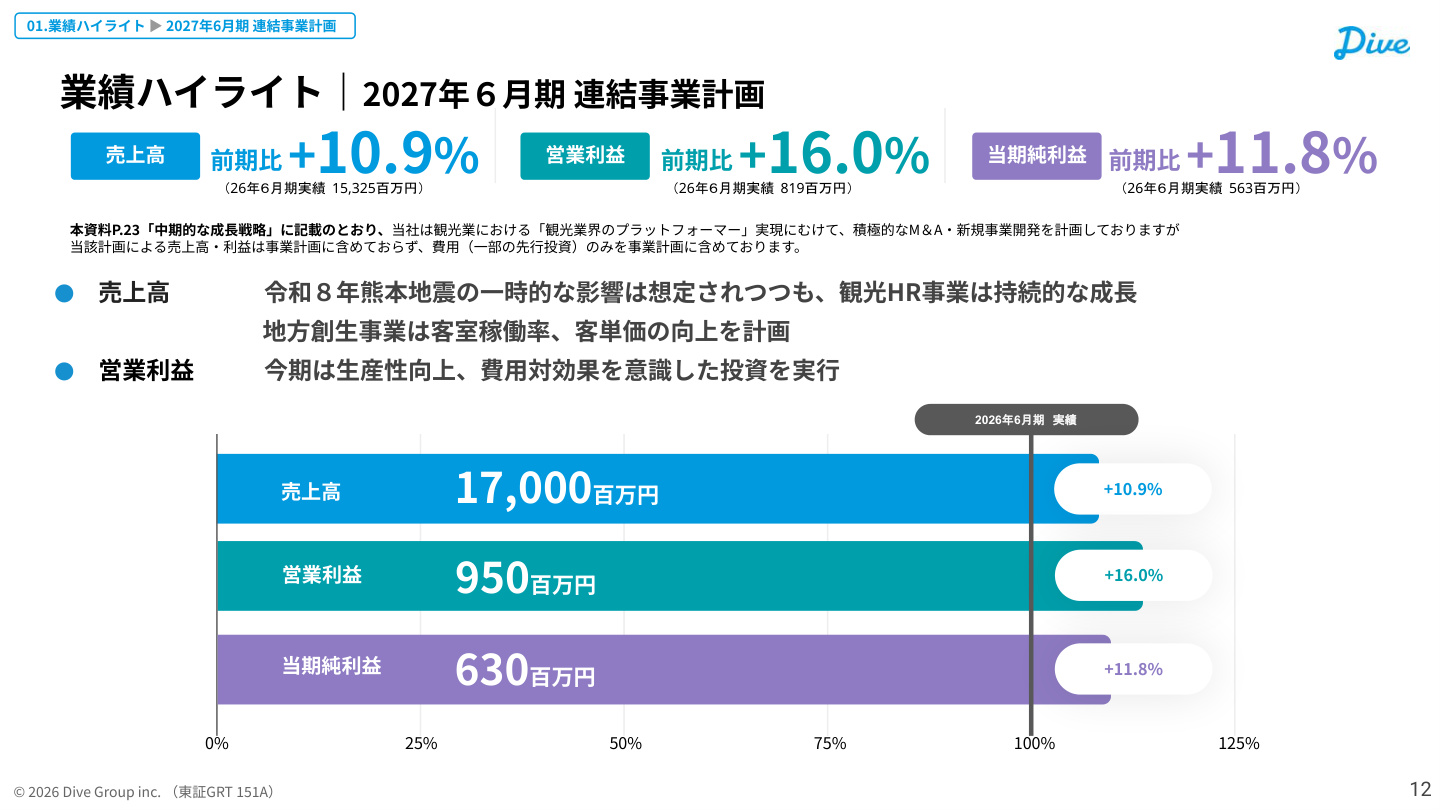
[Slide Commentary: Why this slide is important]
The slide above (Page 11) shows the consolidated business plan targets for FY2027. While conservatively accounting for temporary regional impacts such as the 2026 Kumamoto earthquake, the company has set strong growth targets of 17 billion JPY in net sales (+10.9%) and 950 million JPY in operating profit (+16.0%) . By continuing to expand the existing Tourism HR business, implementing company-wide productivity improvements, and maintaining cost-effective investment decisions, the company demonstrates a profit margin improvement story where operating profit growth (+16.0%) exceeds net sales growth (+10.9%) .
5. Financial Foundation, Organizational Reform, and the 'Tourism Platform' Vision
Robust Cash Flow Generation and Financial Soundness
The company is steadily increasing its cash-generating capacity to fund investments for non-linear growth.
- Cash Flow from Operating Activities : 800 million JPY (Previous: 268 million JPY, +198.3% YoY)
- Cash and Cash Equivalents (Year-end) : 2,485 million JPY (+20.3% YoY)
- Net Cash : Increased to 2.17 billion JPY
With the maintenance of the equity ratio and the reduction of interest-bearing debt, the abundant free cash flow and net cash provide a solid foundation for future M&A and new business development.
Transition to a Holding Company Structure (Dive Group)
On July 1, 2026, the company transitioned to a holding company structure, "Dive Group Inc."
- Dive Inc. : Dedicated to staffing and placement services.
- Yadoya Juku Inc. : Tourism talent development.
- Dive Local Inc. : Regional revitalization business.
- M&A/New Business Division : Exploring new frontiers in the tourism industry.
This organizational structure clarifies responsibilities and authority for each business, enabling agile decision-making and the powerful promotion of non-linear growth strategies.
M&A Strategy and Evolution into the 'Dive 3.0' Tourism Platform
The company envisions a long-term evolution from simple tourism staffing (Dive 1.0) to promoting operational DX (Dive 2.0), and finally to becoming a "Tourism Platform (Dive 3.0)."
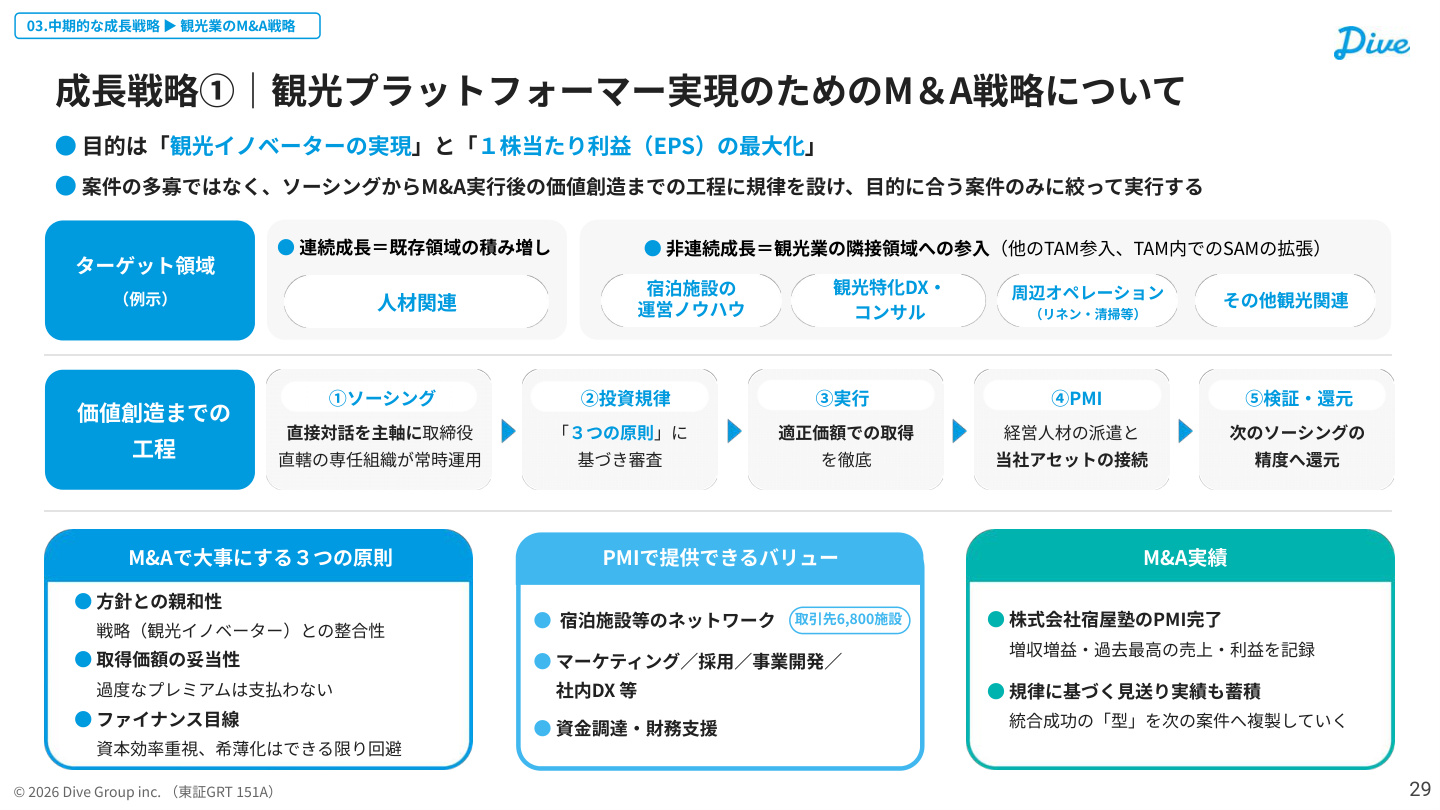
[Slide Commentary: Why this slide is important]
The slide above (Page 28) clearly outlines the rigorous M&A process and value creation model for achieving the company's tourism platform vision. Rather than M&A for the sake of blind scale expansion, the company prioritizes "maximizing earnings per share (EPS)." By strictly applying three investment principles —(1) strategic affinity, (2) acquisition at a fair price (avoiding excessive premiums), and (3) a finance-oriented perspective emphasizing capital efficiency—the company leverages its network of over 6,800 tourist facilities and its own customer acquisition/DX know-how during post-merger integration (PMI) to dramatically enhance the value of acquired companies.
Summary and Comprehensive Evaluation
Dive Group continues to achieve high growth by leveraging two main drivers: market share expansion in its core Tourism HR business (record-high headcount and UU) and productivity improvements through AX . Furthermore, through its transition to a holding company and a disciplined M&A strategy backed by robust cash flow, the company is steadily evolving into a "Tourism Platform Company" that comprehensively solves the severe labor shortages and management challenges facing the tourism industry.
This content is not intended as investment advice or a recommendation. Any opinions expressed are solely the personal views of each article.