

![[Sunwels] Q1 FY2027 Earnings Deep Dive: Navigating Medical Fee Revisions and the Blueprint for Operational Restructuring](https://news-images.stock-club.net/market_news/images/9229/140120260807515761/slide_eyecatch_en_6475347c.webp)
[Sunwels] Q1 FY2027 Earnings Deep Dive: Navigating Medical Fee Revisions and the Blueprint for Operational Restructuring

StockClub
Published: Aug 12, 2026, 10:57 AM
Sentiment Analysis

Sunwels Q1 FY2027 Earnings Deep Dive Report
Sunwels Co., Ltd., the operator of " PD House " facilities specializing in Parkinson's disease, has released its Q1 financial results for the fiscal year ending March 2027. Alongside the results, the company announced a new management structure, including the appointment of a new President, and provided a detailed update on the progress of its structural reforms aimed at business turnaround. This report provides an in-depth analysis of the company's performance highlights, shifts in the revenue structure following medical fee revisions, occupancy trends, cost optimization measures, and the transition process to the Tokyo Stock Exchange (TSE) Standard Market.
1. Management Refresh and Structural Reform Policy
Sunwels has appointed Mr. Toshihiko Shin , a former Ministry of Health, Labour and Welfare official and former outside director, as its new Representative Director and President. Leveraging his expertise in institutional policy, legal affairs, administration, and governance, the company is shifting toward a structure designed to restore trust and lead the business turnaround.
The company's fundamental policy for structural reform is centered on the following four pillars:
- Reviewing Profitability per Facility : Transitioning outsourced cleaning and meal services to in-house staffing and reviewing service fees.
- Driving Sales Initiatives with a Focus on Reducing Vacancies : Deploying sales specialists, enhancing information sharing with local medical institutions, and conducting training to improve sales skills.
- Redesigning Staffing Standards at PD Houses : Transitioning to staffing models compliant with the Comprehensive Home Nursing Care system and optimizing headcount by facility and job function.
- Reducing Administrative Expenses : Reviewing administrative workflows, reallocating staff to facilities, curbing recruitment costs, and eliminating non-essential expenditures.
2. Changes in Revenue Structure Following Medical Fee Revisions
The medical fee revision in June 2026 (the introduction of the Comprehensive Home Nursing Care Fee ) significantly altered the revenue composition per resident in the company's business model.
[Significance and Analysis of the Slide Above]
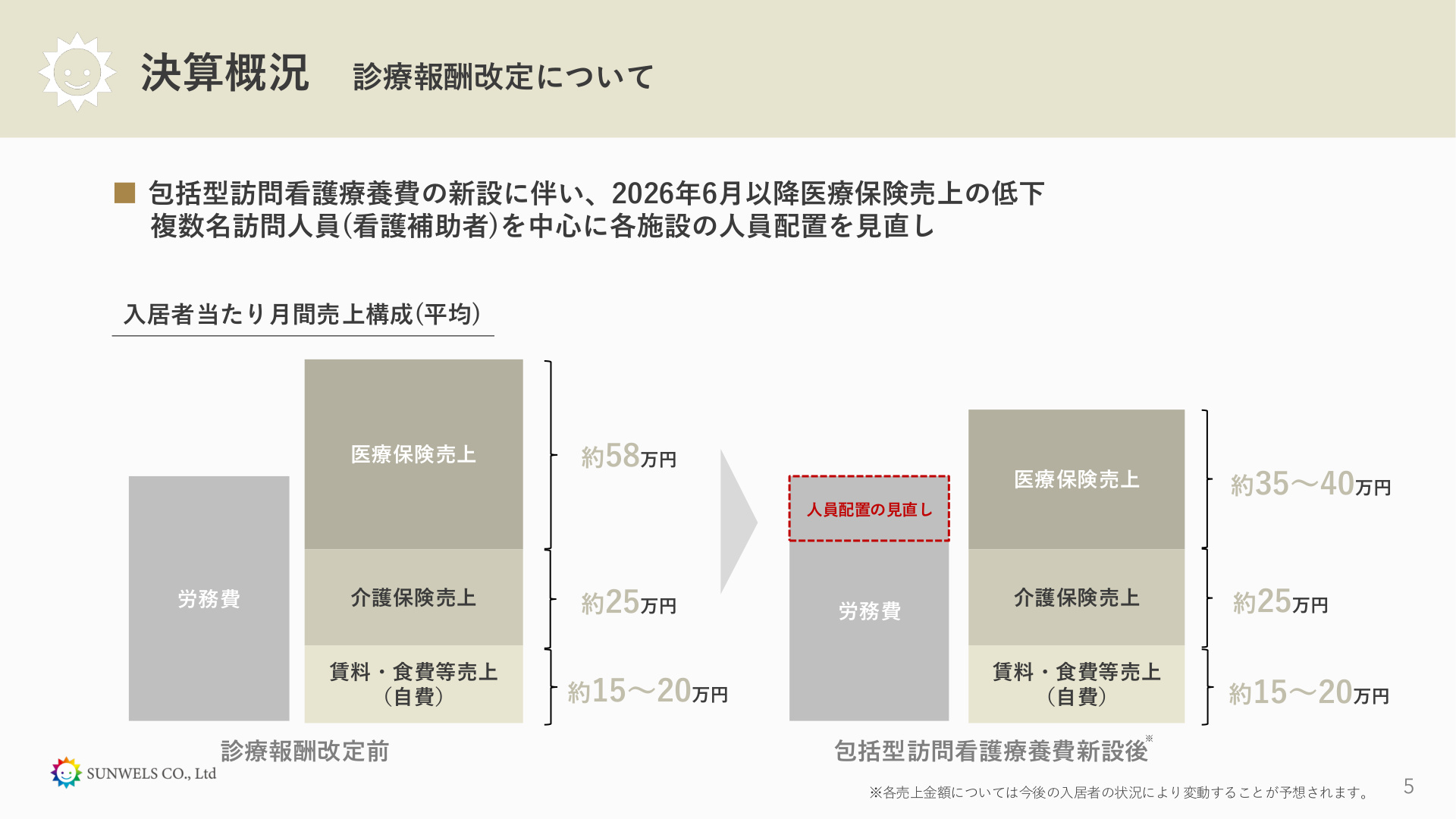
This slide illustrates the change in the "Average Monthly Revenue Composition per Resident" before and after the medical fee revision , serving as the most critical data point for understanding the company's revenue structure.
Prior to the revision, revenue consisted of medical insurance (approx. 580,000 JPY), long-term care insurance (approx. 250,000 JPY), and rent/food expenses (approx. 150,000–200,000 JPY). With the introduction of the Comprehensive Home Nursing Care Fee, medical insurance revenue has declined to approx. 350,000–400,000 JPY . Consequently, the company is downsizing its labor cost structure by reviewing its traditional staffing model, which relied heavily on multiple visiting personnel (nursing assistants, etc.). The ability to promptly optimize staffing in response to lower profitability will be the key to future margin recovery.
3. Q1 FY2027 Performance Highlights and Budget Comparison
Performance for the first quarter (1Q) of the fiscal year ending March 2027 is as follows:
- Net Sales : 7,298 million JPY (1Q Budget: 7,343 million JPY, Achievement: 99.4% , YoY: +10.5% )
- EBITDA : 115 million JPY (1Q Budget: 319 million JPY, Achievement: 36.3% , YoY: +211 million JPY )
- Operating Profit : △347 million JPY (1Q Budget: △168 million JPY, YoY: +160 million JPY (reduction in deficit) )
- Ordinary Profit : △519 million JPY (1Q Budget: △506 million JPY, YoY: +168 million JPY (reduction in deficit) )
- Quarterly Net Profit : △557 million JPY (1Q Budget: △507 million JPY, YoY: +167 million JPY (reduction in deficit) )
Analysis of Budget Variance
Sales and profit metrics fell short of the company's internal plan (budget), primarily due to delays in customer acquisition . Additionally, timing mismatches regarding the disbursement of treatment improvement subsidies (non-operating income) as bonuses (labor costs/COGS) impacted the budget variance for EBITDA and operating profit. However, compared to the same period last year, despite the decline in medical insurance revenue, the increase in the number of residents and cost-cutting measures resulted in a 10.5% increase in sales and a narrowing of the operating deficit, indicating an improving trend.
4. Occupancy Rates, Vacancy Trends, and Strengthening Sales
The driver for earnings recovery is the improvement in the occupancy rate of "PD Houses."
[Significance and Analysis of the Slide Above]
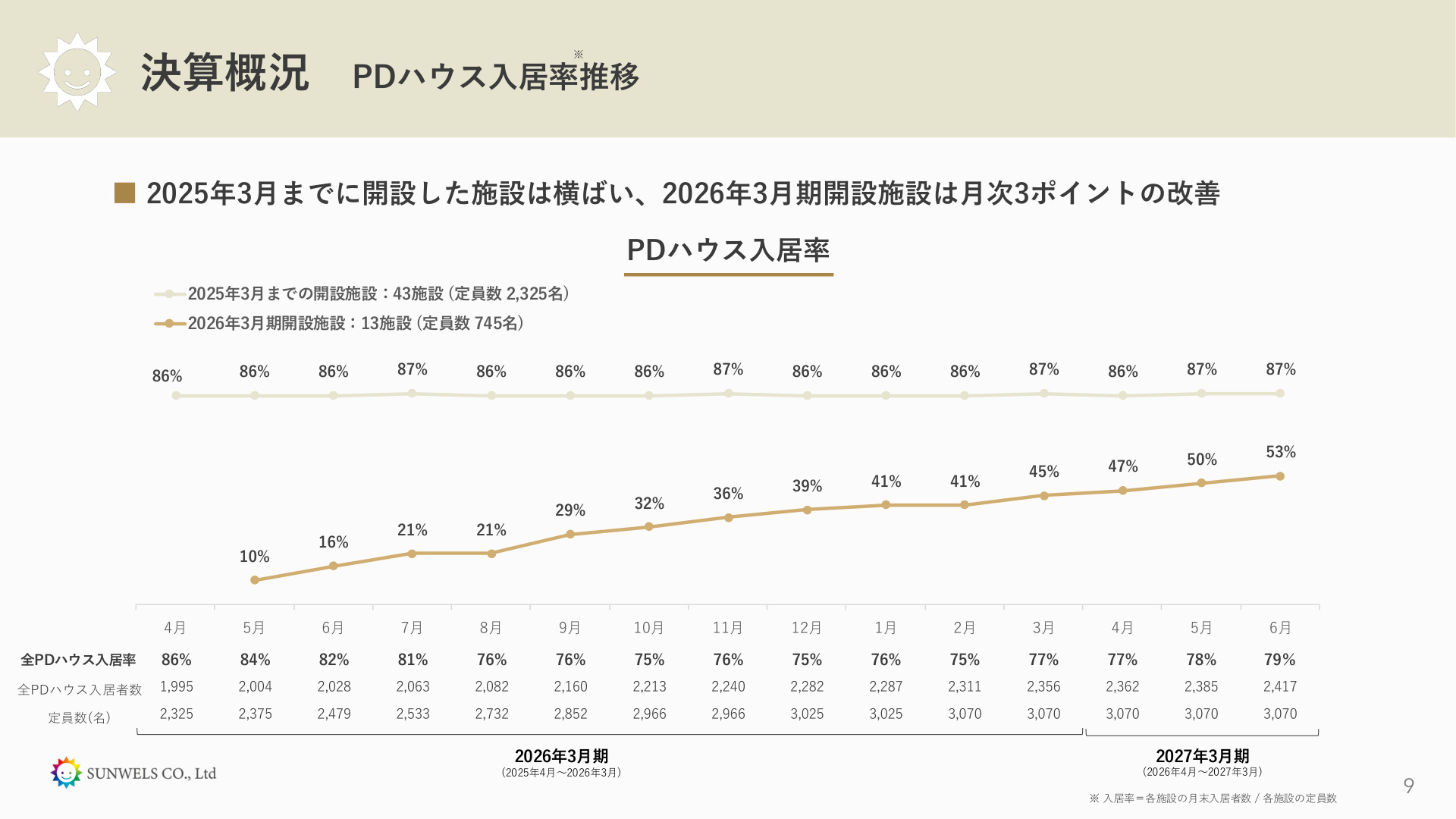
This slide visualizes the "Occupancy Rate Trends by Opening Period" for PD Houses .
The 43 existing facilities opened by March 2025 (capacity of 2,325) remain stable at a very high occupancy level of 86%–87% . Meanwhile, the 13 facilities opened in the fiscal year ending March 2026 (capacity of 745) have steadily increased from 10% in May 2025 to 53% as of June 2026, at a pace of approx. 3 percentage points per month . The average occupancy rate across all 56 facilities has risen to 79% (total of 2,417 residents).
Vacancies across all 56 facilities have decreased to 653 beds , and the company is further accelerating vacancy reduction and securing waitlisted residents through the deployment of sales specialists who maintain close information links with local medical institutions and home-care providers.
5. Staffing Optimization, Cost Structure Revision, and EBITDA Analysis
The company has shifted its recruitment policy in line with business scale expansion, moving toward a more efficient operating structure.
Recruitment Plan and Labor Cost Control
- 1Q New Hires : 145 (Significant reduction from 297 in the same period last year. Full-year plan is 250)
- Employees at Period End : 3,636 (Targeting 3,150 by the end of March 2027 through natural attrition and reallocation)
- Turnover Rate : 17.3%
EBITDA Variance Analysis (YoY +211 million JPY)
1Q EBITDA turned profitable, rising from △95 million JPY in the same period last year to 115 million JPY .
- Sales growth from facilities opened in FY2026 : +965 million JPY
- Increase in labor costs for facilities opened in FY2026 : △720 million JPY
- Reduction in administrative labor costs (SG&A) : +34 million JPY (SG&A ratio dropped to 5.4%)
- Fluctuations in supply and recruitment costs : +173 million JPY
As facilities opened in the previous fiscal year gradually increase their occupancy rates, they are generating revenue growth, which, combined with SG&A efficiency, is boosting profits.
6. Quarterly Performance Trends and Full-Year Outlook
The company's full-year earnings forecast for the fiscal year ending March 2027 is as follows:
- Full-Year Net Sales : 28,872 million JPY
- Full-Year Operating Profit : 420 million JPY
- Full-Year Ordinary Profit : △854 million JPY
- Full-Year Net Profit : △1,060 million JPY
Quarterly Profit Roadmap
Looking at the quarterly progression, the company expects to remain in the red through 1Q (Operating Profit △347 million JPY) and 2Q (Operating Profit forecast △199 million JPY) as it navigates the transition period of upfront investment and labor cost adjustments. However, it plans a rapid V-shaped recovery in 3Q (Operating Profit forecast 307 million JPY) and 4Q (Operating Profit forecast 480 million JPY) . The scenario assumes that the effects of improved occupancy and revised staffing standards will contribute significantly in the second half of the year.
7. Market Segment Change Review and Governance/Financial Reform
As a key initiative for business regrowth and corporate value recovery, Sunwels has applied for a market segment change to the Tokyo Stock Exchange Standard Market.
[Significance and Analysis of the Slide Above]
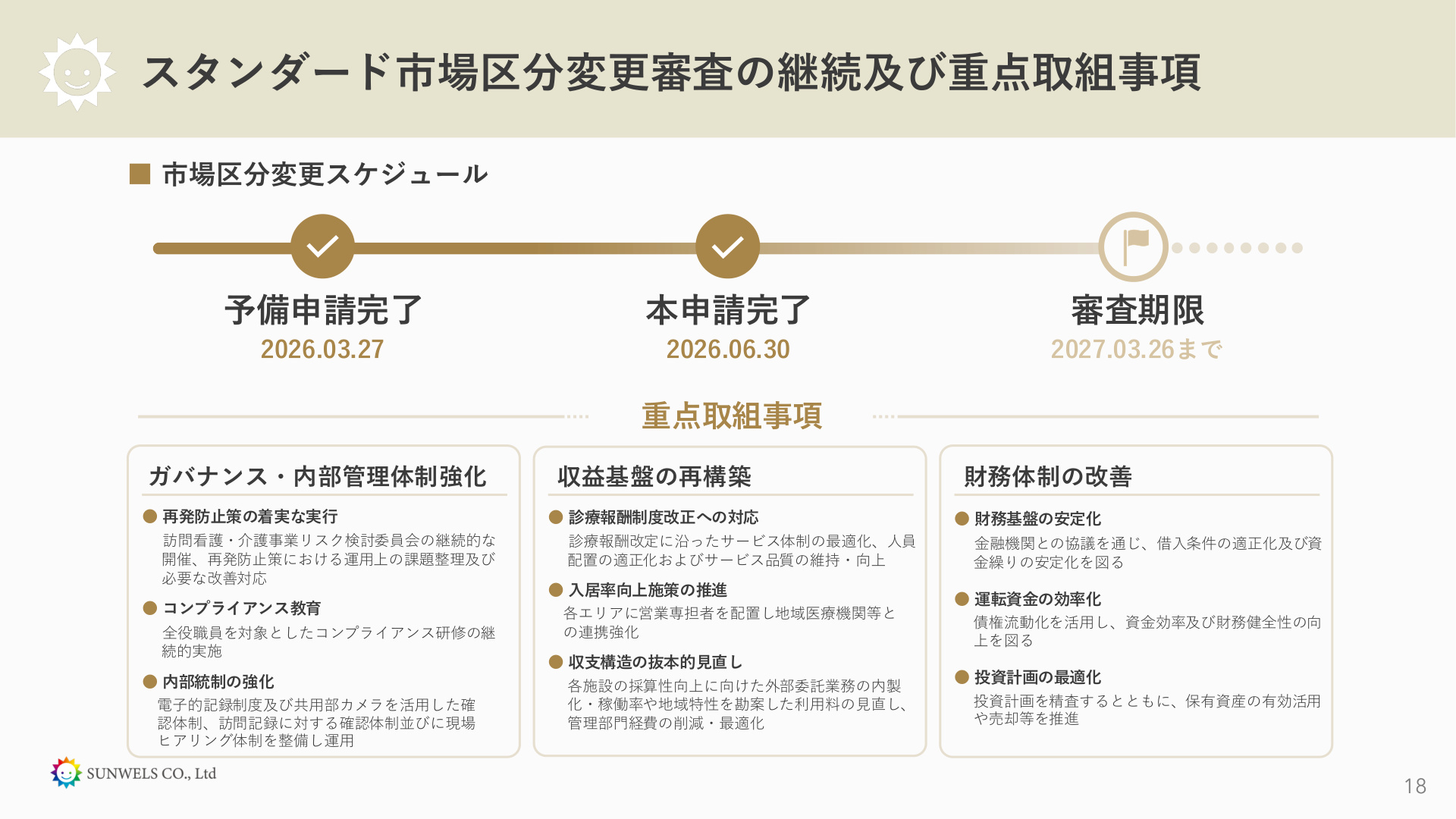
This slide outlines the roadmap for the TSE Standard Market transition schedule and key focus areas .
Preliminary application was completed on March 27, 2026, and the formal application was submitted on June 30, 2026 (review deadline: March 26, 2027). In preparation for the review, the company is executing the following three priority measures:
- Strengthening Governance and Internal Control : Continued operation of the Home Nursing/Care Business Risk Review Committee, compliance training for all officers and employees, and enhanced internal controls using common area cameras and electronic records.
- Restructuring the Revenue Base : Optimizing staffing in line with medical fee revisions, bringing outsourced operations in-house, and rationalizing administrative expenses.
- Improving Financial Structure : Optimizing borrowing terms and stabilizing cash flow through discussions with financial institutions, improving working capital efficiency through receivables securitization, and scrutinizing investment plans while effectively utilizing held assets.
Through these efforts, the company aims to establish a highly reliable management foundation and a stable financial structure.
8. PD House Business Model and Social Specialization
"PD House," operated by Sunwels, is a specialized facility dedicated to Parkinson's disease (and related disorders) , for which the number of patients in Japan is on the rise.
Specialization and Strengths
- Medical Collaboration : Partnerships with 125 neurologists and specialized medical institutions nationwide (as of the end of June 2026).
- Specialized Rehabilitation Programs : Providing evidence-based rehabilitation programs through joint research with top doctors from institutions such as Juntendo University and Kansai Medical University (e.g., Specially Appointed Professor Yoshio Tsuboi, Professor Makiro Takahashi).
- PD Licensing System : An internal certification system for all employees. 2,744 staff members have achieved Level 3 (88% acquisition rate), and 166 have achieved Level 1 (5% acquisition rate), ensuring thorough improvement of staff expertise.
With limitations in home care and general nursing facilities for Parkinson's patients, PD House fulfills a high social need by providing 24-hour nursing care and specialized rehabilitation.
Conclusion
In the first quarter of the fiscal year ending March 2027, Sunwels faced challenges such as the impact of medical fee revisions and budget shortfalls due to delayed customer acquisition. However, the company is currently in a transition phase, swiftly advancing structural reforms under its new management structure . Measures aimed at shifting toward a profitable structure—such as rising occupancy rates in newly opened facilities (a pace of +3pt per month), recruitment restraint, staffing optimization, and a lower SG&A ratio—are beginning to show steady results. Achieving an operating profit in the second half of the year and progress in the transition to the TSE Standard Market will be the key points to watch for future corporate value reconstruction.
This content is not intended as investment advice or a recommendation. Any opinions expressed are solely the personal views of each article.