


Deep Dive Report: Microwave Chemical (9227) FY2026 Financial Results and FY2027 Profitability Roadmap

StockClub
Published: Aug 12, 2026, 10:56 AM
Sentiment Analysis
Deep Dive Report: Microwave Chemical (9227) FY2026 Financial Results and FY2027 Profitability Roadmap
Microwave Chemical Co., Ltd. (Securities Code: 9227) released its full-year financial results for the fiscal year ending June 2026 on August 12, 2026. This report provides a comprehensive analysis of the company's performance, covering 10 key topics including performance trends , financial position and countermeasures , KPI progress , new business acquisition , and the strategic roadmap toward achieving an operating profit in the fiscal year ending June 2027 .
1. Overview of FY2026 Full-Year Results
For the fiscal year ended June 2026 (an irregular 15-month period due to a change in the fiscal year-end), the company reported net sales of 1,057 million JPY , an operating loss of 927 million JPY , an ordinary loss of 948 million JPY , and a net loss of 964 million JPY . Compared to the initial forecast (net sales of 1,613 million JPY, operating loss of 853 million JPY), sales fell significantly short by 35.2% due to delays in securing large-scale projects.
However, compared to the revised plan announced in May (net sales of 1,044 million JPY, operating loss of 954 million JPY), the company achieved 101.3% of its sales target and improved its operating loss by 27 million JPY . This was driven by the rescheduling of raw material and equipment procurement, alongside strict control of SG&A expenses.
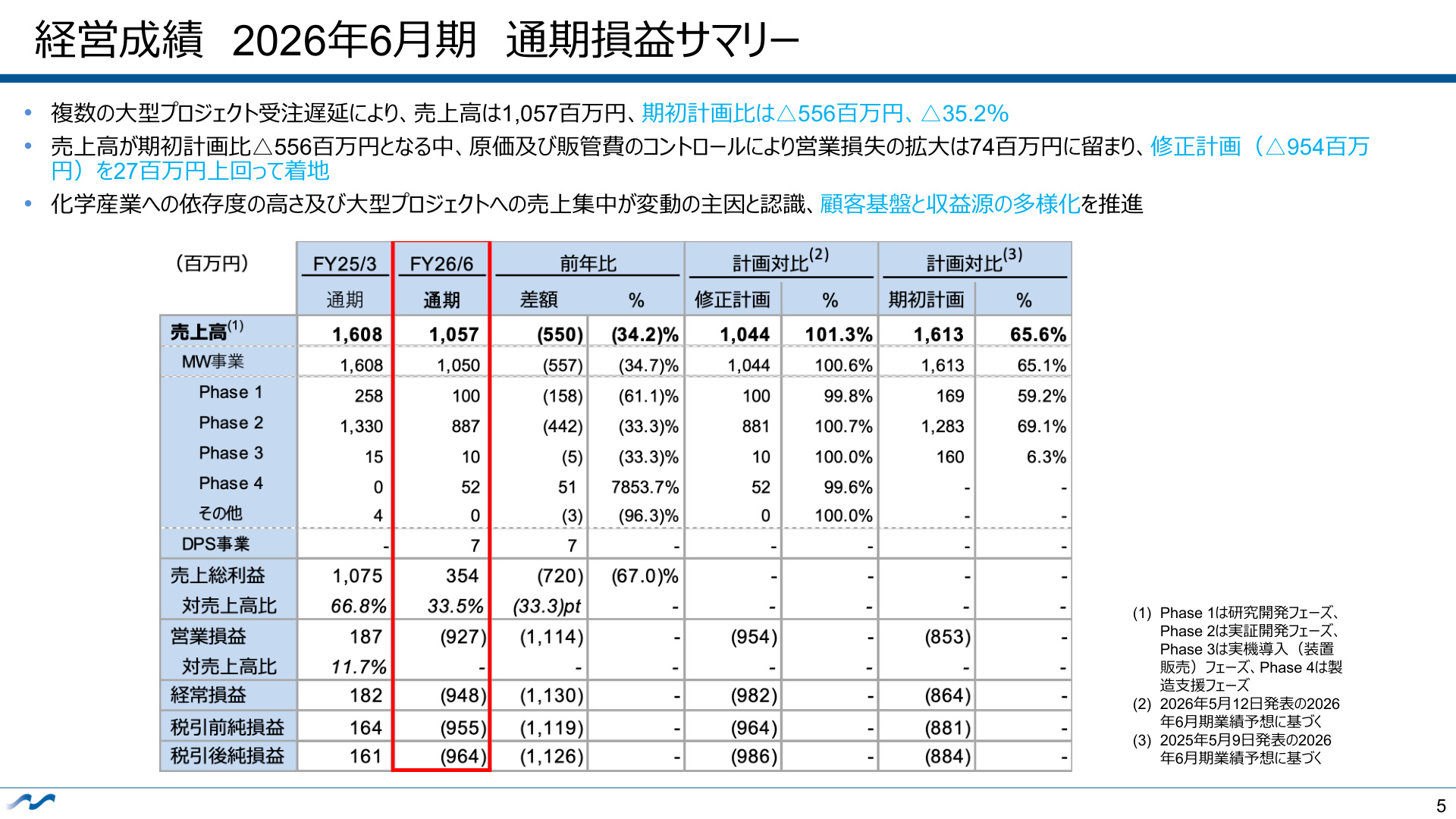
[Slide Commentary: FY2026 Full-Year P&L Summary (P.5)]
This slide is the most critical data set, covering the FY2026 results compared to the previous year, the revised plan, and the initial plan. It shows that gross profit shrank from 1,075 million JPY in the previous year to 354 million JPY (a gross margin of 33.5%) , indicating that the primary factor behind the profitability decline was the deterioration of gross margins on specific large-scale projects involving equipment manufacturing. Furthermore, a breakdown by phase reveals that while Phase 2 (demonstration development) accounted for the majority of sales at 887 million JPY, the delay in transitioning to Phase 3 (commercial equipment installation) and Phase 4 (manufacturing support) directly impacted performance.
2. Financial Challenges and Response to "Going Concern" Uncertainties
Due to the net loss, net assets decreased to 152 million JPY by the end of June 2026, and the equity ratio dropped to 8.6% (from 50.1% at the end of the previous fiscal year). In response to this deterioration, the company has included a note regarding "events or conditions that cast significant doubt on the company's ability to continue as a going concern."
However, the company is implementing agile financial measures to address these temporary funding needs and ensure the liquidity required to drive business toward profitability in the next fiscal year.
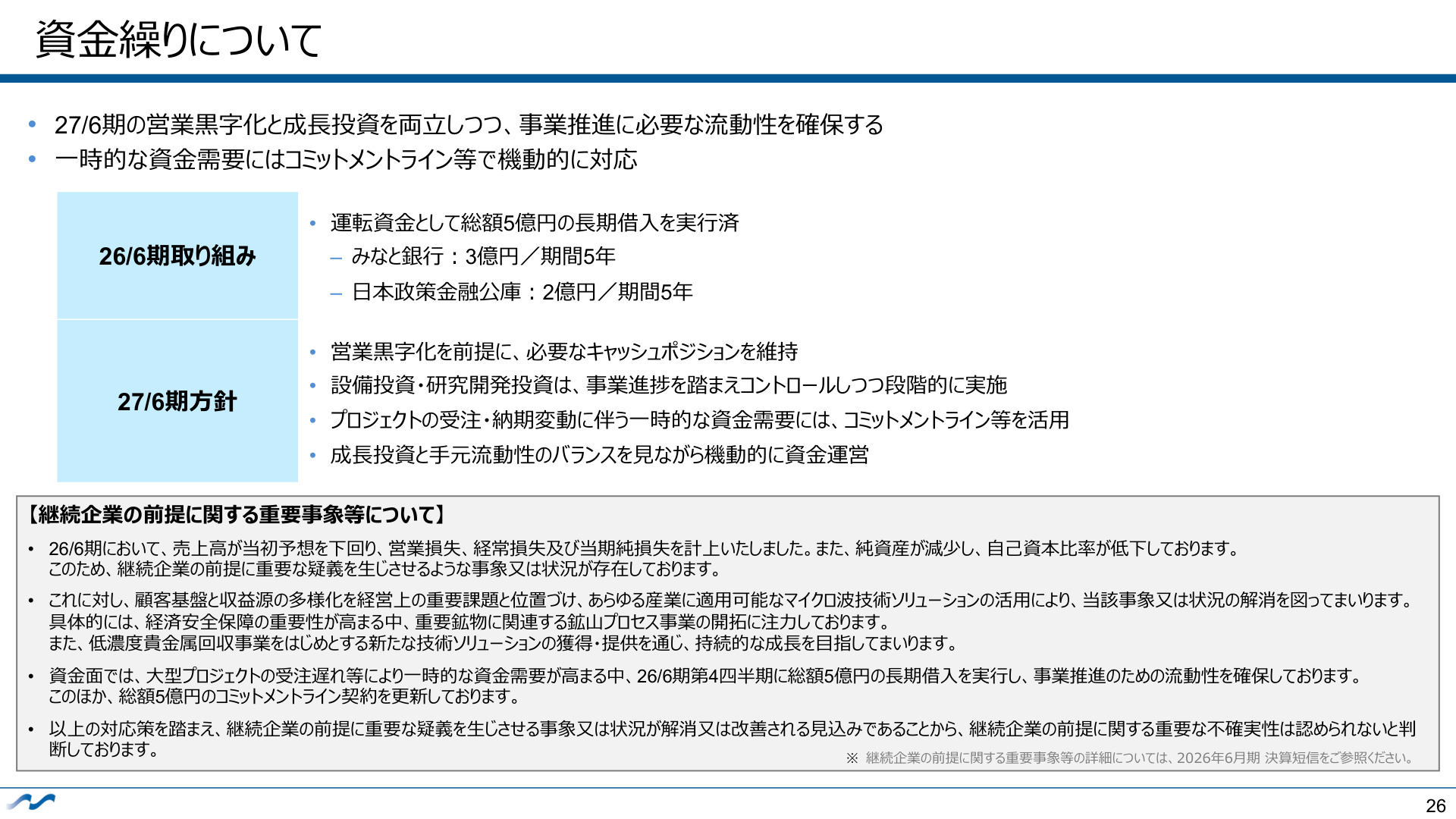
[Slide Commentary: Cash Flow and Funding (P.26)]
This slide is essential for explaining the market's primary concerns: "cash flow" and the "approach to resolving uncertainties regarding the going concern (GC) assumption." In the fourth quarter, the company secured 500 million JPY in long-term loans (300 million JPY from Minato Bank and 200 million JPY from the Japan Finance Corporation, both with 5-year terms). Furthermore, it has renewed a commitment line agreement totaling 500 million JPY , ensuring solid liquidity. The note at the bottom of the slide clearly concludes that "there are no significant uncertainties regarding the going concern assumption," citing the diversification of the customer base and revenue sources, as well as the outlook for operating profitability and successful financing.
3. KPI Trends: New Contract Acquisitions and the Evolution of Project "Quality"
The company focuses on three key KPIs: (1) Number of new contracts , (2) Total number of contracts , and (3) Sales by phase .
- New contracts : 25 contracts achieved against a target of 22 ( 114% of target ).
- Total contracts : 61 contracts achieved against a target of 62 (a decrease from 71 at the end of the previous year, reflecting a strategy of "selection and concentration").
What is noteworthy is the "qualitative shift" in acquired projects. Of the 25 new contracts, a record-high 5 projects started directly from Phase 2 or later , bypassing basic verification (Phase 1). This indicates growing customer understanding and expectations for microwave technology, leading to shorter and larger-scale development phases.
4. Sales Trends by Phase and the Decarbonization Investment Environment
Sales by phase were as follows: Phase 1 (R&D) at 100 million JPY , Phase 2 (Demonstration) at 887 million JPY , Phase 3 (Commercialization) at 10 million JPY , and Phase 4 (Manufacturing Support) at 52 million JPY .
Against the backdrop of hesitant decarbonization and GX-related investments among client companies (primarily major chemical and materials manufacturers), the delay in transitioning to Phase 3 and Phase 4 led to sluggish overall sales growth. The challenge moving forward is to leverage internal expertise to select and concentrate on high-probability projects to advance them to higher phases.
5. Technical Achievements and Major Alliances in Mining and Recycling
In FY2026, the company achieved steady results in verifying advanced technologies and building partnerships that will serve as future revenue pillars:
- Lithium Ore Processing (PMET Resources / Mitsui & Co.) : Signed an MOU to explore the commercialization of low-carbon lithium ore processing technology with a Canadian lithium resource developer and Mitsui & Co. Pilot plant testing is underway.
- Iron Ore Reduction Technology : Successfully reduced approximately 15kg of iron ore using a standard rotary hearth furnace bench unit, marking a key milestone for decarbonizing steelmaking processes.
- Manganese Nodules (University of Tokyo) : Completed roasting tests for several dozen kilograms of manganese ore as part of a smelting process for deep-sea mineral resources.
- Acrylic Resin Recycling (Mitsubishi Chemical / Honda) : Established a track record where recycled acrylic resin produced via jointly developed technology was adopted for Honda's new light electric vehicle (EV) .
6. Expansion via M&A: Acquisition of the "DPS Business"
In September 2025, the company acquired the "Low-Concentration Precious Metal Recovery Business (DPS Business)" from DPEs, a startup originating from Kyoto University.
By incorporating metal recovery solutions that utilize unique porous cellulose structures (DualPore) in addition to existing microwave technology, the company has successfully secured a revenue pillar outside of chemical and material processes . This business is positioned as an immediate revenue source in the FY2027 plan discussed below.
7. FY2027 Full-Year Forecast: V-Shaped Recovery and Operating Profitability
The forecast for the fiscal year ending June 2027 (a 12-month period from July 1, 2026, to June 30, 2027) projects net sales of 1,512 million JPY (+43.0% YoY) , operating profit of 50 million JPY , ordinary profit of 23 million JPY , and net profit of 4 million JPY , marking a plan to achieve operating profitability .
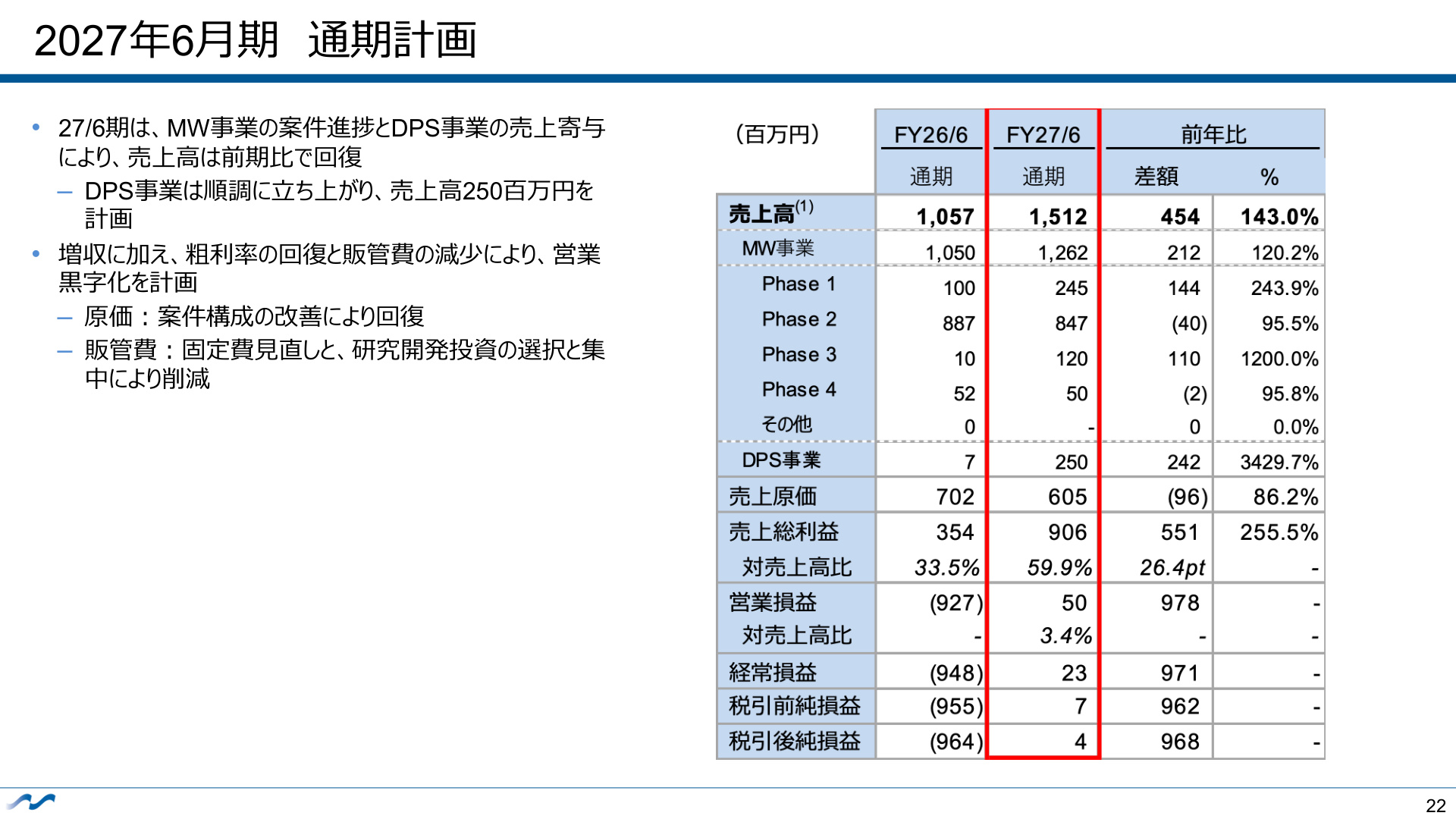
[Slide Commentary: FY2027 Full-Year Plan (P.22)]
This slide details the figures for the company's V-shaped recovery and operating profitability. The core Microwave Solution (MW) business is expected to generate 1,262 million JPY in sales (+20.0% YoY) , while the DPS business acquired last year is expected to expand rapidly to 250 million JPY , accounting for 16.5% of total sales. In terms of P&L, in addition to increased sales, cost of sales is expected to decrease from 702 million JPY to 605 million JPY (a dramatic 26.4-point improvement in gross margin from 33.5% to 59.9%). This is due to the completion of low-margin, large-scale equipment manufacturing projects that previously pressured profitability.
8. Specific Measures for Margin Improvement and Cost Restructuring
To achieve operating profitability in FY2027, the company is simultaneously promoting improvement in cost of sales and optimization of SG&A and R&D expenses .
- Improvement in Cost of Sales : By avoiding the risks of excessive in-house equipment manufacturing and shifting to a business model centered on technology licensing and design, the company aims to achieve a 59.9% gross margin.
- Reduction of SG&A : Implementing strict "selection and concentration" for R&D investments. Total SG&A expenses will be significantly reduced from 1,282 million JPY (15-month equivalent) to 855 million JPY (on a 12-month basis) .
- Optimization of Personnel : Rather than rapidly expanding headcount, the company will prioritize selective hiring and productivity improvements, maintaining a staff size of approximately 52 employees .
9. Corporate Name Change: Becoming "MWCC Inc." in October 2026
The company announced plans to change its corporate name from "Microwave Chemical Co., Ltd." to "MWCC Inc." effective October 1, 2026 (scheduled).
This name change embodies the following three growth vectors (expansions) :
- Expanding Domains : Moving from "chemical processes" to the "resources and mining sector."
- Expanding Value : Integrating second and third proprietary technology platforms, such as DPS (low-concentration precious metal recovery), alongside microwave technology.
- Expanding Markets : Increasing collaboration and transactions with major overseas resource companies and global corporations (capturing needs related to economic security and decarbonization).
This decision symbolizes the company's evolution from a mere chemical venture into a global resource and environmental solutions company.
10. Technology Strategy and Market Opportunities for Mid-to-Long-Term Growth
For sustainable mid-to-long-term growth, the company is advancing "technology standardization" and the "in-house production of core components (oscillators)." The in-house production of core components and the establishment of standard bench units will improve development and installation speeds, enabling scalability and a transition to a high-margin business structure.
In particular, in the "metal smelting and mining process" sector, the increasing demand for critical minerals (lithium, manganese, copper, iron ore, etc.) due to the spread of AI and data centers, combined with decarbonization investments, serves as a strong tailwind. The target market's CAGR is estimated at approximately 7%, and the company expects its technology platform to demonstrate its true value in this space.
Conclusion
Microwave Chemical's FY2026 results were a period of severe trials , characterized by sales shortfalls due to project delays, significant operating losses, and a decline in the equity ratio. However, the company ensured financial safety by securing liquidity through 500 million JPY in long-term loans and a 500 million JPY commitment line , while thoroughly executing project selection and cost control.
In FY2027, the company aims to achieve operating profitability with 1,512 million JPY in sales and 50 million JPY in operating profit , driven by "dramatic gross margin improvement (projected 59.9%)," "full-scale contribution from the DPS business (250 million JPY)," and "optimization of SG&A expenses (855 million JPY)." As indicated by the name change to "MWCC Inc.," the focus will be on the company's execution capability to return to a growth trajectory as a resource and decarbonization solutions company that transcends the boundaries of chemistry.
This content is not intended as investment advice or a recommendation. Any opinions expressed are solely the personal views of each article.