

![[Earnings Analysis] HYUGA PRIMARY CARE Q1 FY2027: Achieving Significant Profit Growth as Upfront Investments Begin to Pay Off, Balancing Qualitative Growth with Foundation Strengthening](https://news-images.stock-club.net/market_news/images/7133/140120260807515630/slide_eyecatch_en_85e54995.webp)
[Earnings Analysis] HYUGA PRIMARY CARE Q1 FY2027: Achieving Significant Profit Growth as Upfront Investments Begin to Pay Off, Balancing Qualitative Growth with Foundation Strengthening

StockClub
Published: Aug 12, 2026, 10:50 AM
Sentiment Analysis
1. Q1 FY2027 Earnings Overview and Highlights
HYUGA PRIMARY CARE’s Q1 FY2027 results mark a strong start, characterized by significant growth in both revenue and profit as the effects of upfront investments made in previous fiscal years begin to materialize.
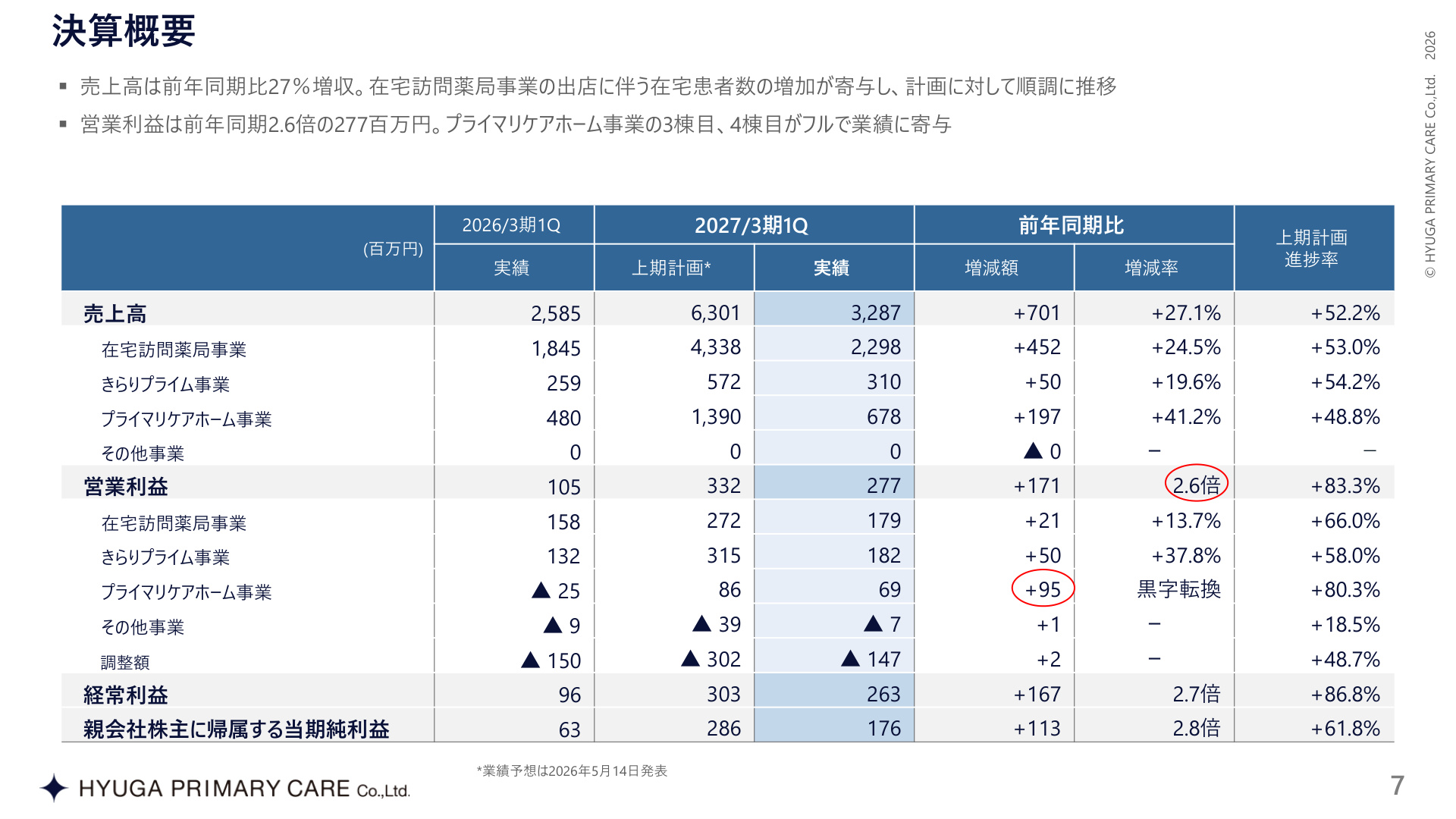
Consolidated performance highlights include net sales of 3,287 million yen (up 27.1% YoY) and an operating profit of 277 million yen (up 161.9% YoY, or 2.6x) . Ordinary profit rose to 263 million yen (2.7x YoY), and net profit attributable to owners of the parent reached 176 million yen (2.8x YoY).
The progress against the first-half targets stands at 52.2% for net sales and 83.3% for operating profit . This reflects the conclusion of temporary costs associated with store and facility openings from the previous year, alongside clear progress in monetization.
Details of the quarterly results are shown in the table below.
Commentary on Slide 7
This slide provides a comprehensive summary of the consolidated income statement and key segment figures for Q1 FY2027, compared against both the previous year and the first-half plan. Of particular note is the V-shaped recovery of the Primary Care Home business, which turned a 25 million yen loss in the same period last year into a 69 million yen profit , and the core Home-Visit Pharmacy business, which secured 179 million yen in profit (up 13.7% YoY) . The simultaneous growth across these multiple business segments is the primary driver behind the 2.6x increase in consolidated operating profit.
2. Impact of the 2026 Medical Fee Revision and Latest Updates
Regarding the 2026 Medical Fee Revision , a major focal point for the medical and pharmaceutical industry, the company conducted a thorough review based on the latest notification from the Ministry of Health, Labour and Welfare (dated May 29) and announced an upward revision to its impact forecast.
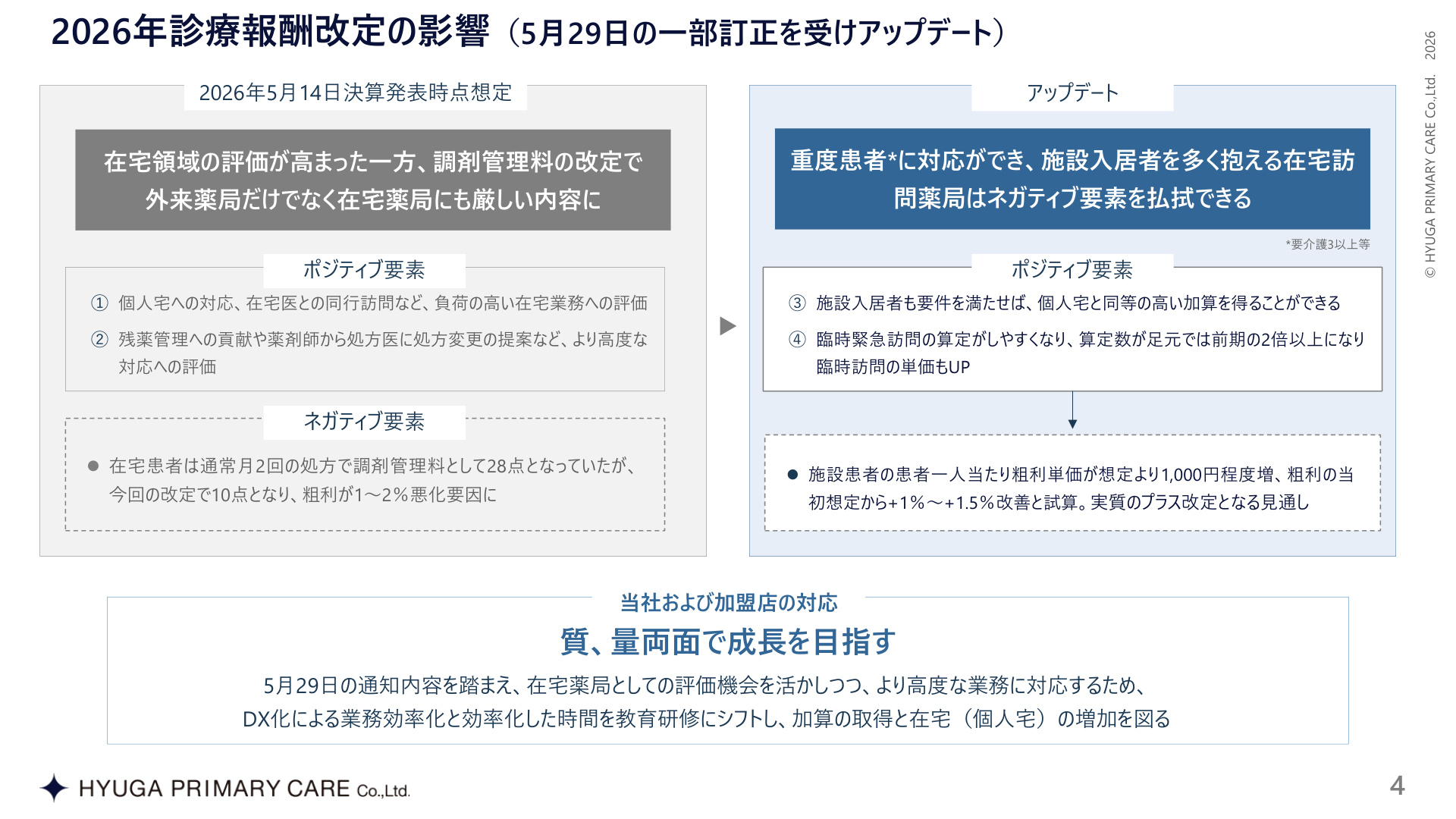
Previously, the company anticipated a negative impact of 1–2% on gross profit margins due to revisions in dispensing management fees, despite the tailwind of improved valuation for the home-care sector. However, the latest calculations indicate that the company’s strengths— “capability to handle high-acuity patients” and “a structure serving many facility residents” —align perfectly with the new requirements, allowing the company to fully absorb the negative impact.
Commentary on Slide 4
This slide is of high strategic value, demonstrating how the company’s business model is resilient to external regulatory changes and can even turn them into tailwinds. By meeting the requirements for additional fees for facility residents with a care level of 3 or higher and benefiting from relaxed requirements for temporary emergency visits (where the current count has more than doubled compared to the previous year), gross profit per facility patient has increased by approximately 1,000 yen more than expected . Consequently, the company-wide gross profit margin is expected to improve by +1.0% to +1.5% from initial projections, effectively turning the revision into a net positive.
3. Business Progress and KPI Analysis by Segment
The company is executing a three-tiered growth strategy: "Home-Visit Pharmacy Business (Step 1)," "Kirari Prime Business (Step 2)," and "Primary Care Home Business (Step 3)."
(1) Home-Visit Pharmacy Business
- Performance : Net sales of 2,298 million yen (up 24.5% YoY), segment profit of 179 million yen (up 13.7% YoY).
- Key KPIs : The number of pharmacies increased by 2 from the end of the previous fiscal year to 65 (3 openings, 1 transfer). The number of home-visit patients increased by 808 to 13,282 .
- Analysis : Increased utilization rates of pharmacies opened in the previous year drove sales. The business maintains a stable profit growth foundation while absorbing temporary costs associated with new openings.
(2) Kirari Prime Business
- Performance : Net sales of 310 million yen (up 19.6% YoY), segment profit of 182 million yen (up 37.8% YoY).
- Key KPIs : The number of member pharmacies increased by 144 to 3,023 (completing expansion into all 47 prefectures).
- Analysis : While there was a QoQ decline in revenue and profit due to the reactionary drop from large-scale consulting projects (M&A, etc.) in Q4 of the previous year, the number of stock-based member pharmacies continues to grow, maintaining a high stock revenue ratio of 65.1% .
(3) Primary Care Home Business
- Performance : Net sales of 678 million yen (up 41.2% YoY), segment profit of 69 million yen (turning profitable from a 25 million yen loss in the same period last year) .
- Key KPIs : Average occupancy rate for the 4 existing facilities is 88% (as of the end of July). Average monthly revenue per resident in Q1 was 411,000 yen.
- Analysis : The progress in occupancy and full operation of the 3rd (Kumamoto Hamasense) and 4th (Kurume) facilities opened last year contributed to record-high quarterly sales and profit.
4. Full-Year Earnings Forecast for FY2027 and Profit Drivers
The company has maintained its initial full-year consolidated earnings forecast for FY2027.
- Net Sales : 13,102 million yen (up 9.3% YoY)
- Operating Profit : 904 million yen (up 10.7% YoY)
- Ordinary Profit : 843 million yen (up 8.7% YoY)
- Net Profit Attributable to Owners of the Parent : 631 million yen (up 25.8% YoY)
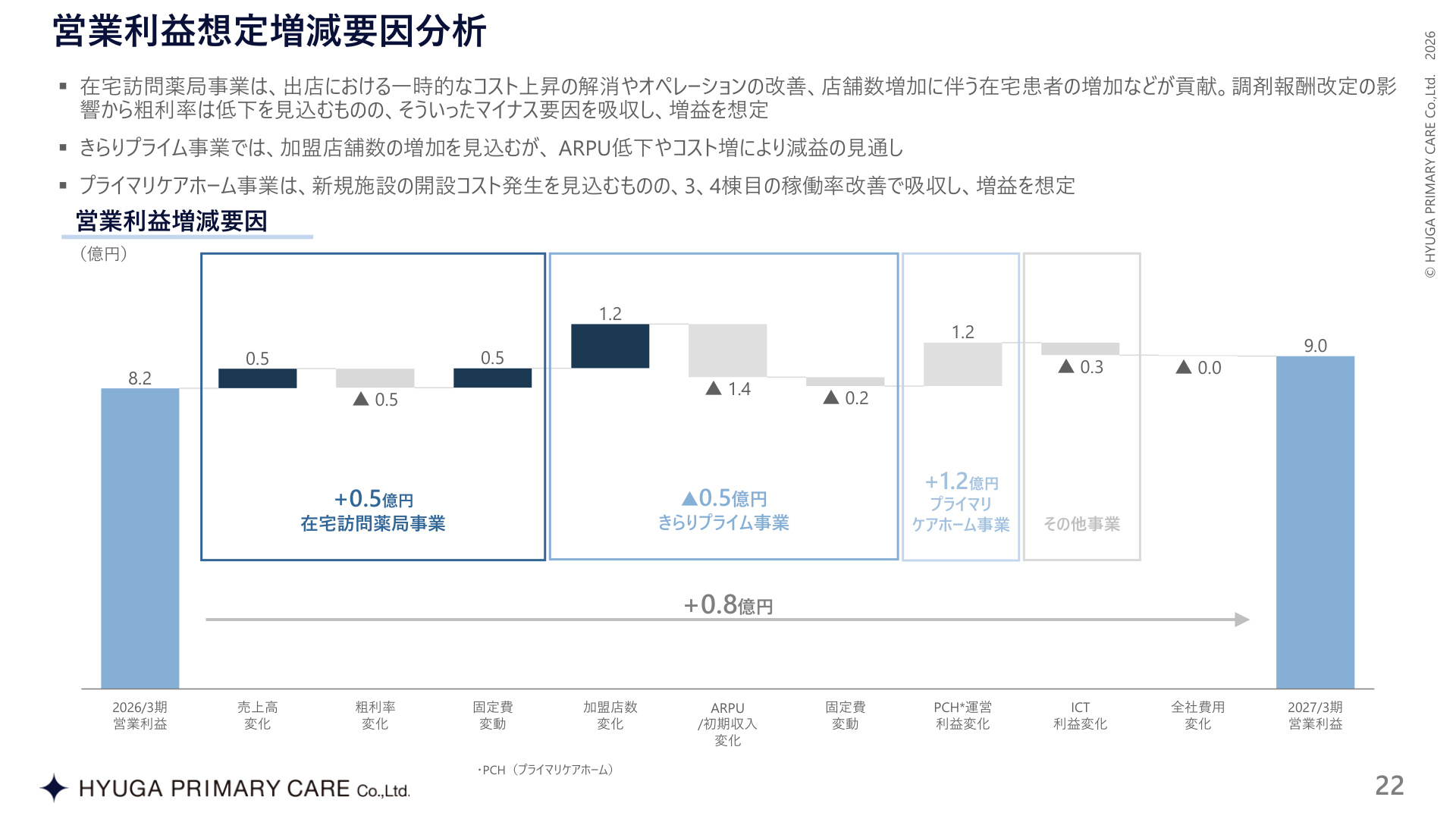
The company plans to return to a profit growth trajectory following the temporary pause in operating profit growth last fiscal year. A detailed analysis of the factors contributing to operating profit changes is presented in the slide below.
Commentary on Slide 22
This slide visualizes the +80 million yen profit increase from the previous year's operating profit (820 million yen) to the current plan (900 million yen). It clearly shows the contribution of each segment: the Home-Visit Pharmacy business (+50 million yen) overcomes the negative impact of the dispensing fee revision (▲50 million yen) through revenue growth and operational efficiency, while the Primary Care Home business (+120 million yen) leads profit expansion through improved occupancy. Conversely, the Kirari Prime business (▲50 million yen) reflects a conservative estimate and lower ARPU.
5. Mid-Term Growth Strategy and Future Business Policy
Reorganizing the Mid-Term Plan and Consolidating the Foundation
While the company exceeded its sales targets for the mid-term growth plan ending in FY2026, ordinary profit fell short of the target (6.5% actual vs. 12% target) due to upfront investments and regulatory changes. Recognizing that internal human resource development and system investments have not kept pace with rapid scale expansion, the company has designated the current period as a “preparation phase to rebuild sustainable growth capacity.” Consequently, the announcement of the next mid-term growth plan has been postponed to FY2028 or later , with a focus on qualitative growth and profitability.
Specific Action Plans by Business
- Home-Visit Pharmacy Business : Implementing a "semi-automated system for collecting personal co-payments" to improve efficiency. Furthermore, to address the shortage of pharmacists in certain regions, the company will utilize "online medication guidance" and focus on opening new stores in key areas such as Tokyo and Northern Chiba.
- Kirari Prime Business : Shifting toward a revenue model that does not rely on large-scale consulting projects to reduce volatility. Increasing the number of pharmacist consultants for member stores to maintain satisfaction and stock revenue.
- Primary Care Home Business : Maintaining high unit prices by strictly adhering to the concept of accepting high-acuity patients (Care Levels 3–5, high medical dependency). A 5th new facility is scheduled to open in Minami-ku, Fukuoka, in February 2027.
6. Financial Soundness and Shareholder Return Policy
Financial Position (B/S)
Total assets at the end of Q1 were 8,669 million yen (up 378 million yen from the end of the previous fiscal year). Tangible fixed assets increased due to store and facility construction, and cash and deposits were increased to 1,241 million yen to prepare for future capital expenditures. The equity ratio is 31.9% (down 1.0pt), and the company continues to manage capital efficiency while controlling interest-bearing debt.
Shareholder Return Policy
Regarding shareholder returns, the company is committed to management that is conscious of the cost of capital, such as ROE and WACC, and plans to provide returns in line with profit growth. The dividend plan for FY2027 is 20 yen per share as a year-end dividend .
Conclusion
HYUGA PRIMARY CARE’s Q1 FY2027 results are highly robust, proving that the company has entered a harvest phase where previously invested locations and facilities are now in full operation. The company’s ability to turn the industry-wide headwind of the dispensing fee revision into a net positive through high-value home and facility medical services is impressive. While prioritizing the strengthening of its organizational foundation in the short term, the company’s long-term growth platform as a primary care provider has evolved to become even more solid.
This content is not intended as investment advice or a recommendation. Any opinions expressed are solely the personal views of each article.