


Integral (5842) FY2026 Q2 Earnings Deep Dive Report

StockClub
Published: Aug 12, 2026, 10:36 AM
Sentiment Analysis
Integral (5842) FY2026 Q2 Earnings Deep Dive Report: Significant Profit Growth Driven by Realized Carried Interest and a Robust Three-Pillar Value Creation Model
Integral Corporation (Ticker: 5842), a leader in the Japanese private equity (PE) industry, achieved substantial year-on-year growth in both revenue and profit for the second quarter of the fiscal year ending December 2026 (FY2026 Q2). This performance was largely driven by the realization of carried interest (CI) in its core PE investment business. This report provides a comprehensive analysis of the company's earnings highlights, unique revenue model, progress across business segments, and long-term growth story, based on 10 key topics extracted from the earnings materials.
1. FY2026 Q2 Earnings Highlights: Overwhelming Year-on-Year Growth
Integral’s consolidated financial results for FY2026 Q2 showed a sharp expansion, with revenue reaching 15.6 billion yen (an increase of 10.7 billion yen or approximately 3.2x year-on-year) and net profit attributable to owners of the parent company hitting 8.7 billion yen (an increase of 7.0 billion yen or approximately 5.1x year-on-year).
As shown in the factor analysis slide below, the primary driver of this remarkable growth is the surge in realized carried interest (CI) .
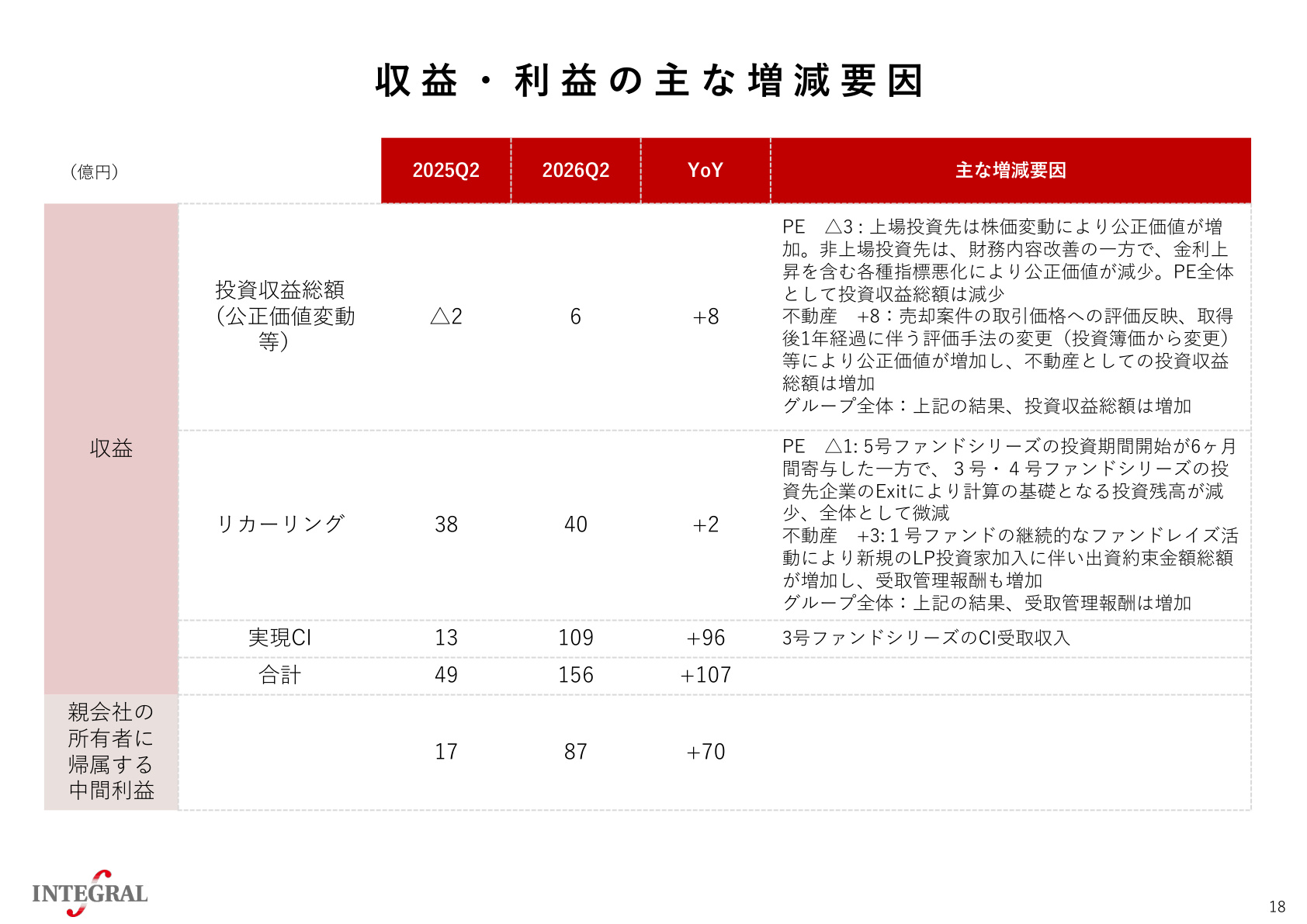
Analysis of Embedded Slide (Slide 18: Key Factors for Revenue and Profit Changes)
This slide is one of the most critical documents for understanding these earnings, as it clearly breaks down the drivers of the FY2026 Q2 performance leap:
- Realized Carried Interest (CI) : Increased dramatically from 1.3 billion yen to 10.9 billion yen (a +9.6 billion yen increase). This is primarily due to CI income realized from the "Fund III series." It represents the fruition of value enhancement and successful exits in the firm's PE fund operations.
- Recurring Revenue (Management Fees, etc.) : Increased from 3.8 billion yen in the same period last year to 4.0 billion yen ( +0.2 billion yen ). While management fees rose due to the start of the investment period for the Fund V series (contributing for six months), this growth offset the impact of a decrease in investment balances resulting from exits in Fund III and IV, demonstrating steady accumulation of stock-type revenue.
- Total Investment Income (Fair Value Changes, etc.) : Improved to 0.6 billion yen (a +0.8 billion yen improvement) from a loss of 0.2 billion yen in the same period last year. This was driven by the reflection of property sale prices in the real estate business, changes in fair value assessment methods, and rising stock prices of listed portfolio companies.
2. The Unique Business Model Supporting Integral: "Three Pillars of Revenue"
Integral’s strength lies in its unique asset management model, which combines "three pillars of revenue," positioning it as more than just a fund management firm.
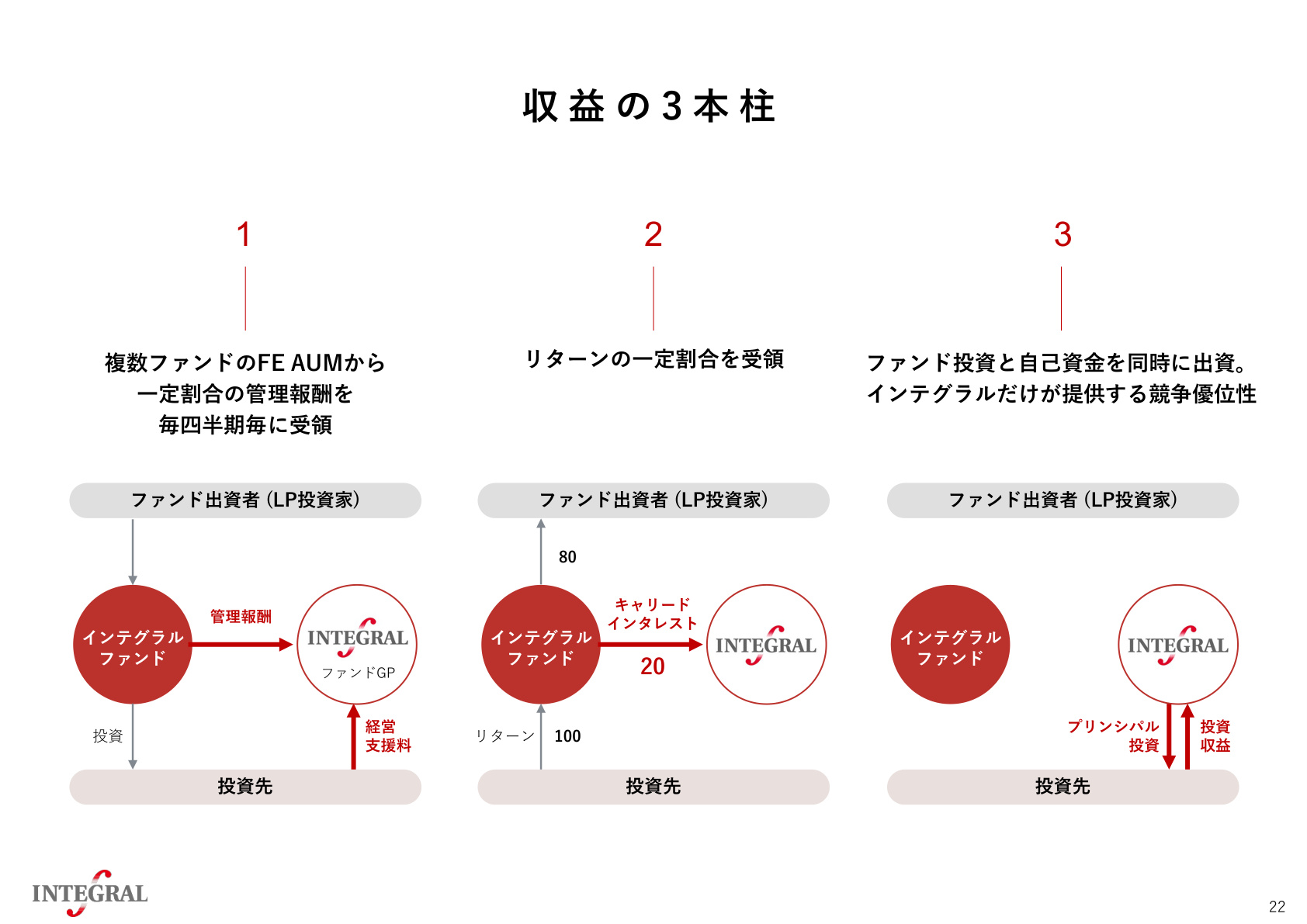
Analysis of Embedded Slide (Slide 22: Three Pillars of Revenue)
This slide illustrates the full scope of Integral’s long-term competitive advantage and revenue model, serving as the foundation for investors to grasp the company's earnings structure:
- First Pillar (Management Fees) : Based on the FE-AUM (Fee-Earning Assets Under Management: 366.1 billion yen) of multiple funds, the company receives management fees every quarter. This provides stable, stock-type revenue that covers operating expenses, maintaining a high recurring margin of 43% (as of Q2 2026).
- Second Pillar (Carried Interest: CI) : When fund performance exceeds the hurdle rate, the company receives a percentage (typically 20%) of the excess returns. This is high-return flow revenue directly linked to the success of the funds.
- Third Pillar (Principal Investment) : The company invests its own capital alongside the funds. By practicing "same-boat investing," where the firm shares risks and returns with LP investors, it enhances trust while directly capturing the fruits of portfolio company growth through its balance sheet.
3. PE Investment Business: Active Investment and Exit Activities
In its core PE investment business , Integral has invested in companies with a cumulative enterprise value (EV) exceeding 870 billion yen , primarily targeting mid-sized Japanese firms. The firm boasts industry-leading performance with a gross MOIC (Multiple on Invested Capital) of 3.0x and a gross IRR (Internal Rate of Return) of 29.9% .
Key Active Developments (January–July 2026)
- Exit Achievements :
- Toyo Engineering (Fund III): Sold via off-floor trading.
- Mamezou Holdings (Fund III): All shares transferred to a third party.
- MUTOH Holdings (Fund IV): Sold via a Tender Offer Bid (TOB).
- New and Add-on Investments :
- Yashima Proceed (High-performance resin manufacturer): Capital participation via Fund V.
- At Home Holdings (Real estate information services): Capital participation via Fund V.
- STPR Inc. (Comprehensive entertainment production): Capital participation via Fund V.
- MiraiVets Partners (Veterinary hospital group): Executed 5 bolt-on (add-on) investments via Fund IV.
This highly active exit strategy is directly linked to the generation of the 10.9 billion yen in realized CI mentioned above.
4. Future Profit Sources: Growth Mechanism of "Unrealized CI" and "Fund Balances"
To gauge Integral’s future earnings power, the most important indicators are the "increase in fund balance value" and the accompanying accumulation of "Unrealized Carried Interest."
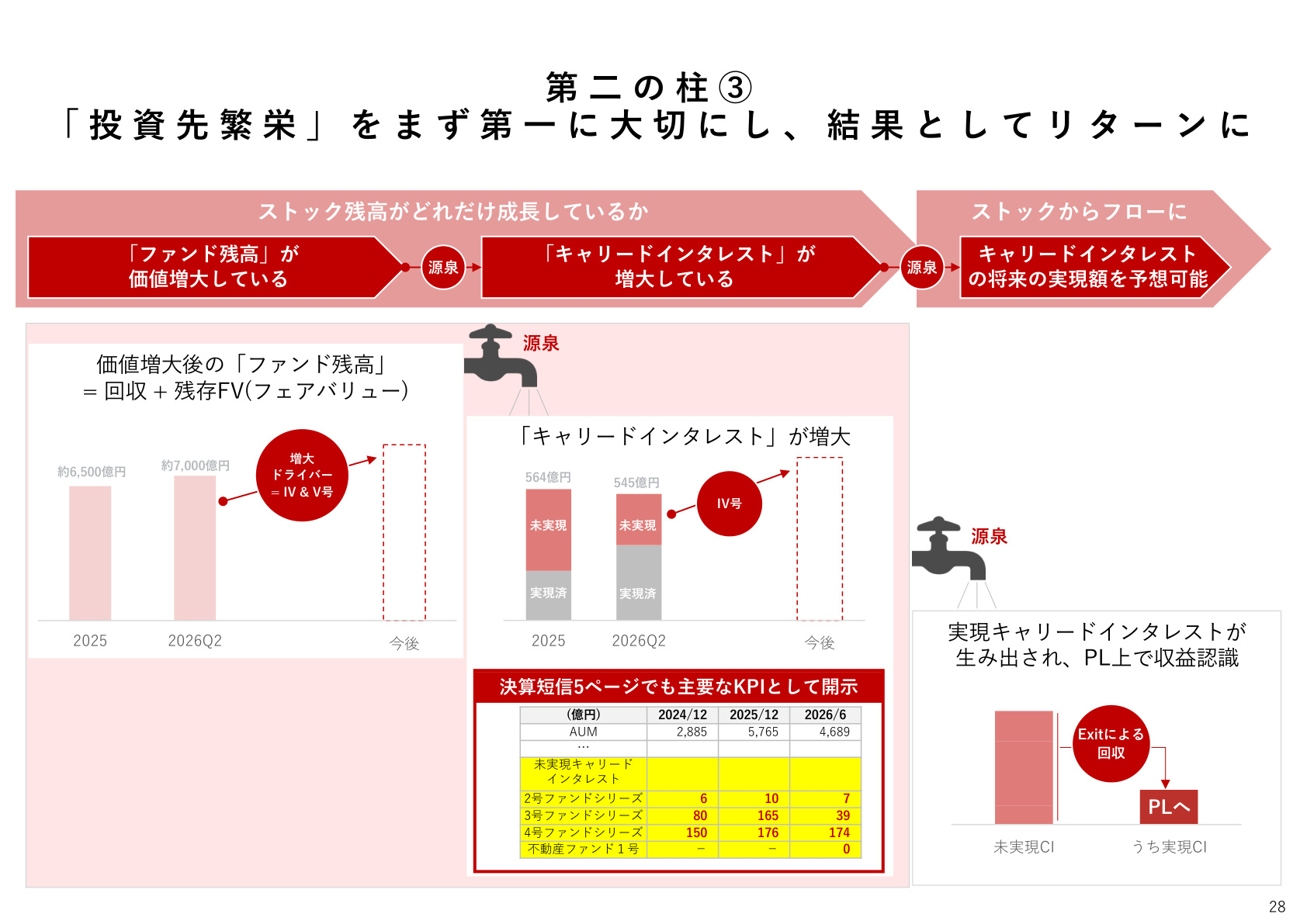
Analysis of Embedded Slide (Slide 28: Second Pillar ③ Prioritizing "Portfolio Prosperity" First, Leading to Returns)
This slide visualizes the mechanism of converting "stock" (fund balances/unrealized CI) into "flow" (realized CI/P&L recognition):
- Expansion of Fund Balances : As the enterprise value of portfolio companies increases (value-up), the total fund balance—comprising recoveries plus remaining fair value (FV)—has expanded to approximately 700 billion yen .
- Deep Stock of Unrealized CI : As of the reporting date, a significant amount of "unrealized CI" is stocked, which will be recognized as realized CI on the P&L as exits progress. Specifically, the firm holds 17.4 billion yen in Fund IV , 3.9 billion yen in Fund III , and 0.7 billion yen in Fund II of unrealized CI (pre-tax).
- DPI as a Leading Indicator : The DPI (Distribution to Paid-In Capital) has risen to 3.5 for the Fund III series and 0.9 for the Fund IV series , indicating that the recovery process toward CI realization is proceeding smoothly.
5. Progress in Diversification: Real Estate Investment and Global Tech Growth
Integral is rapidly diversifying its business foundation by horizontally deploying the value-up methods cultivated in its PE business to other asset classes.
① Real Estate Investment Business
- Expansion of Asset Classes and Scale : Investing in a wide range of assets including multi-family residential, hotels, offices, commercial facilities, and logistics, with property acquisition costs reaching approximately 55 billion yen .
- Value-Up Strategy : Implementing hotel conversions and renovations of residential/office properties. Since Q2 2026, the firm has been actively signing new acquisition and sales contracts, primarily for residential properties and hotels in Fukuoka City.
- Real Estate Fund I (23.5 billion yen in committed capital) is operating smoothly, steadily increasing management fees and future revenue sources.
② Global Tech Growth Investment Business
- Strengthening Global Partnerships : Established a JV and joint fund (Fund I size: $100 million) with Granite Asia , one of Asia's largest multi-asset platforms with over $5 billion in AUM. Also formed an alliance with Touring Capital.
- Investment in Advanced Technology : Building a track record of investments in global growth companies such as AI financial data platform "daloopa," AI voice transcription "notta," image generation AI "PixAI (Pika)," and global transport infrastructure "omio."
6. Growth in Economic Earnings-Based Net Assets and Shareholder Returns
Integral emphasizes "Economic Earnings-Based Net Assets" —which adds after-tax unrealized carried interest (UCAT) to IFRS net assets—as the true indicator of corporate value.
- Trend in Economic Earnings-Based Net Assets :
- 85.7 billion yen as of Q2 2026 (IFRS net assets of 70.5 billion yen + UCAT of 15.2 billion yen ).
- While some portion has shifted to IFRS net assets (retained earnings) due to the realization of CI in the previous period, the firm maintains a high level of net assets.
- Dividend Policy and Interim Dividend :
- In the July Board of Directors meeting, the firm decided on an increased interim dividend of 18.50 yen per share (compared to 17.00 yen in the same period last year), totaling 603 million yen.
- Combined with the projected year-end dividend of 18.50 yen, the annual dividend forecast is 37.00 yen , clearly demonstrating a stable shareholder return policy targeting a DOE (Dividend on Equity) of 2% .
Summary and Future Growth Story
Integral’s FY2026 Q2 earnings were exceptionally robust, driven by 10.9 billion yen in realized CI from exits in the core Fund III and IV series , resulting in overwhelming growth in revenue and profit.
The company’s growth story is structured as follows:
- Expansion of FE-AUM and accumulation of stable management fees (recurring revenue) , backed by a solid track record (29.9% gross IRR).
- Growth of unrealized CI accompanying the value enhancement of portfolio companies, and the subsequent P&L recognition of realized CI as these are recovered.
- Acquisition of direct returns from principal investments using the firm's own capital.
- Deployment of PE-honed expertise into real estate and global tech growth investments , cultivating them as new pillars of revenue.
With a deep stock of unrealized CI (e.g., 17.4 billion yen in Fund IV) and the commencement of new funds (e.g., Fund V), these results demonstrate that the cycle for long-term corporate value enhancement and expanded shareholder returns remains firmly in place.
This content is not intended as investment advice or a recommendation. Any opinions expressed are solely the personal views of each article.