


Healios (4593) Q2 FY2026 Earnings Deep Dive: Industrializing Cell Therapy via 3D Culture and Accelerating Global Expansion

StockClub
Published: Aug 12, 2026, 10:31 AM
Sentiment Analysis
1. Executive Summary and Growth Story
Healios K.K. (TSE: 4593) is undergoing a transformation from a traditional biotech venture into the "world's leading cell therapy manufacturer." The company is driving the social implementation of cell therapy through its dual-engine strategy: the bone marrow-derived somatic stem cell product "HLCM051" and its iPS cell-derived pipeline .
At the core of the company's growth strategy is the shift from conventional "manual cell culture" to "3D culture technology" using closed-system bioreactors. By doing so, Healios aims to build a cell supply system with high reproducibility and stable scalability, evolving cell therapy from a "craft industry" into an "equipment-based industry."
The key points of the company's business topics and growth strategy are summarized in the following 10 items :
- Strategic shift from a biotech venture to the world's leading cell therapy manufacturer.
- Dual-track structure for HLCM051 (ARDS treatment): domestic application and global development.
- Change of commercial manufacturing site to prioritize stable domestic supply and quality assurance.
- Overwhelming manufacturing capacity improvement and standardization through 3D culture technology.
- Establishment of the new Kobe KCIC (500L bioreactor) and a CDMO system capable of supplying 40,000 patients annually.
- Strong alliances with the Ministry of Economy, Trade and Industry (METI) and the U.S. Department of Defense (subsidies and clinical trial funding).
- "Non-dilutive" financing to curb share dilution, securing 9.07 billion JPY in cash and equivalents.
- Expansion strategy for HLCM051 targeting Systemic Inflammatory Response-related Conditions (SIRC).
- Massive potential in the U.S. market (estimated annual sales potential of up to 475 billion JPY).
- Organizational expansion focused on production, quality, and supply chain in preparation for the commercialization phase.
2. Development and Approval Strategy for HLCM051 (ARDS Treatment)
Healios' top priority is obtaining manufacturing and marketing approval (conditional and time-limited approval) in Japan for HLCM051, targeting Acute Respiratory Distress Syndrome (ARDS). Simultaneously, to ensure rapid entry into the global market, the company is pursuing a strategy of running domestic applications and global clinical trials independently.
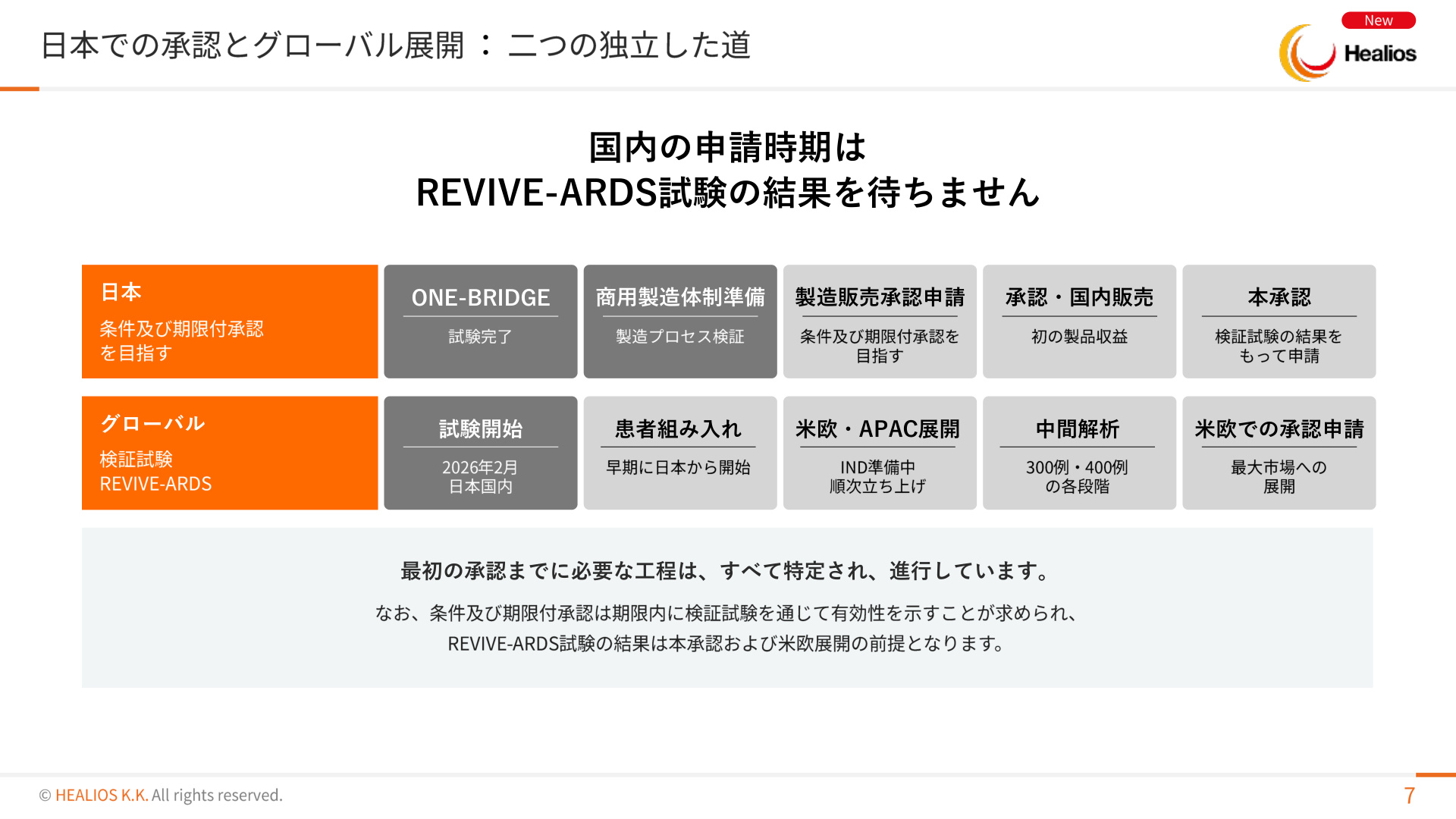
[Slide Commentary: Two Independent Paths for Domestic Approval and Global Expansion]
The slide above (P.7) illustrates the foundation of Healios' approval and monetization strategy . The key takeaway is that "the timing of the domestic approval application will not wait for the results of the global confirmatory trial (REVIVE-ARDS trial)."
- Domestic Route : Based on the positive results of the Phase 2 trial (ONE-BRIDGE) completed in Japan and the establishment of a commercial manufacturing system (manufacturing process validation), the company will file for conditional and time-limited approval . This aims for early domestic approval and product monetization.
- Global Route : The "REVIVE-ARDS trial" (global Phase 3) as a confirmatory study will begin patient enrollment in Japan in February 2026, followed by sequential expansion into the U.S., Canada, APAC, and Europe. The results of this trial will serve as the basis for future full approval in Japan and regulatory filings in the U.S. and Europe. This dual-track structure strategically balances rapid commercialization in Japan with expansion into the world's largest markets in the West.
Regarding the commercial manufacturing site, the company has shifted from its previous overseas plans to the "Minaris Advanced Therapies, Inc. Yokohama Facility" to ensure future product quality and stable domestic supply. Following technology transfer, full-scale manufacturing (50L), and engineering runs, the company is currently conducting validation under conditions identical to actual production, ensuring steady progress.
3. "3D Culture Technology" and Manufacturing Infrastructure Enabling Industrialization
The biggest barriers to the practical application of cell therapy products are "mass production" and "quality uniformity." Healios aims to overcome these challenges by moving away from traditional 2D culture (manual labor) and establishing 3D culture via bioreactors .
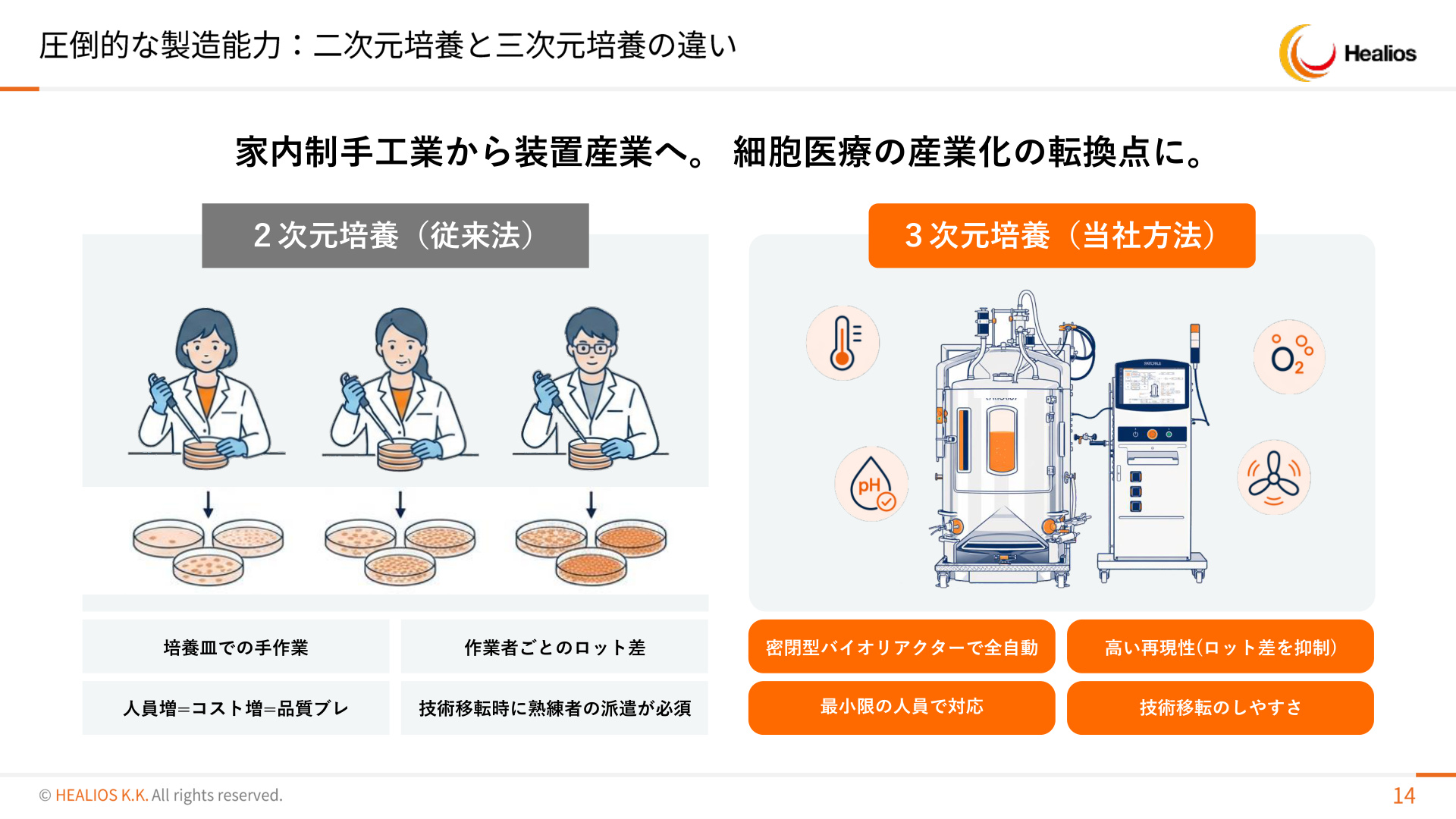
[Slide Commentary: Differences Between 2D and 3D Culture]
The slide above (P.14) visualizes the background of the technological innovation that secures the company's competitive advantage.
- Limitations of Conventional Methods (2D Culture) : Centered on manual work by skilled technicians using culture dishes, this approach faces structural issues such as "more personnel = higher costs = quality fluctuations (lot-to-lot variability)." It also imposes significant limitations on scaling, as sending skilled personnel is essential for technology transfer to overseas sites.
- Strengths of Healios' Approach (3D Culture) : Achieves fully automated control via closed-system bioreactors . By automatically managing pH, oxygen concentration, and agitation conditions, the company ensures high reproducibility and significantly suppresses lot-to-lot variability . Because it requires minimal personnel, it enables substantial cost reductions and smooth technology transfer, serving as the foundational technology that transforms cell therapy from a "craft industry to an equipment-based industry."
Furthermore, the company is not stopping at the 50L capacity at the Minaris Yokohama facility; it is planning to establish the "Healios / KOBE Cell Innovation Center (KCIC)" in Kobe, Hyogo Prefecture, equipped with 500L large-scale bioreactors (scheduled to begin operation in January 2028). This will establish a supply system for 40,000 patients annually , with a policy to cultivate a third revenue pillar through CDMO business (contract manufacturing) , in addition to supplying its own products.
4. Non-Dilutive Financing and Financial Highlights
In the valuation of biotech ventures, the "risk of share dilution" associated with continuous R&D funding is a major concern for investors. Healios has built a "non-dilutive funding structure" that combines subsidies, government alliances, and business revenue .
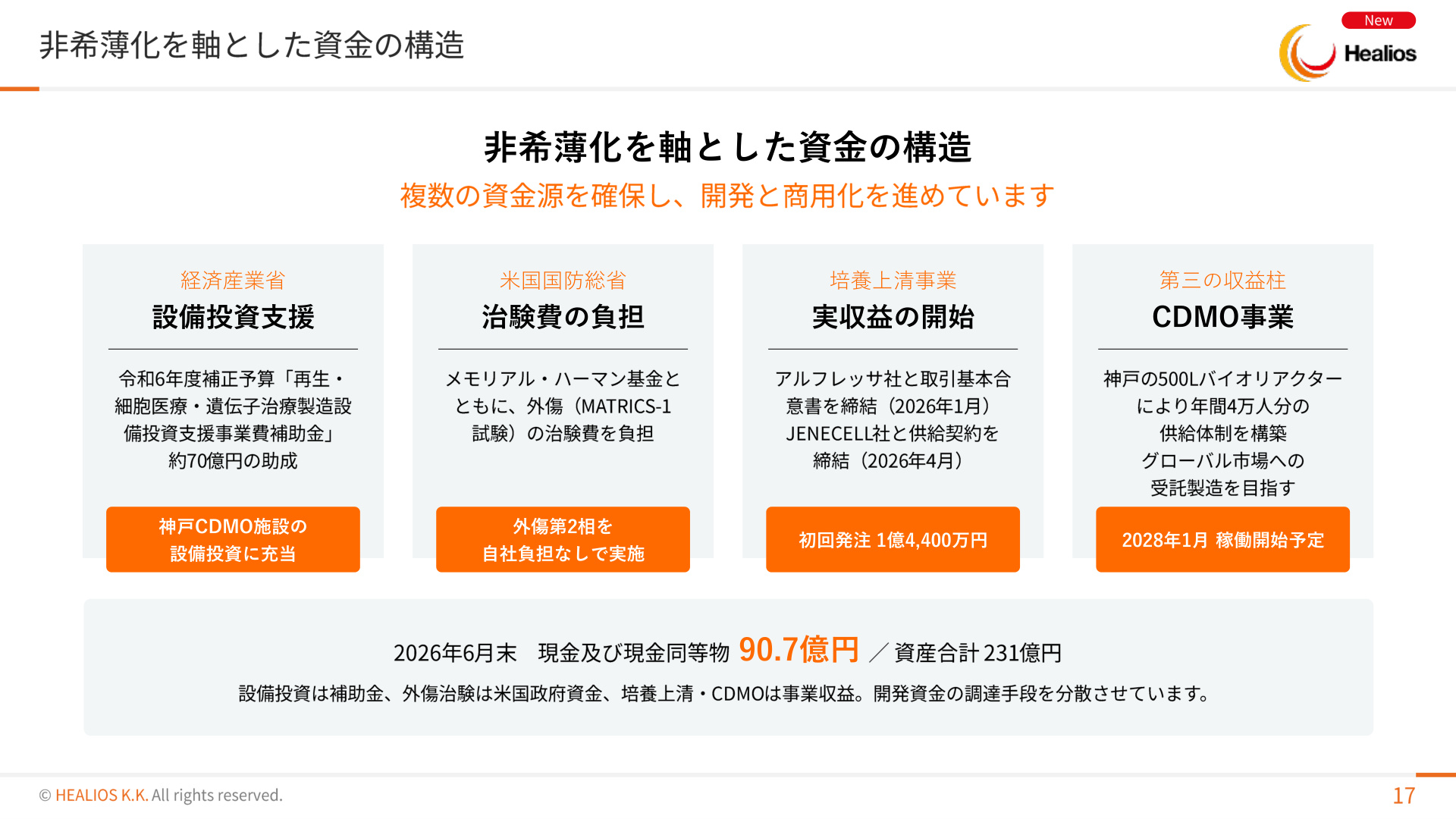
[Slide Commentary: Funding Structure Centered on Non-Dilution]
The slide above (P.17) provides critical data proving the soundness of Healios' financial foundation and the diversification of its funding schemes .
- METI Equipment Investment Support : Secured a subsidy of approximately 7 billion JPY under the FY2024 supplementary budget for "Support for Equipment Investment in Regenerative, Cellular, and Gene Therapy Manufacturing." This will be allocated to capital investment for the Kobe CDMO facility.
- U.S. Department of Defense (DoD) Clinical Trial Funding : Clinical trial costs for trauma (MATRICS-1 trial, Phase 2) are supported by the U.S. DoD and the Memorial Hermann Foundation, allowing the company to advance trials without self-funding .
- Commencement of Business Revenue (Culture Supernatant Business) : In the sale of "UDC" and other products utilizing byproducts (culture supernatant) obtained during the HLCM051 manufacturing process, the company has signed a basic transaction agreement with Alfresa Corporation and a supply contract with JENECELL, recording initial orders of 144 million JPY . This marks the realization of early revenue.
- Financial Position : As of the end of June 2026, the company holds 9.07 billion JPY in cash and cash equivalents (total assets of 23.1 billion JPY), maintaining sufficient liquidity while curbing dilution through the use of non-dilutive schemes.
5. Mechanism of Action, Indication Expansion, and Market Potential of HLCM051
Mechanism of Action (Platform Nature) of HLCM051
HLCM051 is a cell therapy product with immunomodulatory, anti-inflammatory, vascular endothelial protective, and organ-protective effects . It possesses a mechanism that exerts efficacy not just on a single organ, but on Systemic Inflammatory Response-related Conditions (SIRC) triggered by inflammatory cascades (runaway inflammation). Therefore, while prioritizing approval for ARDS, the company plans to expand indications (multi-target deployment) to the following diseases that share the same pathological basis:
- ARDS (Acute Respiratory Distress Syndrome) : Preparing for domestic approval application / Global Phase 3 in progress.
- Trauma-induced Acute Kidney Injury (AKI) : U.S. Phase 2 (MATRICS-1) in progress (supported by U.S. DoD).
- Acute Ischemic Stroke : Phase 3 completed in Japan and the U.S. Currently in ongoing discussions with the PMDA and considering the construction of a data collection system linked to electronic medical records utilizing medical-specialized LLMs.
- Multiple Organ Failure / Sepsis : Candidates for future indication expansion.
Massive Global Market and Revenue Potential
While the number of ARDS patients in Japan is approximately 28,000 per year , there are over 1.1 million patients worldwide (262,000 in the U.S., 670,000 in China, 133,000 in Europe), representing a market size more than 40 times larger .
According to the company's market analysis (estimates based on Dedham Group analysis), the estimated annual number of patients eligible for HLCM051 in the U.S. is approximately 20,000/year (the actual target number after excluding existing comorbidities from moderate-to-severe ARDS patients). Assuming a drug price of approximately 30 million JPY (200,000 USD, at 1 USD = 150 JPY) as the optimal price in the U.S. market, the annual sales potential in the U.S. market alone is estimated to reach up to 475 billion JPY .
6. Organizational Strengthening for Commercialization and Future Outlook
To ensure the transition to the commercialization phase, Healios hired a total of 24 new employees between January and July 2026. The breakdown of hires is centered on the production department (8) , quality department (4) , and logistics/supply chain department (3) , steadily advancing the transition from an R&D-stage company to a commercial manufacturer that "actually manufactures, manages quality, and delivers products to the market."
Summary
The following clear story can be read from Healios' Q2 FY2026 earnings materials:
- Technology : Leading the "industrialization" of cell therapy through 3D culture technology.
- Development : Securing speed to monetization and future market scale through a dual-track approach of early domestic approval application (conditional and time-limited) and global Phase 3 trials.
- Finance : Deploying a funding strategy that minimizes share dilution, including a ~7 billion JPY subsidy from METI, support from the U.S. DoD, and the monetization of the culture supernatant business.
Trends in domestic approval applications, progress in patient enrollment for global Phase 3 trials, and the launch of manufacturing infrastructure such as the Kobe KCIC will be the key focal points for evaluating the company's future business progress.
This content is not intended as investment advice or a recommendation. Any opinions expressed are solely the personal views of each article.