


Infcurion (438A) FY2027 Q1 Earnings Analysis: Explosive 2.3x YoY Growth in BtoB GTV Signals Evolution Toward a Recurring Revenue-Driven Model

StockClub
Published: Aug 12, 2026, 10:22 AM
Sentiment Analysis

Infcurion (438A) FY2027 Q1 Earnings Deep-Dive Report
1. Overview: The Arrival of a High-Growth, High-Profitability Phase Driven by Recurring Revenue
In the first quarter (1Q) of the fiscal year ending March 2027, Infcurion, Inc. (Securities Code: 438A) achieved significant growth in recurring revenue alongside the expansion of its core BtoB payment platform, which served as a powerful driver for consolidated sales and profit margins.
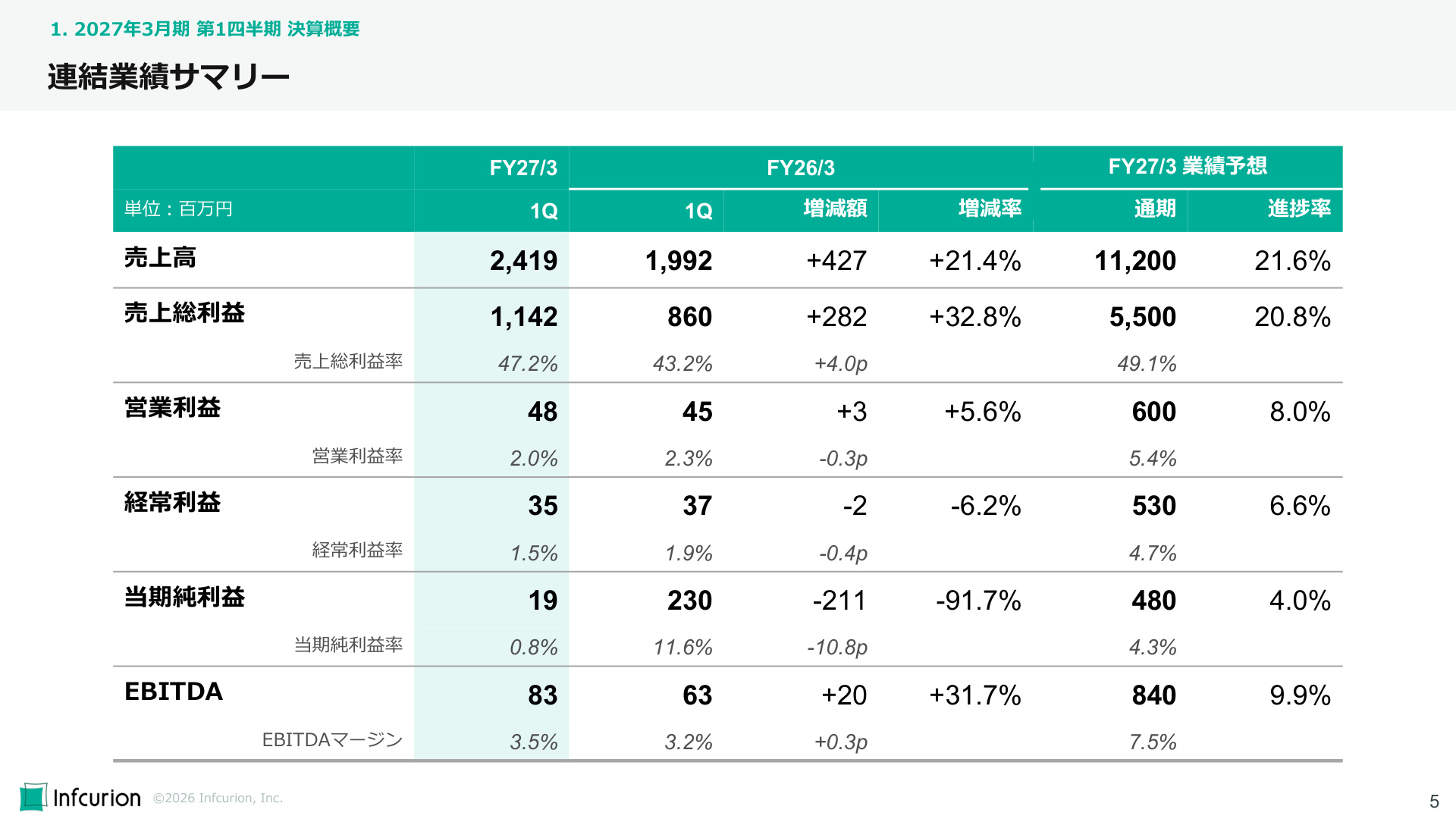
For the first quarter, the company reported consolidated net sales of 2,419 million yen (+21.4% YoY) , gross profit of 1,142 million yen (+32.8% YoY) , EBITDA of 83 million yen (+31.7% YoY) , and operating profit of 48 million yen (+5.6% YoY) .
Slide Commentary: The Significance of Consolidated Performance Summary
The slide above () clearly illustrates the strength of the company's start to the fiscal year. Notably, the growth in gross profit (+32.8%) significantly outpaced the growth in net sales (+21.4%) . As a result, the gross profit margin improved by 4.0 percentage points, rising from 43.2% in the same period last year to 47.2% .
While the progress against full-year forecasts stands at 21.6% for net sales and 20.8% for gross profit, the company’s revenue structure is back-loaded and built on a foundation of accumulating recurring revenue, making this a very solid start. Furthermore, the EBITDA margin rose to 3.5% (from 3.2% in the same period last year) , indicating that the company is successfully leveraging its operating scale.
2. Analysis of Core KPIs Supporting Growth: The Leap in BtoB GTV and Number of Client Companies
To understand Infcurion's sustainable growth, the most critical leading indicators are "BtoB GTV (Gross Transaction Volume)" and the "number of payment platform client companies."
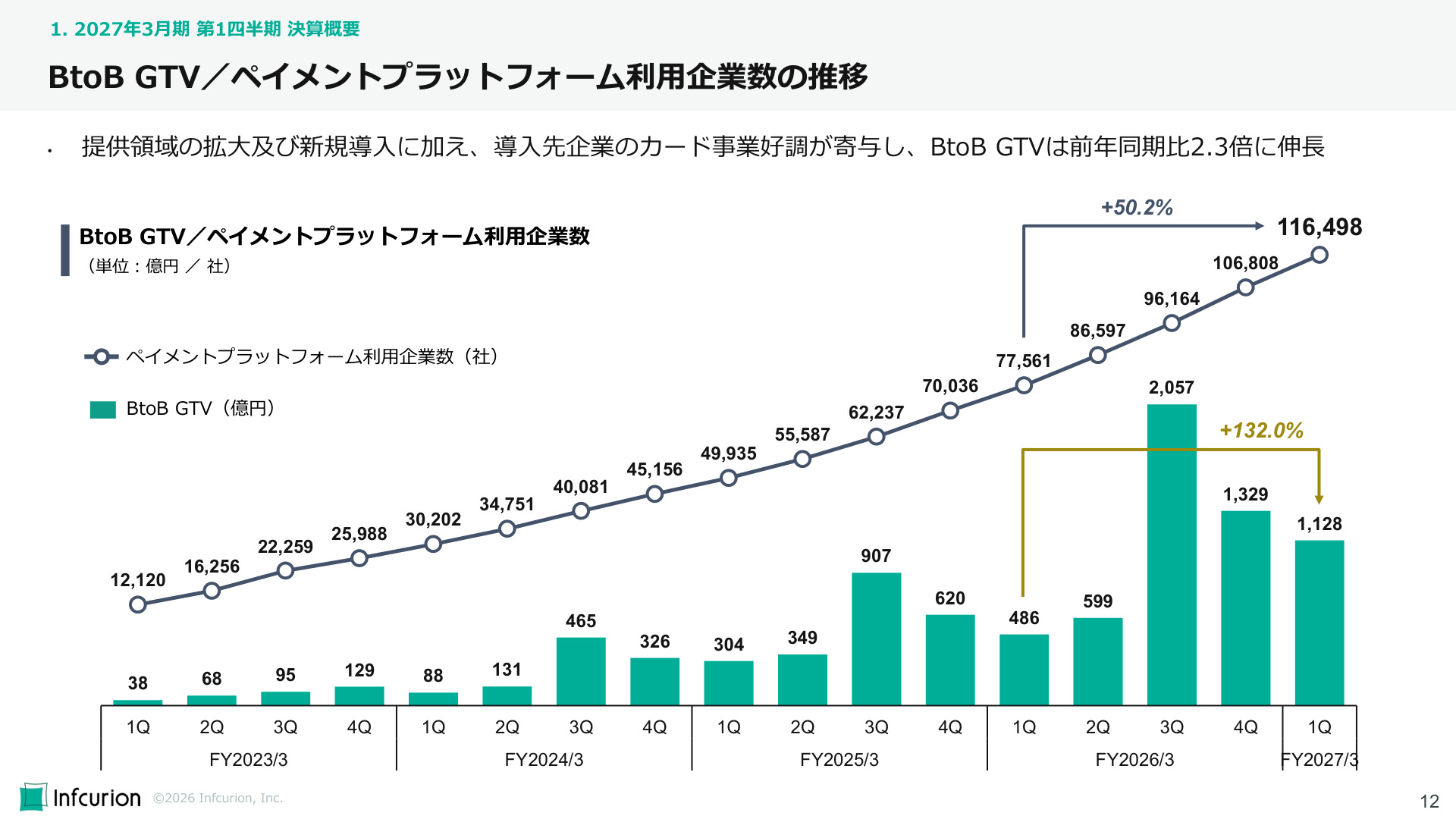
In this first quarter, BtoB GTV reached 112.8 billion yen (a 132.0% increase YoY, or 2.3x) , surpassing the 100 billion yen milestone on a quarterly basis. Additionally, the number of client companies reached 116,498 (+50.2% YoY) , reflecting rapid adoption.
Slide Commentary: Background and Implications of BtoB GTV and Client Growth
The slide above () visualizes the true growth momentum of the company's business model. This data is critically important because platforms like "Xard" and "Winvoice" utilize a "usage-based recurring revenue" model, where Infcurion’s commission income increases in tandem with the transaction volume (GTV) of its client companies.
As the number of client companies expands to over 116,000 , network effects are taking hold, causing GTV to accelerate at a staggering 2.3x (+132.0%) , far outpacing the growth in the number of companies (+50.2%). Although there was a temporary seasonal dip from the 205.7 billion yen recorded in the previous quarter (FY26/3 4Q), the foundation for high year-on-year growth remains extremely robust, driving the structural shift in revenue described in the next section.
3. Structural Shift in Revenue: Surge in Marginal Profit and Segment Performance
(1) Payment Platform Business: Rapid Improvement in Marginal Profit Margin and Countdown to Profitability
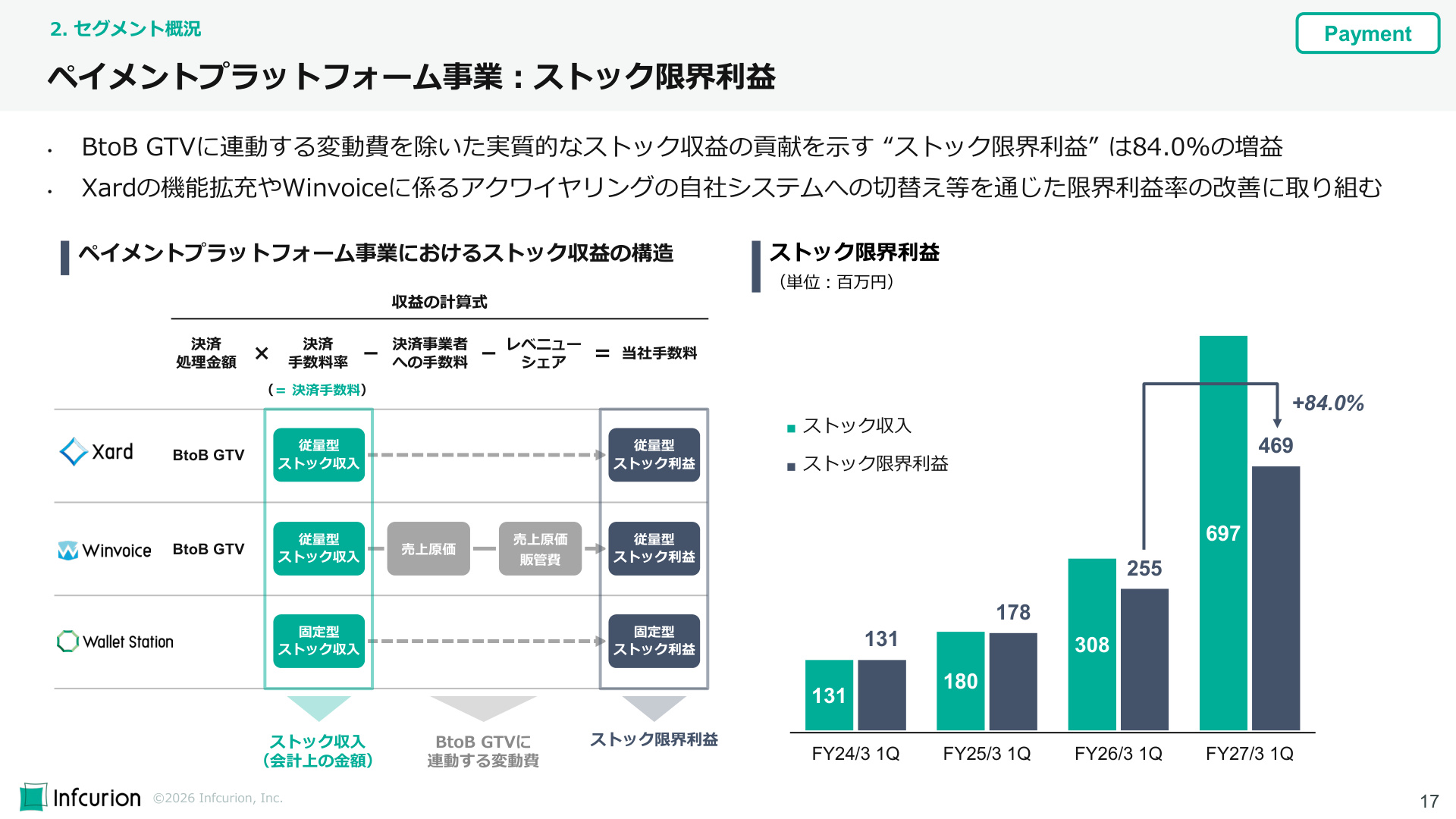
The core Payment Platform business saw segment sales expand rapidly to 1,536 million yen (+58.9% YoY) . Within this, recurring revenue grew by 125.8% YoY to 697 million yen , more than doubling. Segment profit also saw a significant improvement of 164 million yen, moving from a loss of 178 million yen in the same period last year to a loss of 13 million yen , signaling that the structural transition toward full-year profitability is nearing completion.
Slide Commentary: Analysis of Recurring Marginal Profit Structure
The slide above () is fundamental to understanding the "quality of earnings" in the payment business. "Recurring marginal profit," calculated by subtracting direct variable costs linked to GTV from recurring revenue, reached 469 million yen (+84.0% YoY) .
With the functional expansion of Xard and the in-house transition of Winvoice’s acquiring (payment processing) system, the marginal profit margin itself has improved . As recurring marginal profit—which sits atop a fixed-cost system infrastructure—expands rapidly, the company has entered a phase of operating leverage where increased sales translate directly into segment profit.
(2) Merchant Platform Business: Shifting Toward Recurring Revenue
Sales were 603 million yen (-2.5% YoY) , and segment profit was 57 million yen (-47.0% YoY) . Despite a reactionary decline following the temporary front-loading of payment terminal installations (flow revenue) in the previous fiscal year, recurring revenue grew steadily to 351 million yen (+19.2% YoY) , driven by an increase in active terminals in sectors like mobility and the launch of new acquiring systems. The shift from flow-dependency to a stable recurring base is progressing.
(3) Consulting Business: Strategic Resource Shift for Group-Wide Optimization
Sales were 278 million yen (-31.4% YoY) , and segment profit was 108 million yen (-29.6% YoY) . While this appears to be a decline in both revenue and profit, the primary cause is the strategic reallocation of top-tier consulting talent within the group to accelerate the growth of proprietary products (such as payments) and an increase in intra-group transactions (up 61 million yen to 88 million yen YoY) for modernization projects at financial institutions. This is part of a strategic allocation aimed at maximizing the value of the entire group.
4. Cost Structure, Talent Base, and Financial Soundness
Cost Control and AI Utilization
Selling, General, and Administrative (SG&A) expenses for the quarter were 1,093 million yen. Although personnel costs increased (553 million yen) due to aggressive hiring of engineers and the establishment of IPO-related governance in the previous year, the company is promoting the introduction and optimization of generative AI across development and back-office operations . Excluding Winvoice’s payment processing fees (variable costs), SG&A expenses are expected to remain at a stable level throughout the year.
Strengthening the Organization
The number of employees increased from 351 in the same period last year to 395 . In particular, the strengthening of development engineers (169) and sales staff (70) has fortified both product development capabilities and partner acquisition power.
Balance Sheet and Capital Efficiency
Total assets stand at 10,022 million yen , with net assets of 5,618 million yen (equity ratio of approximately 56.1%) . While accounts receivable (1,815 million yen) have increased due to the expansion of Winvoice, the company utilizes short-term financing with a maximum cycle of half a month. By dramatically accelerating the cash collection cycle, the company has built an operation that keeps interest rate and credit risks extremely low.
5. Business Topics and Future Growth Strategy: Toward the "AI x Digital Currency" Era
(1) Product Functional Expansion and New Adoption Cases
- Launch of "Credit/Guarantee Options" : For businesses aiming to enter the corporate card market, Infcurion is providing full-service functions, including credit limit setting and guaranteeing non-payment risks. This significantly lowers the barrier to entry for card businesses and aims to generate new GTV.
- Expansion into Welfare and Education : "Xard" and "CharG" were adopted as the infrastructure for HQ, Inc.'s "Meal Subsidy HQ" (a card for tax-compliant meal subsidies) and Seven Bank’s "money ring," an allowance app for parents and children.
(2) Mid-to-Long-Term Growth Strategy: "AI x Digital Currency" Native Payment Infrastructure
The company foresees an era of "Agentic Commerce," where AI agents autonomously perform purchasing and payments.
- Joint Study with DCP : The company signed a basic agreement with DeFi Consulting Group (DCP) to implement social applications for on-chain finance and instant payment of card charges using tokenized deposits ("DCJPY").
- Fusion of AI and Programmable Money : In the Agentic Commerce market, which is expected to grow to $3–5 trillion globally by 2030, Infcurion aims to secure a position as a next-generation payment infrastructure that integrates digital currencies with existing cashless systems.
6. Summary and Future Observation Points
Infcurion’s FY2027 Q1 earnings demonstrate that BtoB GTV has reached 2.3x YoY , and the resulting surge in recurring revenue (+73.7%) has dramatically improved the profitability of the Payment Platform business.
Key points to watch moving forward include:
- The continuous upward trend in BtoB GTV and recurring marginal profit margins.
- The speed of acquiring new clients through functional expansions like "Credit/Guarantee Options."
- The impact of AI utilization on controlling the SG&A ratio and progress toward an EBITDA margin of 15%.
- Concrete progress in the social implementation of digital currency areas, including DCJPY.
The most significant takeaway from this quarter is the steady and rapid structural transition toward a high-growth recurring business model.
This content is not intended as investment advice or a recommendation. Any opinions expressed are solely the personal views of each article.