


SpiderPlus Q2 FY2026 Earnings Deep Dive: A Growth Story Accelerating Profitability and Platformization

StockClub
Published: Aug 12, 2026, 10:16 AM
Sentiment Analysis

SpiderPlus Q2 FY2026 Earnings Deep Dive: A Growth Story Accelerating Profitability and Platformization
SpiderPlus & Co., a leader in driving construction DX (Digital Transformation), reported strong Q2 FY2026 earnings . Driven by steady revenue growth, rigorous cost control, and the proactive integration of internal AI, the company’s operating profit significantly exceeded its full-year guidance. Moving beyond a mere SaaS provider, SpiderPlus is accelerating its evolution into a "construction infrastructure company" that comprehensively solves on-site challenges through product integration (the Workspace concept), BPO/professional services, and strategic capital and business alliances.
This report extracts 10 key topics from the company's earnings disclosures to provide a detailed analysis of its performance trends, key KPIs, and future growth trajectory.
1. Q2 FY2026 Earnings Highlights and Progress Against Full-Year Plan
For the first half of the fiscal year, revenue reached ¥2,642 million (+12.0% YoY) , with an operating profit of ¥89 million (compared to a ¥29 million loss in the same period last year). In Q2 alone (April–June), revenue was ¥1,374 million (+15.0% YoY) , and operating profit was ¥84 million , marking a significant improvement in profitability.
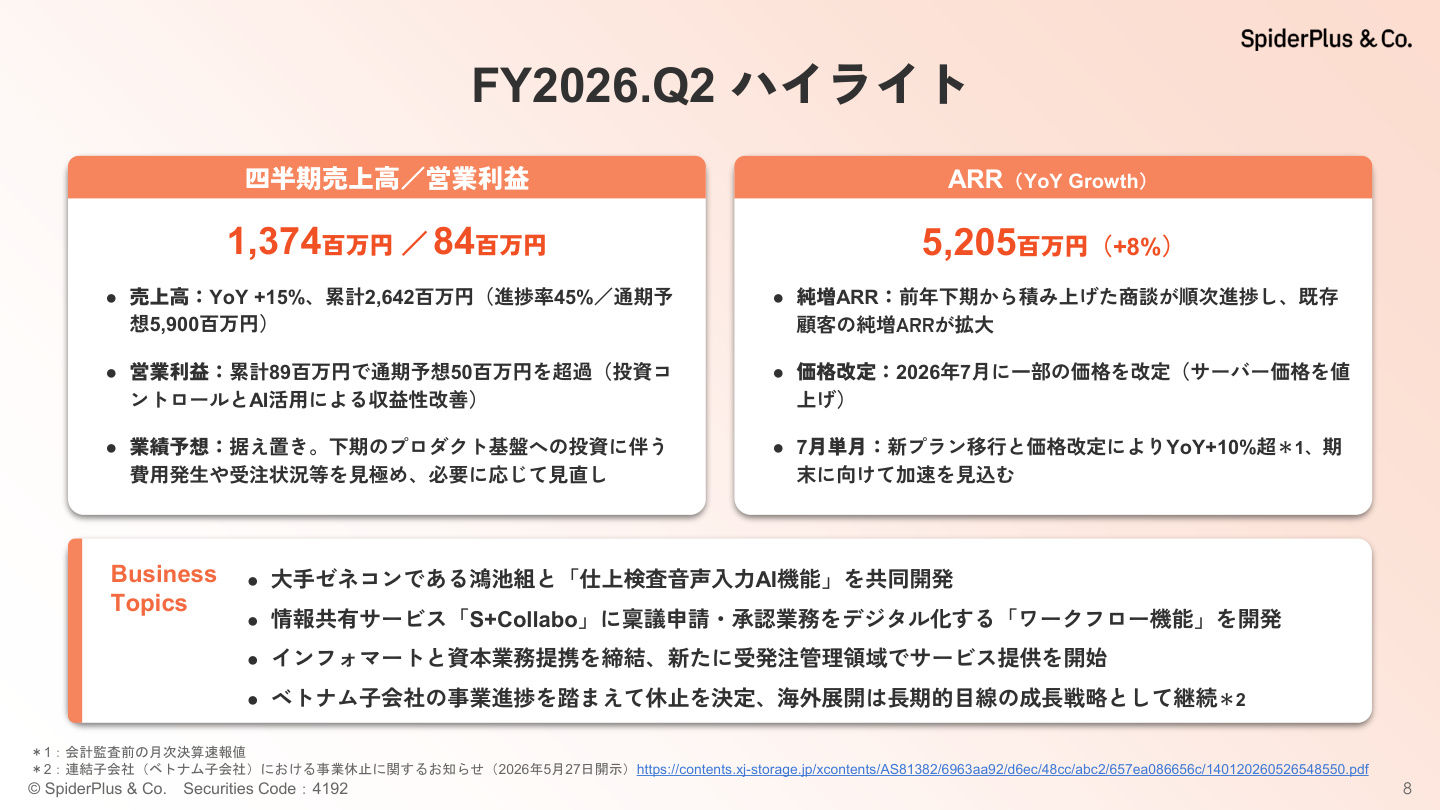
The highlight slide above is critical as it provides a comprehensive overview of the current term and key topics. Most notable is the progress in profitability; against a full-year operating profit forecast of ¥50 million , the company has already achieved ¥89 million in the first half, exceeding its full-year plan. While the company is maintaining its full-year guidance due to planned heavy development investments in the second half to support the "SPIDER+ Workspace" initiative, the first-half results underscore its strong cost control and profit-generating capabilities.
2. Revenue and Operating Profit Trends: A V-Shaped Recovery in Profitability
Quarterly revenue trends show that in addition to the steady accumulation of core stock revenue (SaaS subscription fees), spot revenue ( ¥89 million, +366.3% QoQ ) contributed significantly, driven by progress in contract development (professional services), including joint development projects with major general contractors.
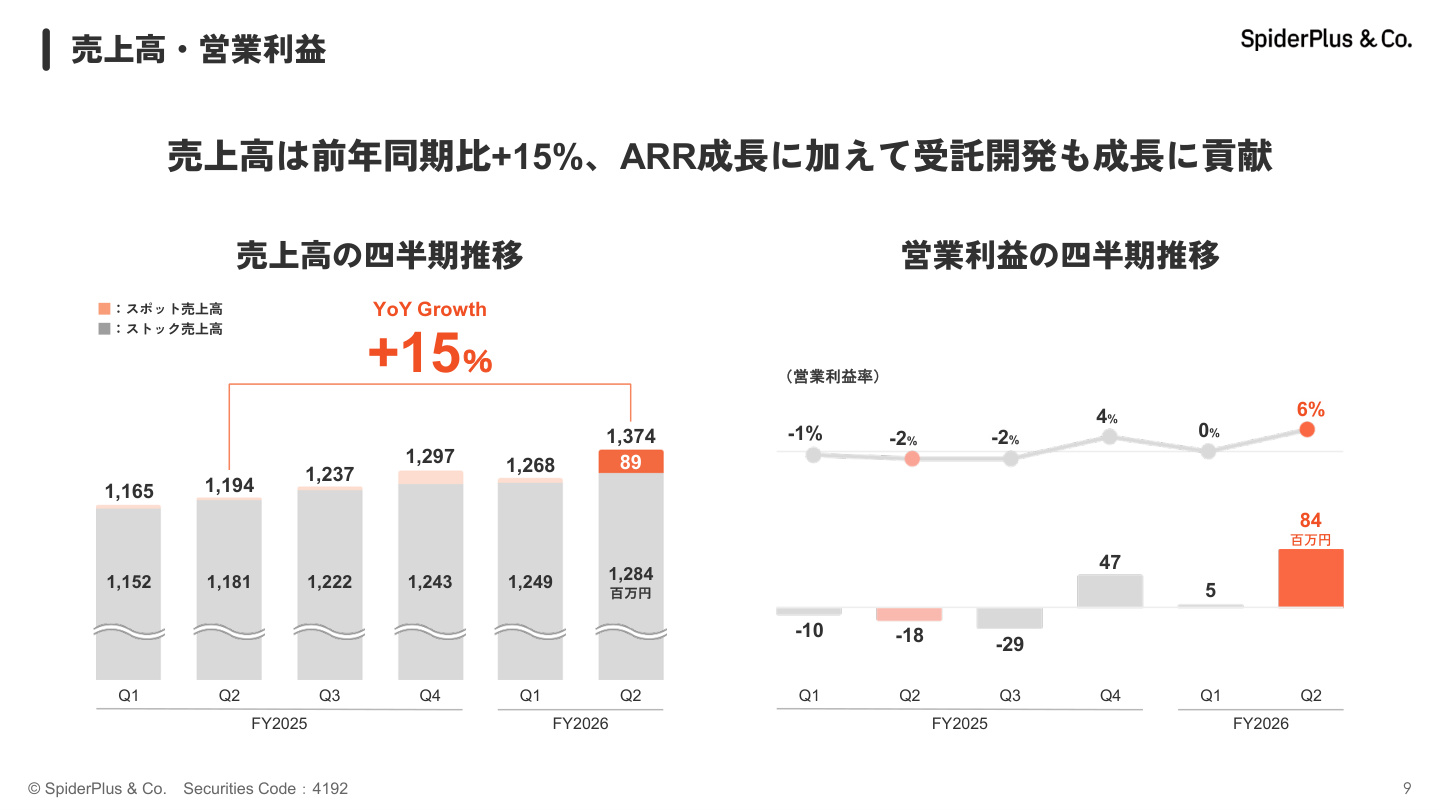
This slide on revenue and operating profit trends is essential for understanding the shift in the company's profit structure. After a period of upfront investment characterized by operating losses and low margins, the company has seen a sharp recovery to an operating profit margin of 6.2% in the most recent quarter. The structure of adding spot revenue on top of a solid base of stock revenue is proving successful, signaling a transition into a phase where revenue growth directly translates into profit growth.
3. Key KPI Trends (ARR, ARPA, Number of Contracts, and Churn Rate)
ARR (Annual Recurring Revenue) , a key indicator of sustainable growth, reached ¥5,205 million (+8% YoY) . The net increase in ARR from the previous quarter was ¥171 million, primarily driven by upsells and cross-sells to existing customers. Furthermore, due to price revisions and transitions to new plans, the ARR growth rate for July 2026 alone has re-accelerated to over 10% .
ARPA (Average ARR per customer) rose to ¥188,000 (+2% YoY) . By company size, large enterprises averaged ¥744,000 , while SMEs averaged ¥82,000 , with deeper utilization among large enterprises driving the increase in unit price.
The number of contracted companies reached 2,297 (+6% YoY) , reflecting steady acquisition of new clients. The 12-month average monthly churn rate remains at an extremely low level of 1.1% , with most churn occurring among small construction firms or temporary users from non-construction industries.
4. Cost Structure and Productivity Gains via Internal AI
In line with revenue growth, the SG&A ratio improved from 74.3% in the same period last year to 69.8% (-4.4pt) . SG&A expenses for Q2 alone were ¥910 million , a decrease from the previous quarter (¥934 million).
This is attributed to the promotion of AI in internal operations and the optimization of hiring plans. Although the headcount was kept at 261 (down from 274 in the previous quarter), ARR per employee reached a record high of ¥19.9 million . The company is successfully transforming into a highly efficient organization that generates greater recurring revenue with limited resources.
5. Gross Profit Margin Trends and Temporary Factors
The gross profit margin for Q2 was 72.4% , a slight decline from 74.1% in the previous quarter. This is a temporary factor caused by the concentration of revenue recognition from specific large-scale contract development projects with relatively lower margins. Excluding these projects, the marginal profit margin remains high at 83.0%, and the company is well-positioned to meet its full-year target of a gross profit margin of 73% or higher .
6. Expansion into Order/Invoice Processing via Capital and Business Alliance with Infomart
One of the biggest business topics this period is the capital and business alliance with Infomart Corporation (TSE Prime). By integrating with Infomart’s "BtoB Platform TRADE," SpiderPlus can provide digital solutions for back-office operations to its customer base.
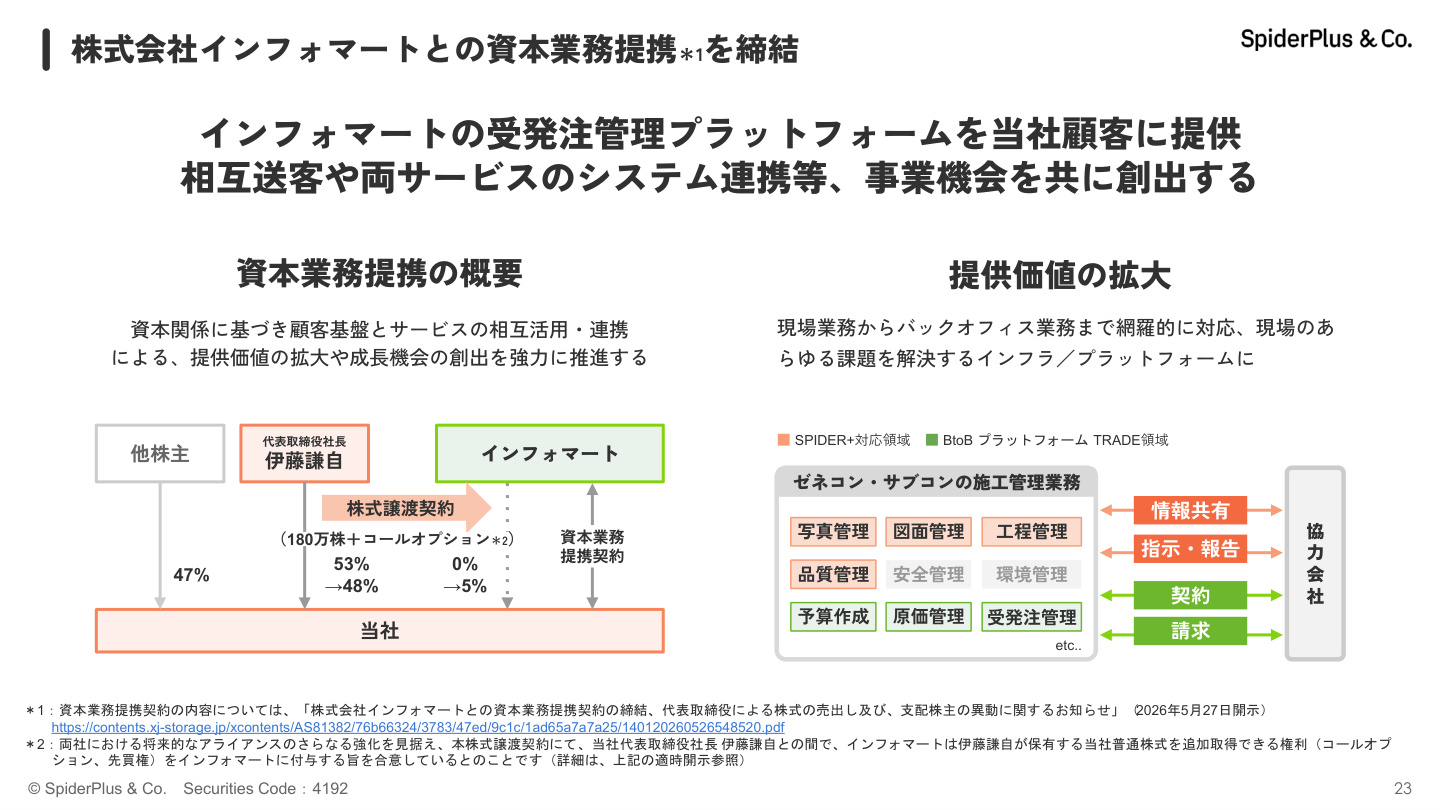
This alliance strategy slide is highly significant, as it indicates SpiderPlus is expanding from its traditional "on-site construction management" domain into the core construction processes of "ordering, invoicing, and accounting." Infomart has acquired shares in SpiderPlus, and the mutual referral of customers and system integration are expected to lower the hurdles for new customer acquisition and create powerful synergies.
7. AI Joint Development with Konoike Construction and the Evolution of "S+Collabo"
Regarding product evolution, the company co-developed an "AI-powered voice input for finishing inspections" with major general contractor Konoike Construction. This AI feature has significantly reduced manual selection and input tasks, successfully cutting inspection time by 33% .
Furthermore, for the information-sharing service "S+Collabo," the company developed and launched a workflow function to digitize approval processes. This allows for the consolidation of communication and decision-making processes—including those involving subcontractors and craftsmen—onto the "SPIDER+ Workspace."
8. Cash Flow and Financial Soundness
Operating cash flow for the first half turned positive at ¥97 million (compared to a ¥13 million deficit in the same period last year), supported by stable cash inflows from stock revenue as ARR grows.
Meanwhile, investment cash flow was -¥246 million , as the company actively funds development investments (such as new mobile apps) with its own capital. The equity ratio remains at 66.5% , establishing a stable financial structure that allows the company to fund growth investments independently while continuing to repay debt.
9. Mid-to-Long-Term Management Policy and the "SPIDER+ Workspace Concept"
As a mid-term strategy, the company is moving away from being a "single SaaS tool vendor" to promoting the "SPIDER+ Workspace Concept," which centrally manages construction, labor, equipment, and information. The goal is to evolve into an "infrastructure company" that broadly solves on-site challenges.
The plan aims for a CAGR of +20% or more in revenue through FY2028, ¥2 billion in revenue from solution areas like BPO/professional services, and a consolidated operating profit margin of 10% or higher . The renewal of the product foundation to resolve scalability constraints and the phased revision of pricing and plan structures will be the pillars supporting future growth.
10. Summary and Outlook
The Q2 FY2026 earnings report, characterized by increased revenue and significant profit growth , marks a full-scale transition into a monetization phase. Key takeaways are as follows:
- Performance: Revenue of ¥2,642 million (+12.0%) and operating profit of ¥89 million, exceeding full-year forecasts.
- KPIs: ARR of ¥5.2 billion (+8%), with growth re-accelerating to over 10% in July. Churn rate remains low at 1.1%.
- Productivity: ARR per employee improved to ¥19.9 million through AI utilization and organizational optimization.
- Strategy: Strong promotion of platformization through the alliance with Infomart and AI joint development with Konoike Construction.
While development costs related to new apps and infrastructure investments are expected in the second half, the progress of the sales pipeline and the effects of price revisions are building a solid foundation for both re-accelerating the top line and improving profitability.
This content is not intended as investment advice or a recommendation. Any opinions expressed are solely the personal views of each article.