


Digital Information Technologies (3916) FY2026 Financial Results & FY2027 Outlook: A Deep-Dive Analysis

StockClub
Published: Aug 12, 2026, 10:09 AM
Sentiment Analysis

This report provides a comprehensive analysis of the FY2026 full-year financial results and the FY2027 earnings forecast for Digital Information Technologies Corporation (DIT), based on the company's official earnings presentation materials. We examine performance highlights, key drivers of change, segment-specific trends, and future growth strategies.
1. Performance Highlights: 16 Consecutive Years of Revenue and Profit Growth
Despite lingering uncertainties in certain business environments—such as the impact of U.S. trade policies and revised investment strategies by automotive manufacturers—DIT successfully captured robust demand for DX (Digital Transformation) and IT investments. As a result, the company achieved record highs in net sales, operating profit, and ordinary profit , marking its 16th consecutive year of increased revenue and profit , a testament to the company's core strength.
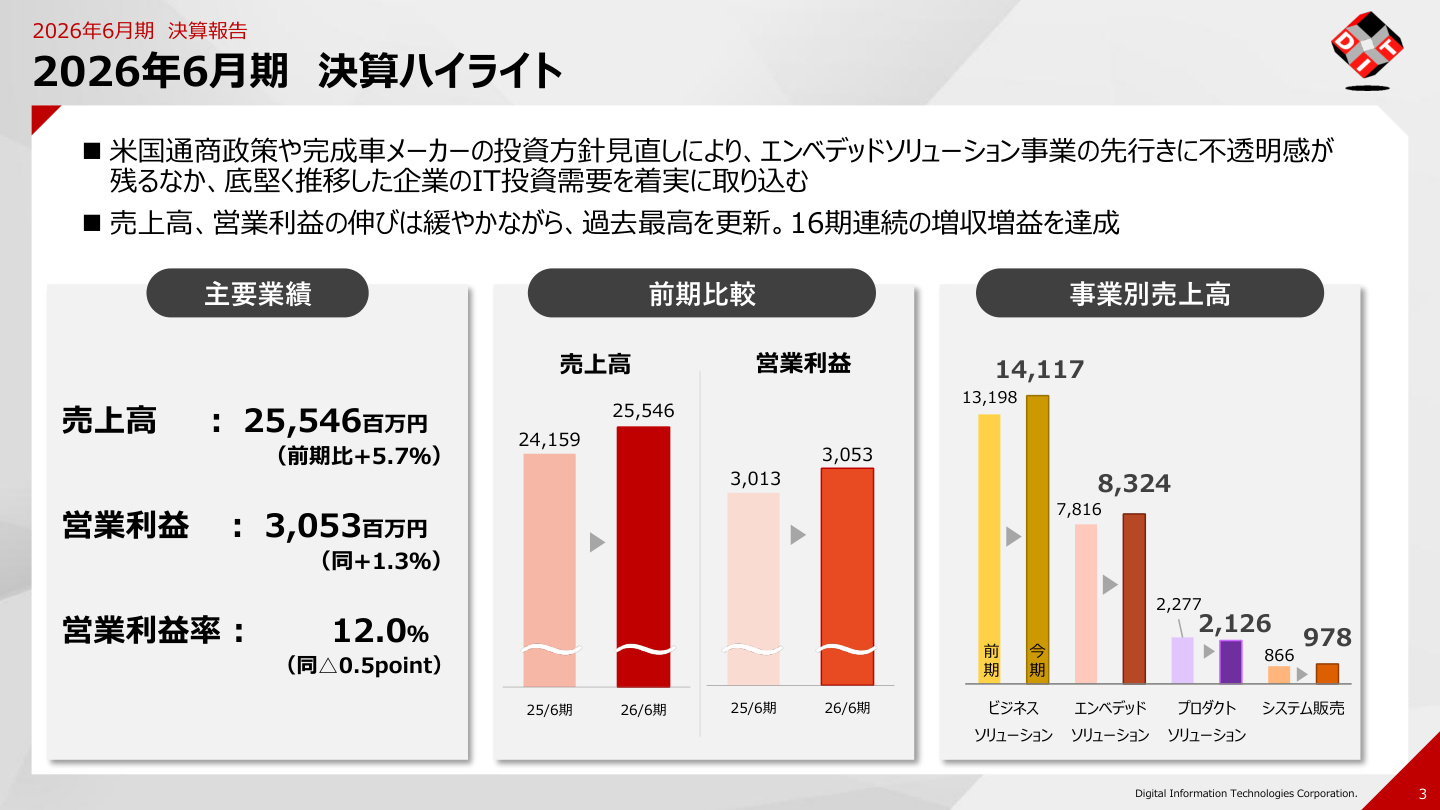
[Slide Commentary: Financial Highlights]
The slide above provides the most critical data visualizing the overall picture for the fiscal year ended June 2026. Net sales rose 5.7% year-on-year to 25,546 million yen , while operating profit increased by 1.3% to 3,053 million yen . Although the operating profit margin saw a slight decline of 0.5 percentage points to 12.0%, it remains among the highest in the industry.
By segment, the Business Solution segment was the primary driver, accounting for 14,117 million yen (approximately 55.3% of total sales) , followed by Embedded Solution ( 8,324 million yen ), Product Solution ( 2,126 million yen ), and System Sales ( 978 million yen ). The company’s diversified portfolio effectively balanced the impact of suppressed automotive-related spending in the Embedded segment and temporary revenue declines in the Product segment with the strong growth of the Business Solution segment.
2. In-depth Analysis of Profit Structure and Drivers
Looking at the details for FY2026, net sales were 25,546 million yen (1.7% below plan), operating profit was 3,053 million yen (0.1% above plan), and ordinary profit was 3,076 million yen (0.9% above plan). While sales fell slightly short of the target, operating and ordinary profits exceeded expectations. Although net income attributable to owners of the parent was 2,092 million yen (a 3.9% year-on-year decrease) , this was primarily due to a 77 million yen extraordinary loss from the valuation of investment securities in a business alliance partner, indicating no underlying weakness in the company's core earning power.
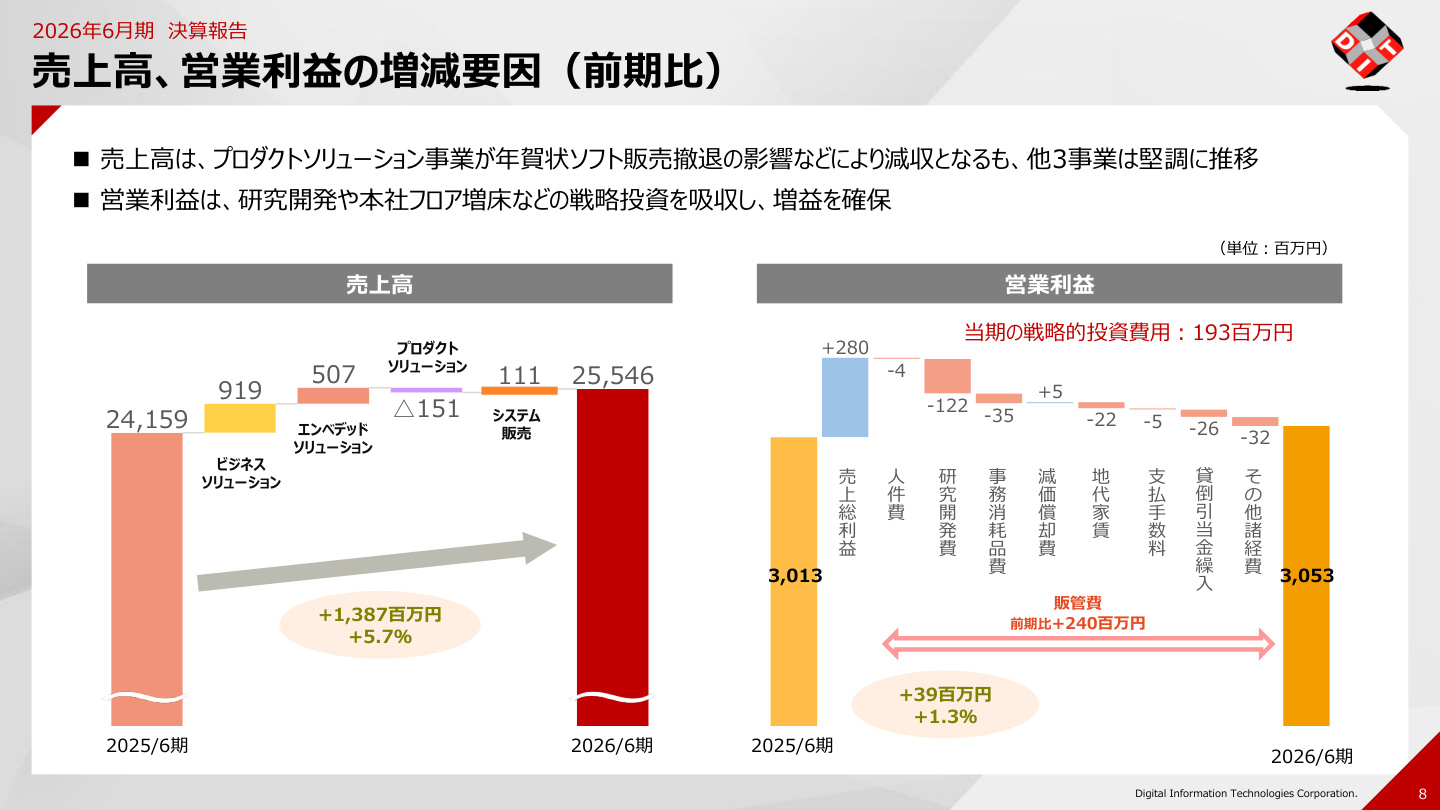
[Slide Commentary: Factors Behind Changes in Sales and Operating Profit]
This slide illustrates the waterfall analysis of the increase in operating profit from 3,013 million yen in the previous year to 3,053 million yen. The reason for the more moderate growth in operating profit compared to sales lies in proactive strategic investments aimed at future growth:
- Increase in Gross Profit (+280 million yen) : Driven by revenue growth, primarily in the Business Solution segment.
- Strategic Investment Expenses (193 million yen) : Significant investments were made in R&D (122 million yen) for implementing AI-symbiosis models and developing strategic products, as well as administrative expenses related to office expansion.
- Natural Increase in Personnel Expenses (-4 million yen) : High productivity was maintained while controlling the increase in personnel costs resulting from talent acquisition and salary revisions.
This demonstrates a healthy profit structure where the increase in gross profit (+280 million yen) successfully absorbed the rise in SG&A expenses (+240 million yen), allowing the company to secure profit growth while simultaneously investing in the future .
3. Segment Performance Trends and Analysis
Performance trends and key points for each of DIT's major business segments are as follows:
(1) Business Solution Segment (Sales: 14,117 million yen, +7.0% YoY)
- Business System Development (Sales: 8,371 million yen, +7.8% YoY) : Despite a reactionary decline from high-unit-price public sector projects, growth in telecommunications projects and a recovery in ERP and pharmaceutical projects offset the impact. The company is also promoting the introduction of generative AI tools at development sites to accumulate know-how.
- Operation Support (Sales: 5,746 million yen, +5.8% YoY) : In addition to expanding market share among key clients, cloud infrastructure construction, data analysis, and value-added services utilizing Microsoft Power Platform grew significantly, leading to a substantial improvement in gross profit margins.
(2) Embedded Solution Segment (Sales: 8,324 million yen, +6.5% YoY)
- Embedded System Development (Sales: 5,997 million yen, +9.2% YoY) : Despite investment constraints by customers in the automotive and semiconductor sectors, the company secured growth by cultivating non-automotive projects , such as those for industrial equipment.
- Embedded System Verification (Sales: 2,327 million yen, +0.1% YoY) : Although affected by the early completion of large-scale verification projects and revised EV investment plans at the U.S. subsidiary, the company has begun marketing AI-driven automated testing services to prepare for next-generation demand.
(3) Product Solution Segment (Sales: 2,126 million yen, -6.6% YoY)
- Revenue declined temporarily due to the discontinuation of New Year's card software and a reactionary drop in one-time licenses for the business efficiency tool "xoBlos." However, security products like WebARGUS and vulnerability assessment services are growing steadily, as the company shifts toward a stock-based business model.
(4) System Sales Segment (Sales: 978 million yen, +12.9% YoY)
- Following the stabilization of the sales structure at the Hokuriku branch, demand for PC replacements due to the Windows 11 transition and revisions to maintenance fees for the "Raku-Ichi" system for SMEs contributed to a significant segment profit of 134 million yen (+69.0% YoY) .
4. Financial Soundness and Capital Efficiency
The company maintains a very healthy balance sheet and cash flow, providing a solid foundation for both growth investment and shareholder returns.
- Financial Base : Total assets at the end of FY2026 expanded to 12,290 million yen (+1,019 million yen YoY). With cash and deposits increasing to 6,167 million yen , the equity ratio remains at an extremely high level of 73.7% .
- Cash Flow : Operating cash flow secured a 2,531 million yen inflow . Despite a 736 million yen outflow in investment CF due to the acquisition of securities, the year-end cash balance increased to 5,900 million yen .
- Capital Efficiency (ROE) : Although ROE was 24.4% (-4.6 points YoY) due to the recording of extraordinary losses, it remains well above the target threshold, demonstrating exceptionally high capital efficiency.
5. FY2027 Full-Year Forecast: Growth Strategy Targeting 17 Consecutive Years of Growth
In FY2027, DIT aims to achieve its 17th consecutive year of revenue and profit growth by capturing expanding DX demand and transitioning to the implementation phase of its growth lever, the " AI-Symbiosis Model ."
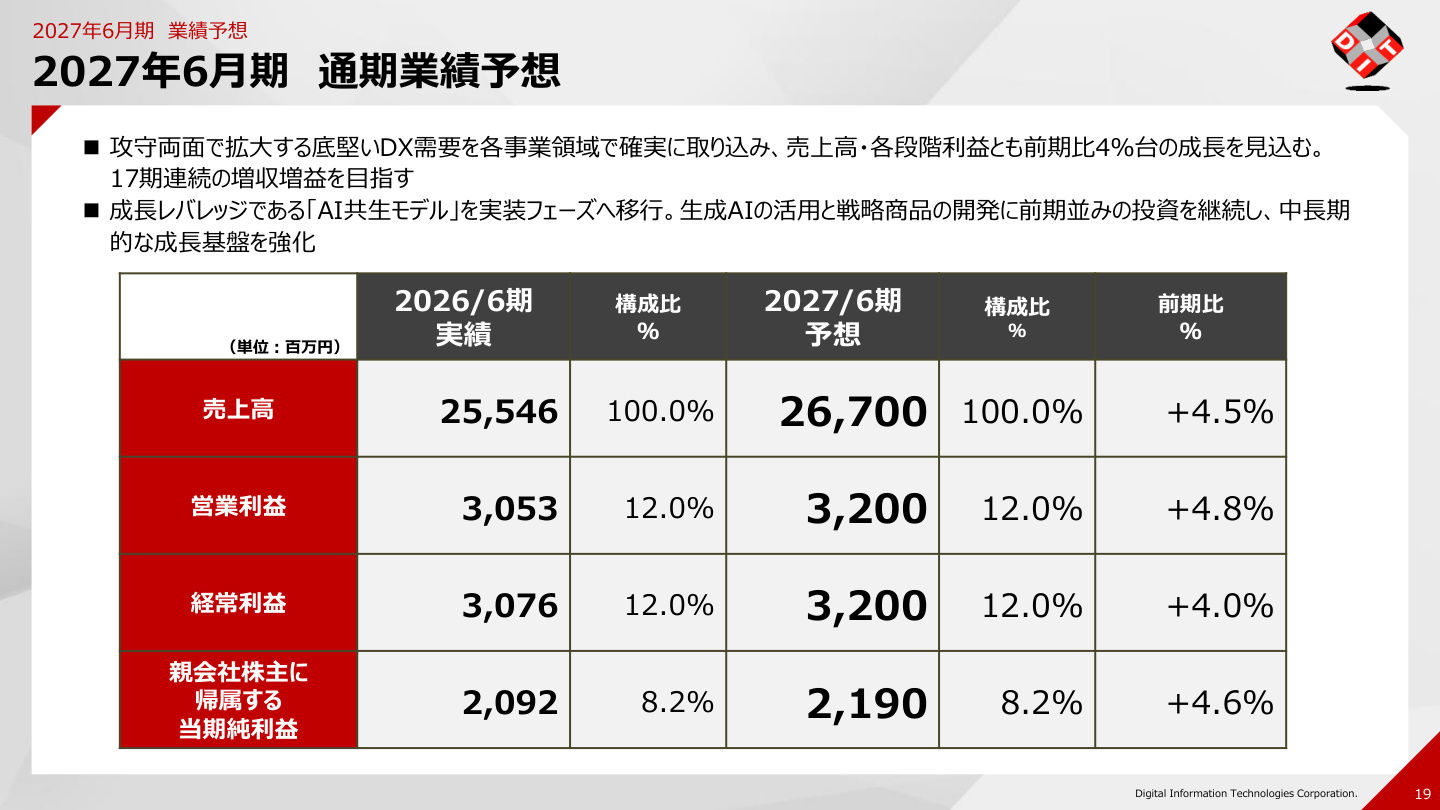
[Slide Commentary: FY2027 Full-Year Earnings Forecast]
The slide above shows the consolidated earnings forecast for FY2027:
- Net Sales : 26,700 million yen (+4.5% YoY)
- Operating Profit : 3,200 million yen (+4.8% YoY)
- Ordinary Profit : 3,200 million yen (+4.0% YoY)
- Net Income Attributable to Owners of the Parent : 2,190 million yen (+4.6% YoY)
In the first half, the company anticipates a temporary decline in operating profit (-6.1% YoY) due to adjustments in automotive software investments. However, the plan is to absorb this through revenue growth across all segments and productivity improvements via AI, achieving solid full-year profit growth (3.2 billion yen in operating profit) .
Segment Growth Outlook and Key Measures:
- Business Solution (Target: 15,000 million yen, +6.2%) : Shift to a co-creation model by strengthening upstream consulting; expand DX support using Microsoft Power Platform.
- Embedded Solution (Target: 8,400 million yen, +0.9%) : Cultivate non-automotive areas such as defense, aerospace, and IoT; advance verification services with "Qualicia" and "Q-Compass."
- Product Solution (Target: 2,300 million yen, +8.3%) : Plan a V-shaped recovery; promote "Sentinel ARGUS" and "WebARGUS"; expand stock-based revenue via data management platforms.
- System Sales (Target: 1,000 million yen, +2.2%) : Acquire new customers centered on cloud systems and strengthen cross-selling through a customer success approach.
6. Summary and Outlook
DIT's FY2026 results were robust, achieving 16 consecutive years of growth despite headwinds in certain markets, thanks to a diverse portfolio and strong DX demand. The company also successfully executed 193 million yen in strategic investments for future growth.
Looking toward FY2027, DIT aims for record-breaking performance (26.7 billion yen in sales, 3.2 billion yen in operating profit) . Key points to watch include: (1) the speed of productivity improvements in development and verification using generative AI and low-code tools , (2) the smooth shift to non-automotive sectors such as defense and aerospace , and (3) the growth rate of stock-based revenue centered on security products .
This content is not intended as investment advice or a recommendation. Any opinions expressed are solely the personal views of each article.