


Fuller FY2026 Financial Results: Poised for Significant Growth in FY2027 Following Strategic Investments – Scaling Through Large-Scale Projects, Enhanced Sales Structure, and AI Integration

StockClub
Published: Aug 12, 2026, 10:08 AM
Sentiment Analysis

Fuller, Inc. (Securities Code: 387A), a provider of digital partner services, announced its financial results for the fiscal year ended June 30, 2026, on August 12, 2026. In its first year as a publicly traded company, the firm actively invested in human capital recruitment, training, and the strengthening of its sales structure to drive future business expansion. Consequently, revenue remained flat year-on-year, resulting in a significant decline in profits. However, the second half of the fiscal year saw a notable increase in new project orders and improved utilization rates. Looking ahead to the fiscal year ending June 30, 2027, the company has announced a robust growth plan, projecting a V-shaped recovery in both revenue and profit.
This report provides a multi-faceted analysis of the company's performance highlights, quarterly trends, key management indicators, and the growth strategy for FY2027, based on the disclosed financial materials.
1. FY2026 Financial Highlights and Profit Structure Analysis
Fuller's full-year results for FY2026 were as follows: Revenue of 2,009 million yen (+0.0% YoY) , Operating Profit of 57 million yen (-69.9% YoY) , Ordinary Profit of 102 million yen (-44.6% YoY) , and Net Income of 132 million yen (-32.6% YoY) . Compared to the revised forecasts issued in February 2026 (Revenue: 2,056 million yen, Operating Profit: 55 million yen, Net Income: 113 million yen), the company achieved 97.7% of its revenue target while exceeding its profit forecasts.
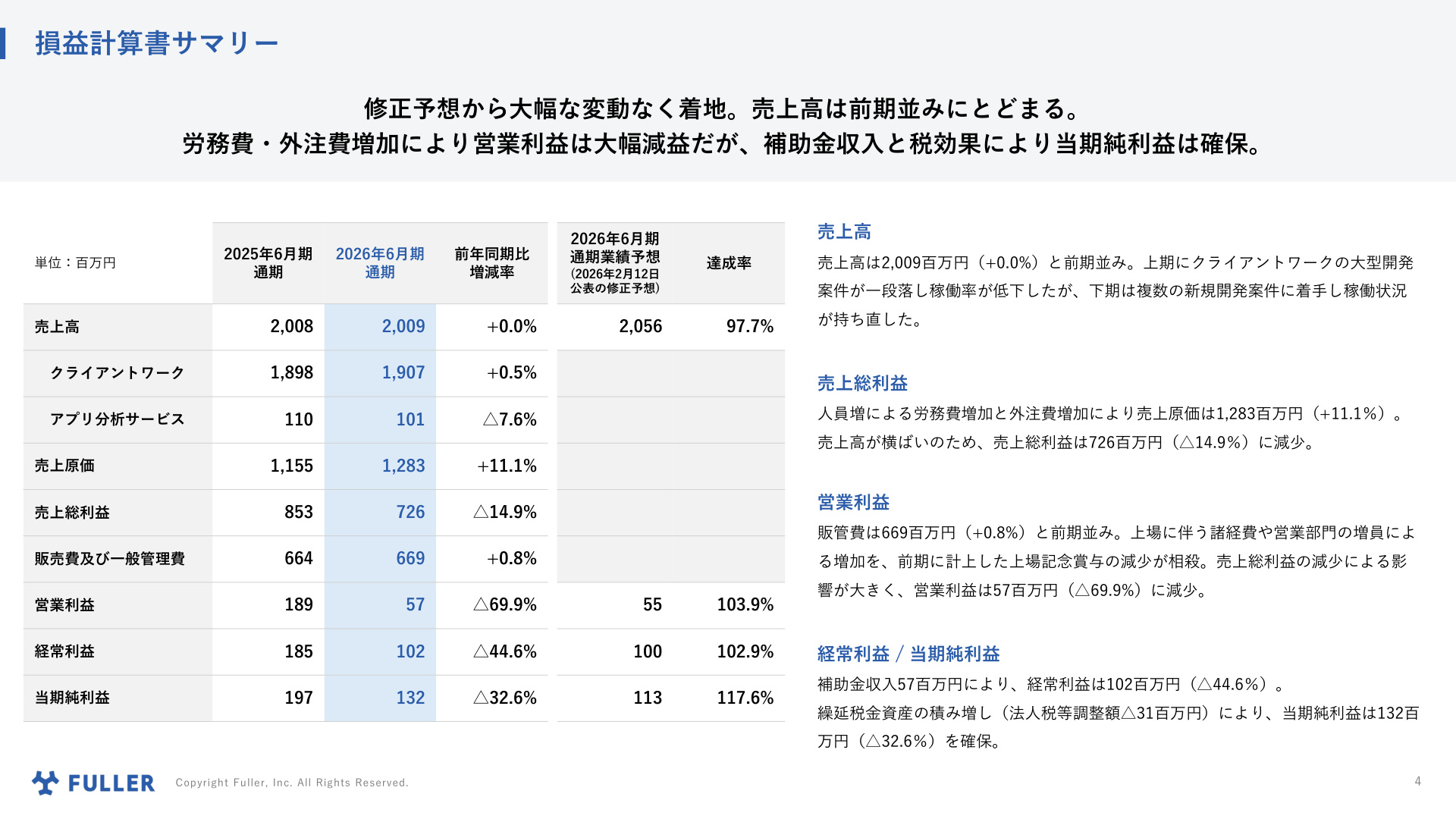
As shown in the income statement summary above, the flat revenue trend was primarily due to the completion of large-scale development projects acquired in the previous fiscal year, which led to a temporary decline in the utilization rate of creative talent during the first half. By segment, the core Client Work business remained steady at 1,907 million yen (+0.5% YoY) , while the App Analysis Service segment struggled slightly at 101 million yen (-7.6% YoY) .
Regarding profitability, cost of sales rose to 1,283 million yen (+11.1% YoY) due to increased labor costs from headcount expansion and higher outsourcing expenses, resulting in a Gross Profit of 726 million yen (-14.9% YoY) . Selling, General and Administrative (SG&A) expenses were 669 million yen (+0.8% YoY); while the company incurred listing-related costs and increased sales staff, these were offset by the absence of the previous year's listing commemorative bonuses. Although operating profit declined significantly, the company secured net profitability through 57 million yen in subsidy income and an increase in deferred tax assets (tax adjustment of -31 million yen).
Quarterly trends show that while Q1 and Q2 faced sluggish sales and high labor costs—resulting in operating profits of 4 million yen and 17 million yen, respectively— Q4 alone recorded a record-high revenue of 581 million yen . The recovery in order intake has become clear, driven by new project wins and the successful delivery of contracted work, which significantly improved utilization rates.
2. Financial Soundness and Key Management Indicators
Financial stability has been further strengthened through capital increases following the IPO and the repayment of long-term debt. According to the balance sheet summary, the equity ratio rose by 13.0 percentage points, from 53.9% at the end of the previous year to 66.9% . Of the 1,825 million yen in total assets, cash and deposits account for 1,289 million yen (including 500 million yen in short-term time deposits as liquidity), maintaining a highly sufficient cash position relative to the scale of operations.
Trends in key performance indicators (KPIs) regarding human capital and the client base are as follows:
- Number of Employees and Creative Talent Ratio : Following the hiring of 19 new graduates (including 16 engineers) in April 2026, the total number of employees increased to 207 (+8.9% YoY) . The number of "creative talent" (directors, designers, engineers, etc.) reached 169 (+11.2% YoY), accounting for 81.6% of total staff (+1.6pt YoY) , successfully maintaining the target of over 80%.
- Monthly Revenue and Gross Profit per Creative Talent : Due to proactive hiring, monthly revenue per capita fell to 1,075 thousand yen (-10.6% YoY) , and monthly gross profit per capita dropped to 388 thousand yen (-23.9% YoY) . This was the primary driver of the decline in profit for the fiscal year.
- Average Monthly Clients and Revenue per Client : Through referrals from partners and strengthened outbound sales, the average number of monthly clients grew steadily to 41.6 (+22.0% YoY) . Conversely, due to the absence of the previous year's large-scale projects, the average monthly revenue per client decreased to 3,823 thousand yen (-17.6% YoY) . The expansion of the client base has laid the foundation for future increases in unit prices and project scale.
3. FY2027 Earnings Forecast and the Growth Story for a V-Shaped Recovery
Fuller has released its earnings forecast for the fiscal year ending June 30, 2027, in a range format. The plan projects Revenue of 2,600–2,720 million yen (+29.4% to +35.4% YoY) , Operating Profit of 180–260 million yen (+215.1% to +355.2% YoY) , Ordinary Profit of 180–260 million yen (+74.9% to +152.6% YoY) , and Net Income of 130–190 million yen (-2.2% to +43.0% YoY) .
This is an aggressive plan anticipating a sharp re-acceleration in growth for both revenue and operating profit, with the operating margin expected to improve significantly from 2.8% in the previous year to 6.9%–9.5% .
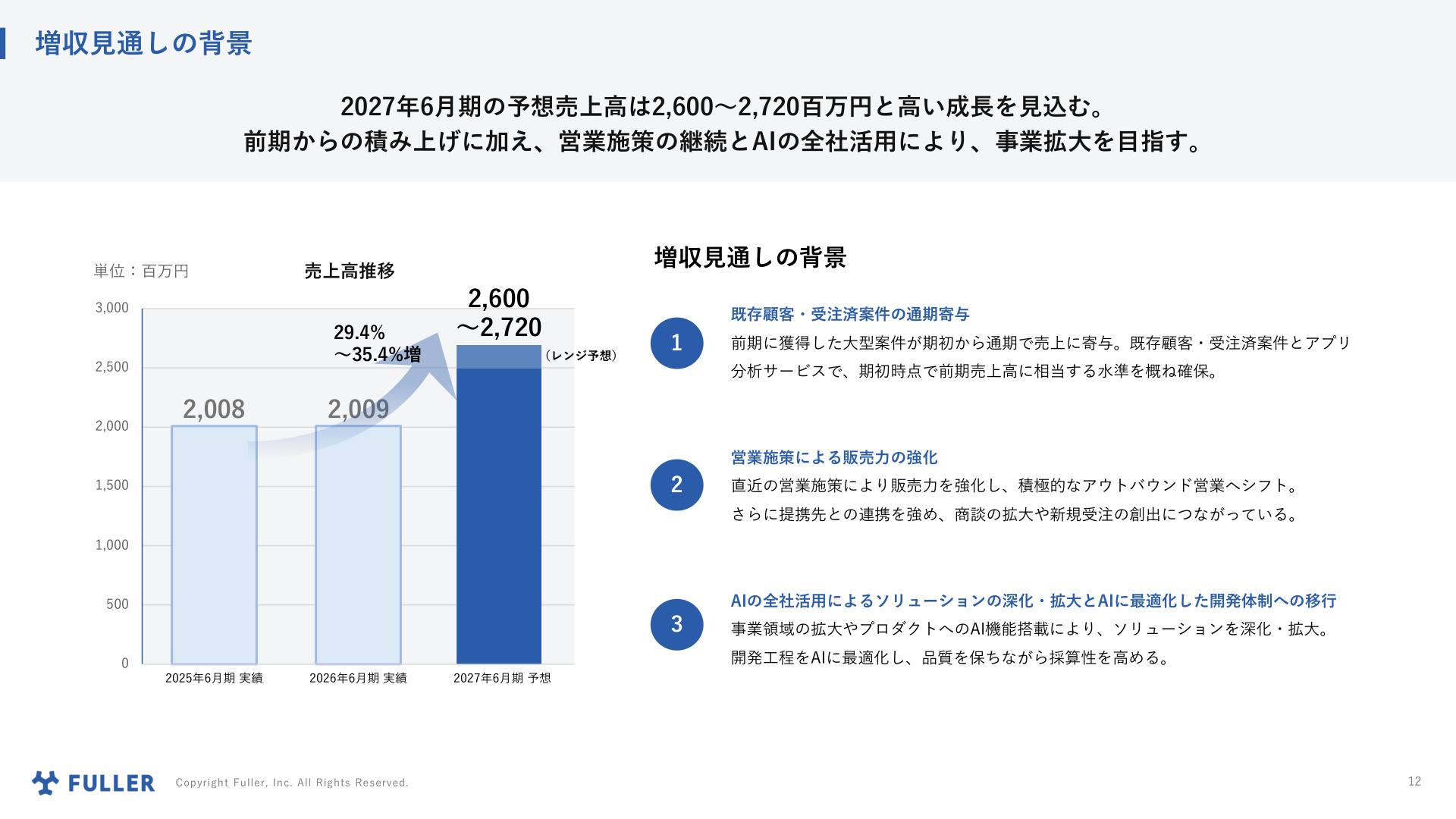
The slide above is the most critical document illustrating the background and quantitative basis for the dramatic revenue growth expected in FY2027. The company's growth thesis is organized into three main elements:
- Full-Year Contribution of Existing Clients and Backlog : Large-scale development projects acquired in the second half of FY2026 will contribute to revenue throughout the entirety of FY2027. As a result, the company has effectively secured a backlog equivalent to the previous year's total revenue at the start of the fiscal year.
- Strengthened Sales Capabilities : The shift toward outbound sales initiated in the second half of the previous year, along with the addition of five sales staff and the appointment of regional specialists, is beginning to yield results.
- Improved Productivity and Profitability via AI : The company plans to aggressively promote AI optimization in the development process, aiming to increase the utilization efficiency of creative talent and project gross margins while maintaining high quality.
4. Three Sales Strategies and Partnerships to Accelerate Growth
To achieve high growth in FY2027, Fuller is continuing and strengthening the following three sales approaches:
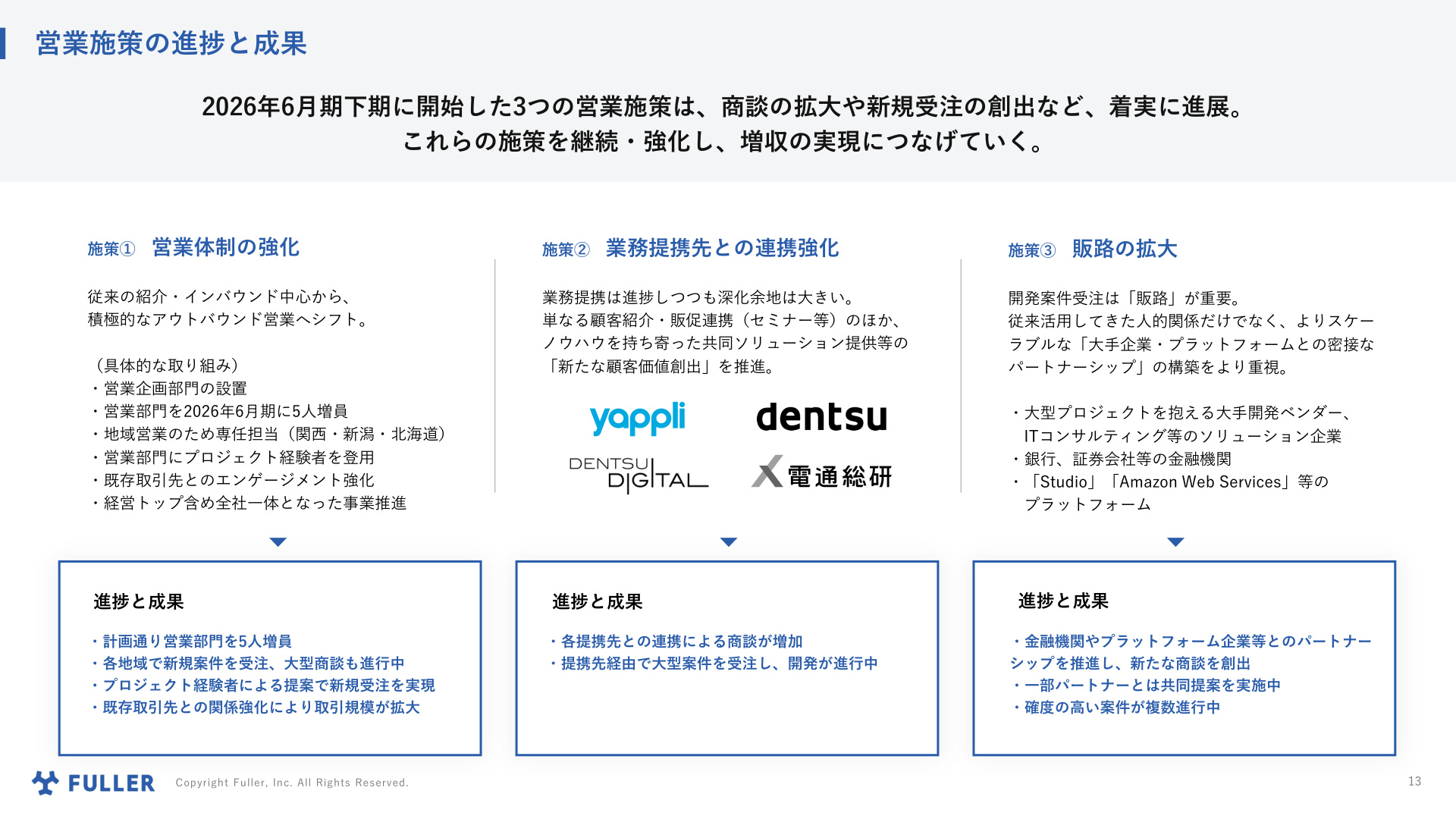
As shown in the structure of the slide above, Fuller is transitioning from a traditional inbound-dependent model to an active project-creation model through multi-faceted approaches.
- Strategy 1: Strengthening the Sales Structure : As planned, the company added five members to the sales department, established a sales planning division, and appointed specialists for the Kansai, Niigata, and Hokkaido regions. By utilizing staff with project experience in sales proposals, the company can provide high-quality proposals that delve deeply into client issues, leading to the acquisition of new large-scale projects across the country.
- Strategy 2: Deepening Partnerships with Business Alliances : Fuller is deepening its collaboration with capital and business partners, including Yappli, Inc. and the Dentsu Group (e.g., Dentsu Digital Inc., Dentsu Soken Inc.). Beyond simple client referrals, the company is expanding the number of business negotiations by offering joint solutions and hosting seminars, with multiple large-scale development projects currently underway through these partnerships.
- Strategy 3: Expanding Sales Channels : The company is promoting partnerships with major development vendors, IT consulting firms, financial institutions (banks, securities firms, etc.), and cloud platform companies (AWS, Studio, etc.). By co-proposing with partners, Fuller has built a structure to win large-scale DX projects from major corporations that were previously difficult to approach.
5. AI-Driven Business Development, Governance Reform, and Capital Policy
Full-Scale AI Utilization
Fuller is pursuing business expansion through two pillars: "deepening and expanding solutions" and "transitioning to an AI-optimized development structure." Internally, the company has introduced Anthropic's "Claude" across the organization and is rapidly training AI-literate talent, centered on young engineers with an average age of 31.5. By increasing development efficiency across all stages—planning, design, development, and operations—the company aims to achieve its target of 1,240–1,297 thousand yen in monthly revenue per capita.
Governance and Management Reform
Following the first anniversary of its IPO, the company will undergo a management restructuring at the annual general meeting of shareholders. The three founders—Shuta Shibuya (current Chairman), Yuki Sakurai (current CDO), and Tadasuke Miyake (current CFO)—will step down from the Board of Directors to focus on business promotion as employees (or advisors). Hiroyuki Hayashi (Executive Officer), Atsushi Izuno (Executive Officer/CTO), and Makoto Yoshioka (Executive Officer at Dentsu Digital) will join the Board. This will transition the company to a more objective and dynamic management structure consisting of six directors (three of whom are external) and three auditors (all external) .
Capital Policy (Gratuitous Capital Reduction)
To ensure flexibility and agility in future capital policy and to reduce tax burdens, the company plans to implement a gratuitous capital reduction , decreasing capital stock by 69,668,612 yen to 30,000,000 yen. This is an accounting transfer procedure (to other capital surplus) that does not affect net assets, the total number of issued shares, or financial performance, and will contribute to financial efficiency.
Summary
While Fuller's FY2026 results reflected a decline in profit due to investments in human capital and sales infrastructure, the seeds of growth are steadily sprouting, as evidenced by record-high revenue in Q4 and an expanding client base. In FY2027, the company enters a critical phase aimed at achieving record-high performance— 2.6 to 2.72 billion yen in revenue and 180 to 260 million yen in operating profit —driven by the full-year contribution of large projects, the maturation of partnerships with the Dentsu Group and Yappli, and improved profit margins through company-wide AI utilization.
This content is not intended as investment advice or a recommendation. Any opinions expressed are solely the personal views of each article.