


Broadleaf (FY2026 Q2 Earnings): Accelerating Cloud Migration Drives Significant Profit Growth, Setting the Stage for Record-Breaking Annual Results

StockClub
Published: Aug 12, 2026, 10:07 AM
Sentiment Analysis

Broadleaf (Securities Code: 3673) reported strong growth in both revenue and profit for the second quarter (interim period) of the fiscal year ending December 2026, driven by the successful progress of its cloud transition and the migration of existing customers. The shift from traditional packaged software to high-value-added cloud services (SaaS) is proceeding according to plan, resulting in a notable improvement in profitability.
This report covers 10 key topics derived from the latest earnings presentation, providing a detailed analysis of the company's current status and its mid-to-long-term growth trajectory.
1. Interim Consolidated Results: Significant Revenue and Profit Growth Exceeding Targets
For the interim period of FY2026, Broadleaf reported revenue of 10,781 million yen (+9.8% YoY) and operating profit of 1,477 million yen (+91.5% YoY) . Compared to the initial guidance issued in February 2026 (revenue of 10,400 million yen, operating profit of 1,100 million yen), the company achieved a strong performance, exceeding revenue targets by 3.7% and operating profit targets by 34.3%.
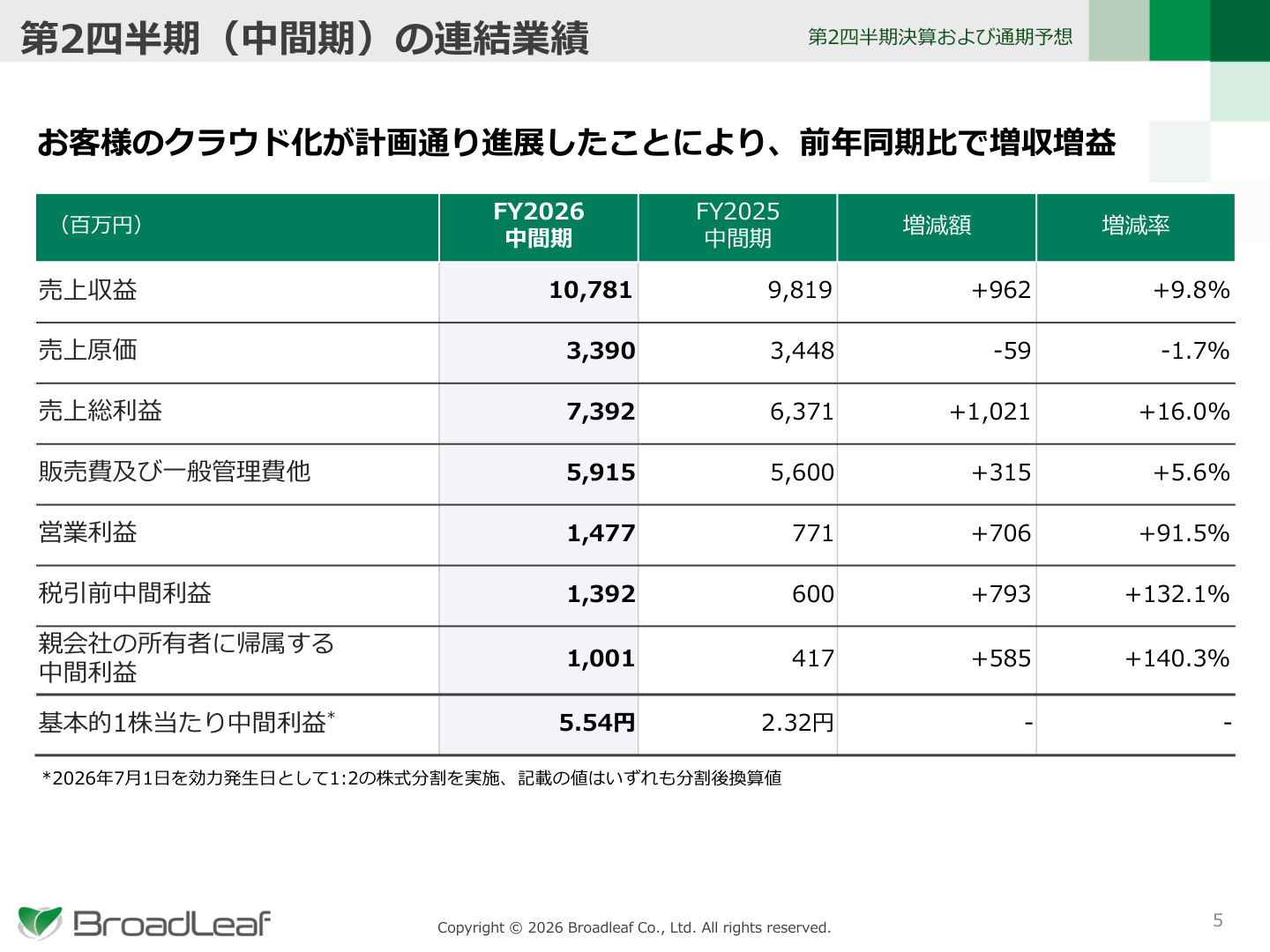
The slide above summarizes the interim performance. It is critical to note that while revenue grew by 9.8%, operating profit surged by 91.5% , and profit attributable to owners of the parent reached 1,001 million yen (+140.3% YoY) . This clearly demonstrates that the revenue growth from the cloud transition has begun to outpace the fixed-cost nature of development and operational expenses, contributing significantly to the bottom line.
2. Segment Performance: Cloud Services Achieve High Growth of 30%
An analysis of the revenue structure reveals that Cloud Services grew significantly to 6,923 million yen (+29.7% YoY) , with the core Software Service revenue reaching 6,682 million yen (+31.6% YoY) . Conversely, revenue from traditional packaged systems declined to 2,541 million yen (-15.3% YoY), reflecting the steady progress of existing customers transitioning to high-value-added cloud services as their contracts expire.
3. Expansion of Recurring Revenue: 18 Consecutive Quarters of Growth
Recurring revenue (the sum of software services, maintenance contracts, and operation/support fees), which the company prioritizes, expanded to 8,051 million yen (+14.3% YoY) . The recurring revenue ratio of total revenue rose to 74.7% (up from 71.7% in the same period last year). On a quarterly basis, recurring revenue has now grown for 18 consecutive quarters , underscoring the robustness of the company's recurring business model.
4. Cost Structure Optimization and Positive Free Cash Flow
Regarding costs, while cloud amortization (-161 million yen) and IT infrastructure costs (-207 million yen) increased due to the expansion of cloud software functionality, the company achieved a substantial increase in operating profit through the containment of outsourcing costs—following the completion of initial cloud development—and the positive impact of revenue growth. Supported by an increase in profit before tax (1,392 million yen), cash flow from operating activities expanded to 3,055 million yen (up from 2,126 million yen in the previous year). Consequently, free cash flow reached 803 million yen , marking a significant turnaround from the negative 147 million yen recorded in the same period last year.
5. Full-Year Forecast: Upward Revision to Revenue and Outlook for Record Operating Profit
Based on the strong interim performance, the full-year consolidated earnings forecast for FY2026 has been revised. Revenue has been adjusted upward to 23,800 million yen (+300 million yen from the previous forecast; +14.3% YoY). The operating profit target remains unchanged at 4,800 million yen (+132.7% YoY) , accounting for various initiatives and infrastructure investments planned for the second half. If achieved, this will mark the company's highest-ever profit .
6. Price Revisions and Second-Half Initiatives
To address rising procurement and operational costs, the company will implement a price revision effective September 2026 , increasing the monthly support fees for the ".NS Series" packaged software by an average of 21% . This is expected to contribute 160 million yen to revenue within the current fiscal year, further bolstering profitability. In the second half, the company plans to accelerate the adoption of its solutions among large and mid-tier customers, leveraging new features developed for major maintenance providers and parts distributors.
7. Key Cloud Software KPIs (Cloud Adoption Rate, ARR, and License Count)
Detailed data on the key performance indicators (KPIs) central to the growth strategy has been disclosed.
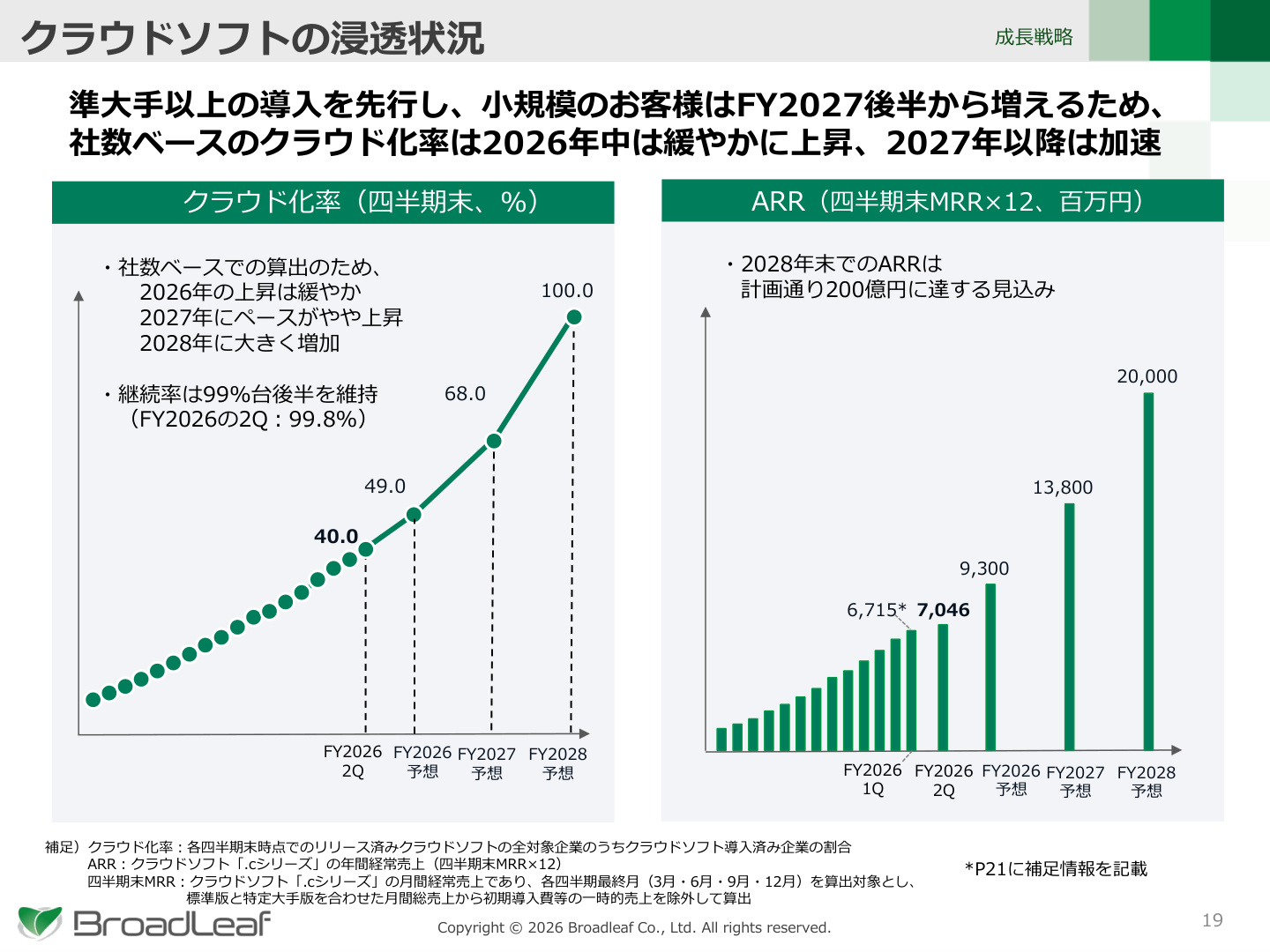
The data in the slide above is the most critical visual information for assessing Broadleaf's future growth potential:
- Cloud Adoption Rate : Reached 40.0% as of 2Q 2026. While the increase in the number of companies is gradual in 2026 due to the prioritization of mid-tier and larger clients, it is expected to accelerate as smaller businesses transition, with a target of 100% by 2028 .
- ARR (Annual Recurring Revenue) : Expanded to 7,046 million yen at the end of 2Q 2026, with a projected growth to 20 billion yen by the end of 2028 .
- Churn Rate : The retention rate remains at an extremely high level of 99.8% (as of 2Q), proving that Broadleaf's products are deeply embedded in the operational infrastructure of its customers.
8. ARPL (Average Revenue Per License) Trends
The number of licenses reached 23,264 as of 2Q 2026, with a linear growth trajectory projected to reach 60,300 by 2028 . Meanwhile, ARPL (monthly revenue per license) stood at 25,240 yen in 2Q 2026. As the proportion of smaller businesses increases, the growth rate of ARPL is expected to moderate (projected at 27,600 yen by 2028). Moving forward, the primary engine for revenue growth will be the "explosive increase in the number of licenses" rather than unit price appreciation.
9. Mid-Term Plan: Roadmap to Over 40% Operating Margin by 2028
The company's mid-to-long-term growth trajectory aims for a transition to exceptionally high profitability.
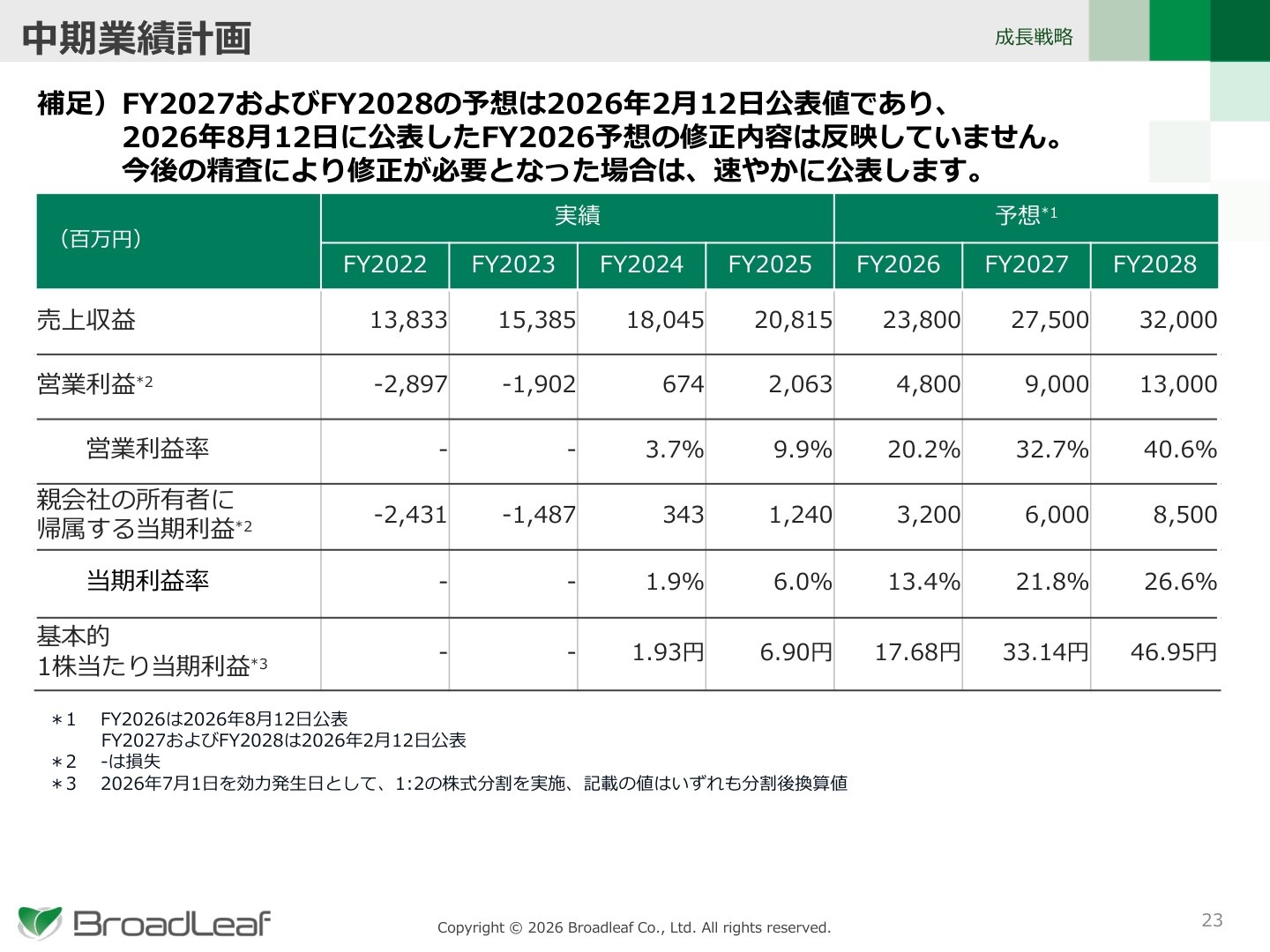
This mid-term plan slide illustrates the financial outcomes of the company's SaaS transformation model:
- FY2026 : Revenue 23,800 million yen, Operating Profit 4,800 million yen (Operating Margin 20.2% )
- FY2027 : Revenue 27,500 million yen, Operating Profit 9,000 million yen (Operating Margin 32.7% )
- FY2028 : Revenue 32,000 million yen, Operating Profit 13,000 million yen (Operating Margin 40.6% )
As the cloud adoption rate approaches 100%, the marginal cost associated with revenue growth will become minimal, enabling the company to achieve a highly profitable structure with an operating margin of 40.6% . Earnings per share (EPS) are also projected to grow rapidly from 6.90 yen in FY2025 to 46.95 yen by FY2028 .
10. AI Utilization, Data Platformization, and Multi-faceted Topics
As the final stage (STEP 3) of its growth strategy, the company is advancing the practical application of 2DX x AI services by leveraging the vast amount of operational and transaction data accumulated on the "Broadleaf Cloud Platform (BCP)." The company is developing new services to solve labor shortages in the automotive aftermarket, including business automation via agentic AI and on-site work support (Physical AI).
To secure its technological edge, the company has acquired 8 patents related to fraud detection in automotive maintenance, ranging from estimate comparisons to work verification. Furthermore, as part of its sustainability efforts, the company is actively engaged in non-financial (ESG) initiatives, such as the "GrowLeaf Project," which involved planting 2,700 trees in Mihara City, Hiroshima Prefecture.
Summary
Broadleaf's FY2026 Q2 earnings demonstrate that the company is successfully shifting from the cloud transition phase to the profit harvest phase . With a clear growth trajectory backed by a high retention rate, steady ARR growth, revenue enhancement through price revisions, and future expansion into AI and data platforms, the company is well-positioned for sustained success.
This content is not intended as investment advice or a recommendation. Any opinions expressed are solely the personal views of each article.