


Renet Japan Group Q3 FY2026 Earnings Deep Dive: Record-Breaking Performance Driven by Special Demand and Business Transformation, and the Future of the 'Environmental-Welfare Synergy' Model

StockClub
Published: Aug 12, 2026, 10:06 AM
Sentiment Analysis
Renet Japan Group, Inc. (Securities Code: 3556) delivered a robust performance for the third quarter of the fiscal year ending September 2026, marking a record-high cumulative Q3 result driven by significant revenue and profit growth in its core 'Reuse & Recycle' segment.
This report provides a comprehensive analysis of the key topics from the latest disclosure, covering current performance highlights, progress across business segments, financial and capital policies, and the company's long-term growth vision.
1. Performance Highlights: Significant Revenue Growth and Dramatic Margin Expansion
For the cumulative third quarter (1Q-3Q) of FY2026, consolidated results were as follows: Net Sales of 10.818 billion JPY (+37.5% YoY) , Operating Profit of 1.014 billion JPY (+380.3% YoY) , Ordinary Profit of 594 million JPY (+112.1% YoY) , and Net Profit Attributable to Owners of the Parent of 472 million JPY (+172.5% YoY) . All profit metrics significantly outperformed the same period last year.
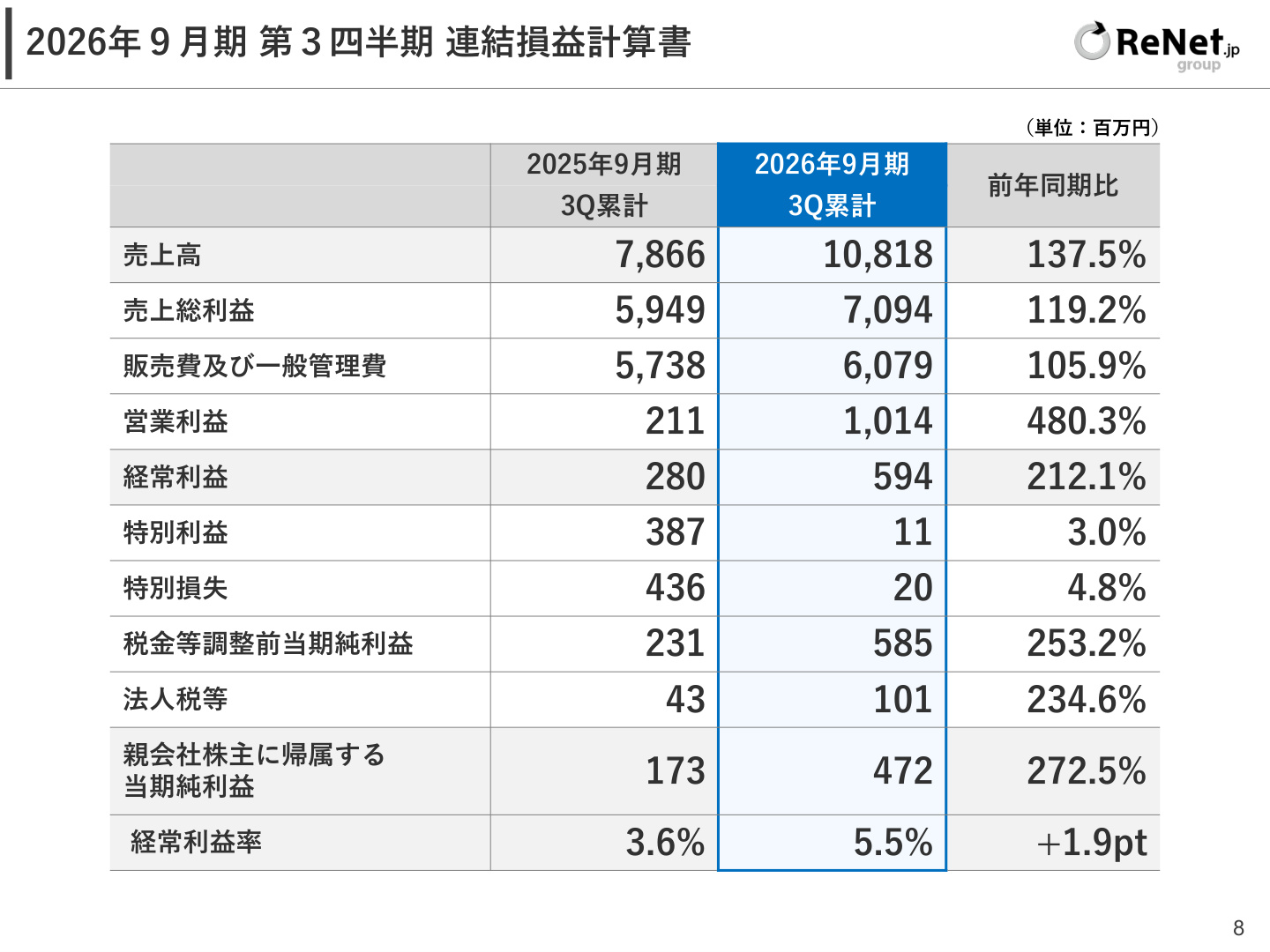
[Slide 7 Analysis: Structural Changes in the P&L Statement]
As shown in the consolidated P&L statement above, operating profit surged approximately 4.8 times (+380.3%) against a 37.5% increase in net sales. This is attributed to an increase in gross profit (+19.2%) combined with a reduction in the fixed-cost ratio and improved operational efficiency, which caused the operating profit margin to improve dramatically from 2.7% in the previous year to 9.4%. The ordinary profit margin also rose from 3.6% to 5.5%, clearly reflecting the strengthening of the company's profit structure.
2. Segment Trends ①: Recycling Business (Full-Scale GIGA School Special Demand)
The primary driver of this performance was the Recycling business. Q3 standalone sales reached a record high of 1.919 billion JPY (+270.0% YoY).
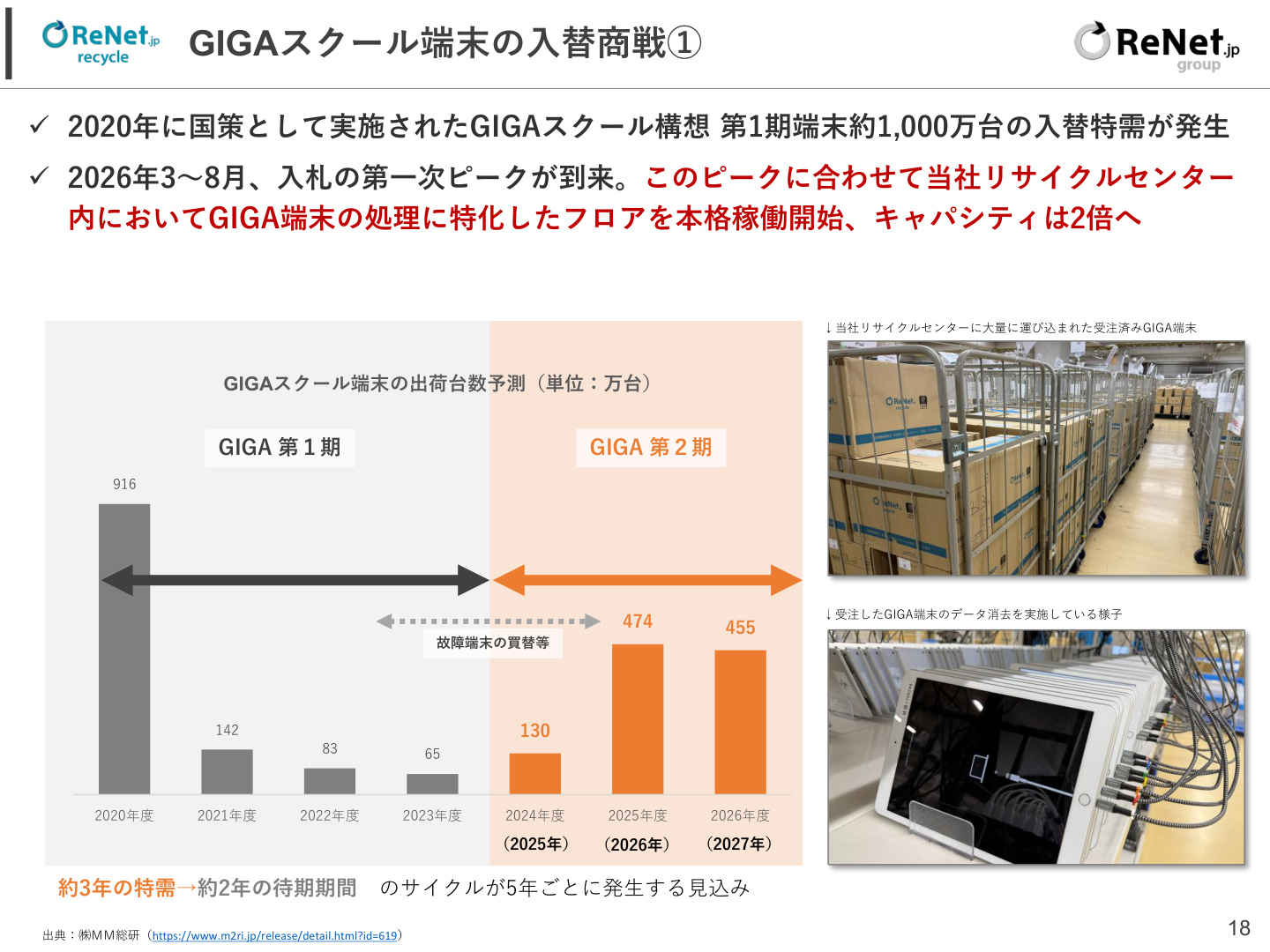
[Slide 17 Analysis: Impact of the National 'GIGA School Concept' Device Replacement]
The slide above illustrates the 'GIGA School device replacement cycle' behind the rapid growth of the Recycling business. The tablets and PCs (approx. 10 million units) introduced as a national policy in 2020 are now entering their second replacement phase, with the first peak of bidding occurring between March and August 2026. To capitalize on this, the company opened a dedicated floor within its recycling center specifically for GIGA device processing, doubling its capacity. This has established a system capable of smoothly handling the collection, data erasure, and recycling of large volumes of devices.
Current Progress and Future Outlook of GIGA Special Demand
Although some revenue recognition has shifted to the next fiscal year due to delays in municipal bidding and actual device collection schedules, the total volume of devices subject to replacement remains unchanged. Compounded by delays in new PC supply due to semiconductor shortages, the GIGA School special demand is expected to persist until early 2028. Consequently, this is not merely a one-time windfall but is expected to contribute as a stable, high-profit source over the long term.
3. Segment Trends ②: Reuse Business (Structural Reform via Shift to Hobbies and Trading Cards)
The Reuse business (NET OFF) also maintained strong momentum, with Q3 standalone sales reaching a record high of 1.83 billion JPY (+22.1% YoY).
To address the gradual decline in the book media market—the company's mainstay since its founding—the company has aggressively pushed a shift toward the hobby sector, centered on trading cards (TCGs). As a result, the following quantitative achievements have been realized:
- Rapid Expansion of TCG Sales : Cumulative Q3 TCG sales surged to approx. 980 million JPY (3.9x YoY).
- Diversification of Business Portfolio : Sales from non-book media now account for 46% of total Reuse business revenue (total hobby sector revenue reached 1.68 billion JPY, +63% YoY).
- Improved Unit Prices and Profitability : The expansion of purchasing and sales of high-unit-price items such as smartphones and TCGs contributed to overall profit growth.
The company plans to further expand its product portfolio through M&A and the growth of peripheral businesses, avoiding over-reliance on specific product categories.
4. Segment Trends ③: Social Care Business & Foreign Human Resources Business
Social Care Business (Disability Welfare)
Cumulative Q3 sales for the Social Care business were 1.19 billion JPY (-22.4% YoY) , with an ordinary loss of 40 million JPY. This decline in revenue and profit is due to business restructuring and organizational reform , including the sale of franchise (FC) operations and the consolidation of unprofitable facilities conducted in the previous fiscal year, as well as upfront investments for new facility openings.
With the restructuring phase largely complete, specific measures for renewed growth are underway:
- Promotion of Roll-up M&A : The company acquired a portion of the shares of Macbee Hill Employment Support Organization , which operates 12 group homes (188 rooms) with daytime service support, primarily in Aichi Prefecture, accelerating its dominant strategy in the Chubu region.
- Successful Launch of In-house Developments : 'Smile Home Nagoya Tokushige' (capacity: 20), opened in June 2026, achieved an 80% occupancy rate within two months. The company plans to develop five new facilities per year.
- Long-term Goal 'Social Care Growth & Roll-up 2030' : The company aims to build a stock-based revenue model targeting 70–90 facilities with daytime service support and 1.4–1.8 billion JPY in operating profit by FY2030, and 200 facilities with 4.5 billion JPY in operating profit by FY2035.
Strong Group Synergy with Foreign Human Resources Business
The Foreign Human Resources business addresses the 'shortage of welfare personnel,' the biggest hurdle to expanding the Social Care business. In addition to Cambodia, the company is strengthening its recruitment pipeline from Indonesia and Vietnam. Currently, 21 foreign workers with 'Specified Skilled Worker' status are active in the company's group homes, with a plan to hire a cumulative total of 300 by FY2030 (3 per facility).
5. Capital Policy and Financial Position: Mitigating Shareholder Dilution and Optimizing Funding
As a significant move in financial and capital policy, the company announced the 'suspension of the exercise of the 25th series of stock acquisition rights.' Considering the current market environment and stock price levels, the company notified the assignee, Cantor Fitzgerald Europe, of the suspension, demonstrating its commitment to preventing unnecessary dilution of shares.
Growth capital required for new group home construction and M&A is being secured smoothly through debt financing from banks. While the equity ratio on the balance sheet is 15.0%, the effective equity ratio, considering capital-subordinated loans, has reached 30.2% , ensuring a structure that allows for continued growth investment while maintaining financial soundness.
6. Future Growth Strategy: Ultra-Long-Term Vision 'Environmental-Welfare Synergy Model'
The concept that represents the company's unique competitive advantage and the maximization of social value is the 'Environmental-Welfare Synergy Model.'
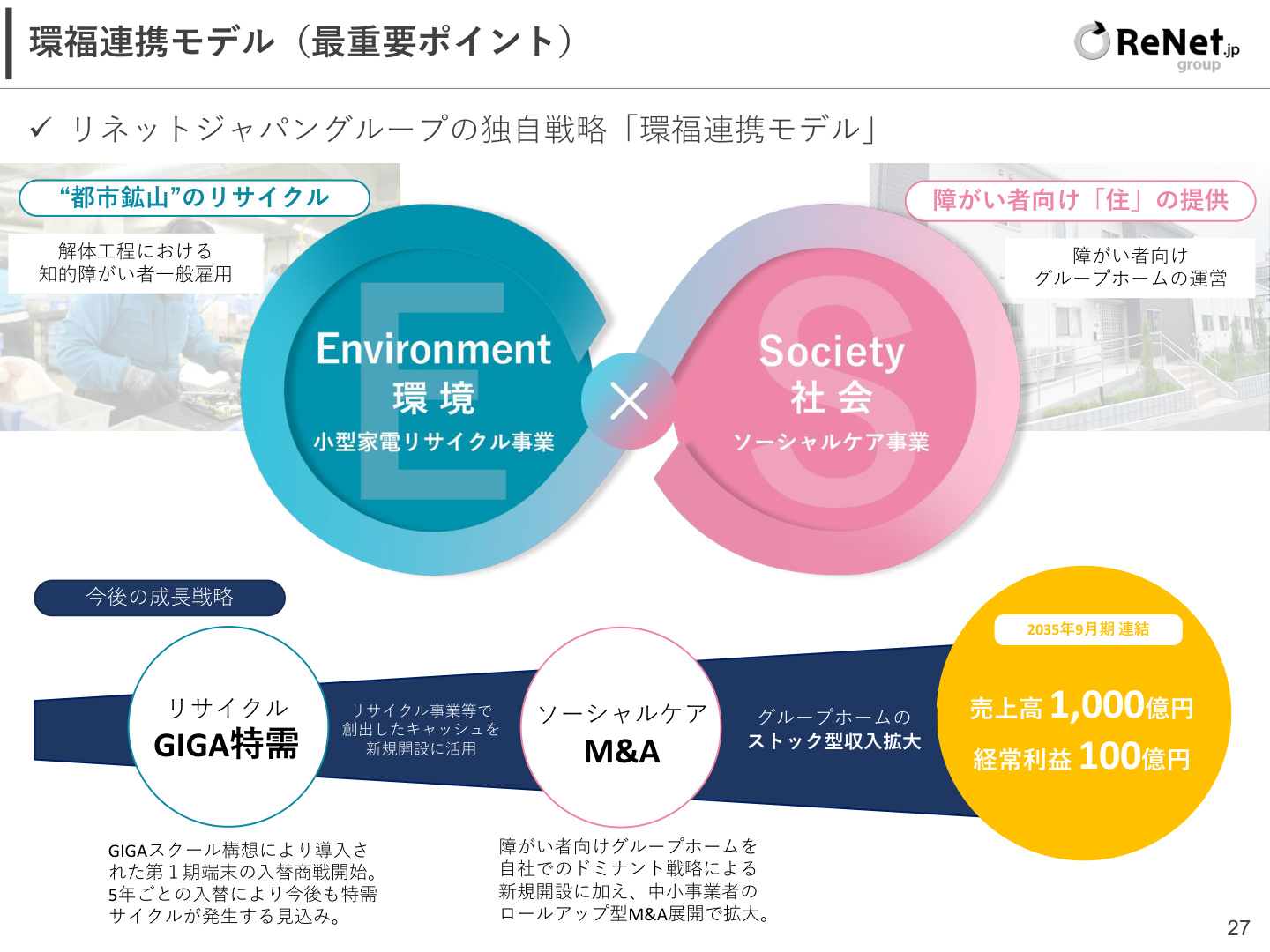
[Slide 26 Analysis: 'Environmental-Welfare Synergy Model' and 2035 Vision]
The slide above is the most important conceptual diagram showing the company's unique strength—where the environmental business (recycling) and social welfare business (social care) circulate and complement each other—along with its ultra-long-term growth goals.
- Environment : Aggressively promote the recycling of small home appliances and PCs (urban mining) to capture special demand and generate overwhelming cash flow.
- Society : Intensely invest the cash generated from recycling into the in-house development and roll-up M&A of social care businesses , such as group homes for people with disabilities.
- Synergy : Create general employment for people with intellectual disabilities in the recycling center's disassembly process, and utilize 'Employment Continuation Support Type B' facilities to refurbish junk items from the reuse business, achieving a high-level balance between 'profitability' and 'social impact.'
By advancing this 'Environmental-Welfare Synergy Model,' the company aims to leap into a mega-company with 100 billion JPY in consolidated sales and 10 billion JPY in ordinary profit by FY2035.
7. Comprehensive Analysis and Summary
The Renet Japan Group, as seen through its Q3 FY2026 earnings, has entered a phase where 'powerful monetization of existing businesses' and 'structural transformation into next-generation stock businesses' are clearly aligned.
- Short-term Growth Drivers : Unprecedented special demand in the recycling business due to the second phase of GIGA School device replacements, and strong performance in the reuse business driven by the rapid growth of the TCG and hobby sectors.
- Mid-to-Long-term Growth Drivers : M&A and in-house development of the social care business using abundant funds from special demand, and the construction of a stock-based revenue foundation integrated with the foreign human resources business.
- Capital Efficiency and Shareholder Consideration : Elimination of dilution concerns through the suspension of stock acquisition rights and the utilization of debt financing.
As the peak of GIGA special demand continues until early 2028, how the generated funds are reinvested into social care group homes (targeting 200 facilities by 2035) and converted into long-term stock revenue will be key. The progress of future M&A and the pace of facility openings will be the critical focus for achieving the company's ultra-long-term goal of '100 billion JPY in sales.'
This content is not intended as investment advice or a recommendation. Any opinions expressed are solely the personal views of each article.