


Medius Holdings: FY2026 Financial Results & New Mid-Term Management Plan Deep Dive Report

StockClub
Published: Aug 12, 2026, 10:03 AM
Sentiment Analysis
This report provides a multi-faceted analysis of the FY2026 consolidated financial results and the newly formulated Mid-Term Management Plan (FY2027–FY2029) for Medius Holdings (Securities Code: 3154), covering key performance highlights, growth strategies, and structural reform initiatives.
1. FY2026 Performance Highlights: Record-High Net Sales
In the fiscal year ended June 2026, consolidated net sales reached ¥302.336 billion (+4.7% YoY), surpassing the ¥300 billion milestone and marking a record high .
Regarding profitability, operating profit was ¥1.78 billion (-5.1% YoY; 101.8% of the target), and ordinary profit was ¥2.306 billion (-4.8% YoY; 100.3% of the target), both landing largely in line with projections. Profit attributable to owners of the parent was ¥944 million (72.6% of the target), falling short of the plan due to extraordinary losses and tax expenses; however, the company’s core earning power remains robust.
2. Drivers of Performance and Stable Customer Segment Structure
The primary driver of sales growth was the recovery and increase in surgical procedures and cases in the cardiovascular and orthopedic fields , which boosted demand for medical consumables. Additionally, new customer acquisitions by relatively new subsidiaries, such as OrthoEdge Japan and Alcent, contributed to the revenue growth.
Profitability was impacted by the reactionary decline following last year’s surge in pre-emptive purchases of large medical equipment and supplies, as well as pre-emptive buying ahead of price revisions due to Middle Eastern geopolitical tensions. Furthermore, upfront investments in logistics and digital transformation (DX) for future growth also affected the bottom line.
By customer segment, public medical institutions account for 48.1% and university hospitals (national and private) account for 19.4% , meaning approximately 70% of the total consists of large-scale medical institutions with highly stable management foundations. This customer portfolio underpins the company’s stable revenue base and strong creditworthiness.
3. New Mid-Term Management Plan (FY2027–FY2029): Targeting 10% Annual Growth in Ordinary Profit
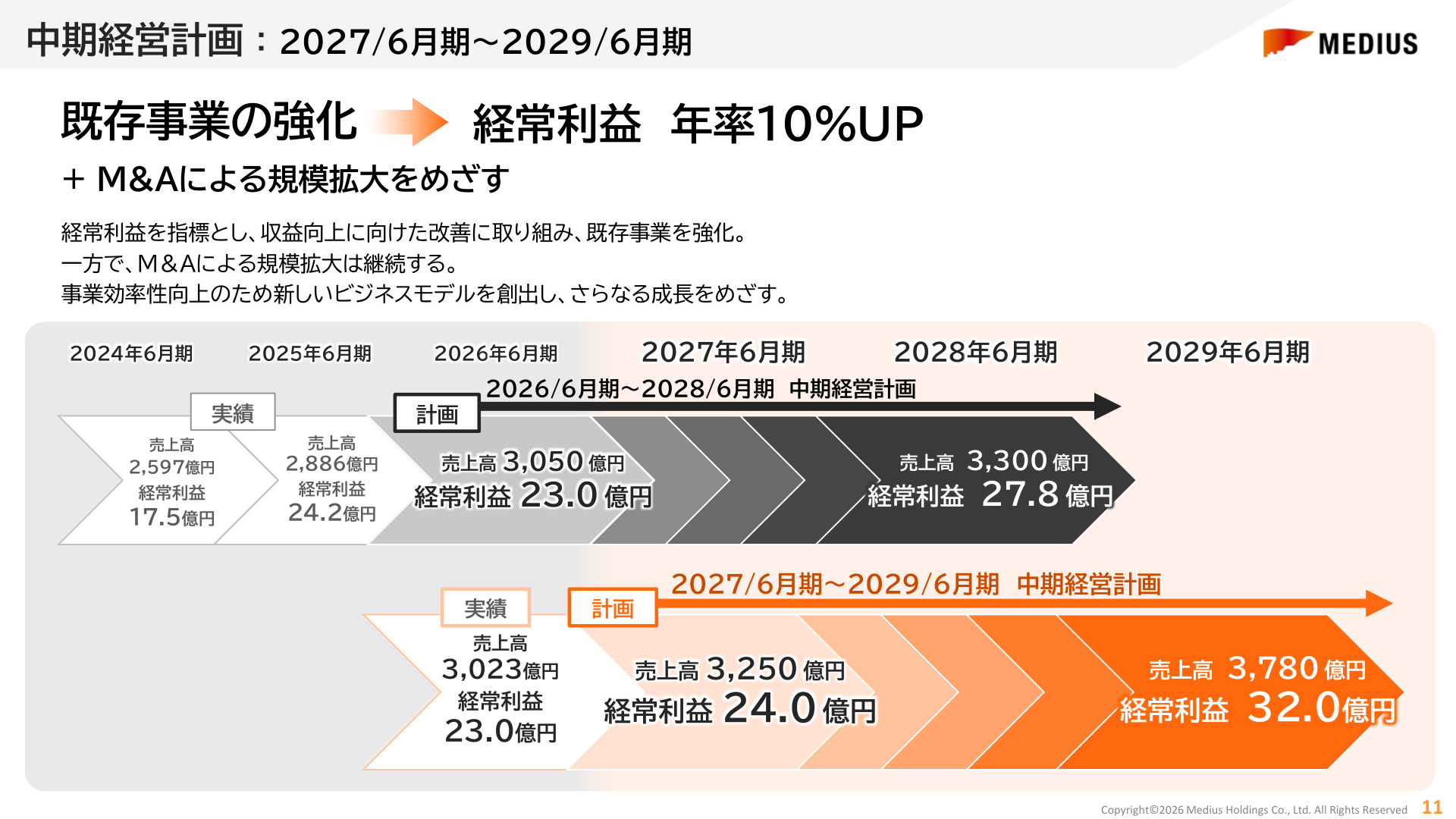
The Medius Group has announced a new three-year Mid-Term Management Plan starting in the fiscal year ending June 2027.
Significance and Background of the Slide
The slide above serves as the most critical roadmap, clearly outlining the company’s future growth trajectory and numerical targets. Building on the achievements of the previous plan (FY2026–FY2028), the new three-year plan sets a 10% annual growth rate in ordinary profit as the most important KPI. By the final year, FY2029, the company aims for net sales of ¥378 billion and an ordinary profit of ¥3.2 billion . The plan demonstrates a clear commitment to fundamentally strengthening the profit structure by combining improvements in gross margins and operational efficiency with economies of scale through M&A, rather than focusing solely on top-line expansion.
4. M&A and Alliance Strategy: Leading Regional Expansion and Industry Consolidation
While demand in the Japanese medical device market is trending upward due to an aging population, reimbursement price (drug and material price) cuts driven by healthcare cost-containment policies continue. This has made it difficult for overseas manufacturers to secure profitability in Japan, leading to the consolidation and selection of distributors.
In response to these market changes, the company is actively pursuing at least one M&A or business succession deal per year . Most recently, in October 2025, it signed a basic agreement for a business integration with Kyoei Ika Kikai Co., Ltd. , which holds a high market share in the Nagano region. Leveraging a network spanning 87 locations across 25 prefectures, the company has established a solid position as the "most trusted and preferred distribution partner" for manufacturers.
5. Cross-Industry Data Infrastructure: Standardization of Master Data via MJC
A notable new development is the establishment of MJC Co., Ltd. (commenced operations in July 2026, 66.7% owned by Medius), a joint venture with Orba Healthcare Holdings. Previously, product master data notations and classifications varied by medical institution and wholesaler, creating a significant burden due to manual entry and duplicate registrations. MJC provides a standardized medical material master data platform that can be used across the industry, serving as common infrastructure to support supply chain efficiency and future medical DX.
6. High-Value-Added Solution Strategy: Moving Beyond "Wholesaling"
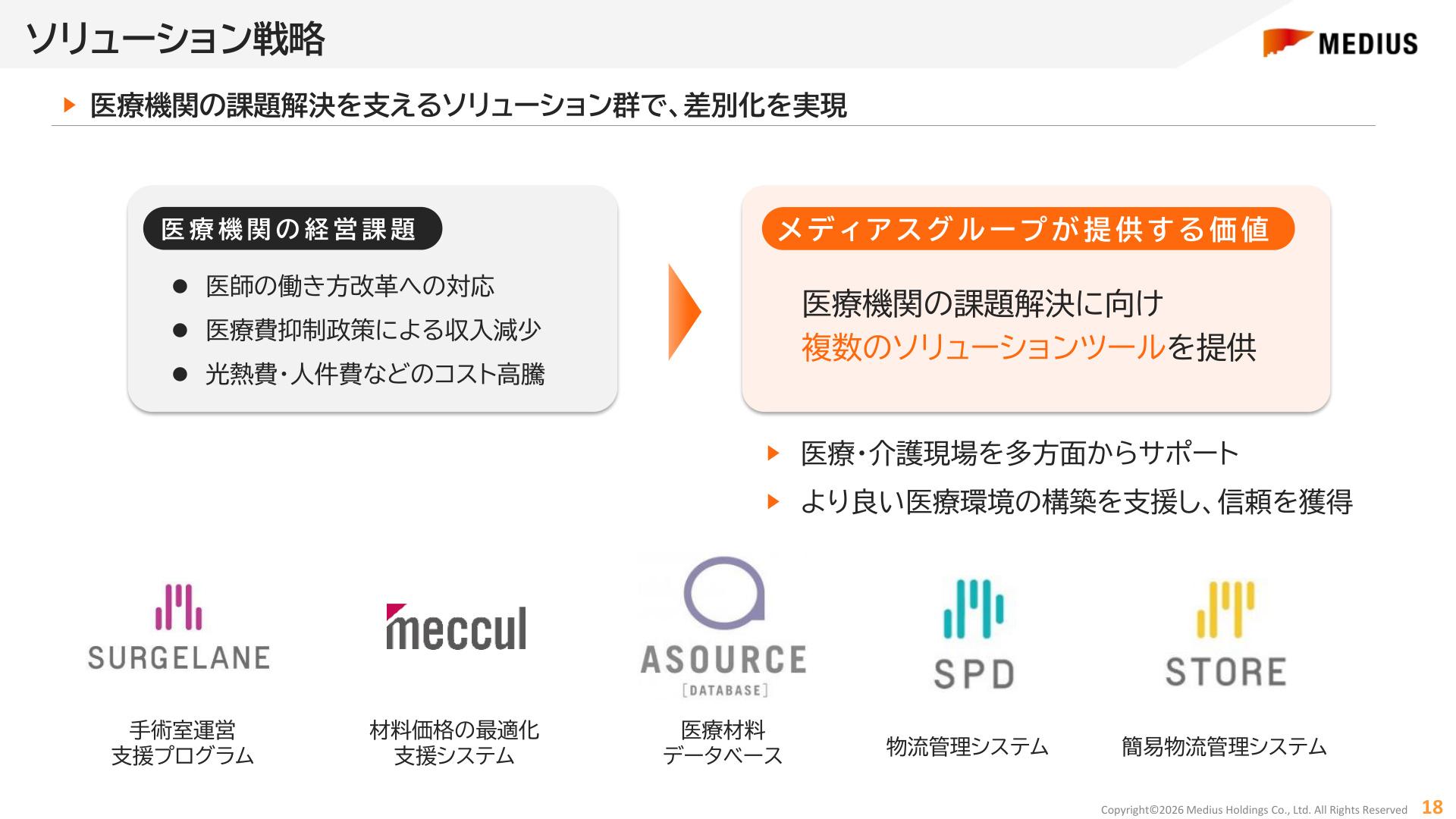
To address management challenges faced by medical institutions—such as "physician work-style reform," "declining income due to healthcare cost containment," and "soaring utility and labor costs"—the company provides a suite of intuitive problem-solving tools.
Significance and Background of the Slide
This slide symbolizes the company’s transformation from a mere product seller (wholesaler) into a high-value-added solution provider . The solution lineup features the following:
- ASOURCE DATABASE : One of Japan’s largest medical material databases, boasting high industry credibility.
- Meccul : Supports purchasing price optimization by comparing data with purchase records from approximately 2,000 hospitals nationwide.
- SURGELANE : Visualizes the profit and loss of "operating rooms"—the core of hospital management—and improves the efficiency of indirect operations.
- SPD / ASOURCE STORE : Optimizes in-hospital logistics and provides simplified SPD for small-to-medium-sized hospitals. These management support tools have helped establish strong partnerships with medical institutions, serving as a major differentiator from competitors.
7. Logistics Structural Reform: Building a Sustainable Medical Logistics Network
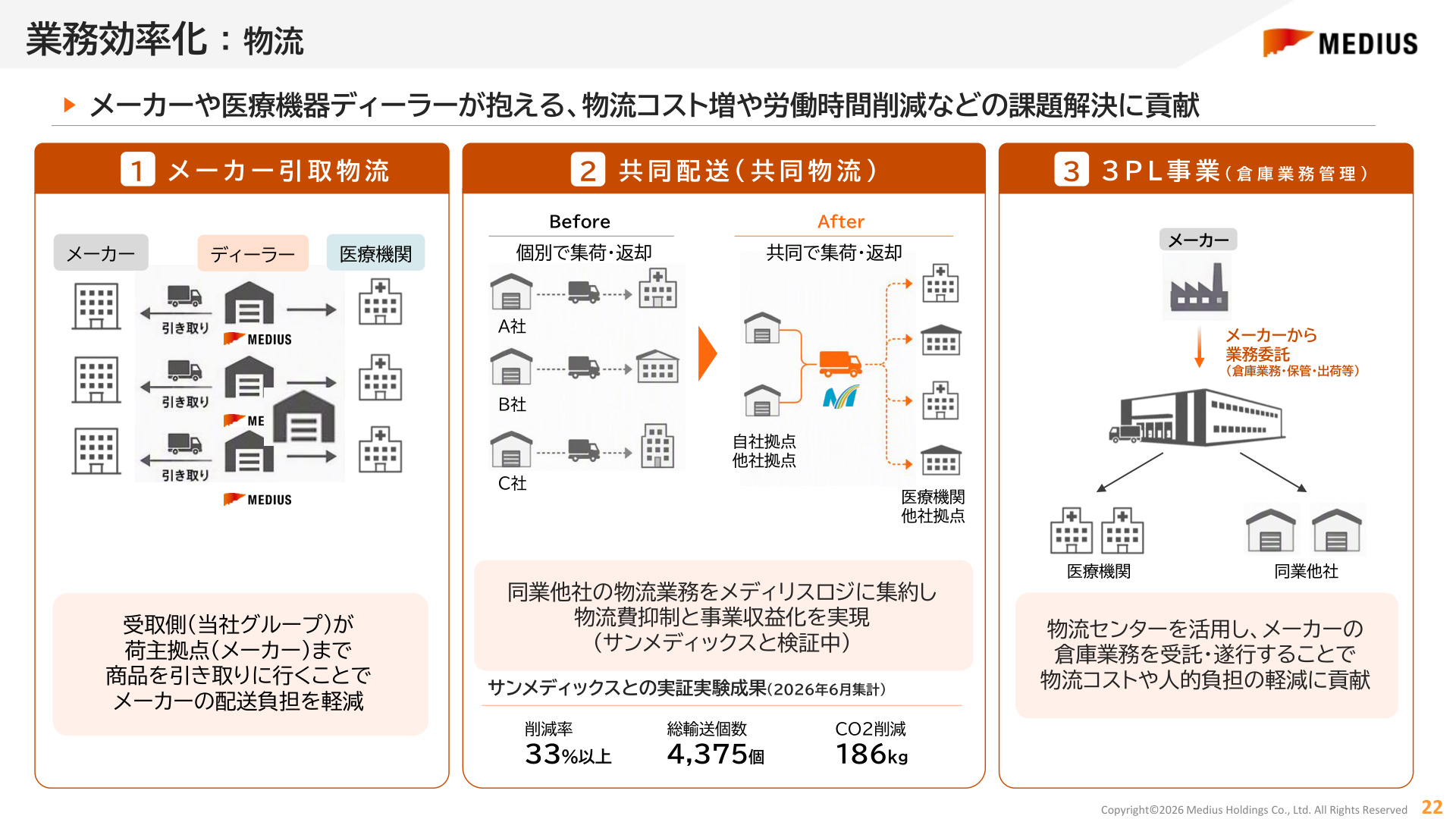
To address industry-wide challenges such as "rising logistics costs" and "driver shortages (the 2024 problem)," the company is promoting advanced logistics reforms centered on its logistics subsidiary, Mediris Logi.
Significance and Background of the Slide
This slide illustrates the company’s logistics scheme, which transcends the traditional role of a medical device distributor. Specifically, it implements three initiatives:
- Manufacturer Pickup Logistics : The receiving party (Medius) picks up products at the manufacturer’s shipping base, reducing the manufacturer’s delivery burden.
- Joint Delivery (Joint Logistics) : Conducted a pilot project with Sun Medics Co., Ltd. By consolidating shipments from industry peers, the company achieved concrete results, including a reduction in freight costs of over 33% and a reduction in CO2 emissions of 186kg (as of June 2026).
- 3PL Business (Warehouse Management) : Undertakes warehouse operations for manufacturers, reducing logistics costs and human resource burdens for both parties. Building a sustainable logistics model that balances environmental impact reduction with cost savings is a major competitive advantage.
8. Group-Wide Operational Efficiency and Sustainability Promotion
Internal group reforms are also underway to strengthen profitability:
- Shared Services for Corporate Functions : Integration of indirect departments to improve operational accuracy and reduce costs.
- Consolidation of Specialized Fields : Reorganizing and centralizing specialized areas like cardiovascular and orthopedics within the group to enhance sales expertise.
- Sustainability and Health Management : Formulated the " Medius Health Action 6 " guidelines to promote employee health and mental health measures, strengthening the foundation for sustainable human capital management.
9. Summary of Financial Results and Future Outlook
Medius Holdings’ FY2026 results marked a significant milestone by surpassing ¥300 billion in net sales, demonstrating a stable growth foundation. The future growth story is clearly aligned across three axes: "Scale expansion through M&A" × "Customer retention through high-value-added solutions" × "Structural cost reduction through joint logistics and master data standardization." As a leading company driving the efficiency and sustainability of medical distribution, its future progress warrants close attention.
This content is not intended as investment advice or a recommendation. Any opinions expressed are solely the personal views of each article.