


Columbia Works (146A) FY2026 Q2 Earnings Deep Dive: Operating Profit Reaches 161% of Plan! Sustainable Growth Driven by Expanding Recurring Revenue and Group Synergies

StockClub
Published: Aug 12, 2026, 09:53 AM
Sentiment Analysis

1. FY2026 Q2 Earnings Summary: Significant Revenue and Profit Growth with Accelerated Progress
Columbia Works (TSE Standard: 146A) reported strong growth for the first half of the fiscal year ending December 2026, with net sales of 19,946 million yen (+105.3% YoY) , operating profit of 3,276 million yen (+156.9% YoY) , ordinary profit of 3,016 million yen (+247.2% YoY) , and net profit attributable to owners of the parent of 1,966 million yen (+183.8% YoY) , achieving exceptionally high growth rates compared to the same period last year.
In addition to the steady sale of high-unit-price properties in the core real estate development business, the rapid expansion of recurring revenue from real estate operations, such as asset management (AM) and property management, contributed significantly to the substantial profit increase.
2. Analysis of Performance Progress and Plan Variance: Why Did H1 Profits Significantly Exceed Expectations?
First-half results not only showed high growth year-on-year but also significantly outperformed the company's initial internal forecasts.
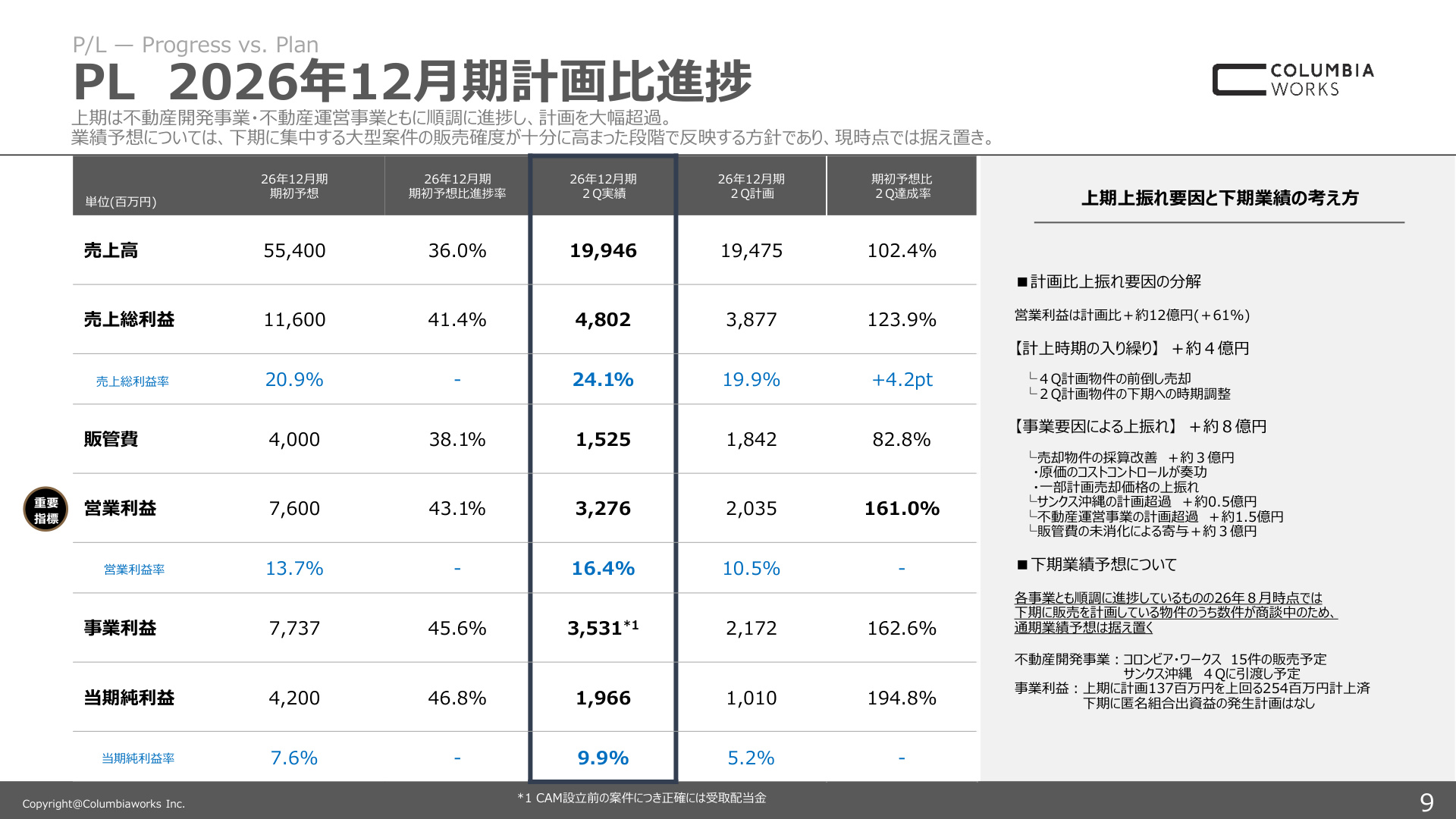
As shown in the slide above (Progress against FY2026 Plan), net sales reached 102.4% of the initial plan , operating profit reached 161.0% of the plan (+1,240 million yen surplus) , and net profit reached 194.8% of the plan for the first half of the fiscal year ending December 2026.
The primary factors behind the operating profit surplus (+1,240 million yen) can be summarized in the following three points:
- Strategic Control of Sale Timing (approx. +400 million yen) : The company successfully optimized sales timing to maximize profitability, including the early sale of properties originally planned for Q4, while adjusting some Q2 plans to the second half.
- Improved Profitability and Cost Management in Development (approx. +300 million yen) : Despite the ongoing market environment of rising construction material costs, the company achieved higher-than-expected yields and gross margins through meticulous cost control and enhanced planning capabilities.
- Strong Performance in Real Estate Operations and Unspent SG&A (approx. +450 million yen) : In addition to the subsidiary's performance exceeding plans due to the expansion of AM fees and property management, the company successfully kept increases in personnel expenses and taxes associated with business scaling within the scope of revenue growth.
Note that the full-year earnings forecast (net sales of 55,400 million yen, operating profit of 7,600 million yen) remains unchanged at this time. This reflects a cautious operational policy, as negotiations for large-scale projects scheduled for delivery in the second half are ongoing, and the company intends to reflect these in the forecast once contract and sales certainty is sufficiently high.
3. Trends in Key Performance Indicators (KPIs) and Business Model Evolution
Trends in various KPIs are crucial for measuring the achievement of the company's growth strategy.
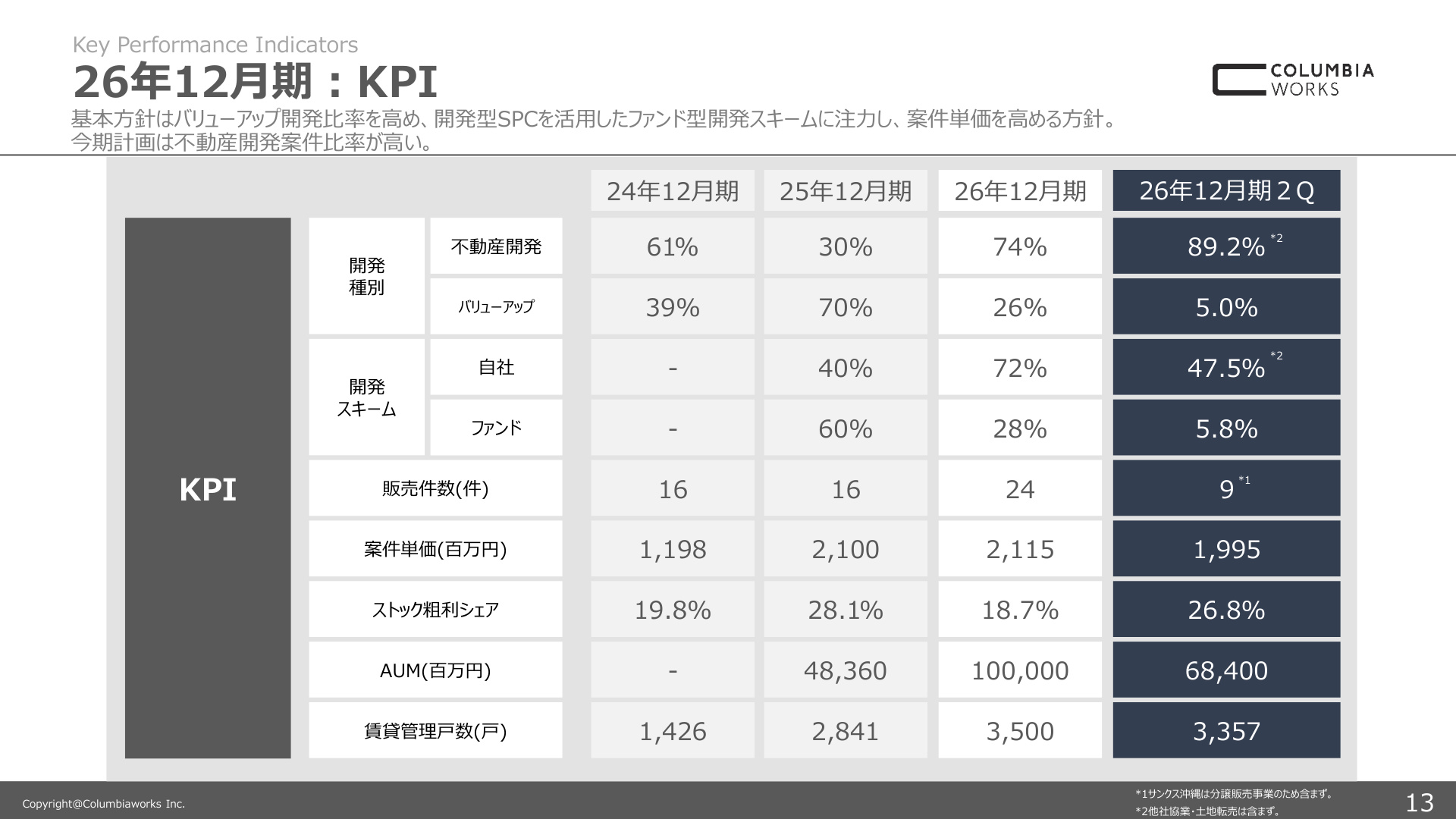
The slide above (FY2026: KPIs) clearly demonstrates through figures how the company's business model is evolving from a flow-dependent model to a "flow + stock hybrid" model.
- Diversification of Development Types and Schemes : In Q2 results, real estate development accounted for 89.2% and value-add projects for 5.0% . Regarding development schemes, in-house development accounted for 47.5% and fund-type development for 5.8% .
- Maintaining High Unit Prices : The average project unit price in Q2 was 1,995 million yen , maintaining the high unit price range of approximately 2 billion yen following the previous period (2,100 million yen), confirming that development leveraging economies of scale has taken root.
- Increase in Stock Gross Profit Share : The stock gross profit share, which indicates the ratio of recurring income to gross profit, reached 26.8% , a steady increase from the same period last year (19.8%).
- Rapid Expansion of Assets Under Management (AUM) and Managed Units : AUM reached 68,400 million yen (compared to 48,360 million yen at the end of the same period last year), and managed rental units reached 3,357 (compared to 2,841 units), progressing steadily toward the full-year targets (AUM of 100 billion yen, 3,500 managed units).
4. Detailed Trends by Segment and Group Companies
(1) Real Estate Development Business: Selective Acquisition of Prime Urban Locations
During Q2, the company completed the sale of properties including Kanda Nishiki-cho (office) in Chiyoda-ku, Tokyo, Senju Nakai-cho (residence) in Adachi-ku, Fuyuki (residence) in Koto-ku, and Tsurumaki (residence) in Setagaya-ku. Regarding acquisitions, the company completed 13 contracts, focusing on prime urban areas such as Shoto in Shibuya-ku , Hiramachi in Meguro-ku , Honjo in Sumida-ku , and Higashi in Shibuya-ku , building a robust pipeline for the next fiscal year and beyond.
(2) Asset Management Business (Columbia Asset Management)
The asset management (AM) business, a major pillar of recurring revenue, is one of the primary growth drivers for this fiscal year.
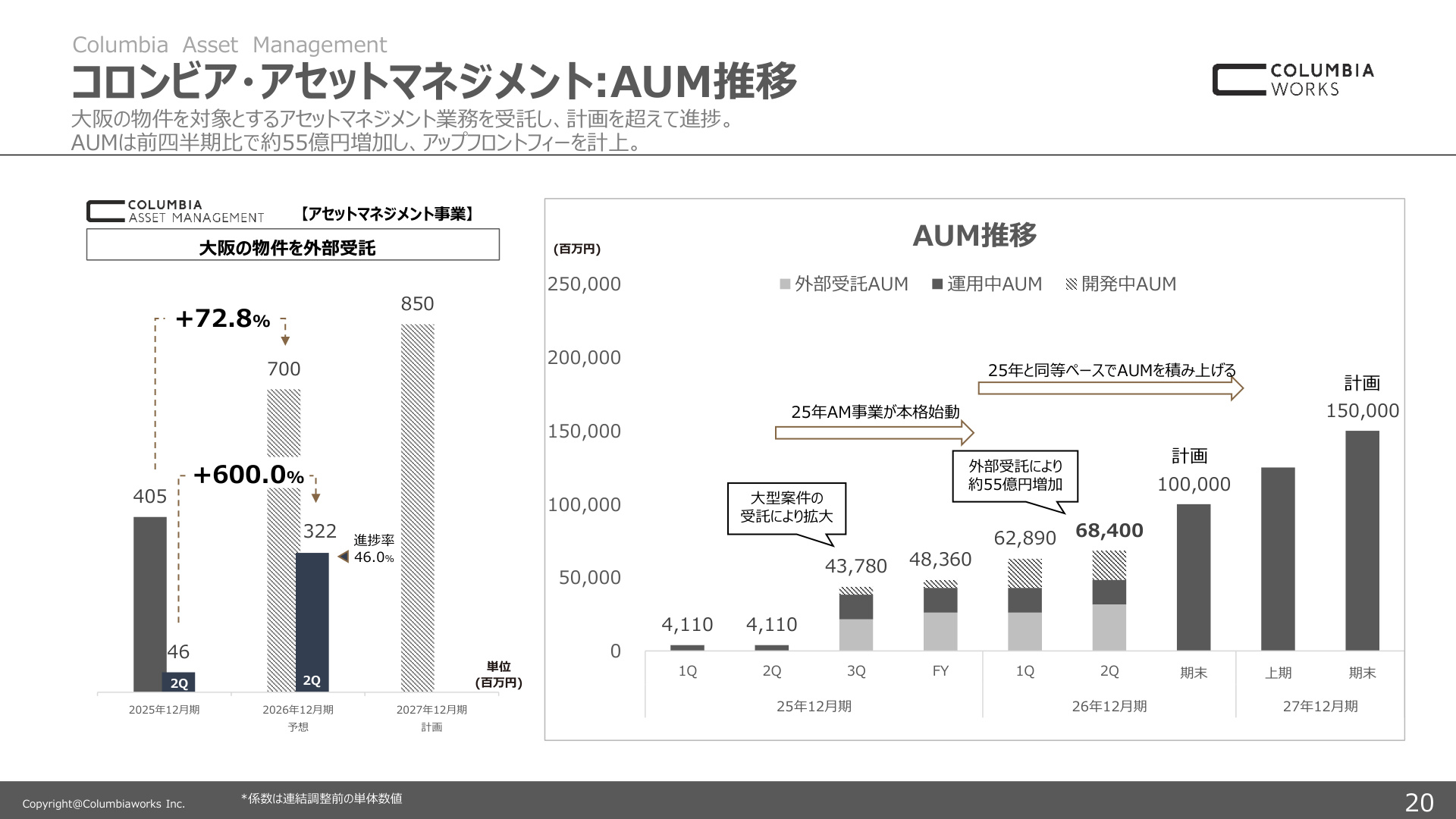
As shown in the slide above (Columbia Asset Management: AUM Trends), AUM increased by approximately 5.5 billion yen from the previous quarter to reach 68,400 million yen . This is driven by the conversion of in-house developed properties into funds (formation of development-type SPCs) and the steady expansion of large-scale asset mandates from external owners.
As a result, AM fee revenue recorded a significant increase of +600.0% YoY to 304 million yen . The company has established a structure where continuous AM fees earned during the operation period increase alongside upfront fees obtained at the time of fund formation, contributing to improved revenue stability.
(3) Property Management Business (Columbia Community) and Promotion of In-house Operations
Managed rental units expanded rapidly to 3,357 (+69.5% YoY) . This was driven not only by management mandates for developed properties but also by the acquisition of large-scale external mandates. Furthermore, the company obtained a construction business license and began internalizing restoration and repair work. By establishing a system to directly capture construction demand generated by the expansion of managed units (i.e., increased owner touchpoints), the company aims to achieve 5 billion yen in property management and construction-related revenue within 10 years .
(4) Steady PMI of Subsidiary Thanks Okinawa
Thanks Okinawa, which covers the Okinawa area, performed well with standalone net sales up 78.3% YoY (538 million yen) . Leveraging population growth and tourism demand, the company is developing new concept residences for wealthy individuals, utilizing Columbia Works' planning, development, and capital capabilities.
(5) Hotel Operation Business (Columbia Hotels & Resorts)
The company is rebranding its existing hotel portfolio and has launched a new brand, "NOCTIS." The first location, "NOCTIS Akihabara-Suehirocho," is scheduled to open after November 2026, and the impact of opening expenses has already been incorporated into the initial plan.
5. Stance on Macro-Environmental Changes (Interest Rates and Material Costs)
The company operates with conservative and effective assumptions regarding monetary policy trends and rising construction costs.
- Preparation for Interest Rate Hike Risks : A total of two policy interest rate hikes (totaling approximately +0.5%) during the fiscal year ending December 2026 have already been incorporated into the initial plan. The NOI improvement effect from rent increases in urban areas is absorbing the increase in interest costs, and the purchasing appetite of institutional investors remains intact.
- Countermeasures Against Rising Construction Costs : The company views rising construction material costs as a structural issue and continues to perform strict cost estimation. By focusing on value-add projects with shorter construction periods and improving turnover rates, the company minimizes market risk.
6. Financial Soundness, Shareholder Returns, and Future Outlook
- Balance Sheet Status : Against total assets of 80,308 million yen, net assets are 18,678 million yen. The equity ratio is 23.3% , maintaining a sound level within the target range (20%–30%). Inventories, including real estate for sale (46,336 million yen), reached 59,228 million yen, ensuring a sufficient source of future revenue.
- Shareholder Return Policy : Based on a return policy linked to profit growth (targeting a dividend payout ratio of 15%–20%), the forecast dividend per share for the fiscal year ending December 2026 is 94.0 yen (forecast dividend payout ratio of 17.3%) .
- Efforts Toward Transition to the Prime Market : While recognizing challenges such as improving the market capitalization of tradable shares, the company is proceeding with preparations for promotion to the Prime Market . It aims to enhance corporate value over the medium to long term by strengthening its governance and IR systems.
This content is not intended as investment advice or a recommendation. Any opinions expressed are solely the personal views of each article.