


toridori (9337) Q2 FY2026 Earnings Analysis: Robust Expansion of Core Platforms and the Full Scope of Strategic Investments for Future Growth

StockClub
Published: Aug 11, 2026, 10:02 AM
Sentiment Analysis

This report provides a comprehensive analysis of the Q2 FY2026 financial results for toridori inc. (Tokyo Stock Exchange Growth Market: 9337), covering key performance highlights, strategic initiatives, and trends in growth KPIs.
In this quarter, the company’s core influencer marketing platform, " toridori marketing ," drove double-digit year-on-year growth in gross profit . Meanwhile, operating profit saw a year-on-year decline due to proactive upfront investments in the next-generation product " Vooster " and the company's private brand (PB) business. This report delves into the performance metrics, factor analysis, KPI trends in growth areas, and governance enhancement measures.
1. Q2 FY2026 Earnings Highlights and Overview
The key consolidated financial figures for Q2 FY2026 are as follows:
- Net Sales : 1,509 million JPY (+2.9% YoY)
- Gross Profit : 1,410 million JPY (+10.7% YoY)
- Operating Profit : 180 million JPY (-23.6% YoY)
- Ordinary Profit : 167 million JPY (-26.6% YoY)
- Net Income Attributable to Owners of Parent : 24 million JPY (-86.3% YoY)
At the core of the performance, the Product segment remained highly robust, allowing the company to maintain stable growth in gross profit at 1,410 million JPY (+10.7% YoY) , which serves as the primary source of the company's earning power.
Conversely, operating profit stood at 180 million JPY , falling below the previous year's level. This is not due to deteriorating performance, but rather a deliberate decision to increase upfront investments in advertising, development, and sales expenses for growth areas (such as "Vooster" and private brands) to solidify the future revenue base.
The significant decline in net income attributable to owners of parent ( 24 million JPY, -86.3% ) is attributed to clear internal factors:
- The relatively heavier tax burden on the group due to losses recorded by the consolidated subsidiary Vooster, which is currently in an investment phase.
- A temporary increase in net income attributable to non-controlling interests following a change in transaction terms with the agency management subsidiary, toridori IS.
Regarding toridori IS, the company decided to and has since executed its full acquisition in July 2026 . Moving forward, this is expected to curb profit leakage and improve net income levels.
2. Gross Profit Trends and Growth Structure by Segment
To accurately understand toridori's revenue structure, it is essential to examine the trends across two business segments: "Product" and "Marketing Partner."
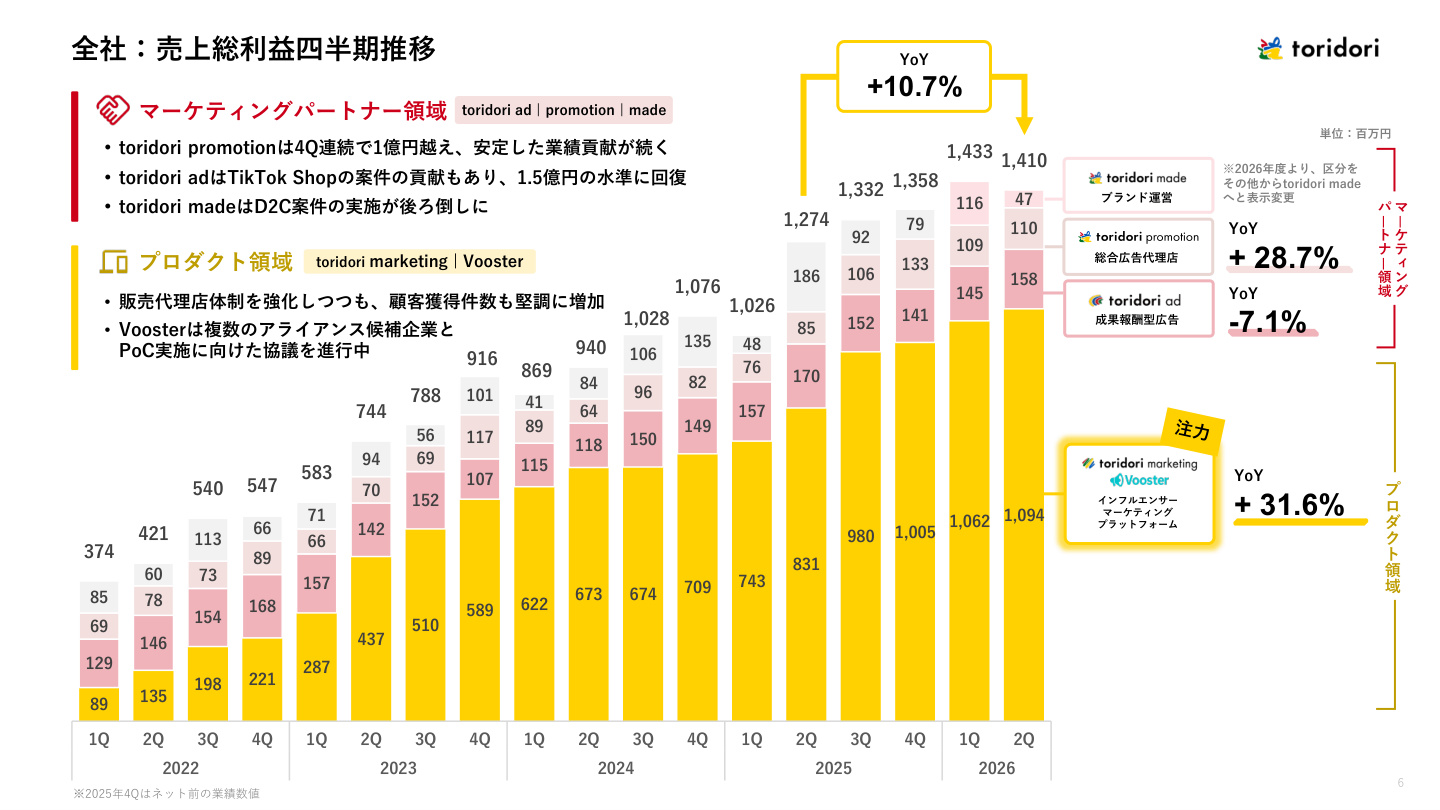
Slide Commentary: The Importance of Quarterly Gross Profit Trends
The slide above visually illustrates the breakdown of the company's gross profit growth. Of particular note is the overwhelming growth speed of the Product segment (toridori marketing / Vooster) , shown in yellow bars. In Q2 2026, the gross profit of the Product segment reached 1,094 million JPY , a remarkable +31.6% increase YoY . With this segment accounting for nearly 80% of total gross profit, it is clear that the company is shifting into a definitive " high-growth platform company ."
Meanwhile, the breakdown of the Marketing Partner segment (shown in pink and purple) is as follows:
- toridori ad (Performance-based advertising) : 158 million JPY (-7.1% YoY) *Showing a recovery trend toward the 150 million JPY level, supported by TikTok Shop projects.
- toridori promotion (General advertising agency) : 110 million JPY (+28.7% YoY) *Achieved over 100 million JPY for four consecutive quarters, contributing stably.
- toridori made (Brand management/D2C) : 47 million JPY *Impacted by the timing of certain D2C projects being pushed back.
In this way, a structure has been established where the ad and promotion segments provide a stable foundation, while the proprietary platform (Product segment) strongly drives the company's overall growth.
3. Analysis of Two Key Growth KPIs in the Product Segment
The performance of "toridori marketing," the core of toridori's growth, is summarized by two KPIs: " Number of Customers " and " Quarterly Gross Profit per Customer (ARPU) ."
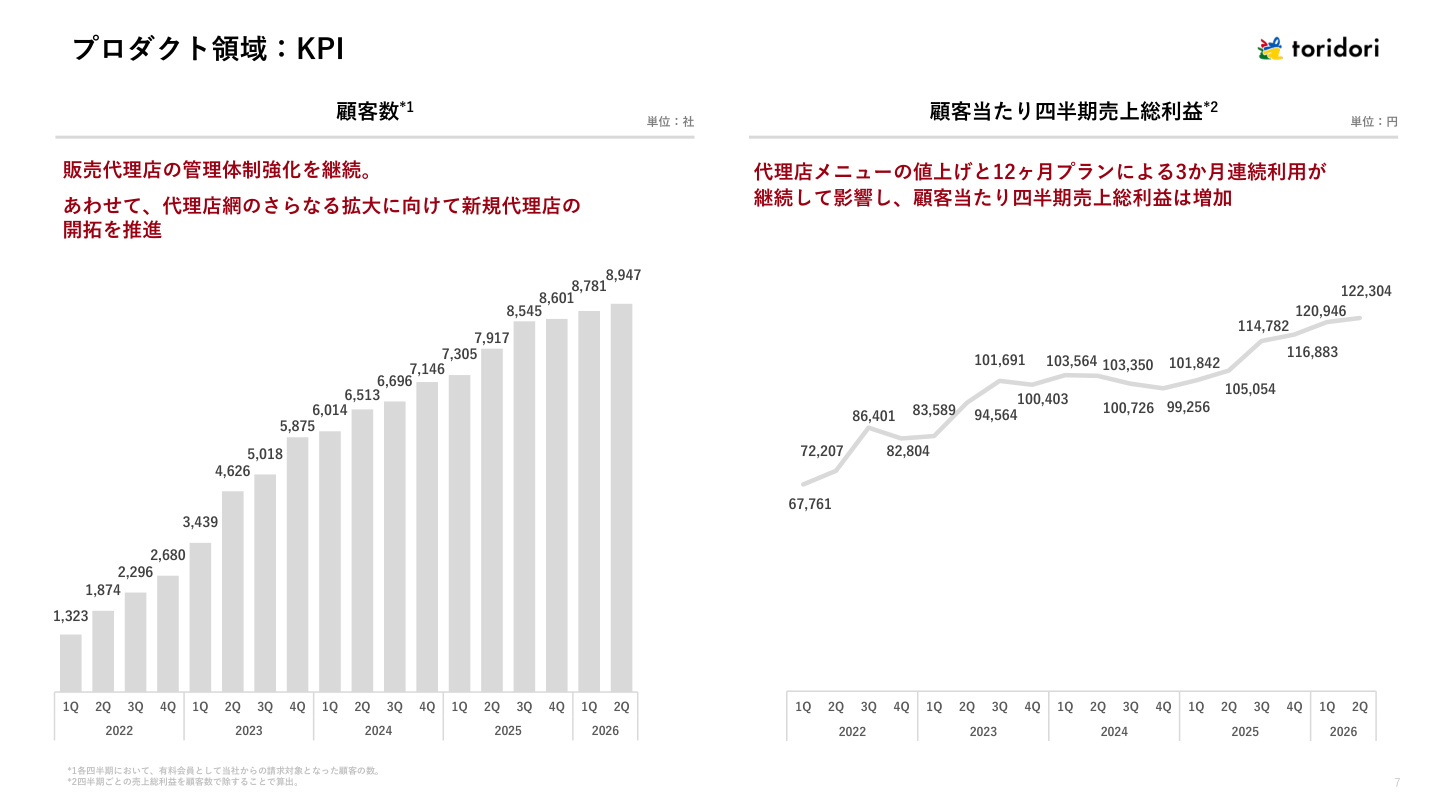
Slide Commentary: The Strength of the Business Model as Shown by Customer Count and Unit Price Trends
The slide above presents two critical data points proving the robustness of the company's business foundation.
-
Steady Expansion of Customer Count (Left Chart)
- As of Q2 2026, the number of customers has expanded to 8,947 .
- As a result of promoting the acquisition of new agencies while strengthening the management system for existing sales networks, the number of users—primarily SMBs and sole proprietors—continues to trend upward.
-
Increase in Quarterly Gross Profit per Customer (Right Chart)
- Quarterly Gross Profit per Customer (ARPU) reached 122,304 JPY , marking a record high.
- Price revisions for agency menus and the successful penetration of the " 12-month plan (e.g., 3 consecutive months of use) " that encourages long-term usage have bolstered the increase in customer unit price.
By realizing the " multiplication " of customer growth and unit price increases, the earning power of the Product segment is structurally and continuously improving.
4. Cost Structure and Investment Strategy: Allocation for Future Growth
Looking at the quarterly SG&A expense trends (see P8), SG&A expenses in Q2 2026 were 1,229 million JPY , an increase from the same period last year (1,038 million JPY).
The main characteristics of the expense breakdown are as follows:
- Advertising and Sales Promotion Expenses : 634 million JPY (Increased from 618 million JPY in the previous quarter and 423 million JPY in the same period last year)
- Personnel and Outsourcing Expenses : 310 million JPY
- Other Expenses : 285 million JPY (Slight decrease from the previous quarter due to the delay in D2C projects in toridori made)
The primary driver of increased expenses is strategic advertising investment in the new product " Vooster " and the private brand " yoin ." The company is not merely chasing short-term profit recovery but is executing disciplined investments to secure future growth drivers. Moving forward, the company plans to optimize the scale of investment sequentially while strictly verifying the Return on Investment (ROI).
5. Group Governance and Profitability Enhancement: Full Acquisition of toridori IS
A major strategic and organizational topic this period is the full acquisition of the agency management subsidiary, toridori IS (resolved on July 27, 2026).
Purpose and Quantitative/Qualitative Benefits of Full Acquisition
- Prevention of Profit Leakage : By incorporating 100% of the profits previously attributable to non-controlling interests into the group, this will have the effect of boosting net income attributable to owners of parent from Q3 onwards.
- Unification of Group Management Structure : Centralizing the management of agency networks and compliance to establish a unified management system for long-term customer base expansion.
- Standardization of Sales Foundation : Sharing the sales know-how held by IS as a group-wide asset to standardize sales training and agency management.
- Synergy Creation and LTV Improvement : Eliminating constraints on ROI by unifying the capital structure, enabling agile promotion of upselling, cross-selling, and the expansion of new product sales.
6. Progress of New Businesses and Growth Drivers
① Use Cases and Roadmap for the New Product "Vooster"
"Vooster" is a product that provides end-to-end support from awareness acquisition to result generation, which the traditional "toridori marketing" could not fully address.
- Expansion of Use Cases : The company is steadily accumulating cases that strengthen purchasing funnels, such as local governments implementing hometown tax programs (inquiries from 6 municipalities), high-unit-price projects (large-scale PR such as popular restaurant collaborations), and TikTok Shop integration .
- Promotion of Alliances : PoC (Proof of Concept) discussions are underway with over 10 candidate companies , including genre-specific e-commerce malls, food manufacturers, and leisure/accommodation booking sites.
- Issue Identification and Future Outlook : Identification of challenges such as development/operations, profitability of customer acquisition channels, and strengthening of specialized sales organizations has been completed. The company is sequentially executing improvement measures, aiming for gradual contribution to earnings starting from the 2027 fiscal year .
② Strong Launch of Private Brand "yoin"
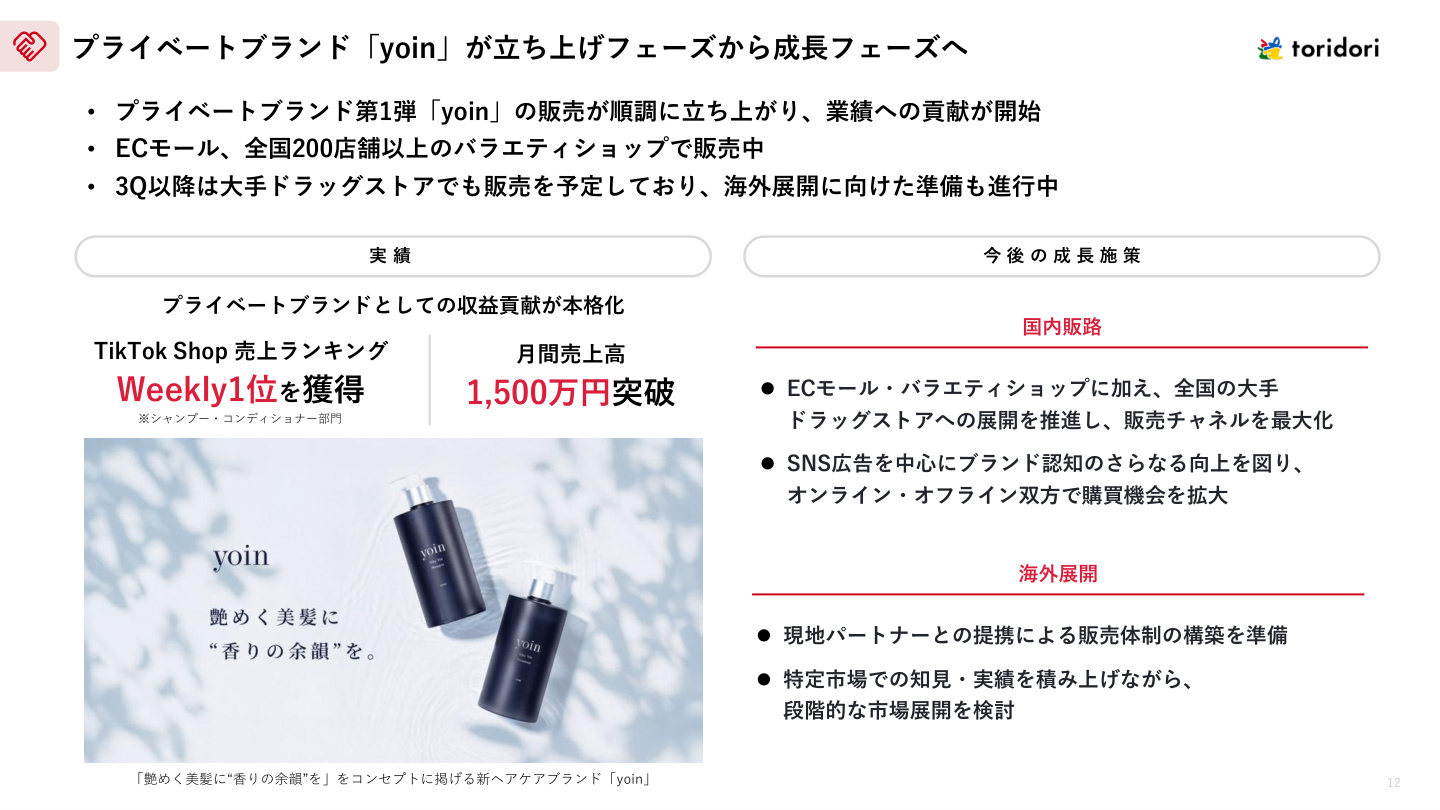
Slide Commentary: Growth Potential in New Areas Fulfilled by PB "yoin"
The slide above shows the success story of " yoin ," the first hair care brand in the company's D2C/private brand (PB) business.
- Track Record : Ranked #1 Weekly in the shampoo/conditioner category on TikTok Shop, with monthly sales exceeding 15 million JPY .
- Expansion of Sales Channels : In addition to development in e-commerce malls and over 200 variety shops nationwide, introduction to major drugstore chains is planned from Q3 onwards. Furthermore, preparations for overseas expansion through partnerships with international partners are underway.
By channeling the influencer reach of the company's own platform into its own brand, this model is expected to contribute to future growth by balancing high gross margins with the creation of brand value.
7. Business Foundation and Competitive Advantage (Network Effects)
The foundation of toridori is supported by a powerful two-sided network effect connecting SMBs (small and medium-sized enterprises/sole proprietors) and micro-influencers .
- Number of Registered Influencers : Approx. 90,000 (as of the end of March 2026)
- Characteristics of Follower Base : Centered on micro-influencers with 30,000 or fewer followers (over 60% of the total), who have high engagement rates with fans and exert "narrow and deep influence on individuals."
- Diverse Attributes : 78% are female, with those in their 20s and 30s accounting for the majority, distributed not only in the Kanto region but across major areas nationwide.
As the number of corporate clients increases, opportunities for influencers to secure projects grow, and as the number of influencers increases, the customer attraction effect for companies improves—this autonomous growth loop (flywheel) is the company's greatest strength.
8. Summary and Future Focus
In summary, the Q2 FY2026 financial results indicate that toridori is at the following stage:
- Overwhelming Growth in Core Business : The flagship "toridori marketing" is performing extremely well with a +31.6% increase in gross profit, driven by the dual effect of 8,947 customers and rising ARPU .
- Growth Investment and Profit Management : While operating profit is temporarily pressured by upfront investments in "Vooster" and "yoin," the company is steadily cultivating future business pillars.
- Net Income Improvement through Structural Reform : With the full acquisition of toridori IS, the suppression of profit leakage and the strengthening of governance are complete from Q3 onwards.
Moving forward, the progress of the "Vooster" PoC, the earnings contribution from the rollout of the PB "yoin" in drugstores, and the pace of net income recovery following the full acquisition of toridori IS will be key observation points for the enhancement of the company's corporate value.
This content is not intended as investment advice or a recommendation. Any opinions expressed are solely the personal views of each article.