

Japan Display Inc. FY26 Q1 Earnings Deep Dive: Structural Reform, Profitability Improvement, Elimination of Capital Deficiency, and Progress in 'BEYOND DISPLAY' Strategy

Sentiment Analysis
Japan Display Inc. (JDI) (Securities Code: 6740) reported its FY26 Q1 financial results , which, despite continued revenue contraction, clearly demonstrated the tangible impact of the structural reforms implemented since the previous fiscal year. While revenue stood at 23.9 billion yen (a decrease of 8.5 billion yen year-on-year), the company saw a significant narrowing of losses, with EBITDA at -0.5 billion yen (an improvement of 7.6 billion yen YoY) and operating profit at -1.2 billion yen (an improvement of 7.9 billion yen YoY). Furthermore, through the exercise of stock acquisition rights as part of capital enhancement measures, net assets reached 3.6 billion yen , successfully achieving the elimination of capital deficiency .
This report extracts 10 key topics from the disclosed financial materials to provide a multi-faceted, in-depth analysis of the company's overall performance, the results of its structural reforms, the strengthening of its financial foundation, and the progress of its "BEYOND DISPLAY" growth strategy.
1. List of Key Extracted Topics
The following 10 points from the latest financial materials are critical for evaluating the company's future corporate value and growth potential:
- FY26 Q1 Earnings Summary and Significant Profitability Improvement (Substantial reduction in losses across all profit tiers)
- Fixed Cost Reduction via Structural Reform (+10.1 billion yen profit improvement effect from Mobara plant production termination and personnel cost reductions)
- Exercise of Stock Acquisition Rights and Elimination of Capital Deficiency (Recovery to 3.6 billion yen in net assets)
- Reduction of Interest-Bearing Debt and Interest Expenses (14 billion yen reduction in interest-bearing debt, resulting in an annual interest expense reduction of approximately 1.7 billion yen)
- Promotion of Asset Divestiture (Mobara Plant, etc.) (Ongoing discussions with multiple candidates to maximize corporate value)
- Roadmap for Compliance with Listing Maintenance Criteria (Net Asset Criteria) (FY27 operating profit target and steps)
- Non-disclosure of FY26 Earnings Forecast and Timeline for Operating Profitability (Targeting operating profit in FY27)
- Group Reorganization and Management Efficiency (Consolidation of overseas bases, absorption-type mergers of subsidiaries, and centralization under the COO)
- Strategic Development of Automotive and Consumer/Industrial Displays (Addressing geopolitical risks and capturing high-value-added segments)
- Full-scale Launch of "BEYOND DISPLAY" New Domains (Bio, Sensors, Communications) (e.g., mass production of bio-devices in collaboration with CyteSi)
2. Earnings Highlights and Analysis of Profit Structure
In the FY26 Q1 income statement, despite the decline in revenue, the significant improvement in profitability at each profit level is notable.
[Significance and Background of Slide 4]
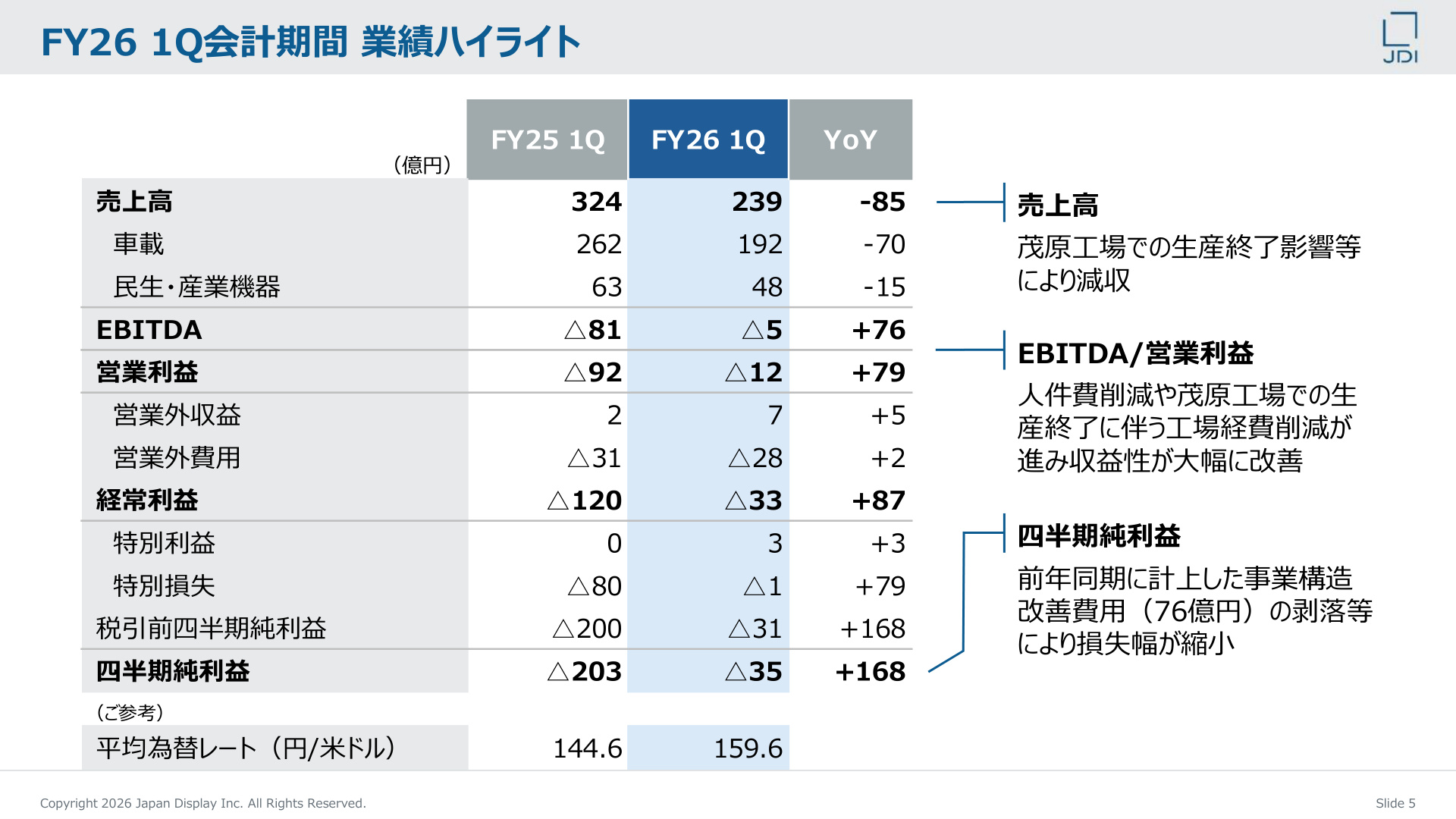
Slide 4 presents the earnings highlights , comparing key financial indicators between the same period last year (FY25 Q1) and the current period (FY26 Q1). This slide is crucial as it clearly demonstrates that despite a decline in revenue, the company achieved a dramatic reduction in losses across all profit metrics .
- Revenue : Declined from 32.4 billion yen in FY25 Q1 to 23.9 billion yen (down 8.5 billion yen, approx. -26%). Both automotive (down 7.0 billion yen to 19.2 billion yen) and consumer/industrial (down 1.5 billion yen to 4.8 billion yen) segments saw revenue declines. The primary cause is the streamlining of unprofitable lines and the termination of production at the Mobara plant .
- Operating Profit/Loss : Achieved an improvement of 7.9 billion yen , moving from -9.2 billion yen in FY25 Q1 to -1.2 billion yen . The fact that the operating loss narrowed to 1.2 billion yen despite a significant drop in revenue confirms that the business's break-even point has dropped substantially.
- Quarterly Net Profit/Loss : Benefiting from the absence of business structural reform expenses (7.6 billion yen) recorded in the same period last year, the result improved by 16.8 billion yen , from -20.3 billion yen in FY25 Q1 to -3.5 billion yen .
It is evident that the structural reform objective—prioritizing higher marginal profit ratios and cutting fixed costs over chasing revenue scale—is being reflected in the financial figures.
3. Analysis of Operating Profit Variance: Concrete Results of Structural Reform
The factors behind the significant improvement in operating profit from -9.2 billion yen to -1.2 billion yen are analyzed using a detailed waterfall chart.
[Significance and Background of Slide 5]
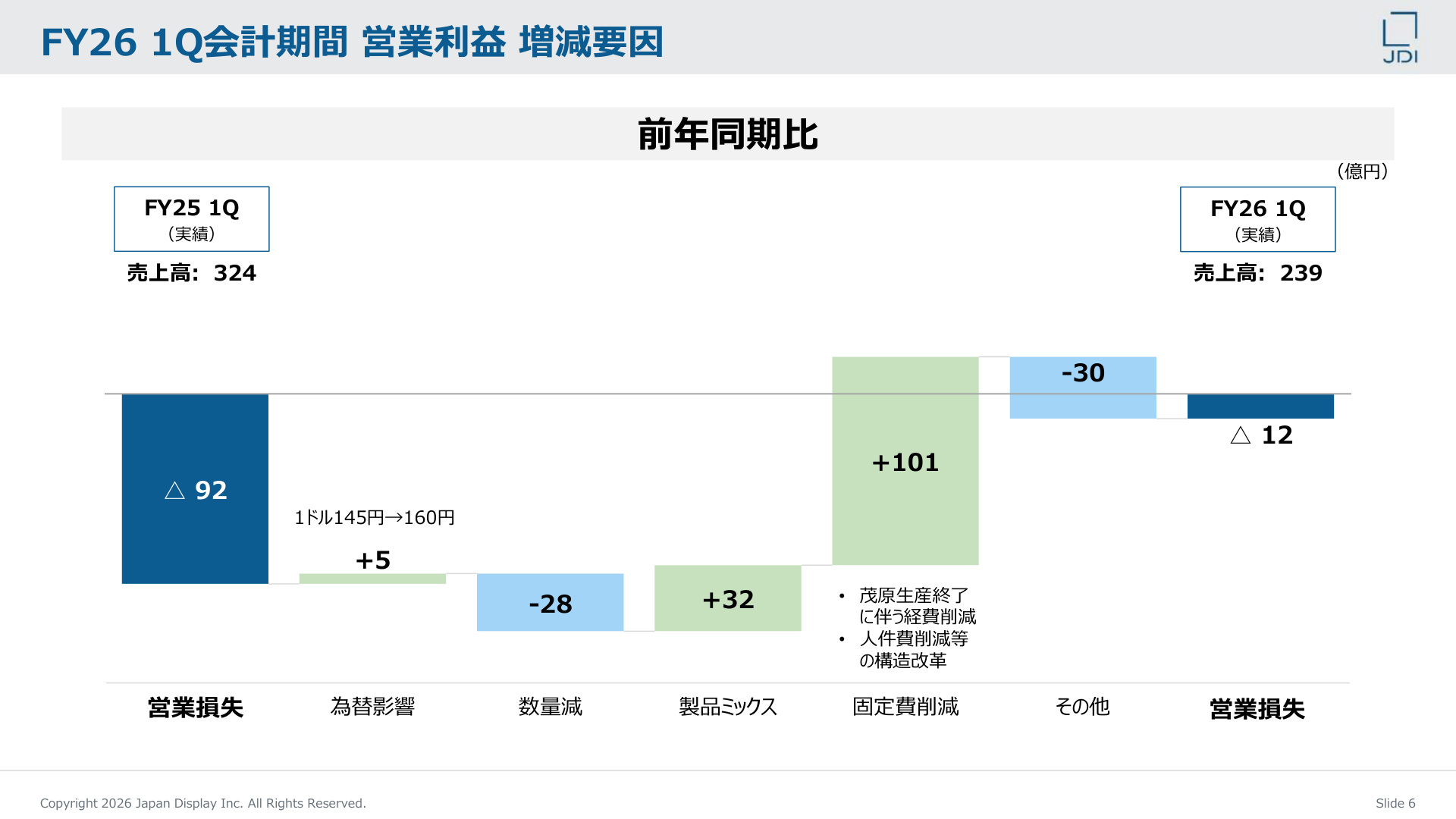
Slide 5 breaks down the factors behind the change in operating profit compared to the same period last year. This is the most core data in the report for objectively evaluating whether profit improvements were driven by external factors (e.g., exchange rates) or internal management efforts (structural reform).
- Fixed Cost Reduction (+10.1 billion yen) : The largest contributor to profit improvement was the drastic compression of fixed costs , including expenses associated with the termination of the Mobara plant and company-wide personnel cost reductions. Realizing a 10.1 billion yen fixed cost reduction in a single quarter is the primary driver of the narrowed loss.
- Product Mix Improvement (+3.2 billion yen) : The shift toward high-value-added products and the reduction of low-margin products largely offset the impact of the revenue decline, contributing 3.2 billion yen to profit.
- Exchange Rate Impact (+0.5 billion yen) : The shift in the USD exchange rate from 144.6 yen to 159.6 yen year-on-year provided a 0.5 billion yen boost due to the weaker yen.
- Impact of Volume Decline (-2.8 billion yen) : The decrease in sales volume due to the Mobara plant shutdown and business selection acted as a 2.8 billion yen drag on earnings.
This analysis highlights a structure where, rather than relying on currency tailwinds, the company generated a total of 13.3 billion yen in positive impact through internal structural reforms— fixed cost reduction (+10.1 billion yen) and product mix improvement (+3.2 billion yen) —fully absorbing the impact of volume decline.
4. Strengthening the Financial Foundation: Elimination of Capital Deficiency and BS Transformation
The most significant topic on the financial front is the elimination of capital deficiency and the return to positive net assets .
[Significance and Background of Slide 12]
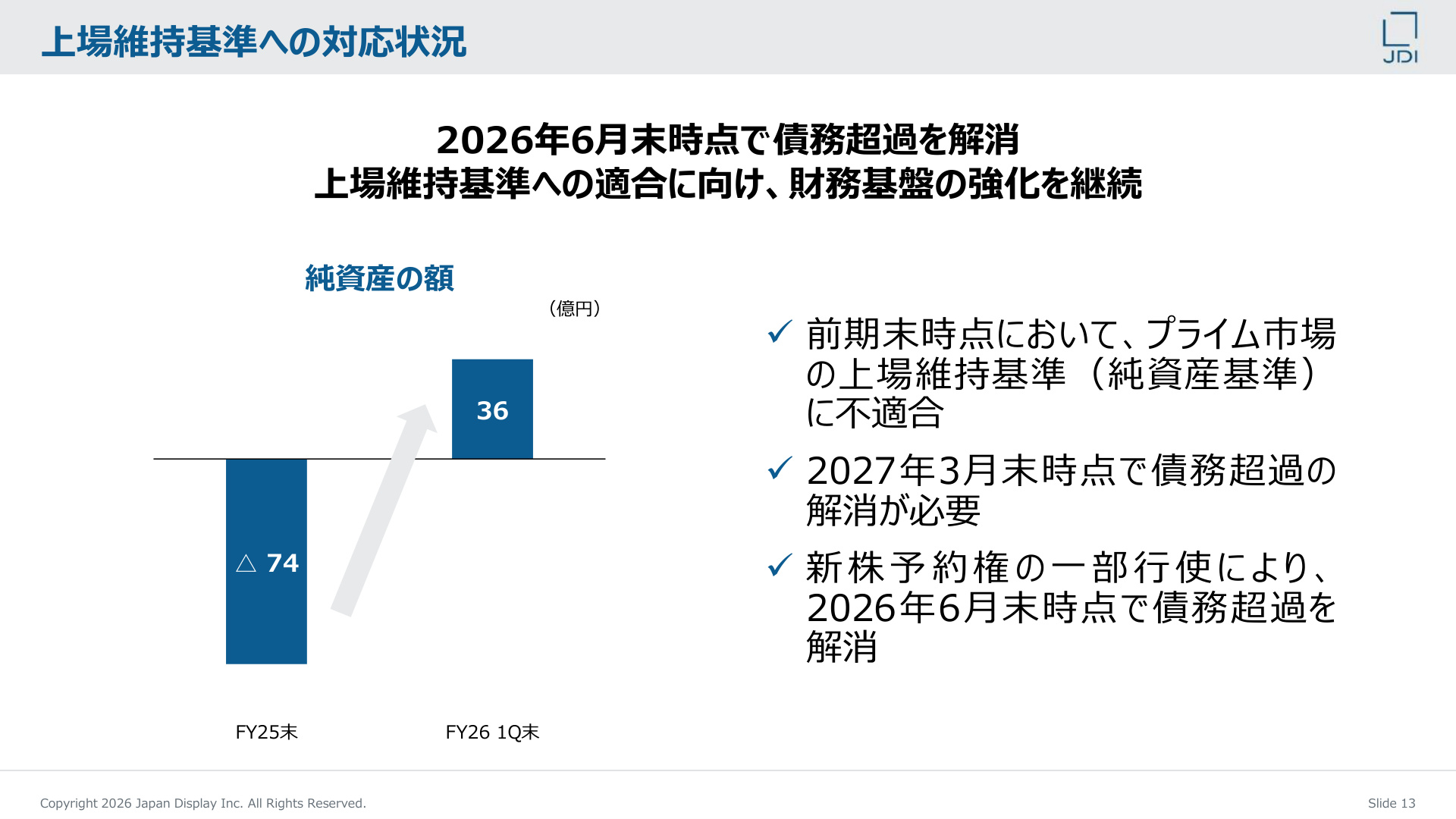
Slide 12 shows the status of compliance with the Tokyo Stock Exchange's listing maintenance criteria (net asset criteria) and the trend in net assets. Recovering net assets was the top priority to maintain the company's listing.
- Net Asset Trend : While the company was in a capital deficiency of -7.4 billion yen at the end of FY25, it recovered to 3.6 billion yen in net assets (+11.0 billion yen from the previous fiscal year-end) by the end of FY26 Q1, successfully eliminating the deficiency.
- Background and Mechanism : The direct cause was the partial exercise of the 14th series of stock acquisition rights by major shareholder Ichigo Trust, which completed a 14.4 billion yen capital injection during the first quarter (total cumulative procurement: 17.3 billion yen).
- Compression of Interest-Bearing Debt and Financial Costs : Parallel to capital procurement, the company repaid loans, reducing interest-bearing debt from 66.3 billion yen at the end of the previous fiscal year to 52.3 billion yen (a 14 billion yen reduction) . The repayment of 14 billion yen to Ichigo Trust is expected to reduce interest expenses in FY26 by approximately 1.7 billion yen , contributing significantly to the improvement of non-operating profit/loss.
- Divestiture of Mobara Plant Assets : The company continues to pursue the sale of assets such as the Mobara plant to improve financial health and is carefully negotiating with multiple candidates to maximize corporate value.
5. Roadmap for Compliance with Listing Maintenance Criteria and Earnings Outlook
The company has presented a systematic five-step roadmap to comply with listing maintenance criteria:
- Step 1: Implementation of Structural Reform (Completion of plant consolidation and personnel reduction)
- Step 2: Compliance with Net Asset Criteria (Target: End of FY26) (Execution of financial measures, asset sales, and capital accumulation through profit improvement)
- Step 3: Operating Profitability (Target: FY27)
- Step 4: Expansion of Investor Base
- Step 5: Compliance with Tradable Share Ratio Criteria (Target: End of FY27)
FY26 earnings forecasts remain undisclosed . This is due to the wide range of variables affecting the business environment, including various measures to improve financial conditions and the ongoing assessment of the U.S. display business. However, the company emphasizes its management timeline, setting the achievement of operating profitability for "FY27."
6. Management Efficiency through Group Reorganization
To further solidify its business foundation, a bold group reorganization was implemented effective July 1, 2026:
- New Structure : All business divisions have been centralized under the COO (Chief Operating Officer) to strengthen cross-functional collaboration in development, sales, and quality.
- Reorganization of Overseas Sales Bases : As part of fixed cost reduction, the dissolution and liquidation of JDI Hong Kong were decided.
- Optimization of Development Organization : To accelerate decision-making and consolidate resources, the absorption-type merger of JDI Design and Development was decided.
Through these reorganizations, the company is building a structure that accelerates decision-making and minimizes operational costs.
7. Progress of the "BEYOND DISPLAY" Growth Strategy
The company is moving away from being a mere display manufacturer to pursuing the "BEYOND DISPLAY" strategy , which provides high technological value-added solutions. This report details specific achievements and progress in each application.
(1) Automotive Displays
- Addressing Geopolitical Risks : Utilizing the Ishikawa Plant (G4.5) for flexible response to high-mix, low-volume customization needs, and establishing an automotive production system at the subsidiary Nanox Philippines . This secures supply lines independent of specific regions.
- New Order Wins : Recognized for its geopolitical risk management, the company won new orders from a major U.S. customer for full display mirrors and HUD (Head-Up Display) platform models .
(2) Consumer and Industrial Displays
- Digital Camera Market : By evolving its proprietary " WhiteMagic® " technology, which achieves high brightness and low power consumption, the company maintains the top market share (by revenue) in the digital camera market and continues to acquire new customers.
- Industrial/Specialized Demand : Adoption of displays for European railways is expanding, and the company is broadening its customer base by leveraging its customization capabilities for high-security, specialized needs such as defense.
(3) Bio and New Domains (Collaboration with CyteSi)
- Bio-Application of Technology : Applying JDI's backplane technology to the bio-field, the company is co-developing micro-bio-sample processing devices with CyteSi . This will significantly reduce verification/inspection time and reagent costs.
- Mass Production Schedule : Final preparations are underway for the start of mass production in FY26 Q2 , targeting entry into growth markets such as drug discovery, infectious disease testing, and genetic analysis (next-generation sequencing).
(4) Sensors and Next-Generation Communications
- ZINNSIA : Initial mass production shipments began in June 2026, with activities underway to expand applications.
- Next-Generation Satellite Communication Antennas : Prototyping and shipping of antenna substrates for Kymeta are underway, with development accelerating toward mass production approval.
- Thermal Imaging Sensors : Development integrating Obsidian's MEMS process with JDI's TFT backplane is progressing on schedule for a mid-2027 mass production start .
8. Summary and Comprehensive Analysis
The FY26 Q1 earnings report marks a major turning point for the company.
While paying the price of revenue decline due to the suspension of the Mobara plant, the 10.1 billion yen reduction in fixed costs in a single quarter brought operating profit very close to equilibrium (-1.2 billion yen). Furthermore, securing 3.6 billion yen in net assets and eliminating capital deficiency through capital support from Ichigo Trust (exercise of stock acquisition rights) is a decisive step toward meeting listing criteria and ensuring long-term business continuity.
Future focus will shift to further streamlining existing fixed costs during FY26 (including the status of Mobara plant asset sales), the full-scale monetization of new high-value-added areas (BEYOND DISPLAY) such as bio-related devices (CyteSi collaboration) and ZINNSIA starting in FY26 Q2, and the feasibility of achieving the targeted operating profit in FY27 .
Correction (September 29, 2026): Corrected the specified amounts, rates or reporting periods against the original company disclosure; the verified changes are recorded in the correction ledger. Source
This content is not intended as investment advice or a recommendation. Any opinions expressed are solely the personal views of each article.