


EM Systems FY2026 Q2 Earnings Analysis: A Strategic Shift Toward Organic Growth Post-Special Demand, Rebuilding Profitability via AI Integration and Price Optimization

StockClub
Published: Aug 11, 2026, 09:54 AM
Sentiment Analysis
EM Systems (Ticker: 4820) FY2026 Q2 Earnings Analysis
EM Systems' FY2026 Q2 (interim) results reflect a year-on-year decline due to the fading of special demand related to government healthcare policies (such as the introduction of the online health insurance verification system and electronic prescriptions). However, the company outperformed the revised guidance announced on May 14 . EM Systems is rapidly shifting away from a business model dependent on temporary demand, pivoting toward a medium-to-long-term growth scenario anchored by enhanced product/service value and autonomous demand (organic growth).
Below, we provide a detailed analysis of the company's overall performance, segment trends, KPI progression, and AI-driven growth strategy, based on 10 key topics extracted from the earnings materials.
1. FY2026 Q2 Consolidated Earnings Summary: Profit Levels Exceeding Revised Guidance
Interim consolidated results were as follows: Net Sales of 10,434 million yen (down 14.1% YoY, up 1.6% vs. revised plan) , Operating Profit of 922 million yen (down 55.7% YoY, up 106.2% vs. revised plan) , Ordinary Profit of 1,279 million yen (down 46.7% YoY, up 61.6% vs. revised plan) , and Net Income Attributable to Owners of the Parent of 663 million yen (down 58.6% YoY, up 92.6% vs. revised plan) .
While the year-on-year figures show a significant decline due to the high base effect of the previous year's special demand, the company achieved a substantial upside against the May revised plan, driven by the establishment of a cross-functional specialized sales structure and the increased adoption of optional software.
2. The End of Healthcare Policy-Driven Demand and Refocus on "Organic Growth"
Demand stemming from government policies—such as online health insurance verification and electronic prescriptions—which bolstered the medical and pharmacy industry over the past few years, has largely run its course. The company has clearly recognized this shift and is redefining its earnings structure.
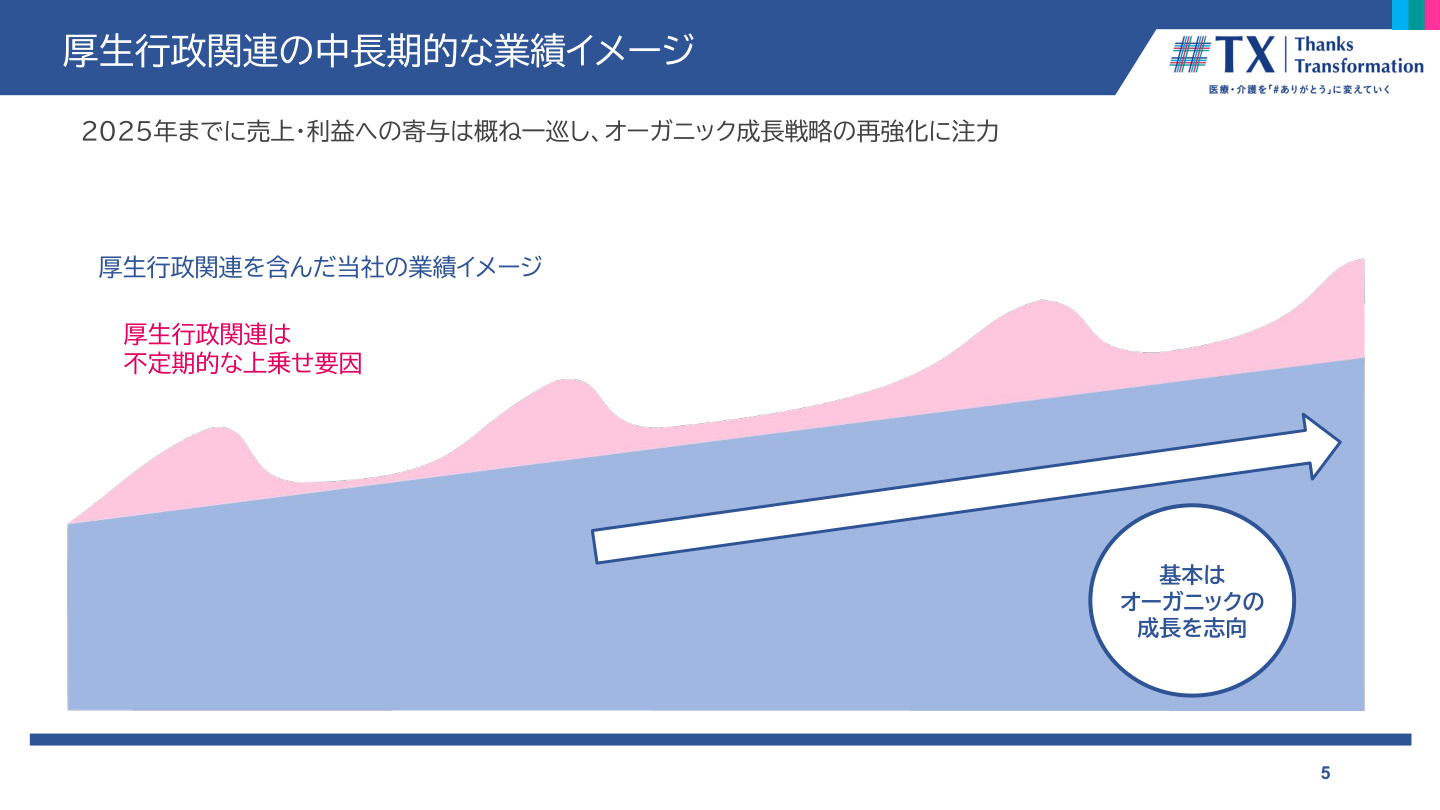
[Slide Commentary: Why This Chart Matters]
This slide visually represents the company's medium-to-long-term growth vision and revenue structure philosophy . The "Healthcare Policy-Related" segment, shown in pink, represents irregular and temporary upside (special demand), which causes volatility in performance. Conversely, the "Organic Growth" shown in blue is the company's fundamental growth engine. Now that special demand has subsided as of 2025, the company has fully committed to a strategy of pushing up the blue arrow (baseline) through autonomous customer value creation and ARPU improvement, rather than relying on irregular policy-driven demand.
3. Segment Trends: Performance Divergence and Structural Reform in Pharmacy, Medical, and Nursing Care
Business conditions for each segment are as follows:
- Pharmacy System Business : Net sales of 8,339 million yen (down 15.6% YoY), operating profit of 1,276 million yen (down 39.9% YoY). The decline was driven by the reaction to the previous year's special demand (online verification -368 million yen, electronic prescriptions -645 million yen) and a strategic shift to prioritize acquiring new customers from competitors over internal replacements (initial systems -602 million yen). However, stock-based revenue is steadily growing due to the increased adoption of the Pharmacy Record Generation AI option (detailed later).
- Medical System Business : Net sales of 1,225 million yen (down 18.2% YoY), operating loss of 254 million yen (compared to an 80 million yen profit in the same period last year). Similar to the pharmacy segment, the end of electronic prescription demand (-125 million yen) lowered initial sales, but subscription revenue (stock) is increasing due to steady replacements from competitor systems.
- Nursing/Welfare System Business : Net sales of 411 million yen (up 56.6% YoY), operating loss of 130 million yen (compared to a 169 million yen loss in the same period last year). The transition to the new product "MAPs for NURSING CARE," a review of the pricing structure to match service value, and the consolidation of Conduct Co., Ltd. contributed to significant revenue growth and a reduction in operating losses.
4. Key KPI Trends: Rising Pharmacy ARPU and Growth in Medical Customers
"Number of Customers" and "ARPU (Average Revenue Per User per month)," the most critical indicators for measuring sustainable growth, are progressing as planned.
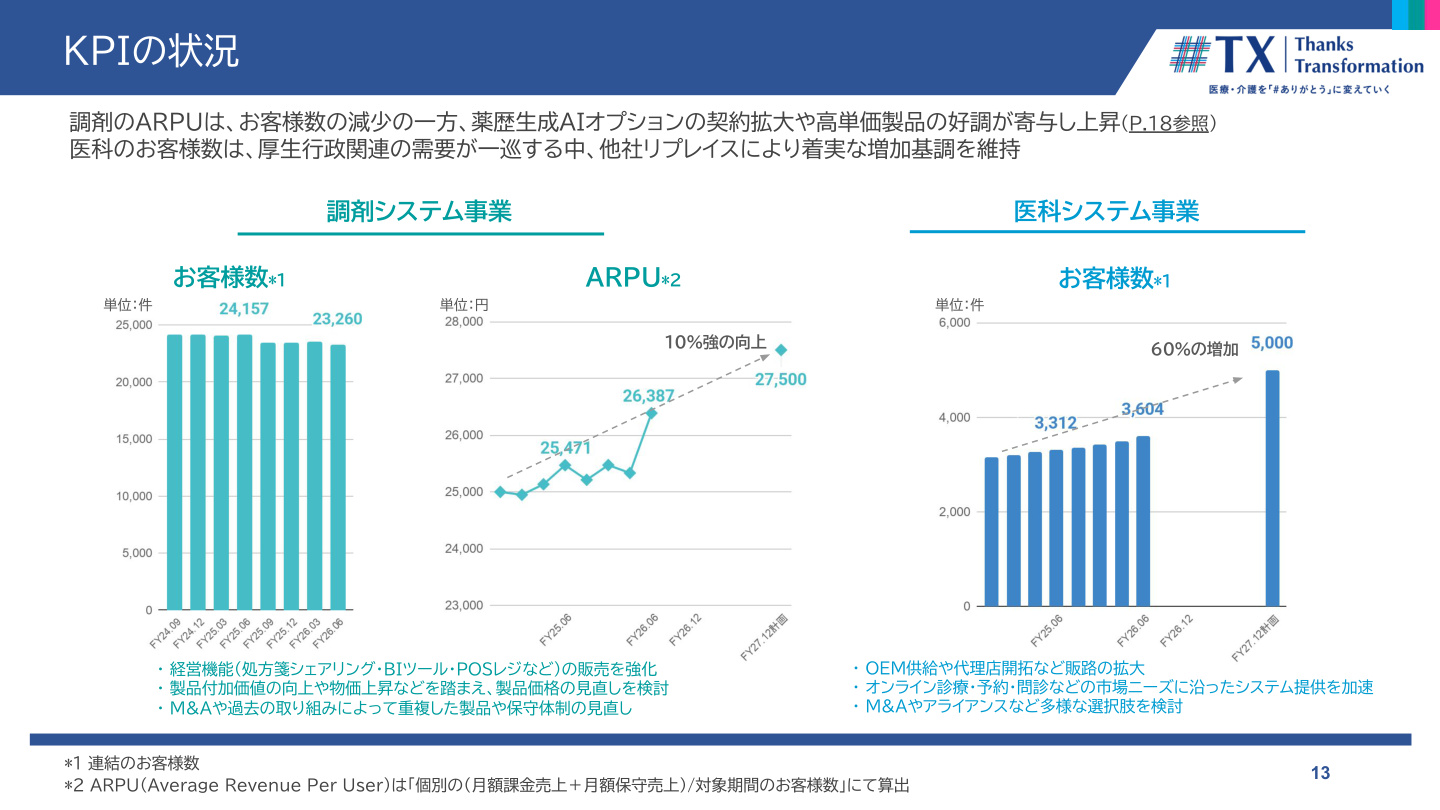
[Slide Commentary: Growth Drivers Indicated by Data]
The slide above shows the trends in customer numbers and ARPU for pharmacy and medical systems.
- Rising Pharmacy ARPU : While the number of pharmacy customers is slightly declining to 23,260 due to the consolidation of overlapping products, ARPU has trended upward to 26,387 yen (up 3.6% YoY) . This is the result of cross-selling new features and AI options, as well as price increases, showing steady progress toward the medium-term management plan target of "a 10%+ increase (27,500 yen)."
- Steady Expansion of Medical Customers : The number of medical system customers has grown to 3,604 , and efforts to expand sales channels through OEM supply and agency development are yielding results toward the target of 5,000 customers by the final year of the medium-term plan (FY27.12).
5. High Value-Added via AI: Results of the "Pharmacy Record Generation AI Support Option"
Product DX, which integrates generative AI into products, is becoming the source of the company's competitive advantage.
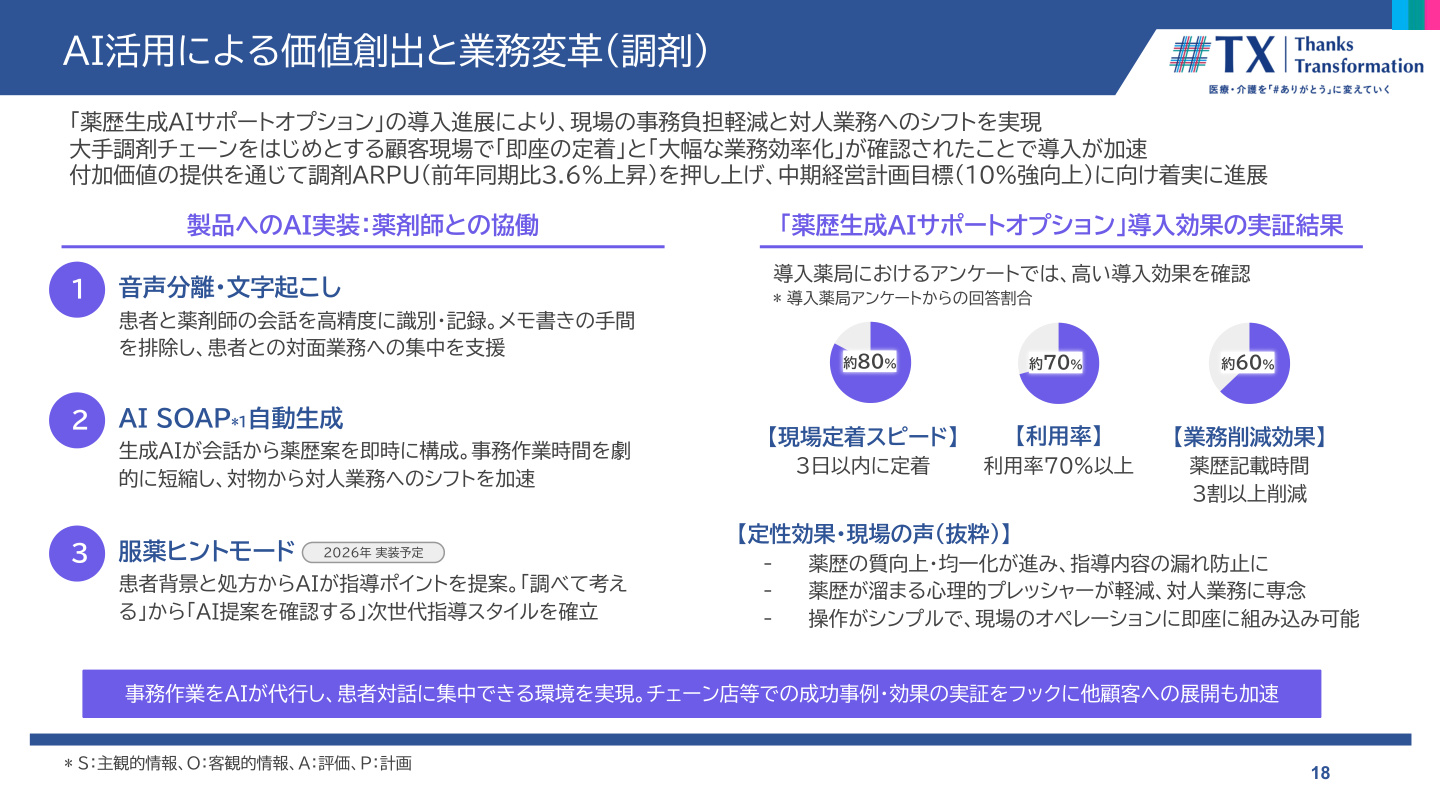
[Slide Commentary: The Core of Product Differentiation and Operational Transformation]
This slide summarizes the functions and verification results of the "Pharmacy Record Generation AI Support Option" introduced for pharmacy operations. This feature performs real-time "voice separation and transcription" of conversations between patients and pharmacists, and the AI automatically generates a "SOAP-format (Subjective, Objective, Assessment, Plan) pharmacy record draft." Verification surveys confirmed extremely high efficiency gains, including "adoption in the field within 3 days," "usage rate of over 70%," and "reduction of pharmacy record writing time by over 30%." This track record has become a powerful hook, accelerating adoption among major pharmacy chains and directly driving the aforementioned increase in pharmacy ARPU (+3.6% YoY) . Furthermore, plans are underway to integrate AI features into the cloud-based electronic medical record system for clinics, "MAPs for CLINIC."
6. Concrete Initiatives for Profitability Improvement and Corporate Value Enhancement
Amidst a challenging external environment—including stricter medical fee revisions, higher requirements for medical DX, and rising development/support costs due to inflation—the company is implementing the following structural reforms :
- Comprehensive Optimization of Pricing Structure : Promoting revisions to appropriate prices that reflect the value provided, in response to inflation and stricter system requirements.
- Revamping the Pharmacy Sales Structure : Since May 2026, a specialized team composed of selected members from across the company has been established to balance new customer acquisition with the promotion of high-function options.
- M&A and Group Synergy Creation : Advancing the integration of Precal (AI-related M&A) and Conduct (nursing/welfare sector), and maximizing sales efficiency by transitioning to a joint sales structure with Good Cycle System.
7. Full-Year Earnings Outlook and Shareholder Return Policy
- Maintenance of Full-Year Earnings Forecast : The FY2026 full-year consolidated earnings forecast remains unchanged: Net Sales of 22,762 million yen (down 3.8% YoY) , Operating Profit of 3,316 million yen (down 9.8% YoY) , and Net Income of 2,193 million yen (down 10.6% YoY) . Although the interim period significantly exceeded the plan, the company is maintaining a cautious stance regarding the uncertainty of healthcare policy-related demand in the second half.
- Maintenance of 100% Payout Ratio Policy : There is no change to the "consolidated dividend payout ratio of 100%" policy stated in the medium-term management plan, with an interim dividend of 5 yen per share. The company plans to appropriately reflect shareholder returns based on full-year results. Additionally, the cancellation of 4,000,000 shares of treasury stock (5.37% of total issued shares before cancellation) was completed in December 2024, demonstrating a strong commitment to improving capital efficiency.
Conclusion
EM Systems' FY2026 Q2 results show that behind the "superficial figures" of a year-on-year decline due to the end of policy-driven special demand, the strengthening of the fundamental organic growth base —including ARPU growth via AI options, an increasing number of medical customers, price optimization, and a revamped sales structure—is progressing smoothly. The company's transformation from a business reliant on special demand into a high-value-added medical and nursing DX platform provider is worth watching.
This content is not intended as investment advice or a recommendation. Any opinions expressed are solely the personal views of each article.