


Valtes Holdings FY2026 Q1 Earnings Analysis: Record-High Revenue and Strategic Progress in Generative AI Development

StockClub
Published: Aug 11, 2026, 09:53 AM
Sentiment Analysis
Valtes Holdings Co., Ltd. (Securities Code: 4442) reported its financial results for the first quarter of the fiscal year ending March 31, 2027 (FY2026 Q1). The company achieved record-high Q1 revenue of 3.008 billion yen, a 9.4% increase year-on-year . While the company recorded an operating loss of 7 million yen (compared to an operating profit of 99 million yen in the same period last year), this was primarily due to upfront costs associated with aggressive investments in generative AI testing tool development —as outlined in the new medium-term management plan—and increased training costs for new hires. Performance remains ahead of internal projections.
This report provides a detailed analysis of the company's overall performance, the factors behind the profit decline, key KPI trends, and the future vision centered on its generative AI strategy.
1. FY2026 Q1 Financial Overview and Highlights
The first quarter results reflect a pattern of revenue growth alongside a decline in profit. While the top line expanded steadily due to strengthened sales structures and robust project acquisition, investments aimed at long-term competitiveness have pressured the bottom line.
- Revenue : 3,008 million yen ( +9.4% YoY / +259 million yen) ※Record High
- Operating Profit : -7 million yen (vs. 99 million yen in the same period last year; -106 million yen YoY) ※Exceeded internal plan
- EBITDA : 64 million yen ( -60.9% YoY / -99 million yen)
- Ordinary Profit : -11 million yen (vs. 96 million yen in the same period last year)
- Quarterly Net Profit Attributable to Owners of Parent : -105 million yen (vs. 53 million yen in the same period last year)
The significant decline in quarterly net profit is attributed not only to operating results but also to impairment losses on investments . However, this impact is considered temporary and is expected to have a negligible effect on full-year results.
The following slide illustrates the quarterly trends in revenue and operating profit, along with the full-year outlook.
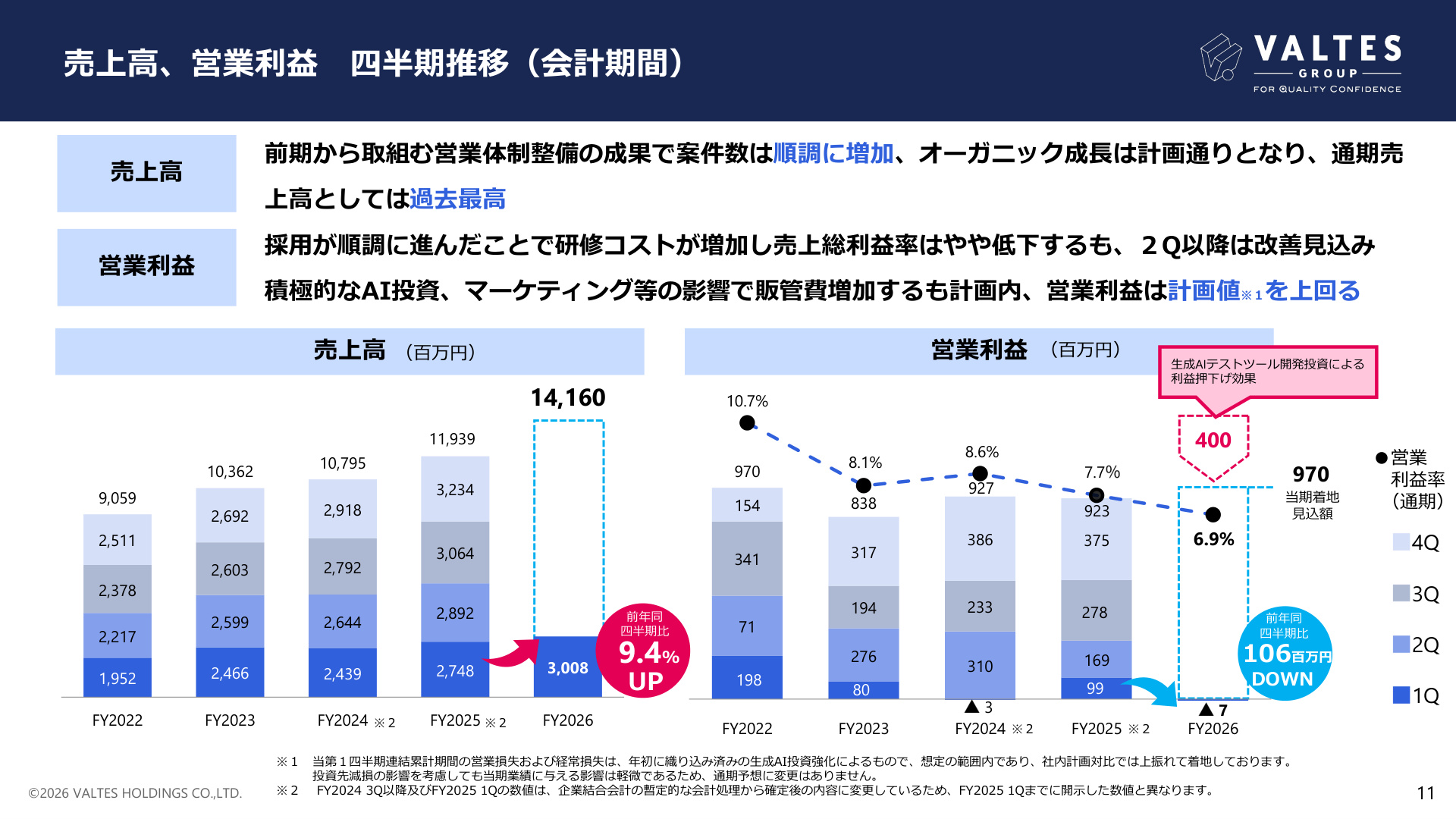
【Significance and Background of Slide 11 (PAGE_10)】 This slide is crucial for visually understanding the company's growth trajectory and current investment phase. As the left graph shows, quarterly revenue continues to trend upward, surpassing the 3 billion yen milestone for the first time in a Q1 period. Conversely, the right graph shows an operating loss of 7 million yen for the current quarter (FY2026 Q1). As noted in the callout, this is the result of profit-diluting investments in generative AI testing tool development (projected at 400 million yen for the full year) being executed as planned. This confirms that the company is not experiencing a decline in earning power, but is instead in the midst of intentional "upfront investment for the future."
2. Analysis of Operating Profit Fluctuations (Why the temporary decline?)
The change in operating profit for Q1 (-106 million yen YoY) can be broken down into three main factors: "revenue growth effect," "fluctuations in gross profit margin," and "increase in SG&A expenses."
- Revenue Growth Effect (+73 million yen) : Expansion in the core software testing business boosted profits.
- Fluctuations in Gross Profit Margin (-41 million yen) : Concentrated training costs for newly hired engineers increased the cost of sales, temporarily lowering the gross profit margin. Profit margins are expected to improve from Q2 onwards as these engineers begin active project work.
- Fluctuations in SG&A Expenses (-138 million yen) : SG&A expenses increased due to the execution of planned investment measures:
- Increase in R&D expenses (-40 million yen) : Accelerated development of generative AI testing tools (surging from 22 million yen to 62 million yen YoY).
- Advertising and Marketing expenses (-13 million yen)
- Payment commissions (-13 million yen)
- Costs associated with the introduction of a shareholder benefit program (-10 million yen)
- Increase in personnel and recruitment expenses (-43 million yen) : Higher base personnel costs and recruitment expenses due to organizational expansion.
The following waterfall chart details the factors behind the change in operating profit.
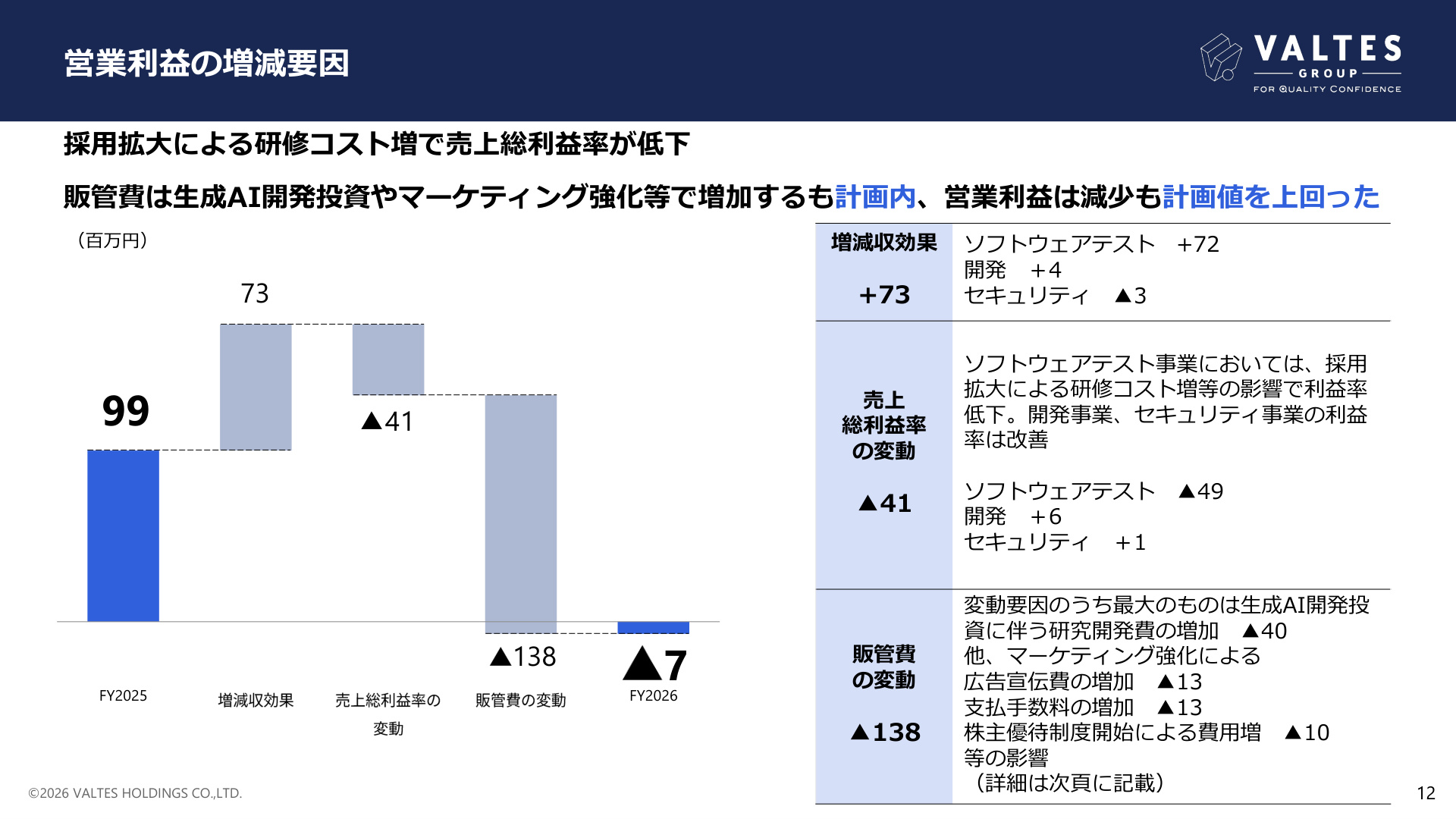
【Significance and Background of Slide 12 (PAGE_11)】 This slide provides critical data for assessing the "quality" of the profit decline. It confirms that against the 99 million yen operating profit of the previous year, the core business generated a +73 million yen profit increase through top-line growth. While the decline in gross profit margin (-41 million yen) and the increase in SG&A expenses (-138 million yen) outweighed this, the primary driver of the SG&A increase was R&D for generative AI. All expenditures, including advertising and shareholder benefits, remain within the scope of the pre-set plan . Furthermore, the results exceeded internal targets, demonstrating that this is a controlled investment period.
3. Segment Performance and Business KPIs (Unit Price and Active Engineers)
By business segment, the core Software Testing Business demonstrates overwhelming growth potential.
Revenue and Operating Profit by Segment
- Software Testing Business : Revenue 2,621 million yen (+10.8% YoY), Operating Profit 52 million yen (vs. 137 million yen last year)
- Development Business : Revenue 463 million yen (-1.9% YoY), Operating Profit -33 million yen (vs. -9 million yen last year)
- Security Business : Revenue 41 million yen (-25.3% YoY), Operating Profit -12 million yen (vs. 0 million yen last year)
While the Development and Security businesses faced challenges, the Software Testing business drove consolidated revenue with a +255 million yen increase year-on-year.
Key KPIs for the Domestic Software Testing Business
Two key indicators supporting the expansion of the software testing business (engineer unit price and number of active engineers) have both reached record highs.
- Engineer Unit Price (Monthly) : 838,000 yen (+11,000 yen YoY)
- Due to the sophistication of testing processes and the expansion of consulting services, the unit price has maintained an upward trend over the past several years.
- Total Active Engineers : 1,385 (+145 YoY) ※Record High
- Full-time employees: 765 (+31 YoY)
- Contract employees and Business Partners (BP): 620 (+114 YoY)
- The company is balancing the expansion of both full-time staff and business partners to meet robust demand.
- Total Number of Projects : 1,792 (+117 YoY)
4. Generative AI Investment Strategy and Progress
Valtes Holdings has set the goal of "strengthening and expanding a business model that does not rely on human labor" in its new medium-term management plan, with a 1.2 billion yen investment plan (400 million yen per year for three years) for generative AI. Key Q1 progress topics include:
- Academic-Industry Partnership with Shiga University (July 8, 2026)
- Signed a partnership agreement with Shiga University, home to Japan's first Faculty of Data Science. A research center is scheduled to be established on campus in late August to address challenges in data science and AI and to cultivate highly specialized talent. Efforts will focus on AI test design, local LLM environments, and the formulation of quality evaluation standards for AI-equipped systems (QA4AI).
- Official Release of Document Quality Analysis AI Tool "QuintSpect" (July 6, 2026)
- Following a pilot phase with 14 companies, the tool was officially released with enhanced analysis scheduling, management functions, and improved security.
- External Recognition of Test Automation Tool "T-DASH"
- Received the "The Best Software by Category 2026" award in the test automation tool category from ITreview, highlighting its product superiority.
- Launch of New Subsidiary "Valtes Solutions & AI Co., Ltd." (July 1, 2026)
- Established a structure to integrate development, quality assurance, and AI utilization, providing end-to-end support from system development to operation and maintenance.
5. FY2026 Full-Year Earnings Outlook and Growth Story
Based on Q1 progress, the company has maintained its full-year earnings forecast for FY2026.
- Revenue : 14,160 million yen (+18.6% YoY / +2,220 million yen)
- Operating Profit : 970 million yen (+5.0% YoY / +46 million yen)
- Operating Profit Before AI Investment (Reference) : 1,370 million yen (+13.8% YoY / +166 million yen)
- EBITDA : 1,270 million yen (+4.9% YoY)
- Net Profit Attributable to Owners of Parent : 610 million yen (+6.4% YoY)
- Earnings Per Share (EPS) : 30.76 yen
The following slide shows the comparison between the annual investment plan and the earnings outlook.
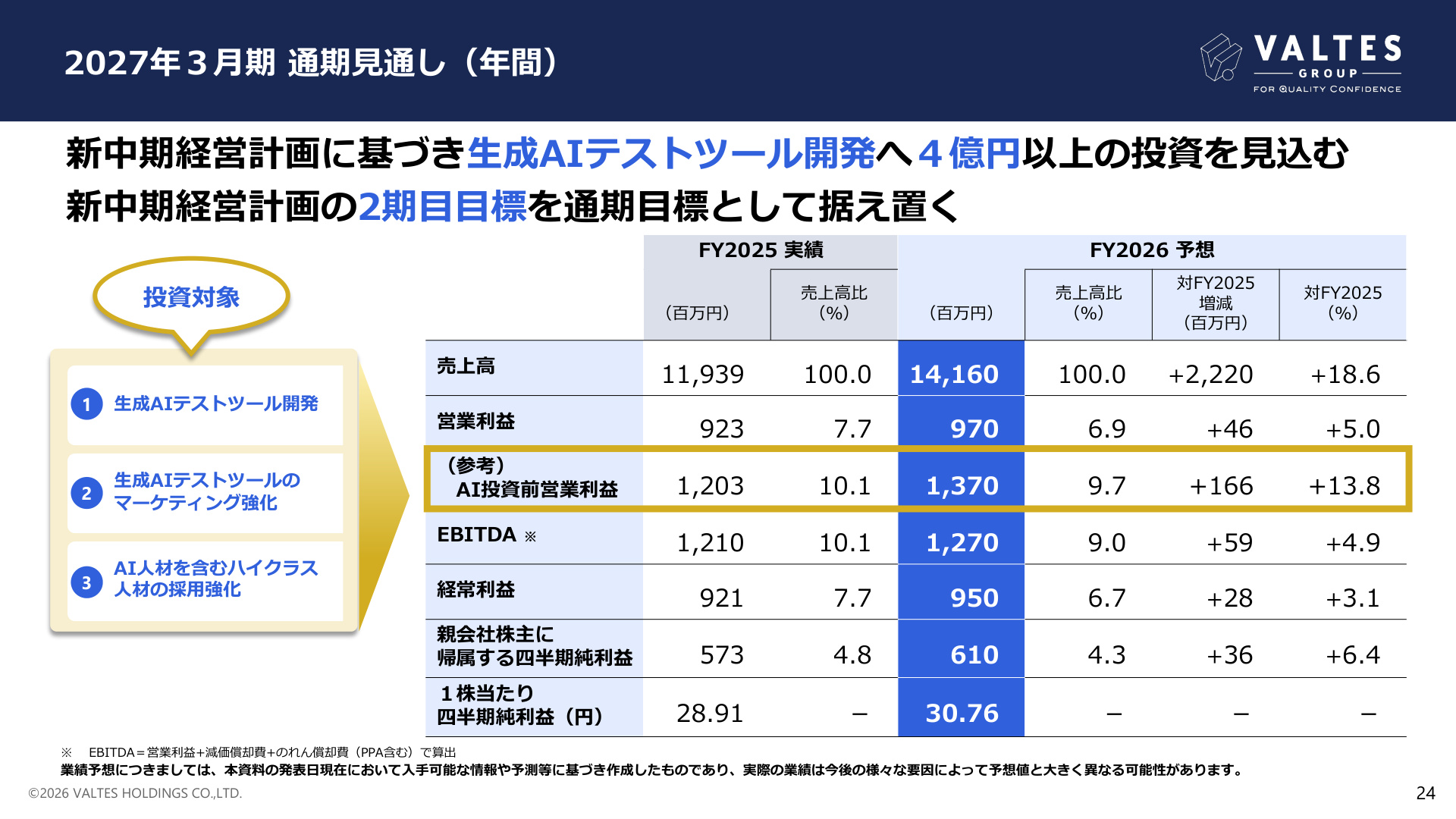
【Significance and Background of Slide 24 (PAGE_23)】 This slide contains a key indicator showing the company's intrinsic earning power (organic growth capability) . The figure highlighted in the yellow box, "Operating Profit Before AI Investment: 1,370 million yen (+13.8% YoY)," demonstrates that excluding the 400 million yen+ in upfront investments for generative AI tool development, marketing, and high-level talent acquisition, the core business is maintaining double-digit growth. The plan aims to secure 970 million yen in operating profit (+5.0% YoY) while simultaneously executing these investments, showcasing a commitment to balancing growth investment with profit generation.
6. Summary
Valtes Holdings' FY2026 Q1 results demonstrate steady progress in top-line expansion (3.008 billion yen in revenue) and the strengthening of its engineering foundation (1,385 active engineers, 838,000 yen unit price) . The temporary Q1 operating profit decline is a planned upfront investment in "generative AI development (R&D expenses +179.5% YoY)" and "training costs for new engineers" with an eye toward future platformization and productivity gains.
Looking ahead, attention will focus on how the recovery in profit margins—driven by the deployment of engineers who have completed training from Q2 onwards—and the commercialization and adoption of AI toolsets like "QuintSpect" and "TestScape" will contribute to medium-term profitability.
This content is not intended as investment advice or a recommendation. Any opinions expressed are solely the personal views of each article.