


Biken Techno Q1 Earnings Deep Dive: Business Restructuring and Mid-to-Long-Term Growth Strategy Amidst Post-Special Demand Normalization

StockClub
Published: Aug 10, 2026, 10:44 AM
Sentiment Analysis
Biken Techno Q1 Earnings Deep Dive: Business Restructuring and Mid-to-Long-Term Growth Strategy Amidst Post-Special Demand Normalization
This report provides a comprehensive analysis of Biken Techno (Securities Code: 9791) based on their latest financial results, covering performance highlights, segment trends, ongoing business restructuring, and mid-to-long-term growth strategies.
1. Financial Overview and Performance Highlights
For the first quarter of the current fiscal year, the company reported net sales of 8,316 million yen (down 539 million yen year-on-year), operating profit of 439 million yen (down 118 million yen), ordinary profit of 505 million yen (down 81 million yen), and quarterly net profit attributable to owners of the parent of 322 million yen (down 92 million yen).
The year-on-year decline in revenue and profit is primarily attributed to the normalization of operations following the special demand associated with the Osaka-Kansai Expo in the previous fiscal year. However, progress against the full-year earnings forecast remains exceptionally robust.
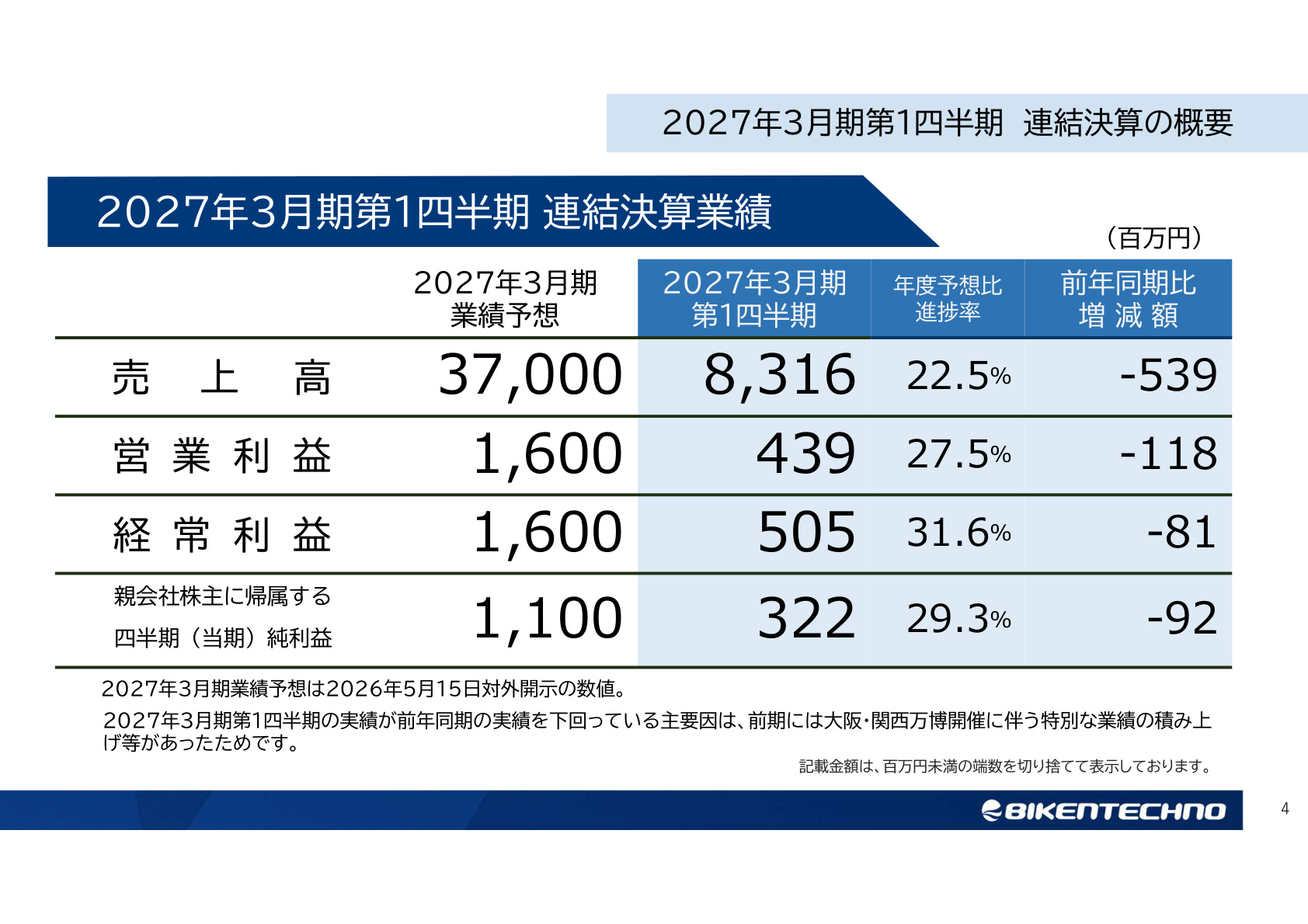
The performance summary slide above is critical data for understanding the current quarter's results, progress toward full-year targets, and the factors contributing to year-on-year fluctuations.
Progress rates against the full-year earnings forecast (Net Sales: 37,000 million yen, Operating Profit: 1,600 million yen, Ordinary Profit: 1,600 million yen, Net Profit: 1,100 million yen) are as follows:
- Net Sales Progress: 22.5%
- Operating Profit Progress: 27.5%
- Ordinary Profit Progress: 31.6%
- Net Profit Progress: 29.3%
With profit metrics reaching between 25% and over 30% in the first quarter, it is evident that the company has made a solid start toward achieving its full-year targets while successfully absorbing the impact of the Expo-related demand normalization.
2. Building Maintenance Business: Trends and Growth Strategy
The company's core Building Maintenance Business is steadily securing new contracts, including maintenance for large-scale redevelopment projects, new commercial facilities, and logistics centers. Segment performance for Q1 recorded net sales of 7,450 million yen (compared to 7,913 million yen in the same period last year) and segment profit of 888 million yen (compared to 1,037 million yen).
As this segment accounts for the largest share of total sales and profit, the company is implementing strategies to adapt to the rapidly changing external environment.
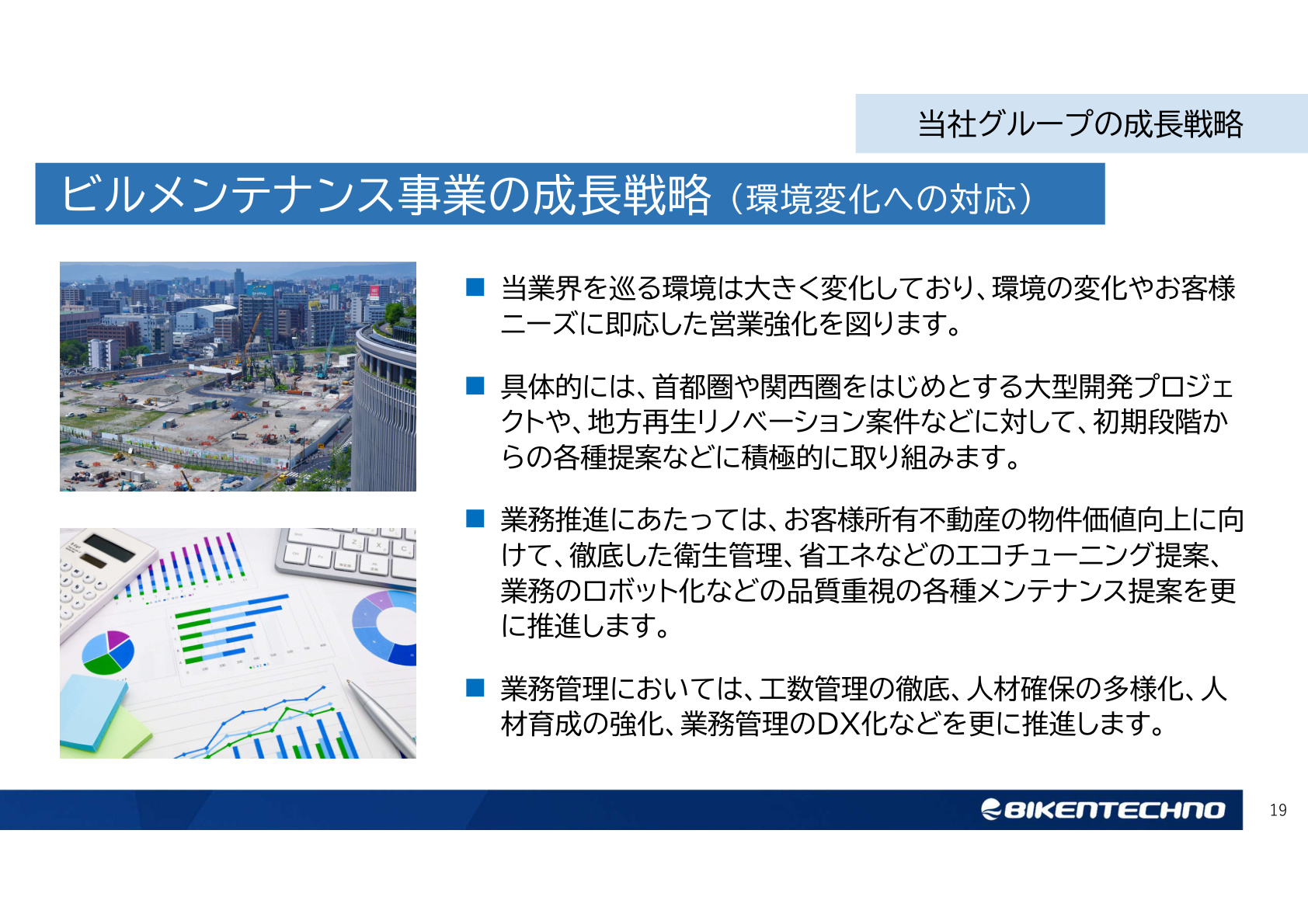
This slide serves as a strategic roadmap illustrating how the core building maintenance business will enhance its competitiveness and sustain growth.
Specific initiatives include the following four points:
- Strengthening Sales and Early-Stage Proposals : Engaging in large-scale development projects in the Tokyo and Kansai metropolitan areas and regional revitalization projects from the initial planning stages.
- Value-Added Proposals Focused on Quality : Promoting thorough hygiene management, Eco-Tuning proposals to contribute to energy savings, and the robotization of cleaning and inspection tasks to enhance property value.
- Operational Efficiency : Promoting DX (Digital Transformation) of business processes in addition to rigorous man-hour management.
- Talent Acquisition and Development : Elevating on-site construction and management quality through the recruitment and development of diverse talent.
Furthermore, the company is pursuing multifaceted business expansion, including the growth of PPP (Public-Private Partnership) projects , securing maintenance contracts for high-demand logistics warehouses and data centers , expanding sanitation services for food manufacturing lines, and strengthening sales bases in the Yokohama area (new office in the Yokohama Minato Mirai district).
3. Detailed Analysis of Business Segments
Beyond the building maintenance business, other segments are deploying measures tailored to their specific characteristics.
【Real Estate Business】
Engaged in real estate sales, brokerage, and leasing. As there were no large-scale property sales in Q1—similar to the same period last year—the segment remained stable with net sales of 189 million yen (188 million yen last year) and segment profit of 52 million yen (53 million yen last year).
【Nursing Care Business】
Operates facilities such as the "Merci Midorigaoka" nursing home. Following the business transfer of one facility in March 2026, net sales decreased to 155 million yen (216 million yen last year). However, due to the review of unprofitable and low-efficiency facilities, the segment loss narrowed to -24 million yen (from -29 million yen), indicating a trend toward improved profitability.
【Franchise (FC) Business】
Operates brands such as Salvatore Cuomo, Pronto, Mister Donut, and proprietary Kushikatsu shops. Following a "scrap-and-build" strategy (closing/reviewing unprofitable stores) based on rigorous cost analysis over the past few terms, net sales slightly decreased to 217 million yen (222 million yen last year), but segment profit increased to 5 million yen (4 million yen last year), confirming margin improvement.
【Hotel Business】
Operates two hotels (including the "BELKEN" brand) in Tokyo and Okinawa. Driven by the recovery in domestic tourism and business travel, occupancy rates and ADR (Average Daily Rate) increased , leading to net sales of 238 million yen (231 million yen last year). Segment profit saw a slight decline to 76 million yen (78 million yen last year) due to the impact of typhoons in Okinawa.
【Other Businesses】
Includes solar power generation and the sale of eco-friendly products (e.g., "Protoclean Aqua" disinfectant). Following the withdrawal from the in-house food court operation business , which was struggling, net sales decreased to 64 million yen (84 million yen last year), but the segment achieved a V-shaped recovery, posting a profit of 9 million yen (compared to a loss of 13 million yen last year).
4. Business Portfolio Optimization and Divestment of Unprofitable Businesses
At the core of the company's growth strategy is portfolio optimization : enhancing synergies with the core building maintenance business while rigorously reviewing low-profit operations.
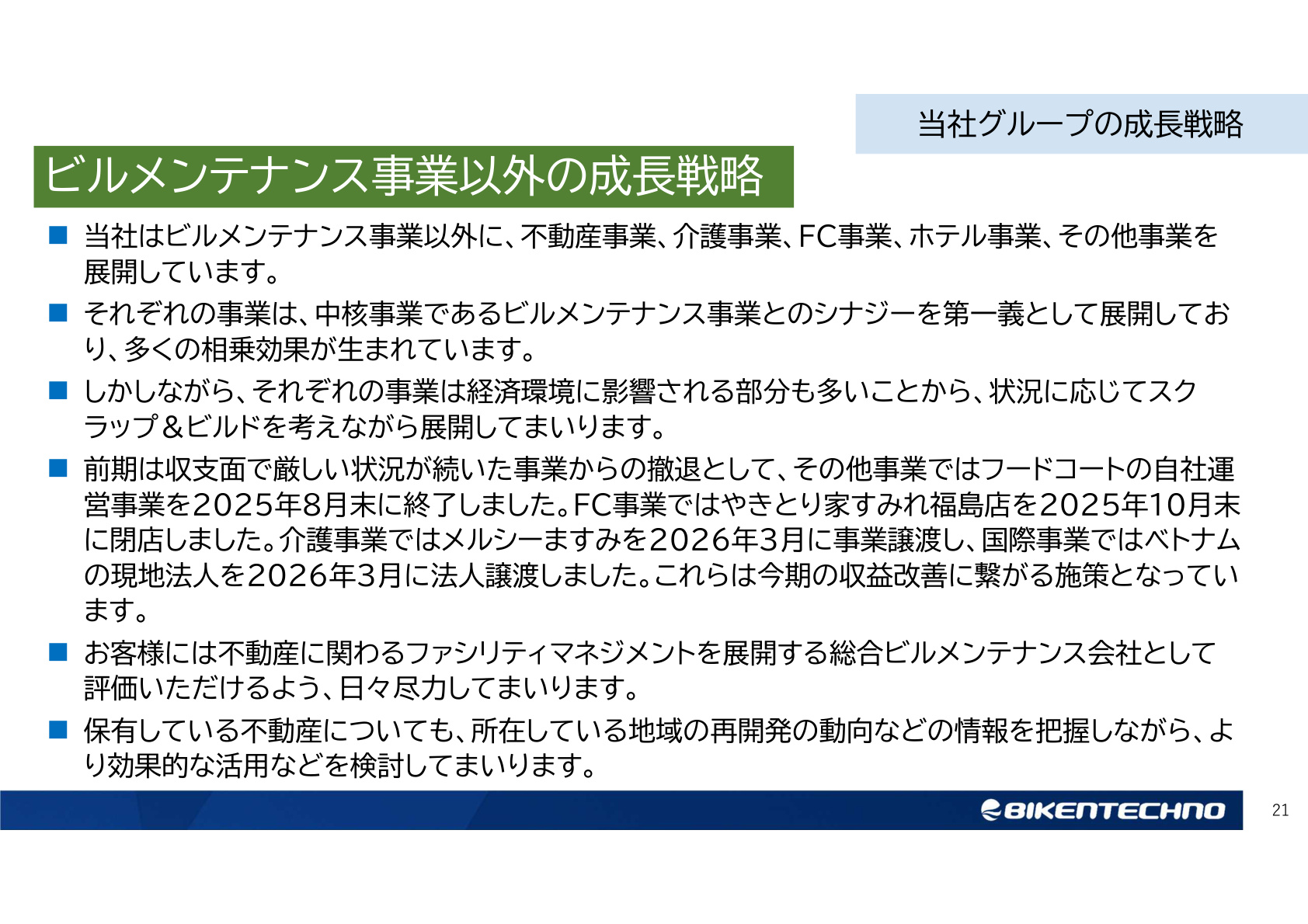
This slide is a key document illustrating specific examples of the "scrap-and-build" initiatives the group has undertaken to improve profitability and accelerate growth .
Key structural reforms implemented recently include:
- Other Businesses : Withdrawal from the in-house food court operation business (completed at the end of August 2025).
- FC Business : Closure of Yakitoriya Sumire Fukushima store (end of October 2025).
- Nursing Care Business : Business transfer of Merci Masumi (March 2026).
- International Business : Transfer of the Vietnam subsidiary (March 2026).
With the completion of these divestments, the company has removed loss-making factors, establishing a structure that will boost group-wide profitability from this term onward.
5. Group Strengths and Synergy Creation
Biken Techno is enhancing its comprehensive capabilities as a total facility management company by deepening collaboration with consolidated subsidiaries acquired through M&A.
Key group company highlights include:
- Best Property Co., Ltd. (Minato-ku, Tokyo): Specializes in property management (PM) for J-REIT properties, ranking 3rd nationwide and 1st in Tokyo's five central wards in terms of managed J-REIT properties.
- Sowa Kogyo Co., Ltd. (Setagaya-ku, Tokyo): Excels in the proprietary "Lambda Method," which eliminates the need for indoor scaffolding, strengthening its sales base in renovation fields such as ceiling panel work.
- Maimu Community Co., Ltd. (Minato-ku, Tokyo): Expanded from corporate housing management, management association support, and real estate brokerage into the management of condominium units.
- Kokura Kosan Co., Ltd. (Kitakyushu, Fukuoka): Participates in the securitization of large commercial buildings through LP (Limited Partner) investments, providing community-rooted maintenance services.
6. Shareholder Returns and Sustainability (SDGs)
【Shareholder Returns (Dividends and Perks)】
Reflecting its commitment to shareholder returns based on performance, the annual dividend per share has shown an upward trend:
- FY ended March 2022: 20 yen
- FY ended March 2023: 24 yen
- FY ended March 2024: 28 yen
- FY ended March 2025: 28 yen
- FY ended March 2026 (Actual): 36 yen
Regarding shareholder perks, the company has transitioned from traditional company products to digital gifts (effective from the end of March 2026) to improve shareholder convenience.
【Sustainability Strategy】
Under the slogan "Biken Techno: Advanced Technology," the company contributes to a sustainable society through energy conservation, DX, and robotics. Through initiatives such as Eco-Tuning, eco-friendly products, green procurement, and the employment and development of foreign talent, the company continues its efforts toward achieving the SDGs (Sustainable Development Goals) .
7. Conclusion
While Biken Techno's Q1 results showed a year-on-year decline in revenue and profit due to the normalization of Expo-related demand, the progress rate against full-year forecasts remains at a very high level , indicating solid underlying performance.
With the completion of business structural reforms (scrap-and-build) , such as the withdrawal from unprofitable businesses, the profit base has been strengthened. Combined with the robotization, DX promotion, and large-scale contract acquisitions in the core building maintenance business, as well as deepened collaboration with group subsidiaries, the company has built a robust foundation for sustainable corporate value enhancement.
This content is not intended as investment advice or a recommendation. Any opinions expressed are solely the personal views of each article.