

eREX Co., Ltd. (9517) Q1 FY2027 Earnings Deep Dive: A Comprehensive Analysis of Revenue Structure Reform and Global Decarbonization Strategy

StockClub
Published: Aug 10, 2026, 10:42 AM
Sentiment Analysis
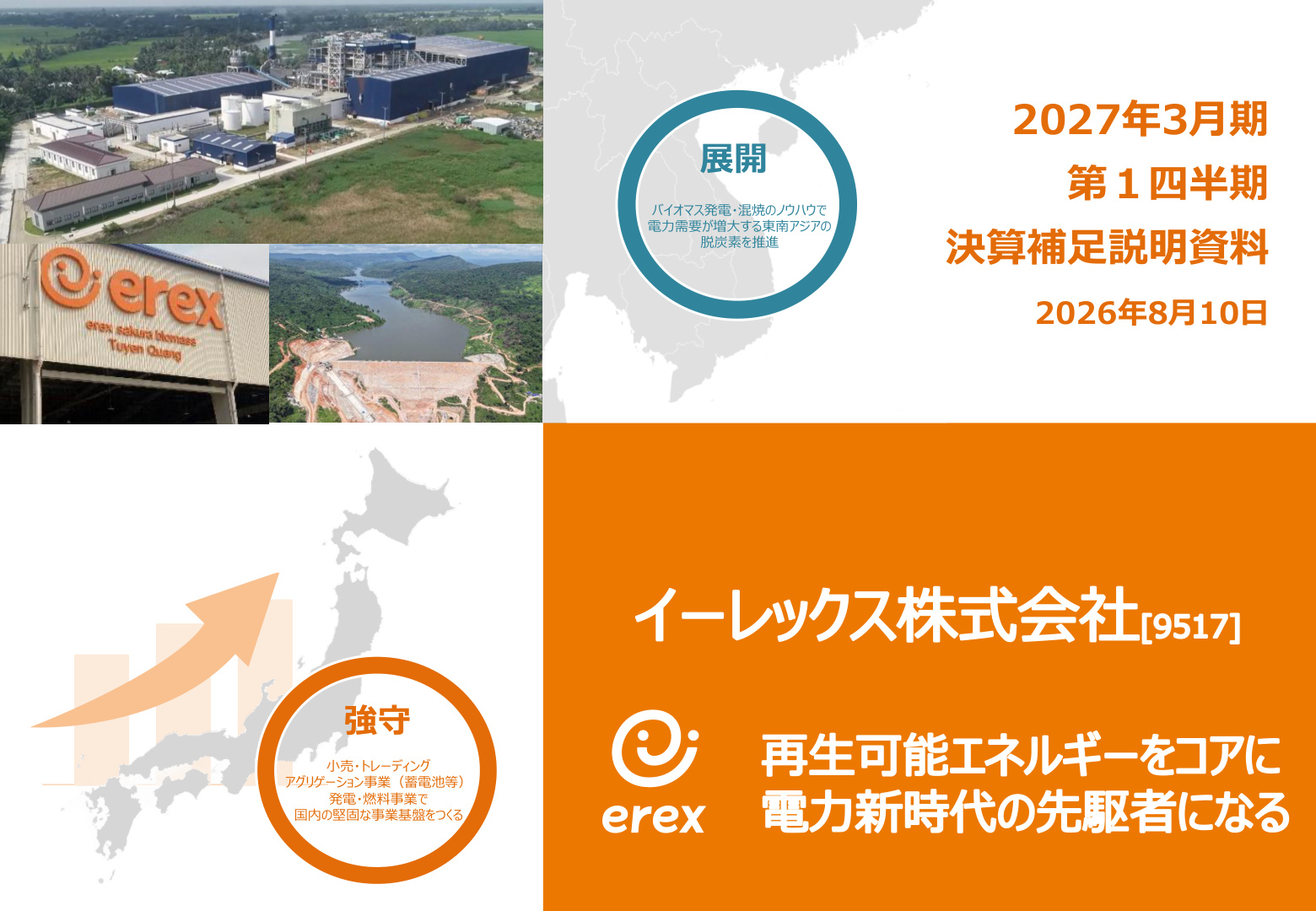
eREX Co., Ltd. (Securities Code: 9517) announced its financial results for the first quarter of the fiscal year ending March 31, 2027 (April 2026 – June 2026, IFRS). Driven by rising electricity market prices in Japan and improved operational performance in overseas projects, the company reported year-on-year growth in both revenue and net profit.
This report provides a comprehensive analysis based on the company's supplementary earnings materials, covering performance highlights, segment trends, the "Profit Creation Triangle" management strategy, and the progress of new decarbonization projects accelerating both domestically and internationally.
1. Q1 FY2027 Earnings Overview and Performance Highlights
Consolidated financial results for the first quarter are as follows:
- Revenue : ¥48.5 billion (up 31.0% YoY / +¥11.4 billion)
- Operating Profit : ¥0.6 billion (down 56.6% YoY / -¥0.8 billion)
- Profit Before Tax : ¥1.2 billion (up 132.3% YoY / +¥0.7 billion)
- Quarterly Profit Attributable to Owners of the Parent : ¥0.8 billion (compared to a loss of ¥0.1 billion in the same period last year)
Revenue grew significantly due to higher retail unit prices following the rise in wholesale electricity market prices, increased fuel sales, and improved overseas operations, reaching 20.2% of the full-year forecast (¥240.6 billion).
Conversely, operating profit declined year-on-year. The primary factors were higher procurement costs in the retail and trading business due to market price increases, the recording of temporary derivative losses , and the rebound effect from development fees recorded in the same period last year (IFRS adjustment of -¥0.6 billion). However, due to non-operating items such as foreign exchange gains resulting from the weak yen (financial profit of ¥0.6 billion, compared to a loss of ¥0.8 billion in the same period last year), the company achieved a V-shaped recovery (return to profitability) at the bottom line, with profit before tax at ¥1.2 billion (13.4% of full-year target) and quarterly profit at ¥0.8 billion (15.9% of full-year target).
Although the first quarter is seasonally weak, the company has made a solid start toward achieving its full-year targets (operating profit of ¥7.8 billion, net profit of ¥5.4 billion) through the onset of peak demand seasons, the return to profitability of the two initial projects in Vietnam, and gross margin improvement measures in high-voltage retail.
2. The "Overall Strategy" Supporting eREX's Competitive Advantage
The strength of eREX's business model lies in its integrated structure, which spans from fuel procurement to power generation and electricity supply, rather than focusing solely on retail.
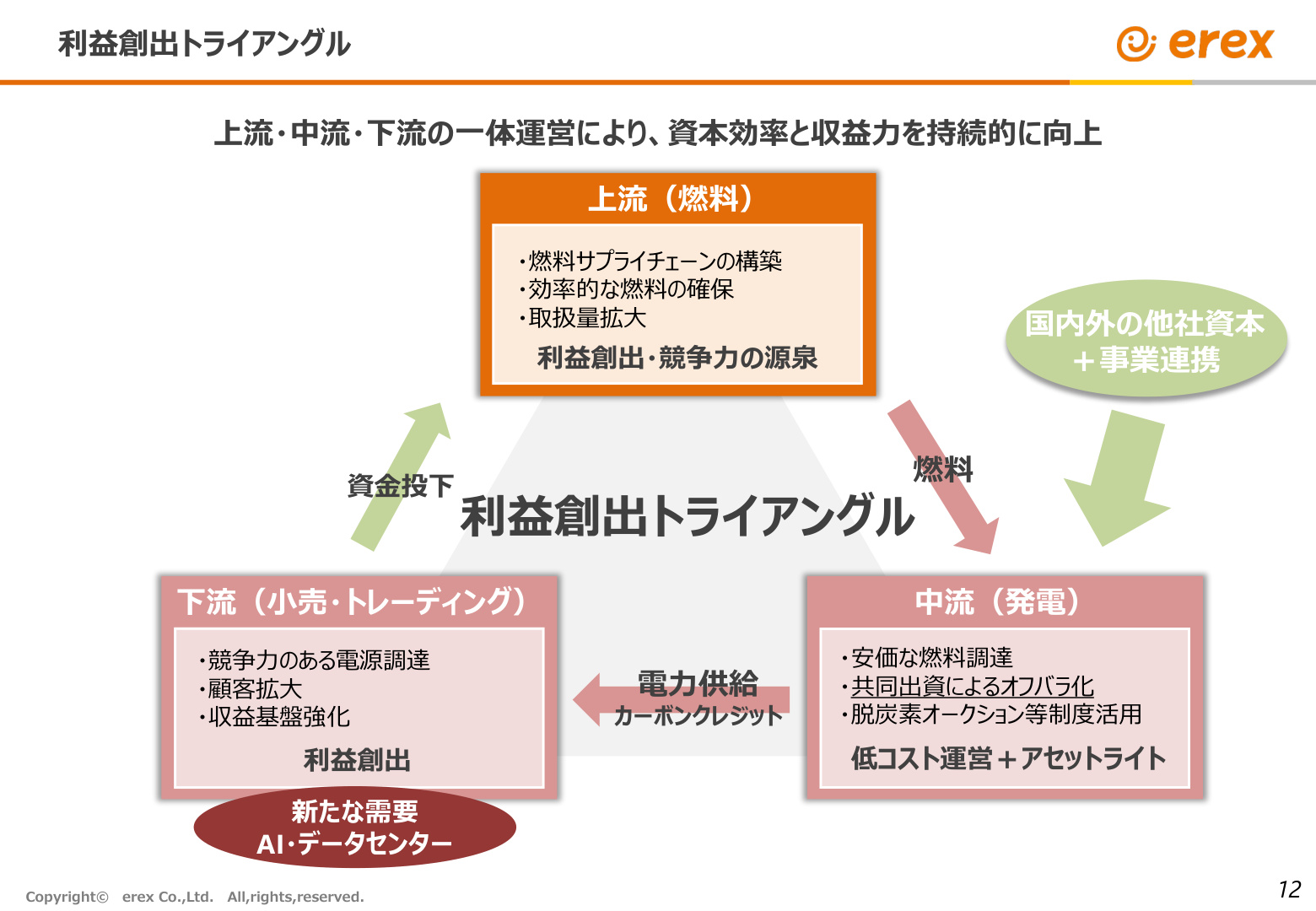
[Slide Commentary: Why the "Profit Creation Triangle" is Critical]
The slide above illustrates the overall business model eREX calls the "Profit Creation Triangle." In an environment of volatile energy markets, this structure ensures profitability across the entire business without relying on any single phase:
- Upstream (Fuel) : Building and securing an in-house supply chain for biomass fuel to maintain the competitive edge that serves as the source of profitability.
- Midstream (Generation) : Promoting off-balance sheet and asset-light operations through low-cost fuel procurement and joint ventures, while leveraging systems like decarbonization auctions.
- Downstream (Retail/Trading) : Expanding the customer base with competitive power procurement while adding high value through electricity supply to new high-demand sectors like AI and data centers, combined with carbon credits.
By integrating these upstream, midstream, and downstream operations and actively utilizing external capital and business partnerships, the company aims to achieve both high capital efficiency and sustainable profitability .
3. Domestic Business Trends: Retail, Trading, and Storage Battery Deployment
(1) Retail and Trading Segment Performance and KPI Progress
In Q1, the retail and trading segment reported revenue of ¥53.8 billion (up ¥13.1 billion YoY) and an operating profit of ¥1.6 billion (down ¥0.3 billion YoY).
- High-Voltage Retail : Electricity sales volume reached 664 GWh (up 5.3% YoY), with revenue of ¥14.9 billion (up 21.8% YoY). To counter rising wholesale market prices caused by factors such as the situation in the Strait of Hormuz, the company is improving gross margins by encouraging customers to switch from market-linked plans to fixed-price plans utilizing futures . Contract capacity reached 1,076 MW , exceeding the target of 1,064 MW.
- Low-Voltage Retail : Revenue was ¥7.9 billion (up 9.4% YoY), and the number of supply contracts reached 273,000 (up 1.9% YoY), with strong new acquisitions primarily through real estate channels.
(2) Acceleration of Grid-Scale Battery Business
To meet the need for power grid stabilization accompanying the expansion of renewable energy, the company is strengthening investments in grid-scale battery storage .
- Kushima City, Miyazaki Prefecture (Unit 1) : In August 2026, the company began its first transaction in the supply-demand adjustment market for "Primary Adjustment Power (Offline)." Future plans include maximizing revenue through multi-use operations combining secondary and tertiary adjustment power, the wholesale electricity market, and the capacity market.
- Kameoka City, Kyoto Prefecture (Unit 3) : The company concluded an investment decision and construction contract for a storage facility with an output of 2 MW and a capacity of 8 MWh , with operations scheduled to begin in Q1 of FY2027.
4. Decarbonization Auctions and Large-Scale Project Promotion
The most significant topic in the domestic power generation business is the acquisition of a long-term fixed-income model.
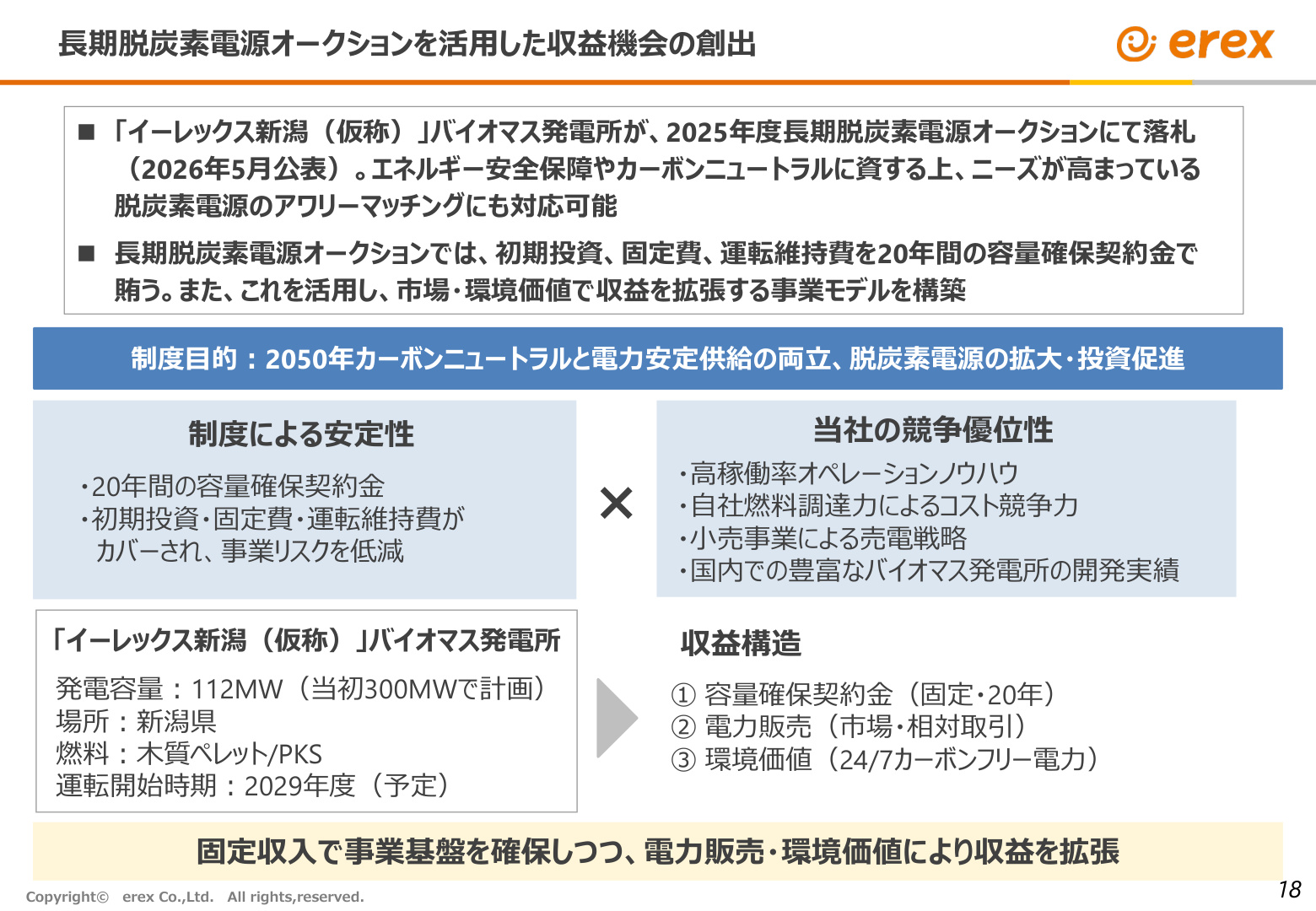
[Slide Commentary: Significance of the Long-Term Decarbonization Power Auction]
This slide presents the business model for the "eREX Niigata (tentative name) Biomass Power Plant" (112 MW output, scheduled to begin operations in FY2029), which was successfully bid in the FY2025 Long-Term Decarbonization Power Auction .
The key point of this project is the mechanism that guarantees the recovery of initial investment, fixed costs, and operating/maintenance costs as "Capacity Assurance Contract Payments" over a 20-year period . By combining the "business stability" provided by the system with the company's competitive advantages—"high-utilization operations" and "in-house fuel procurement cost efficiency"—eREX expects to expand profits through market electricity sales and environmental value (24/7 carbon-free electricity) while maintaining a stable fixed income base.
Furthermore, in July 2026, the company signed an MOU with Samsung C&T Japan to jointly develop the "Niigata Integrated Decarbonization Project," initiating joint studies on biomass fuel supply, storage battery projects, and new business opportunities in the AI era.
5. Overseas Business Trends: Growth Strategy in Southeast Asia
Overseas segment revenue increased to ¥1.1 billion (up ¥1.0 billion YoY), reflecting steady progress in building a business foundation in Southeast Asia.
(1) Projects in the Cambodian Market
- Hydropower (Pursat Province, 80 MW) : Construction of the dam embankment and diversion tunnels is complete. The sluice gates were closed in June 2026, and impoundment has begun . The project is progressing steadily toward commercial operation in January 2027 (a 35-year PPA has been signed with Electricité du Cambodge).
- Biomass Power (Kampong Speu Province, 50 MW) : In July 2026, the project was selected for the FY2025 "Joint Crediting Mechanism (JCM) Equipment Subsidy Project." Using wood residue as fuel, the company aims to begin operations within FY2027.
(2) Profitability Measures and Coal Co-firing in Vietnam
- Profitability of Initial Two Projects : For the Hau Giang Biomass Power Plant (20 MW, 82% utilization rate in Q1) and the Tuyen Quang Pellet Factory (150,000 tons/year), the company is pushing for higher utilization rates, expanding procurement of low-cost raw materials like veneer residue, and negotiating higher electricity sales prices.
- Biomass Co-firing at Existing Coal Plants : Co-firing tests have been completed at coal-fired power plants owned by Vinacomin Power (Na Duong, Cao Ngan). The co-firing test for the third plant, Nong Son Coal-Fired Power Plant (30 MW) , scheduled to begin in September 2026, has been selected for a support project by the Ministry of Economy, Trade and Industry (METI). The company is expanding its business to meet robust power demand in Southeast Asia while supporting decarbonization.
6. Earnings Outlook and Roadmap for New Businesses
The revenue impact and schedule for new projects launching over the next few years are summarized below.
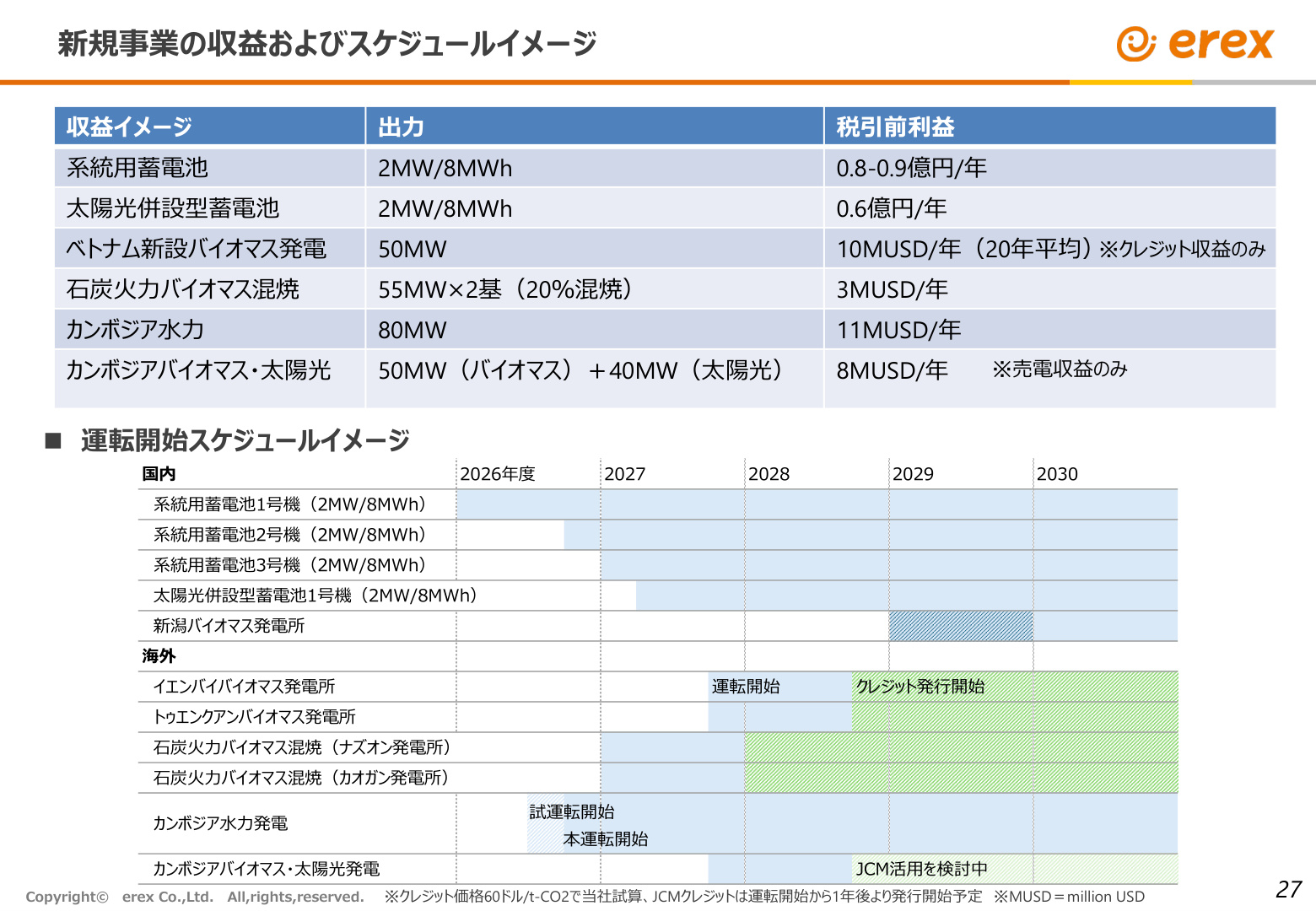
[Slide Commentary: Key Points of the New Business Earnings and Schedule Image]
The slide above shows a medium- to long-term roadmap indicating the future profit-before-tax contributions of new domestic and international projects currently under development or in the startup phase.
- Domestic Storage Batteries (Units 1-3, etc.) : Contribution of ¥80–90 million/year in profit before tax (ramping up sequentially from FY2026–2027).
- New Vietnam Biomass (50 MW) : Projected $10 million/year (20-year average) from credit revenue alone.
- Coal-Fired Biomass Co-firing (55 MW x 2 units, etc.) : Contribution of $3 million/year (from FY2026 onwards).
- Cambodia Hydropower (80 MW) : Contribution of $11 million/year (commercial operation scheduled for January 2027).
- Cambodia Biomass/Solar (50 MW + 40 MW) : Projected $8 million/year from electricity sales alone.
Starting with the launch of domestic storage batteries, the full-scale operation of large overseas projects (Cambodian hydropower, Vietnamese biomass, etc.) from FY2027 to FY2028 is expected to significantly elevate the company's medium- to long-term earnings base.
7. Financial Position and Shareholder Returns
(1) Consolidated Balance Sheet (B/S) Overview
As of the end of Q1 FY2027, total assets were ¥173.7 billion (up ¥3.6 billion from the end of the previous fiscal year). Non-current assets increased due to the rise in construction in progress for the Vietnam projects. Total liabilities were ¥97.2 billion (up ¥4.8 billion), and total equity was ¥76.5 billion (down ¥1.1 billion). The equity ratio attributable to owners of the parent stood at 40.7% (compared to 41.4% at the end of the previous fiscal year), maintaining a healthy level in the 40% range.
(2) Establishment of Shareholder Benefit Program
To improve stock liquidity and expand the investor base, the company launched the "eREX Premium Benefit Club" website in May 2026. Shareholders holding 300 shares or more as of the end of March and September each year receive benefit points (redeemable for over 5,000 items including gourmet food, home appliances, and experience gifts) based on the number of shares held, aimed at strengthening engagement with shareholders.
Conclusion
eREX's Q1 FY2027 results, while including temporary factors for operating profit decline, achieved revenue growth and a return to net profitability , demonstrating steady progress toward full-year targets. With market risk mitigation in domestic retail, the acquisition of a 20-year stable income base through long-term decarbonization auctions, the start of full-scale grid-scale battery operations, and the increasing operation of large-scale decarbonization projects in Southeast Asia (Cambodia and Vietnam), the company's growth story as a "leading company in renewable energy and decarbonization" is steadily materializing.
This content is not intended as investment advice or a recommendation. Any opinions expressed are solely the personal views of each article.