


In-Depth Earnings Report: GMS Group (544A) Q1 FY2027 Results – A New Chapter Following Business Integration, PMI Progress, and the Path to Full-Year Profitability

StockClub
Published: Aug 10, 2026, 10:20 AM
Sentiment Analysis
GMS Group Co., Ltd. (Securities Code: 544A) has announced its consolidated financial results for the first quarter of the fiscal year ending March 31, 2027 (April 1, 2026, to June 30, 2026), marking the company's first reporting period under the new group structure formed by the business integration of Nissei Plastic Industrial and TOYO INOVEX. This report provides a comprehensive analysis of the earnings highlights, regional and product-specific performance, financial position, full-year outlook, and the progress of Post-Merger Integration (PMI) and future synergies based on the released supplementary materials.
1. Q1 FY2027 Consolidated Earnings Highlights
For the first quarter, consolidated net sales reached 16,942 million yen (+6.4% YoY), while operating loss was 639 million yen (compared to a 133 million yen loss in the same period last year). Ordinary loss stood at 231 million yen (compared to a 320 million yen profit in the same period last year), and quarterly net income attributable to owners of the parent surged to 6,110 million yen (compared to 124 million yen in the same period last year, an increase of 5,986 million yen ).
In terms of revenue, the company achieved year-on-year growth driven by significant expansion in the Asian region , particularly in the automotive and consumer goods sectors in China and India. Conversely, profitability was impacted by rising material costs due to the prolonged depreciation of the yen, unfavorable energy costs, and under-absorption of fixed costs resulting from lower production volumes, leading to an expanded operating loss.
However, the final bottom line—net income attributable to owners of the parent—recorded a substantial increase due to the recognition of a 6,596 million yen gain on negative goodwill as an extraordinary profit following the business integration.
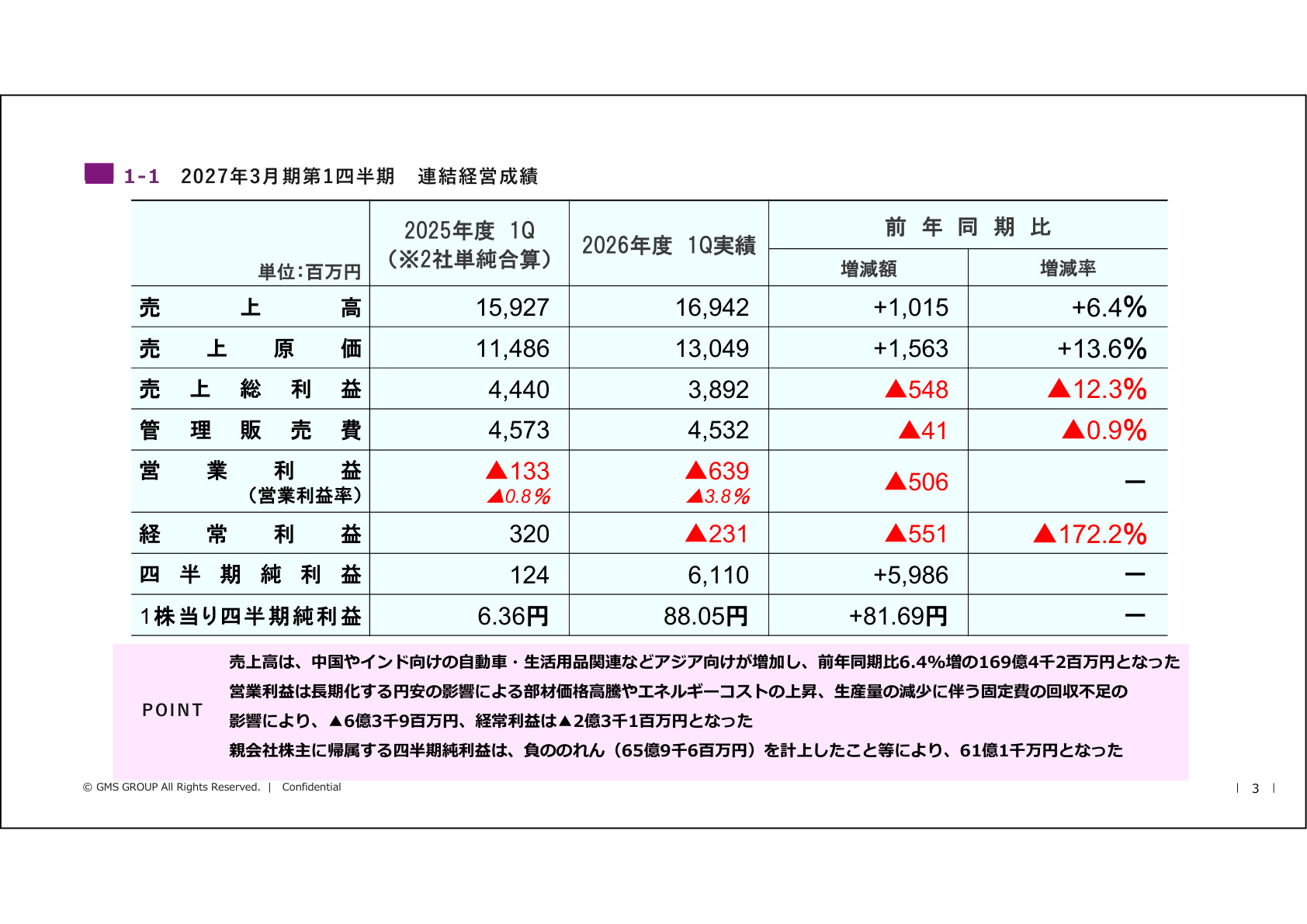
[Significance and Background of Slide 3]
This slide is critical for understanding the overall consolidated performance following the launch of the GMS Group. While sales grew by 6.4% compared to the simple combined figures of the two companies in Q1 FY2025, the cost of sales ratio rose from 72.1% to 77.0% (cost of sales increased by 13.6% to 13,049 million yen ), highlighting the structural pressure of rising costs on margins. Furthermore, the data clearly illustrates the unique nature of this quarter's results: the operating and ordinary losses were offset by the accounting treatment of negative goodwill (6,596 million yen) , which significantly boosted the final net income.
2. Regional and Product-Specific Performance Analysis
(1) Regional Trends: Rapid Expansion in Asia vs. Sluggishness in Japan, Europe, and the US
Regional sales and operating profit trends are as follows:
- Japan : Sales of 4,243 million yen (-5.1% YoY), operating loss of 261 million yen (vs. 215 million yen loss in the same period last year). The loss widened due to declining sales.
- Europe/US : Sales of 4,743 million yen (-9.3% YoY), operating loss of 212 million yen (vs. 140 million yen loss in the same period last year). Operating performance deteriorated due to reduced demand.
- Asia : Sales of 7,956 million yen (+27.8% YoY), operating loss of 111 million yen (vs. 56 million yen loss in the same period last year). Despite strong growth in automotive and consumer goods, the region posted an operating loss due to intensifying price competition and increased cost burdens.
As a result, Asia's share of total company sales rose to 47% (up from 39% in the same period last year), establishing it as the primary driver of the group's top-line growth.
(2) Product-Specific Sales Trends
An analysis of the product mix reveals the strengths of the business structure:
- Injection Molding Machines (including peripherals and molds) : Sales of 12,633 million yen (+955 million yen YoY), supported by demand in China and India.
- Die-Cast Machines : Sales of 933 million yen (-574 million yen YoY), hit by declining automotive demand in China and Vietnam.
- Services and Parts : Sales of 3,376 million yen (+634 million yen YoY), bolstered by strong support demand for existing machines in China and Vietnam, providing a stable, high-margin revenue stream.
3. Business Environment and Order Trends
Market conditions vary by product line:
- Injection Molding Machines : Since 2025, demand for small molding machines (under 200 tons) for semiconductors and AI data servers has been on an upward trend. Future growth is expected in cutting-edge fields such as humanoid robots and physical AI .
- Die-Cast Machines : Global automotive investment recovery is lagging due to the slowdown in the EV shift and geopolitical conflicts in Ukraine and the Middle East. Additionally, the market faces intense price competition from local manufacturers in major markets (China, India, Asia), putting pressure on order volumes for Japanese-made machines.
4. Financial Structure and Balance Sheet (B/S)
The business integration has significantly expanded and transformed the GMS Group's financial foundation.
Total assets post-integration reached 122,472 million yen . This reflects the consolidation and restructuring of the former Nissei Plastic Industrial (85,763 million yen) and the former TOYO INOVEX (32,588 million yen). Key assets include 15,285 million yen in cash and deposits, 16,803 million yen in trade receivables, and 44,609 million yen in inventories. While interest-bearing debt stands at 39,473 million yen , the company maintains a healthy financial position with 61,950 million yen in net assets, an equity ratio of 49.9% , and a book value per share (BPS) of 879.99 yen .
5. Full-Year Consolidated Earnings Forecast for FY2027
Despite starting the first quarter with an operating loss, the company anticipates a significant recovery for the full fiscal year ending March 31, 2027.
- Full-Year Sales : 81,000 million yen (+7.1% YoY)
- Full-Year Operating Profit : 1,270 million yen (a V-shaped recovery of +2,677 million yen from the previous year's 1,407 million yen loss, with an operating margin of 1.6%)
Regional sales plans also project growth across all areas: Japan at 22,400 million yen (+3.6%), Europe/US at 26,400 million yen (+7.6%), and Asia at 32,200 million yen (+9.4%).
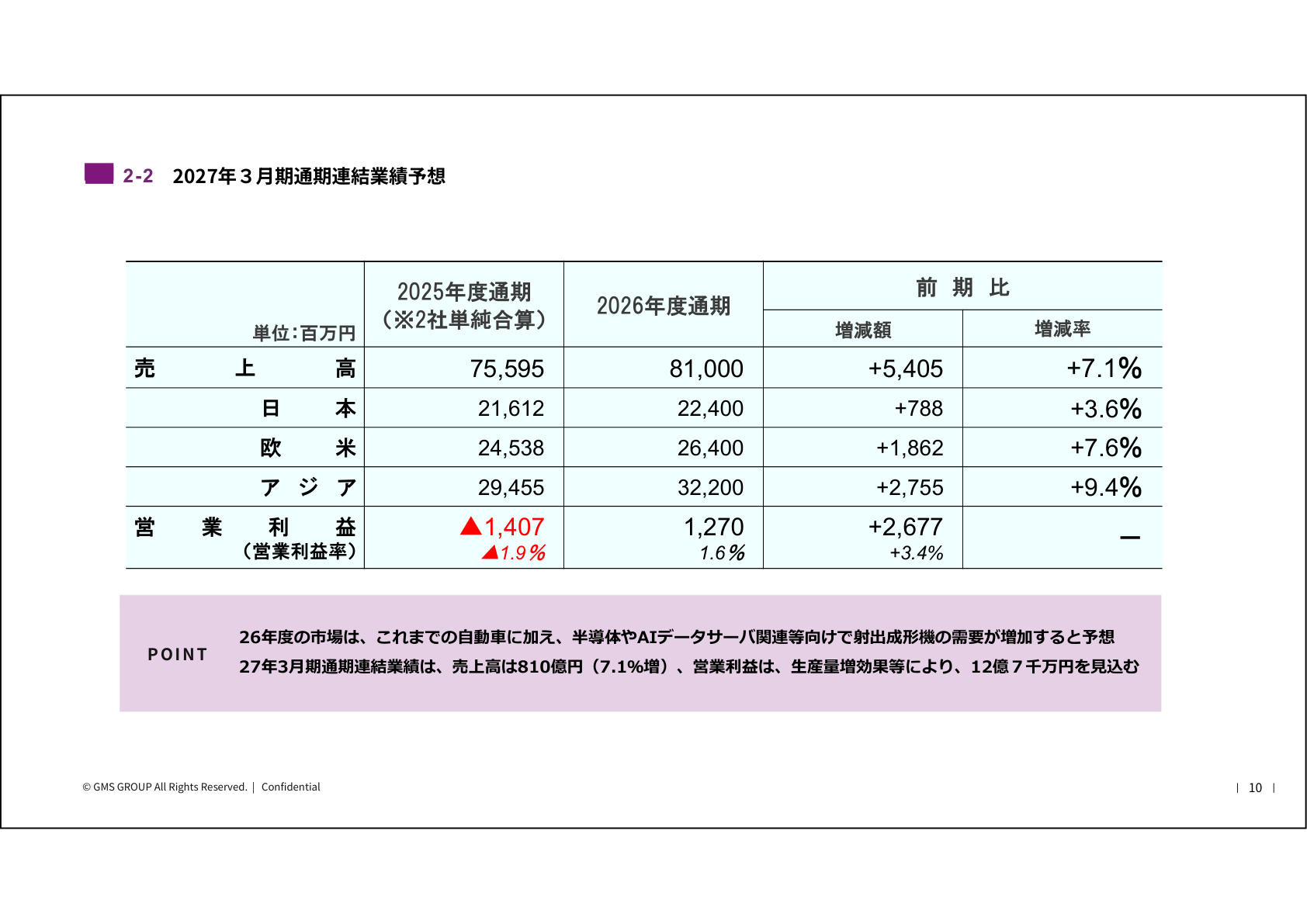
[Significance and Background of Slide 10]
This slide outlines the logic for achieving full-year profitability despite the Q1 operating loss. While the company struggled with unabsorbed fixed costs and high material prices in Q1, it expects to achieve over 2.6 billion yen in operating profit improvement by the second half, driven by a recovery in automotive demand, the capture of demand for AI/semiconductor-related small molding machines, and improved capacity utilization (fixed cost absorption effect) .
6. Shareholder Return Policy and Dividend Forecast
The company views shareholder returns as a key management priority, aiming for stable dividends based on free cash flow while balancing growth investments.
- Interim Dividend : Planned at 5.00 yen per share for the second quarter.
- Year-End Dividend : Currently undecided . The company is refining its capital allocation strategy as part of its first Medium-Term Management Plan, which will be announced in November 2026 .
7. PMI Progress and Future Synergy Creation
Since the establishment of the GMS Group in April 2026, the company has spent its first 100 days (the "100-Day Plan") understanding both businesses and identifying integration synergies. The following sales and cost synergies have been identified:
(1) Sales Synergy Initiatives
- Cross-selling for market share expansion (Short-term): Mutual proposal of complementary product lines.
- Shared service centers and personnel (Medium-term): Strengthening global customer support.
- Development of new elemental technologies (Long-term): Combining technical expertise for next-gen machines.
- Shift to solution-based business (Long-term): Moving from selling hardware to selling solutions.
(2) Cost Synergy Initiatives
- Mutual use of manufacturing bases (Short-term): Optimizing production efficiency.
- Joint/Centralized procurement (Short-term): Reducing procurement costs for key components.
- Component optimization and technical integration (Medium-term): Standardizing parts and integrating plasticization technology.
- Rationalization of overlapping products/functions (Short-term to Long-term): Consolidating product lineups and restructuring factory roles.
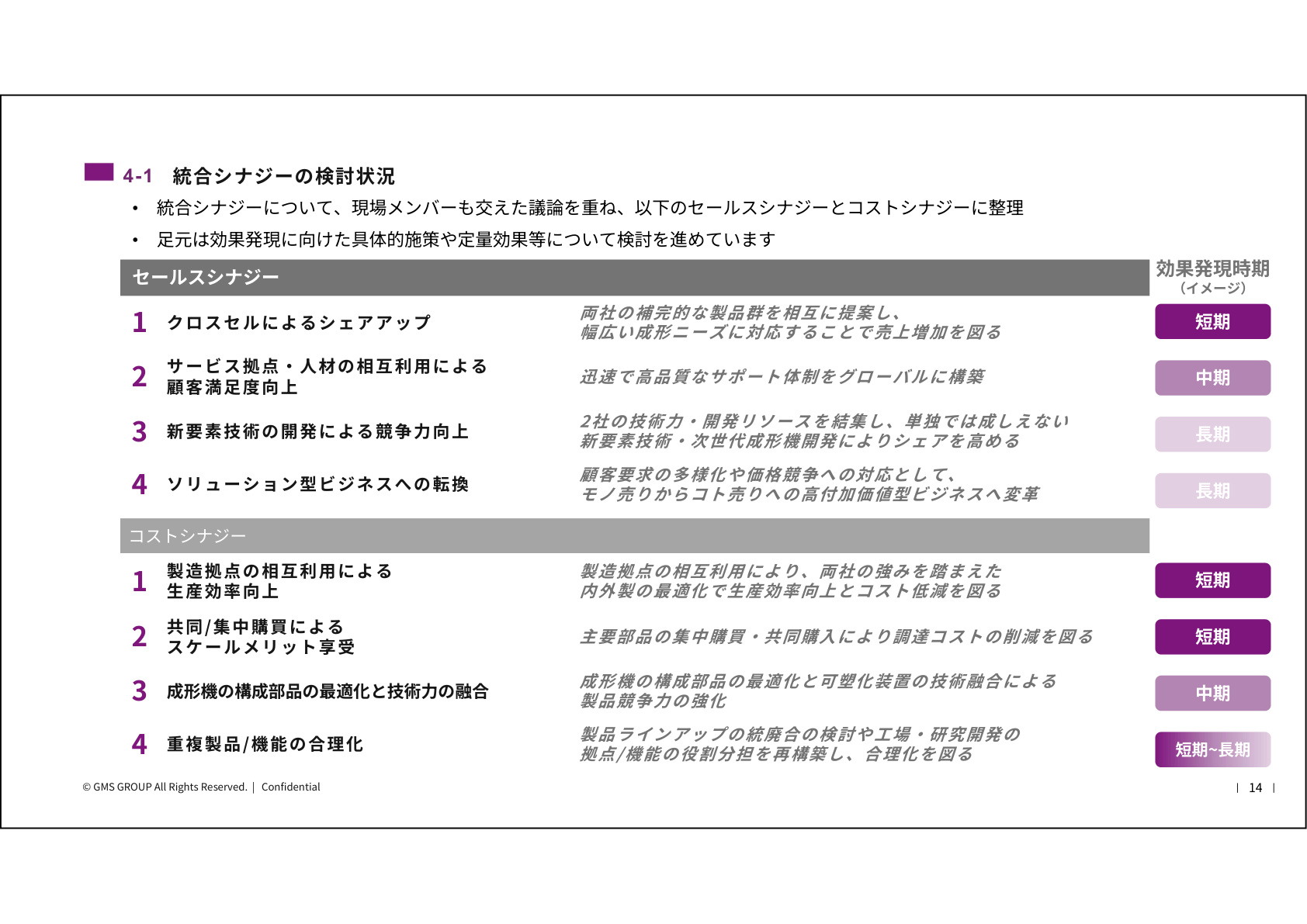
[Significance and Background of Slide 14]
This is the most important slide for evaluating whether the integration will create true value. It outlines "when," "in which area," and "what effect" will occur over a specific timeline. Short-term cost synergies, such as shared manufacturing bases and joint procurement, are expected to be powerful levers to overcome current margin pressures. Furthermore, the company has set a milestone to announce its "Medium-Term Management Plan" in November 2026 , which will include quantitative targets for these synergies.
8. Summary and Conclusion
In Q1 FY2027, the GMS Group navigated the transition period following its integration, recording an operating loss due to high material costs and fixed cost burdens, while simultaneously achieving overwhelming sales growth in the Asian market and a significant bottom-line profit due to negative goodwill.
Moving forward, the key to long-term corporate value will be the company's ability to capture demand for AI/semiconductor-related small molding machines and the extent to which the quantitative effects of integration synergies —to be detailed in the November Medium-Term Management Plan—can support the V-shaped recovery in operating profit (1.27 billion yen for the full year).
This content is not intended as investment advice or a recommendation. Any opinions expressed are solely the personal views of each article.