


Modalis (4883) Q2 FY2026 Earnings and Business Progress Deep Dive Report

StockClub
Published: Aug 10, 2026, 10:14 AM
Sentiment Analysis
Modalis (4883) Q2 FY2026 Earnings and Business Progress Deep Dive Report
Based on the Q2 FY2026 financial results and business progress presentation materials of Modalis Inc. (Securities Code: 4883), this report provides a comprehensive analysis of the company's core technology, pipeline progress, financial foundation, and future growth strategy.
1. Financial Highlights and Capital Base
Expense Structure and Profit/Loss Status
The financial results for the first half of the fiscal year ending December 2026 reflect the full-scale preparation activities for the clinical trials of the lead program, "MDL-101."
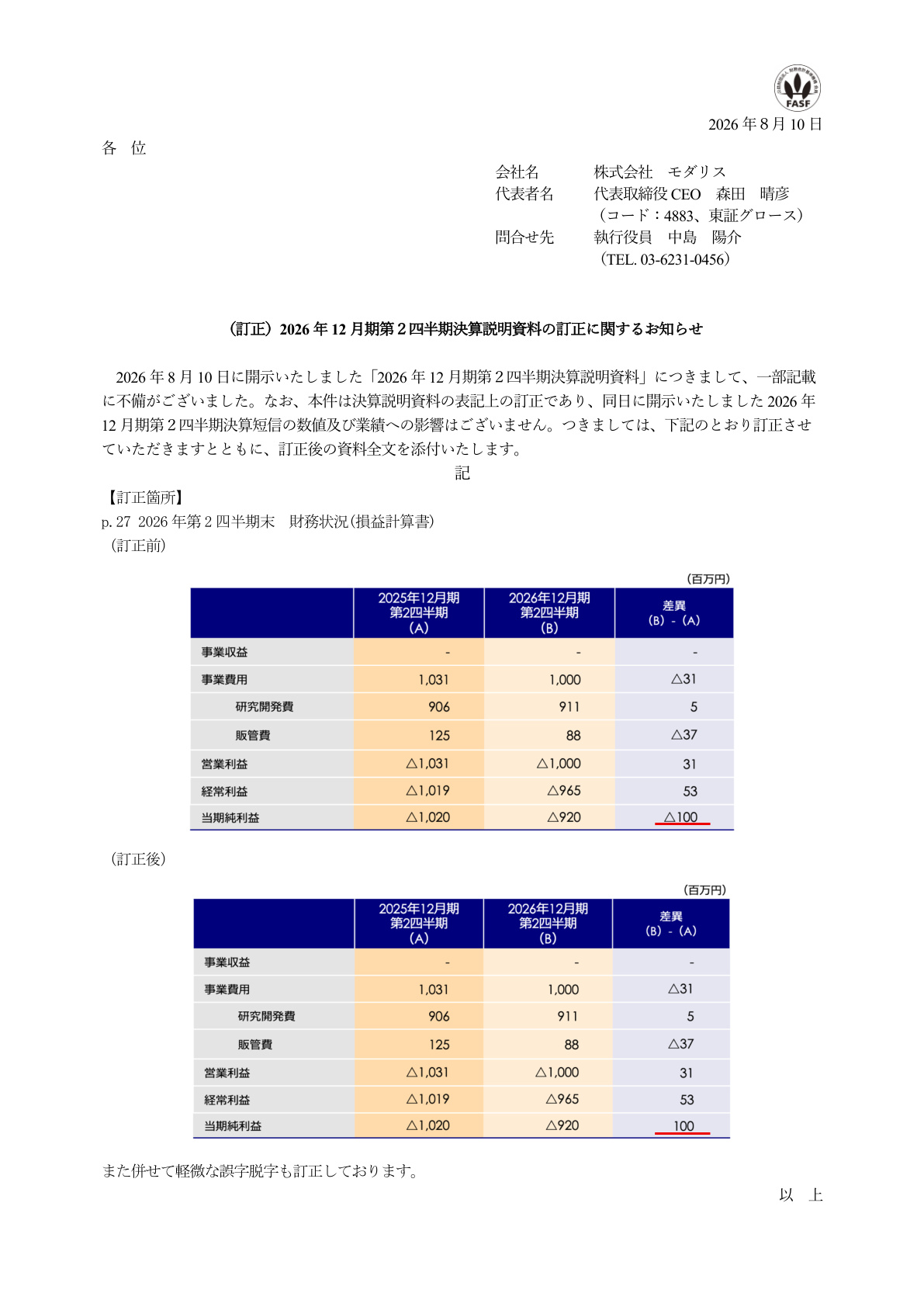
- Operating Revenue : 0 million JPY (Previous year: 0 million JPY)
- Operating Expenses : 1,000 million JPY (Previous year: 1,031 million JPY, a decrease of 31 million JPY YoY)
- R&D Expenses : 911 million JPY (Previous year: 906 million JPY, an increase of 5 million JPY YoY)
- SG&A Expenses : 88 million JPY (Previous year: 125 million JPY, a decrease of 37 million JPY YoY)
- Operating Profit : -1,000 million JPY (Previous year: -1,031 million JPY)
- Ordinary Profit : -965 million JPY (Previous year: -1,019 million JPY)
- Net Profit : -920 million JPY (Previous year: -1,020 million JPY)
Consistent with the business model of a drug discovery biotech venture, the company generates no operating revenue during the independent development phase. Meanwhile, R&D expenses account for 911 million JPY , representing the majority of operating costs, demonstrating a steady commitment to transitioning into clinical development.
Balance Sheet and Cash Position
The status of assets, liabilities, and net assets as of the end of Q2 FY2026 is as follows:
- Cash and Deposits : 3,015 million JPY (Increase of 203 million JPY from end of FY2025)
- Total Assets : 3,136 million JPY (Increase of 172 million JPY from end of FY2025)
- Current Liabilities : 669 million JPY (Increase of 535 million JPY from end of FY2025)
- Total Net Assets : 2,462 million JPY (Decrease of 330 million JPY from end of FY2025)
- Equity Ratio : 76.9% (End of FY2025: 93.0%)
Due to the exercise of stock acquisition rights and the issuance of straight bonds (300 million JPY) mentioned later, liquidity has been improved and maintained with cash and deposits at 3,015 million JPY . Although the equity ratio has declined from the end of the previous year, it remains robust at 76.9% .
2. Proprietary Platform "CRISPR-GNDM®" and Market Positioning
Technical Features: Epigenome Editing Without DNA Cleavage
Modalis's greatest strength lies in its proprietary gene regulation platform, "CRISPR-GNDM® (Guide Nucleotide-Directed Modulation)." While conventional CRISPR-Cas9 technology modifies genes by cutting DNA, CRISPR-GNDM® utilizes dCas9 , which has lost its cleavage activity.
- gRNA (guide RNA) directs the system to the target genomic site (acting as a pointer).
- dCas9 binds to the target DNA (acting as a binder).
- The bound epigenome editor modifies the switch portion of the genome, controlling the expression of the target gene to be "ON (activation)" or "OFF (suppression)."
Because it does not cut DNA, a major feature is the ability to avoid the risk of irreversible genomic damage .
Competitive Advantage in Epigenome Editing
While various biotech companies worldwide are developing epigenome editing (e.g., Tune, nChroma, Epicrispr, Epigenic, Scribe, Mammoth), many of their lead programs focus on "gene suppression (OFF)" for conditions like hypercholesterolemia or Hepatitis B.
In contrast, Modalis's "MDL-101" employs a "gene activation (ON)" approach for rare diseases, establishing a world-leading position in the field of gene activation via epigenome editing .
3. Deep Dive Analysis of Lead Pipeline "MDL-101"
Target Disease and Innovative Approach
MDL-101 targets LAMA2-RD (LAMA2-related congenital muscular dystrophy type 1A; CMD1A) , a severe designated intractable disease caused by mutations in the LAMA2 gene, leading to significant muscle weakness and hypotonia shortly after birth. With an incidence of approximately 8.3 per million (approx. 2,500 patients in the U.S.), there is currently no fundamental treatment. The market size is estimated at $500 million (over 50 billion JPY) .
Because the LAMA2 gene is large (approx. 9kb), it exceeds the capacity of standard AAV (Adeno-Associated Virus) vectors used in gene therapy, making direct gene supplementation impossible. Modalis devised a unique approach using CRISPR-GNDM® to turn "ON" the sister gene "LAMA1," which is normally dormant in muscle, to compensate for the function of LAMA2.
Strong Efficacy Data in Non-Clinical (IND-enabling) Studies
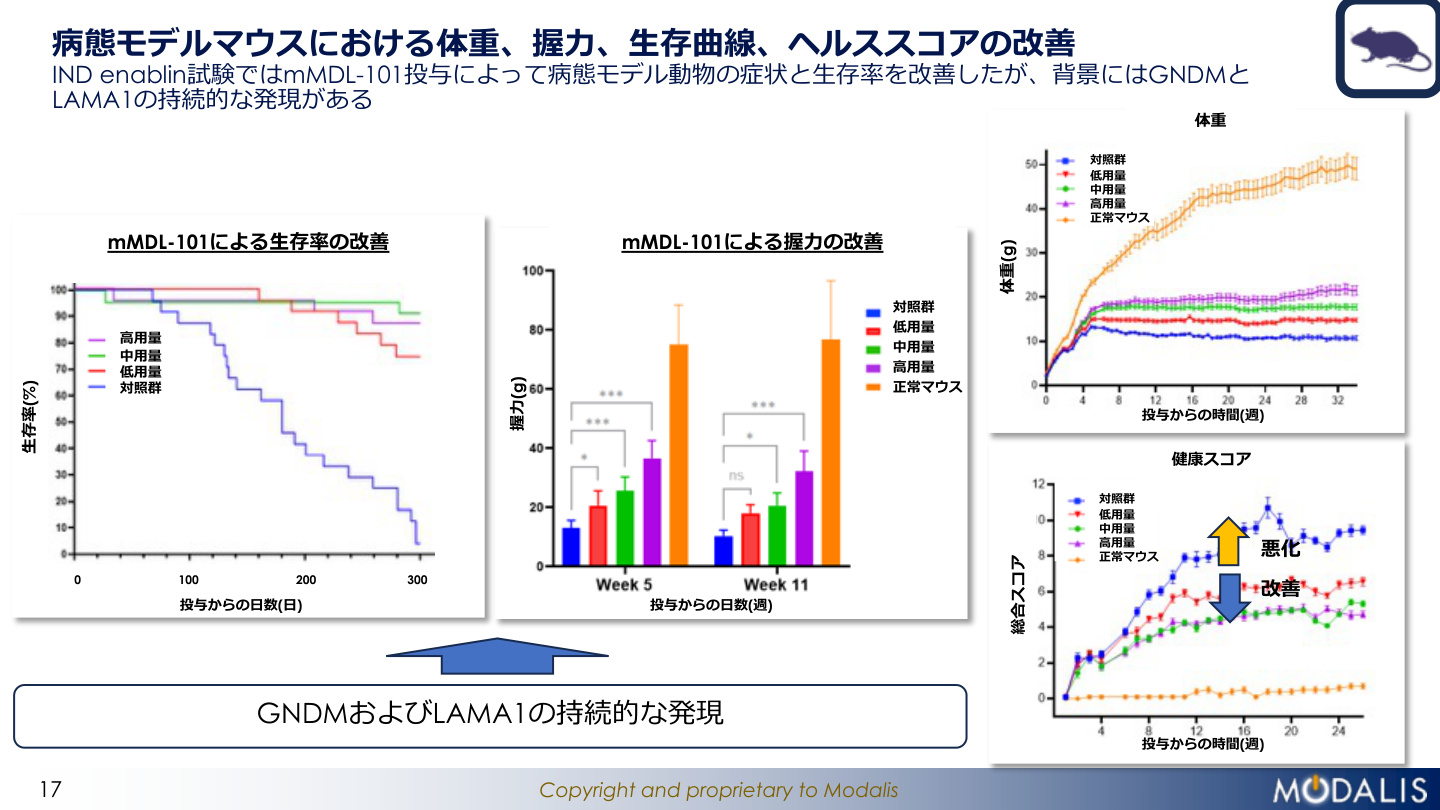
Dramatic effects were observed in studies using disease model mice treated with MDL-101 (mMDL-101).
Significance and Background of Slide 17
The slide above is critical non-clinical data visually proving the high disease-modifying efficacy of MDL-101 . As shown in the graph, while the untreated control group (blue line) shows a rapid decline in survival rate and significant deterioration in health scores, the groups treated with high-to-medium doses of mMDL-101 show a remarkable improvement in survival rates . Furthermore, grip strength tests at 5 and 11 weeks post-administration confirmed statistically significant recovery of muscle function compared to the control group, along with the suppression and improvement of health score deterioration . This data confirms that GNDM and LAMA1 are expressed sustainably in the body, fundamentally improving the pathology itself , providing a solid scientific basis (PoC) for transitioning to human clinical trials.
4. Detailed Roadmap and Workstreams for IND Filing
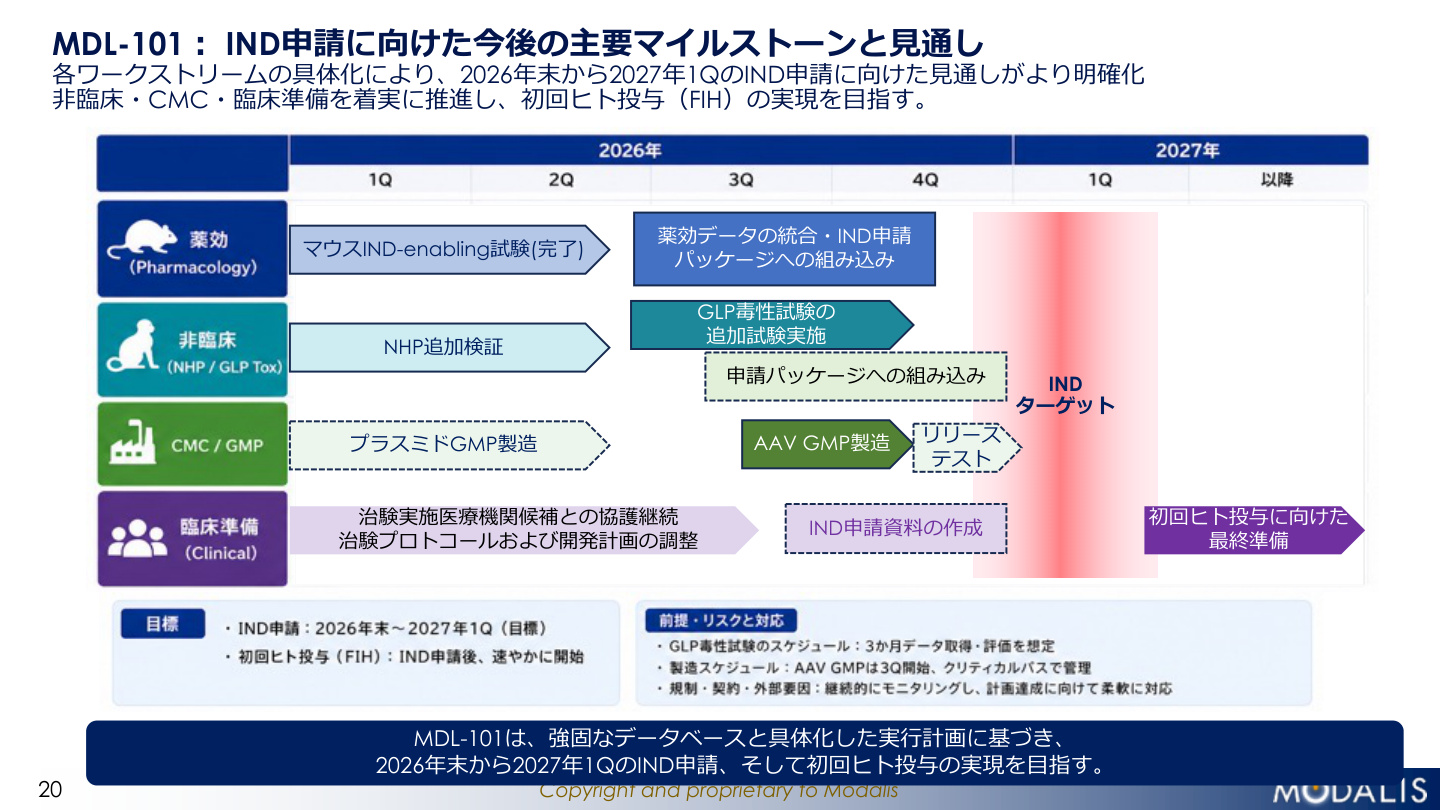
Modalis is steadily advancing its workstreams with the goal of a U.S. IND (Investigational New Drug) application in late 2026 to Q1 2027 , followed by First-in-Human (FIH) dosing .
Significance and Background of Slide 20
The slide above presents the company-wide timeline and risk management structure for initiating MDL-101 clinical trials . In biotech venture investment, the realism of the plan and the visibility of progress are among the most important factors.
The slide shows that the following key workstreams are being executed in parallel with high precision:
- Pharmacology : Mouse IND-enabling studies are already complete.
- Non-clinical (NHP / GLP Tox) : Additional verification using Non-Human Primates (NHP) is underway, with additional GLP toxicity studies scheduled to begin in early September 2026 (3-month data acquisition and evaluation).
- CMC / GMP : Prioritizing plasmid GMP manufacturing , with AAV GMP manufacturing scheduled to begin in Q3 2026.
- Clinical : Ongoing discussions with potential clinical trial sites and adjustments to clinical protocols.
By advancing these four axes in synchronization, the company has clearly demonstrated an increased probability of achieving a U.S. IND application between late 2026 and Q1 2027.
Clinical Trial Design (MDL-101-001)
The planned Phase 1/2 clinical trial is an open-label dose-escalation study targeting LAMA2-deficient patients aged 5 and under . Safety and efficacy will be evaluated in low-dose (N=3) and high-dose (N=3) cohorts via single intravenous (IV) administration, with a comparative analysis against natural history study data planned.
5. Financial Strategy and Future Growth Scenario
Finance Strategy for Achieving Clinical PoC
To maximize the value of its pipeline and complete in-house development, Modalis is pursuing an aggressive financial strategy.
Significance and Background of Slide 28
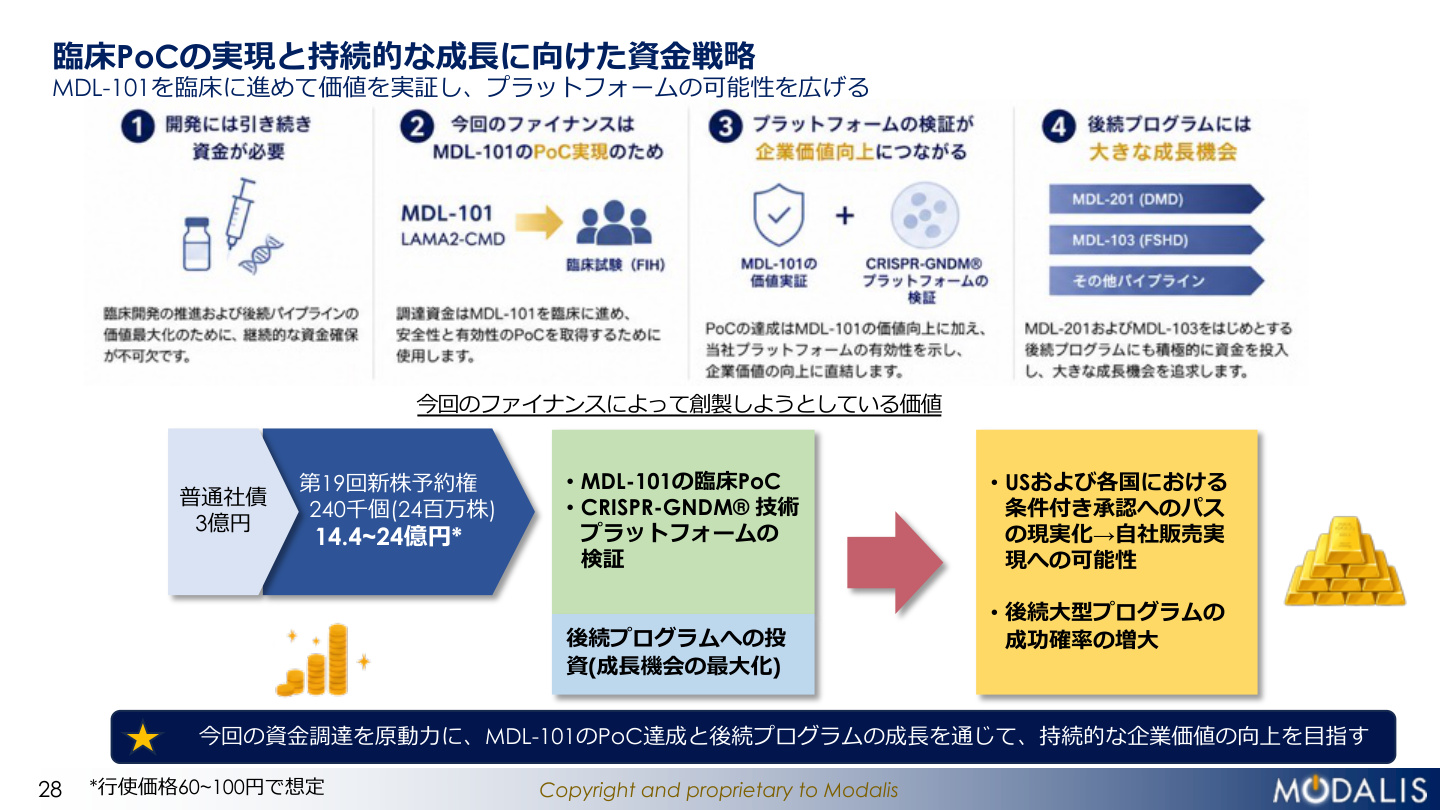
This slide is a strategic diagram showing the purpose of the company's financing and how it directly leads to increased corporate value . For a biotech venture, fundraising is inseparable from concerns about dilution, but this financing is an essential process to achieve the ultimate catalyst: "obtaining clinical Proof of Concept (PoC) for MDL-101."
Specifically, the plan is to secure necessary funds by combining 300 million JPY in straight bonds and the 19th series of stock acquisition rights (expected proceeds of 1.44 to 2.4 billion JPY) . By concentrating these funds on the clinical development of MDL-101 and proving efficacy and safety in humans (achieving PoC), the technical credibility of the entire CRISPR-GNDM® platform will increase dramatically . This strategic structure not only paves the way for accelerated or conditional approval in the U.S. and other regions but also leads to increased value for follow-on pipelines and the realization of large-scale licensing-out negotiations.
Pipeline Expansion and Future Outlook
While the company follows a "Focus Strategy" by prioritizing resources on MDL-101, preparations for follow-on pipelines are steadily progressing at the preclinical stage:
- MDL-201 : Duchenne Muscular Dystrophy (DMD) (Utrophin activation)
- MDL-202 : Myotonic Dystrophy Type 1 (DM1) (DMPK suppression)
- MDL-103 : Facioscapulohumeral Muscular Dystrophy (FSHD) (DUX4 suppression)
- Future Programs : Expansion into Alzheimer's and CNS (Central Nervous System) diseases utilizing "JUST-AAV®" (blood-brain barrier crossing technology) through a strategic partnership with JCR Pharmaceuticals.
Summary
Q2 FY2026 for Modalis marks a crucial milestone as preparations for the clinical proof (PoC) of its proprietary CRISPR-GNDM® technology enter the final stage . With the robustness of MDL-101's non-clinical data, a clarified IND application roadmap for late 2026 to Q1 2027, and the financial foundation supporting these efforts, the company is solidifying its unique position in the gene therapy field.
This content is not intended as investment advice or a recommendation. Any opinions expressed are solely the personal views of each article.