


artience (4634) H1 FY2026 Earnings Deep Dive: Revenue and Profit Growth Across All Segments, Structural Reform Progress, and a Growth Story Driven by Advanced Materials

StockClub
Published: Aug 10, 2026, 10:10 AM
Sentiment Analysis
The H1 FY2026 (fiscal year ending December 2026) financial results for artience Co., Ltd. (Securities Code: 4634) demonstrated exceptionally robust performance. Despite a challenging external environment marked by soaring raw material costs due to escalating tensions in the Middle East, the company achieved year-on-year revenue and profit growth across all business segments , driven by swift price revisions, increased sales volumes in overseas markets, and the progress of structural reforms.
This report provides a detailed analysis of the H1 earnings highlights, factors behind profit fluctuations, segment-specific trends, the progress of the medium-term management plan "artience2027/2030 'GROWTH'," and future growth strategies, based on key topics extracted from disclosure materials.
1. H1 FY2026 Consolidated Earnings Highlights
The consolidated results for the first half of FY2026 showed significant growth in both revenue and all profit categories compared to the same period last year.
- Net Sales : 189.7 billion JPY (+12.4% YoY)
- Operating Profit : 12.6 billion JPY (+34.1% YoY)
- Ordinary Profit : 14.6 billion JPY (+69.4% YoY)
- Net Income Attributable to Owners of Parent : 13.7 billion JPY (+150.9% YoY)
- Operating Profit Margin : 6.6% (+1.0 percentage point YoY)
- Overseas Sales Ratio : 56.3% (+2.1 percentage points YoY)
Net sales were driven by strong performance in liquid inks and UV inks in overseas markets (a volume increase of over 10% YoY). On the profit front, in addition to the growth in color filter (CF) materials for displays and optical adhesives, the company successfully mitigated rising raw material costs through agile price revisions and the substitution of non-naphtha-derived raw materials, contributing to a significant increase in operating profit. Furthermore, net income more than doubled compared to the same period last year, bolstered by a 5.1 billion JPY gain on the sale of investment securities resulting from the reduction of cross-shareholdings.
2. Analysis of Operating Profit Fluctuations and Pricing Power
Regarding the external environment, domestic naphtha prices surged from 65,700 JPY/KL in Q1 to 118,900 JPY/KL in Q2 following the intensification of Middle East tensions since March. While the full-year impact of rising raw material costs is expected to expand from the initial estimate of 12 billion JPY to approximately 17 billion JPY , the company is prepared to absorb this through appropriate price pass-throughs and cost reductions.
Details of the factors behind the operating profit fluctuations in the first half are as follows:
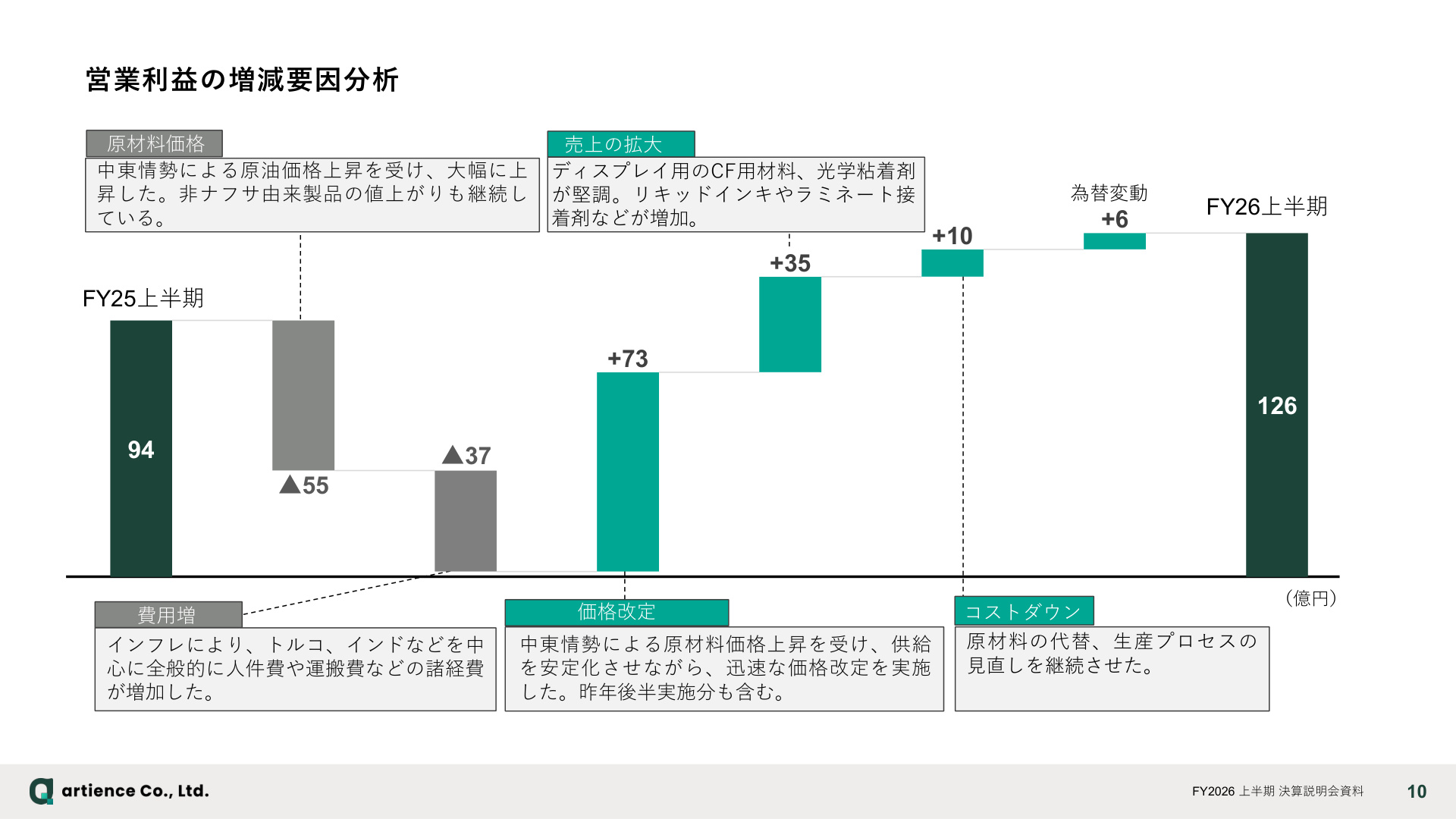
[Significance and Analysis of Slide 10 (PAGE_9)] The slide above is a waterfall chart visualizing the mechanism behind the 3.2 billion JPY increase in operating profit from H1 FY2025 (9.4 billion JPY) to H1 FY2026 (12.6 billion JPY). The following key facts can be derived from this data:
- Impact of Rising Raw Material Costs (-5.5 billion JPY) : Higher crude oil prices and price hikes in non-naphtha-derived products pressured profits.
- Increase in Expenses (-3.7 billion JPY) : Inflation led to higher personnel and logistics costs, particularly in Turkey and India.
- Strong Compensation via Price Revisions (+7.3 billion JPY) : By implementing swift price pass-throughs while ensuring supply stability, the company achieved profit improvements that significantly outweighed the cost increases.
- Sales Expansion and Cost Reductions (+3.5 billion JPY, +1.0 billion JPY) : Increased sales volumes of display CF materials and liquid inks, combined with cost reductions through production process reviews, bolstered profits.
In summary, the company's ability to completely overcome external inflationary and raw material cost pressures through a combination of 'pricing power' and 'sales volume growth' was the major achievement of the first half.
3. Performance Overview by Business Segment
All segments achieved revenue and profit growth, indicating a well-balanced portfolio.
- Color Materials & Functional Materials : Net Sales 42.7 billion JPY (+3.3%), Operating Profit 1.9 billion JPY ( +129.6% )
- Overview : CF materials for displays remained steady for large-sized panels, with expansion into sensor applications. Price revisions and cost reductions in colorants and pigments led to more than double the operating profit compared to the previous year.
- Polymers & Coating Materials : Net Sales 49.9 billion JPY (+13.7%), Operating Profit 4.6 billion JPY ( +25.2% )
- Overview : Optical adhesives for displays remained strong in China and South Korea. Growth was driven by the expansion of packaging laminate adhesives in Thailand and the performance of "Liofolan®" insulation materials for semiconductors.
- Packaging Materials : Net Sales 52.0 billion JPY (+18.1%), Operating Profit 3.6 billion JPY ( +44.7% )
- Overview : Overseas liquid ink volumes increased by over 10%. New market acquisitions in Malaysia and India, along with high order levels in Thailand, contributed to a significant expansion in segment profit.
- Printing & Information Materials : Net Sales 43.8 billion JPY (+13.0%), Operating Profit 2.4 billion JPY ( +18.3% )
- Overview : Despite the impact of rising paper prices on domestic offset inks, performance was supported by sales expansion of UV inks (functional inks) for cards and high-end paper packaging in China and North America.
4. Progress of Medium-Term Management Plan "artience2027/2030 'GROWTH'"
The company is advancing its medium-term management plan by focusing on 'Transformation into a High-Profitability Existing Business Group' and 'Creation of Strategic Priority Business Groups.'
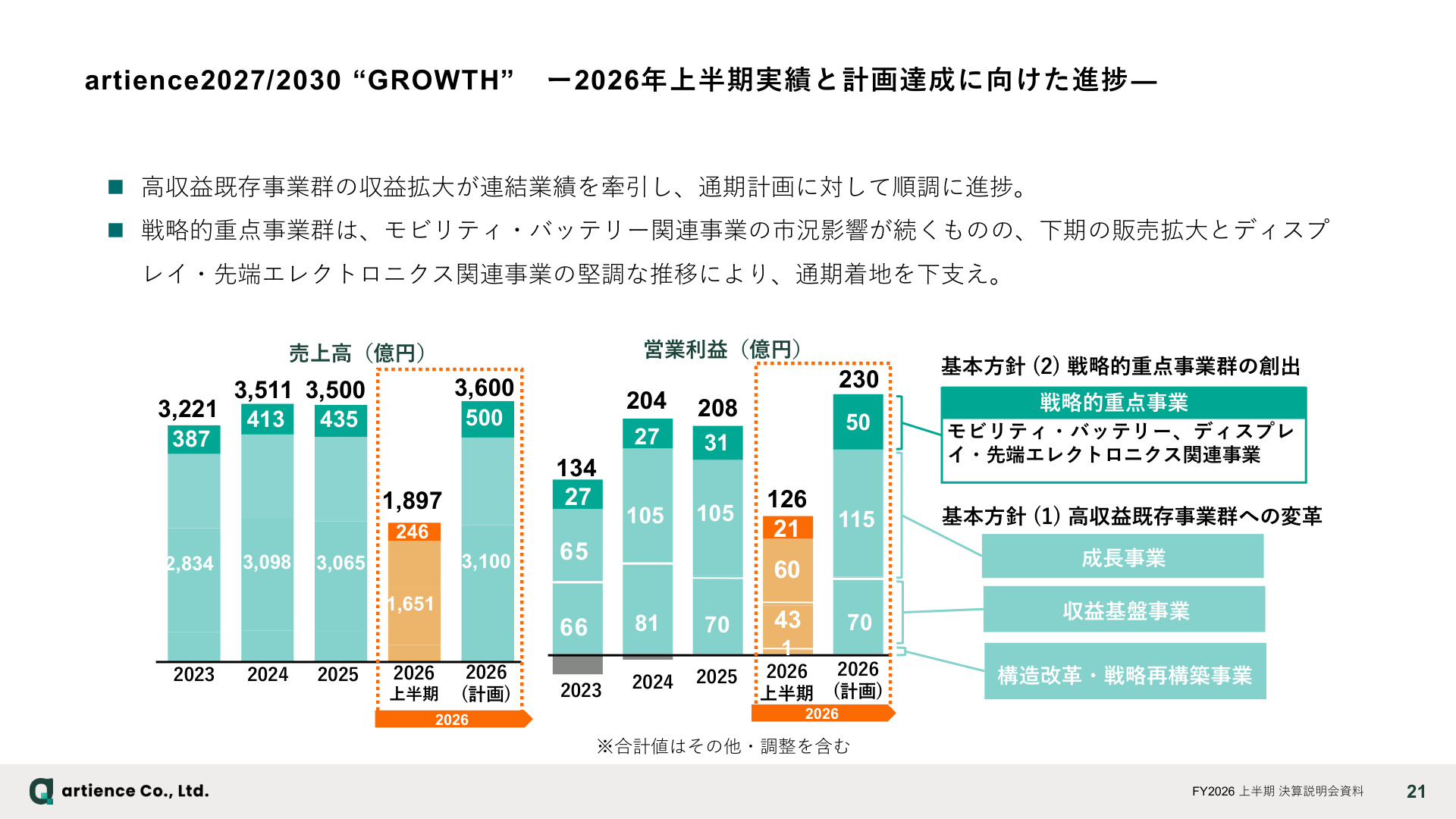
[Significance and Analysis of Slide 21 (PAGE_20)] Slide 21 is a crucial roadmap showing the progress of performance targets in the medium-term management plan against H1 FY2026 results.
- Profit Drivers from High-Profitability Existing Businesses : Operating profit from growth businesses (overseas adhesives, overseas liquid inks, UV inks, etc.) reached 6.0 billion JPY in H1 against a 11.5 billion JPY plan, steadily building a profit foundation.
- Achieving Profitability in Structural Reforms : In the "Structural Reform & Strategic Restructuring Businesses" (domestic offset inks and pigments), previously considered underperforming, the review of business structures proved successful, achieving a 100 million JPY profit in H1 FY2026 (compared to a loss of 500 million to 1.8 billion JPY in the same period last year). This has effectively removed a drag on company-wide profits.
- Maintenance of Full-Year FY2026 Plan : The full-year targets of 360 billion JPY in net sales, 23 billion JPY in operating profit, and 8.0% ROE remain unchanged to cautiously monitor market trends, though the operating profit progress rate stands at a healthy 54.8% as of H1.
5. Deep Dive into Strategic Priority Business Groups: LiB Materials and Optical Semiconductor Materials
In the "Strategic Priority Business Groups," which serve as future growth drivers, the company is executing agile strategy adjustments in response to market changes and concentrating on high-value-added areas.
(1) Mobility & Battery Materials (CNT Dispersions for LiB)
In response to the slowdown in the EV market (the so-called 'EV Chasm'), the company is adapting regionally. In China, Q2 volumes were 1.5 times higher than Q1, and performance in Europe and Japan (for HEVs) remains steady, though the US is tracking below plan. Consequently, the company is flexibly reviewing its capital investment plan, reducing the 3-year LiB-related investment budget from the initial 33% to 17% (estimated total of 11 billion JPY) , clearly prioritizing capital efficiency.
(2) Display & Advanced Electronics Materials
In the display sector, the company is responding to the shift in panel production to China by establishing joint ventures with local partners and expanding production capacity. Of particular note are materials for optical semiconductors (color resist inks for CMOS Image Sensors: CIS).
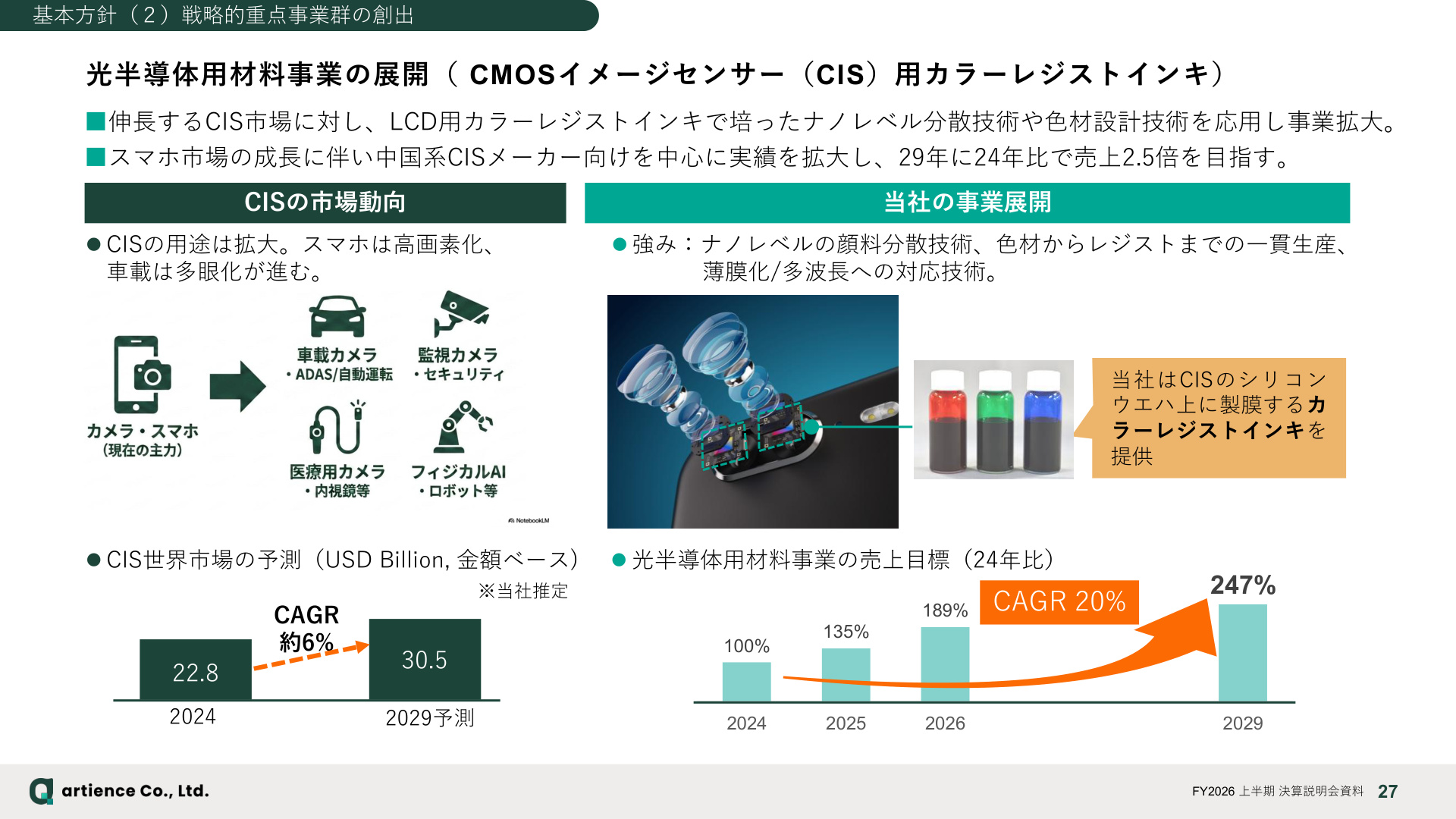
[Significance and Analysis of Slide 27 (PAGE_26)] Slide 27 illustrates the growth strategy in the advanced electronics field, applying the company's cultivated nano-level pigment dispersion technology.
- Market Background : Beyond the increasing pixel counts and multi-lens configurations in smartphone cameras, CIS applications are rapidly expanding into autonomous driving (ADAS), surveillance cameras, medical equipment, and AI robots (Physical AI).
- Company Strengths : Leveraging nano-dispersion technology developed for LCD color resists, the company develops and supplies high-definition color resist inks that are coated directly onto silica wafers.
- Overwhelming Growth Targets : The company has set ambitious growth targets for the optical semiconductor materials business: 2.5 times (247%) growth by 2029 compared to 2024 , with a CAGR of 20% . This is a key strategic slide aimed at capturing high-margin revenue by securing strong demand, primarily from Chinese CIS manufacturers.
6. Optimization of Capital Investment, Capital Efficiency, and Shareholder Return Policy
The company is promoting balance sheet streamlining and cash flow optimization to achieve an 'ROE of 8% or higher' at an early stage.
- Review of Capital Investment Allocation : Within the 3-year total investment plan of 60 billion JPY, the company is curbing LiB investments in response to the EV market slowdown while reallocating capital to growth/efficiency investments and additional investment areas (16% for additional investments, 25% for strengthening existing foundations, etc.).
- Reduction of Cross-Shareholdings : The number of held stocks will be reduced to 32 by the end of 2026 (halved from 61 in 2020), enhancing asset efficiency.
- Strengthening Shareholder Returns :
- Dividend Policy : While maintaining stable dividends as a base, the annual dividend per share is forecast to increase to 120 JPY from 100 JPY in the previous year (57 JPY interim, 63 JPY year-end).
- Total Return Ratio : The company targets a total return ratio of 50% or more , and with share buybacks (approximately 20 billion JPY currently being executed), the total return ratio for FY2026 is expected to remain at a high level.
7. Conclusion and Future Outlook
artience's H1 FY2026 results achieved record-level profit growth despite the headwinds of rising raw material costs, thanks to strong pricing power in existing businesses and the return to profitability of structural reform businesses.
Moving forward, the key to long-term corporate value enhancement lies in accelerating the market penetration of high-value-added advanced electronics materials , such as resists for CMOS image sensors and semiconductor insulation materials (Liofolan®), while maintaining flexible control over capital expenditures in response to market changes.
This content is not intended as investment advice or a recommendation. Any opinions expressed are solely the personal views of each article.