

Oncolys BioPharma Earnings & Business Progress Deep Dive: Commercialization Strategy and Growth Trajectory Following 'Standard Approval' and Drug Pricing of Telomelysin

StockClub
Published: Aug 10, 2026, 10:08 AM
Sentiment Analysis
Overview and Report Objective
This deep-dive report provides a comprehensive analysis of Oncolys BioPharma (TSE: 4588) based on their latest earnings presentation and pipeline progress reports. It covers the company's financial performance, capital base, the approval, pricing, and supply chain of its flagship pipeline Telomelysin (OBP-301) , as well as its global expansion strategy and next-generation pipeline status.
Chapter 1: 1H 2026 Financial Performance and Capital Base
For the six months ended June 2026, the company’s financial performance improved significantly, driven by the recognition of milestone revenue following the Ministry of Health, Labour and Welfare’s (MHLW) manufacturing and marketing approval of its flagship product, Telomelysin (OBP-301) .
- Net Sales : ¥503 million (an increase of ¥475 million from ¥28 million in the same period last year)
- Operating Loss : ¥767 million (a loss reduction of ¥500 million from ¥1,267 million in the same period last year)
- Ordinary Loss : ¥760 million (an improvement of ¥551 million from ¥1,311 million in the same period last year)
- Net Loss : ¥762 million (an improvement of ¥551 million from ¥1,313 million in the same period last year)
The improvement in profitability was largely attributed to the milestone revenue and a ¥251 million decrease in R&D expenses (from ¥1,017 million to ¥766 million), as the manufacturing process development for OBP-301 reached a milestone. Additionally, non-operating foreign exchange gains contributed to the reduction in ordinary loss.
【Financial Position Overview】 As of the end of June 2026, the company maintains a cash and deposit balance of ¥3.186 billion . By utilizing loans from Mizuho Bank (total borrowings of ¥784 million), the company has secured stable working capital, with total current assets of ¥4.46 billion and total net assets of ¥3.257 billion . Furthermore, milestone payments and advances associated with the marketing approval were received sequentially in July 2026, providing a robust foundation for current business operations.
Chapter 2: Quantitative Impact of 'Standard Approval' and Drug Pricing for Telomelysin (OBP-301)
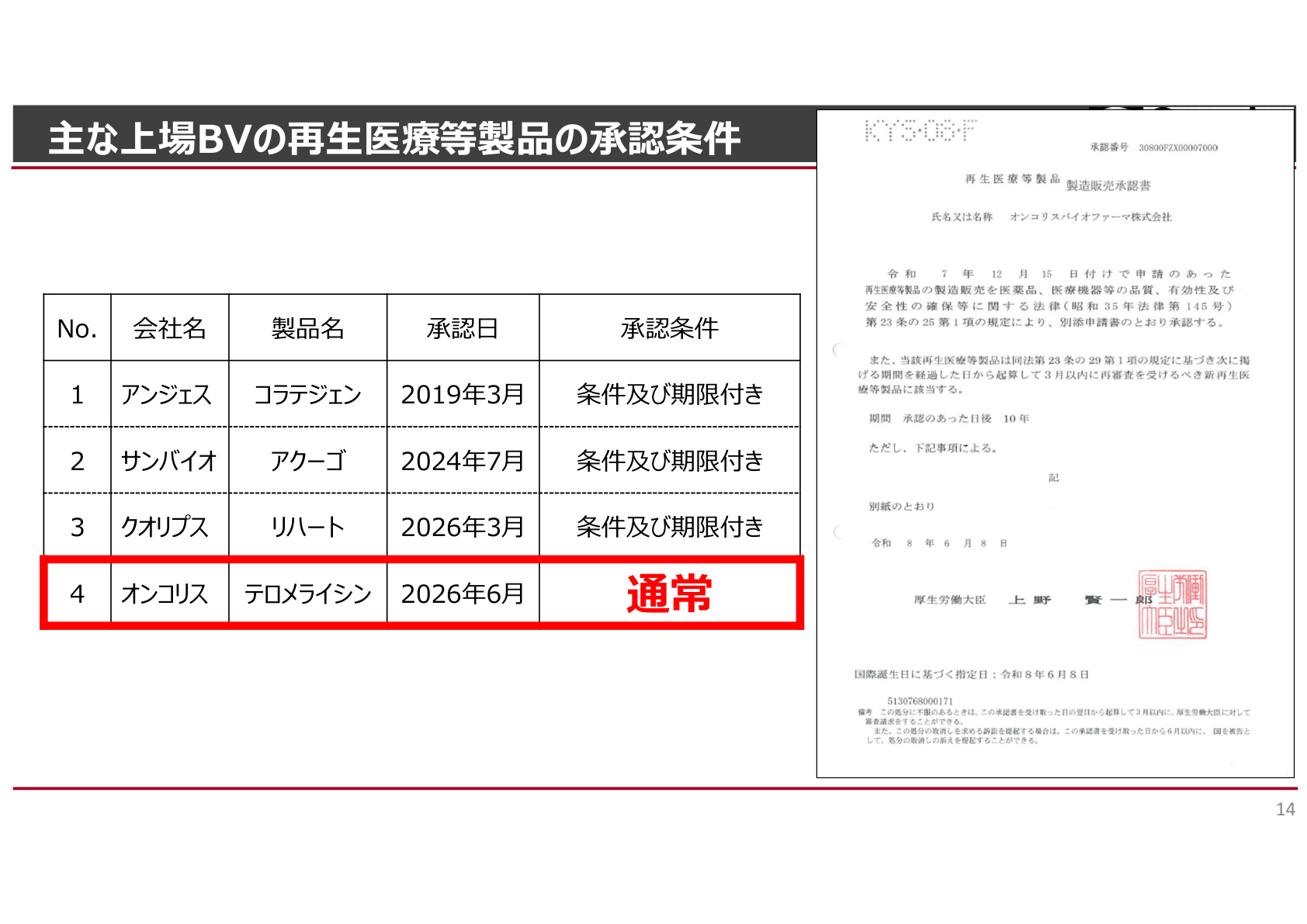
The most significant milestone in the company's history was the manufacturing and marketing approval of Telomelysin (OBP-301) achieved in June 2026. Notably, this was a 'Standard Approval' rather than a conditional one.
Significance of Slide 13
The slide above compares the approval conditions for regenerative medical products developed by major listed biotech companies in Japan. While many biotech firms have historically received 'conditional and time-limited approvals' (based on estimated efficacy with a requirement for re-evaluation), Oncolys BioPharma secured a 'Standard Approval' for Telomelysin. This confirms that the MHLW has verified sufficient efficacy and safety data, serving as a powerful differentiator that establishes a stable business foundation throughout the 10-year post-marketing re-examination period.
Drug Pricing Structure and High Economic Value
Following the approval, the drug pricing process yielded highly favorable conditions.
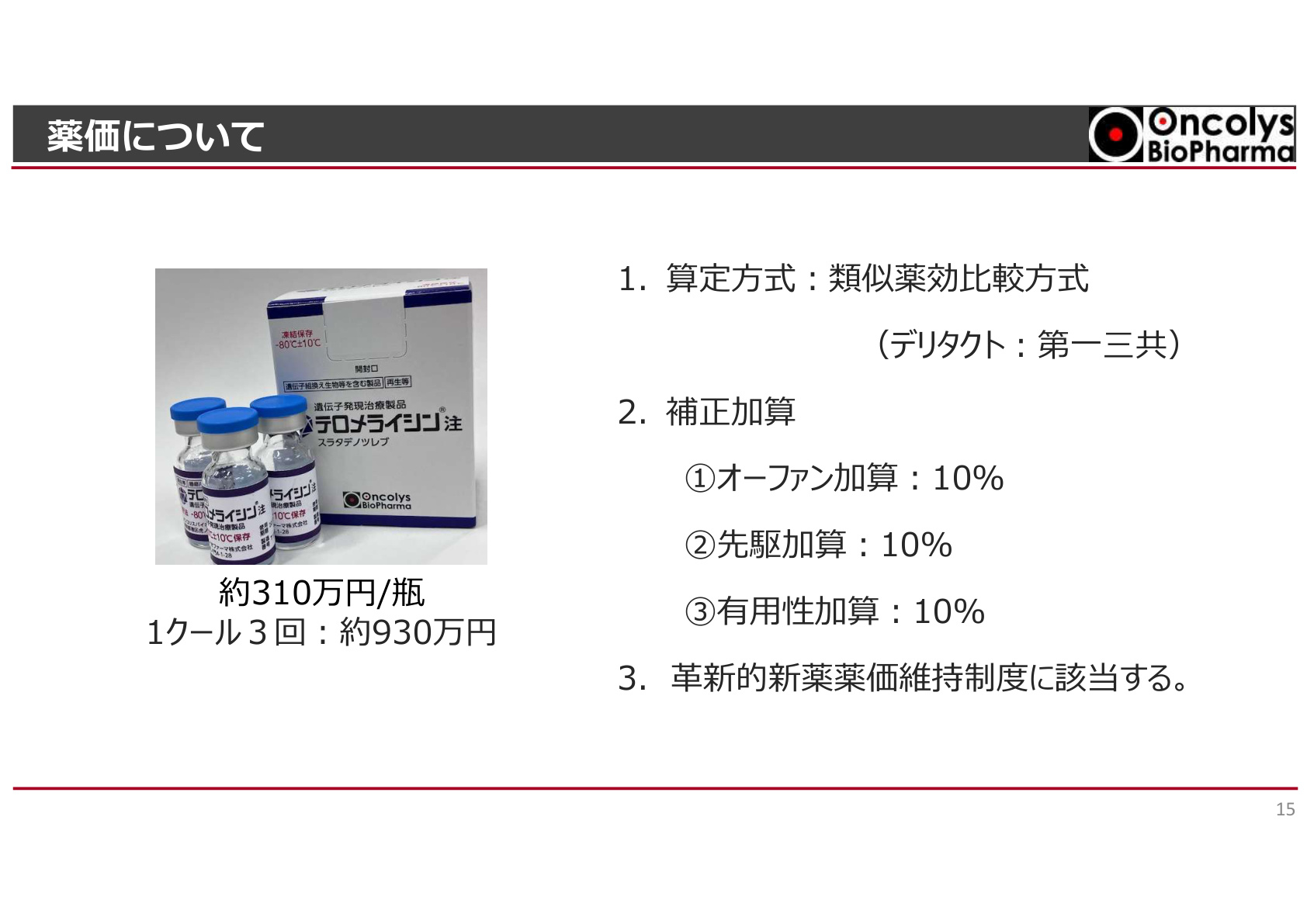
- Pricing Method : Similar Efficacy Comparison Method (Comparator: Daiichi Sankyo’s Delytact)
- Premium Additions : Total 30% premium achieved
- Orphan Drug Premium (10%)
- Sakigake (Pioneer) Designation Premium (10%)
- Usefulness Premium (10%)
- Price Maintenance : Subject to the Innovative New Drug Price Maintenance System
Significance of Slide 14
This slide outlines the specific drug pricing structure. The price for Telomelysin was set at approximately ¥3.1 million per vial , resulting in a high product unit price of approximately ¥9.3 million per course (3 doses) . The fact that all three premium additions were granted simultaneously is public recognition of the drug's high medical value and underscores the significant revenue impact expected on future earnings.
Chapter 3: Supply Chain and Commercialization Strategy
Following the drug pricing and approval, the company has established a framework for rapid commercialization. Insurance coverage was effective as of August 13, 2026 , with sales commencing on August 21 .
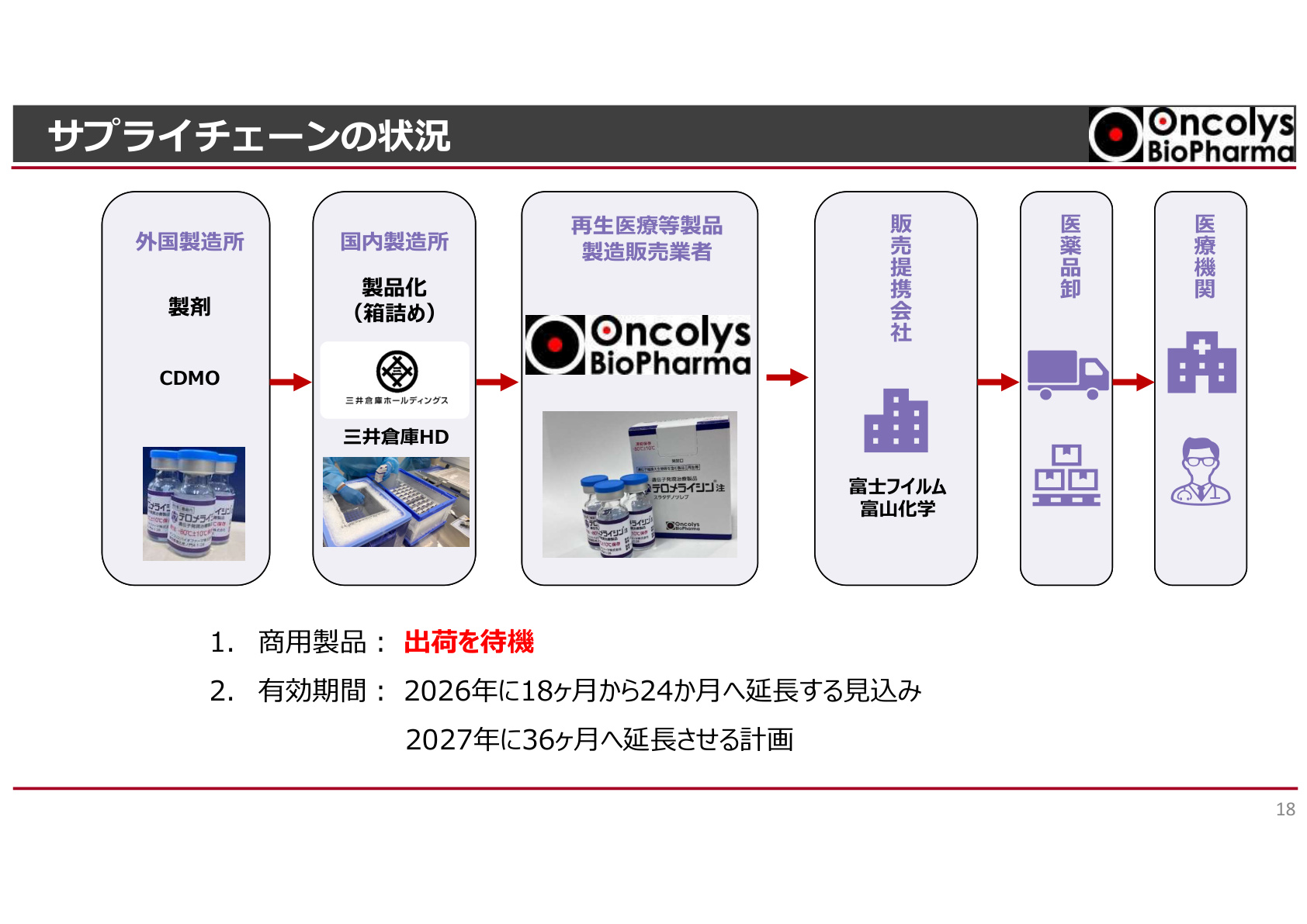
Significance of Slide 17
For a biotech startup, the biggest bottleneck in commercialization is the establishment of a stable manufacturing and distribution (supply chain) system. Slide 17 demonstrates that the supply chain is fully operational , spanning from the overseas CDMO (API/drug product manufacturing) to Mitsui-Soko Holdings (packaging/manufacturer), Oncolys BioPharma (marketing authorization holder), the sales partner FUJIFILM Toyama Chemical , and finally to pharmaceutical wholesalers and medical institutions. Commercial products are already awaiting shipment, confirming that concerns regarding stable supply have been resolved.
Furthermore, the product shelf life is expected to be extended from 18 to 24 months in 2026, with plans to extend it to 36 months in 2027, further optimizing inventory management and logistics.
Target Patient Population and Sales Strategy
The number of new esophageal cancer patients in Japan is approximately 25,000 per year . Telomelysin targets "esophageal cancer not indicated for curative resection or chemoradiotherapy," providing new treatment options for the following patient segments:
- Over 1,500 patients annually receiving radiation monotherapy.
- Patients with residual tumors after "immune checkpoint inhibitor + chemotherapy."
- Patients with Stage I or IV who were ineligible for clinical trials, or those who do not wish to undergo surgery or chemotherapy.
Regarding sales, partner FUJIFILM Toyama Chemical will handle nationwide distribution, with plans to expand from approximately 80 facilities at launch to over 300 facilities shortly thereafter. While both companies are currently refining detailed sales forecasts, the company has set a clear roadmap to achieve profitability by 2030 .
Chapter 4: Expansion of Indications and Robust Patent Strategy
The potential of Telomelysin extends beyond esophageal cancer. Under the concept of "from the entrance to the exit of the digestive tract," the company is promoting the expansion of indications across the entire gastrointestinal tract.
- Scope of Expansion : Plans include development for oral cancer , laryngeal cancer , gastric cancer , and lower rectal/anal canal cancer .
- Lower Rectal Cancer Pilot Study : A Phase 1b/2a study for Stage II/III lower rectal/anal canal cancer is planned. By combining chemoradiotherapy with Telomelysin, the company aims to establish a new treatment that avoids the need for a stoma (artificial anus) and maintains the patient's Quality of Life (QOL) .
【Intellectual Property (IP) Barriers to Entry】 The company holds a patent for the "endoscopic administration of oncolytic adenovirus," with patent protection secured until May 14, 2040 . This patent covers not only OBP-301 but also the follow-up pipeline OBP-702, creating a strong competitive advantage that limits entry by other companies into this field.
Chapter 5: Global Expansion and Overseas Alliance Strategy
Since approximately 80% of esophageal cancer patients worldwide are concentrated in Asia , the company is accelerating its overseas business expansion with a focus on the Asian region.
- Asia : Rights have been licensed to Medigen in Taiwan, with preparations for early approval filing underway. In South Korea, the company is in discussions with multiple firms. Negotiations with major pharmaceutical companies in Southeast Asia are also progressing, with the goal of signing a new overseas contract within the year .
- Europe : The company is receiving interest from European pharmaceutical firms and is exploring the possibility of priority approval filing in the UK, leveraging the "Standard Approval" data from Japan.
- US and China : The company is conducting market research on radiation monotherapy and planning a long-term approach.
Chapter 6: Progress of Next-Generation Pipeline (OBP-601, OBP-702)
Oncolys BioPharma's growth engine is not solely dependent on Telomelysin. The pipeline is being diversified through partnerships with licensees and academia.
1. OBP-601 (Licensed to Transposon Therapeutics)
Development for neurodegenerative diseases is progressing, with Transposon planning to raise $20–30 million this year.
- Progressive Supranuclear Palsy (PSP) : Under FDA Fast Track designation, dose-optimization studies are scheduled to proceed promptly.
- Amyotrophic Lateral Sclerosis (ALS) : Based on positive Phase 2 results, preparations for a Phase 2/3 study are accelerating.
- Alzheimer's Disease : Having secured $5 million in funding from a drug discovery foundation, preparations for a Phase 2 study are underway.
2. OBP-702 (Next-Generation Bio-Pipeline)
This is a "dual-wielding" next-generation agent that combines oncolytic activity with the introduction of the powerful tumor-suppressor gene p53 . It attacks not only cancer cells themselves but also cancer-associated fibroblasts (CAFs) that form the tumor microenvironment. In collaboration with Okayama University, an investigator-initiated Phase 1 study for drug-resistant Stage III/IV pancreatic cancer is being planned.
Chapter 7: Future Outlook and Milestone Summary
Earnings guidance for the fiscal year ending December 2026 remains undisclosed while the company refines sales forecasts with its partner, FUJIFILM Toyama Chemical. However, the company plans to resume the disclosure of earnings guidance from the fiscal year ending December 2027 .
Key milestones achieved by the company in 2026 are as follows:
- OBP-301 Manufacturing and Marketing Approval ( Achieved June 2026 )
- OBP-301 18-month stability test cleared ( Achieved February 2026 )
- OBP-301 Efficacy expansion study initiated ( Achieved June 2026 )
- OBP-301 Drug price listing (Scheduled August 13, 2026)
- OBP-301 Domestic launch (Scheduled August 21, 2026)
- OBP-301 New overseas contract signing within the year
The story of commercializing its own pipeline, establishing a revenue model through drug pricing, expanding indications, licensing out overseas, and advancing the clinical progress of the next-generation pipeline is proceeding smoothly, laying a solid foundation for profitability by 2030 .
This content is not intended as investment advice or a recommendation. Any opinions expressed are solely the personal views of each article.