


Palma Co., Ltd. (3461) Q3 FY2026 Earnings Deep Dive: Robust Profit Growth Driven by Record-High BPO Performance and Improved Operational Efficiency

StockClub
Published: Aug 10, 2026, 10:01 AM
Sentiment Analysis
Based on the Q3 FY2026 earnings report for Palma Co., Ltd. (Securities Code: 3461) , a company providing BPO and development/operational support services for the self-storage industry in Japan, this report provides a detailed analysis of its performance, business topics, and growth scenarios.
1. Earnings Highlights and Profit Structure Analysis
For the cumulative third quarter of the fiscal year ending September 2026, Palma achieved both revenue growth and a significant increase in operating profit compared to the same period last year. This was primarily driven by the steady expansion of its core Business Solution (BS) segment and improved profitability in the rental operations of its Turnkey Solution (TKS) segment .
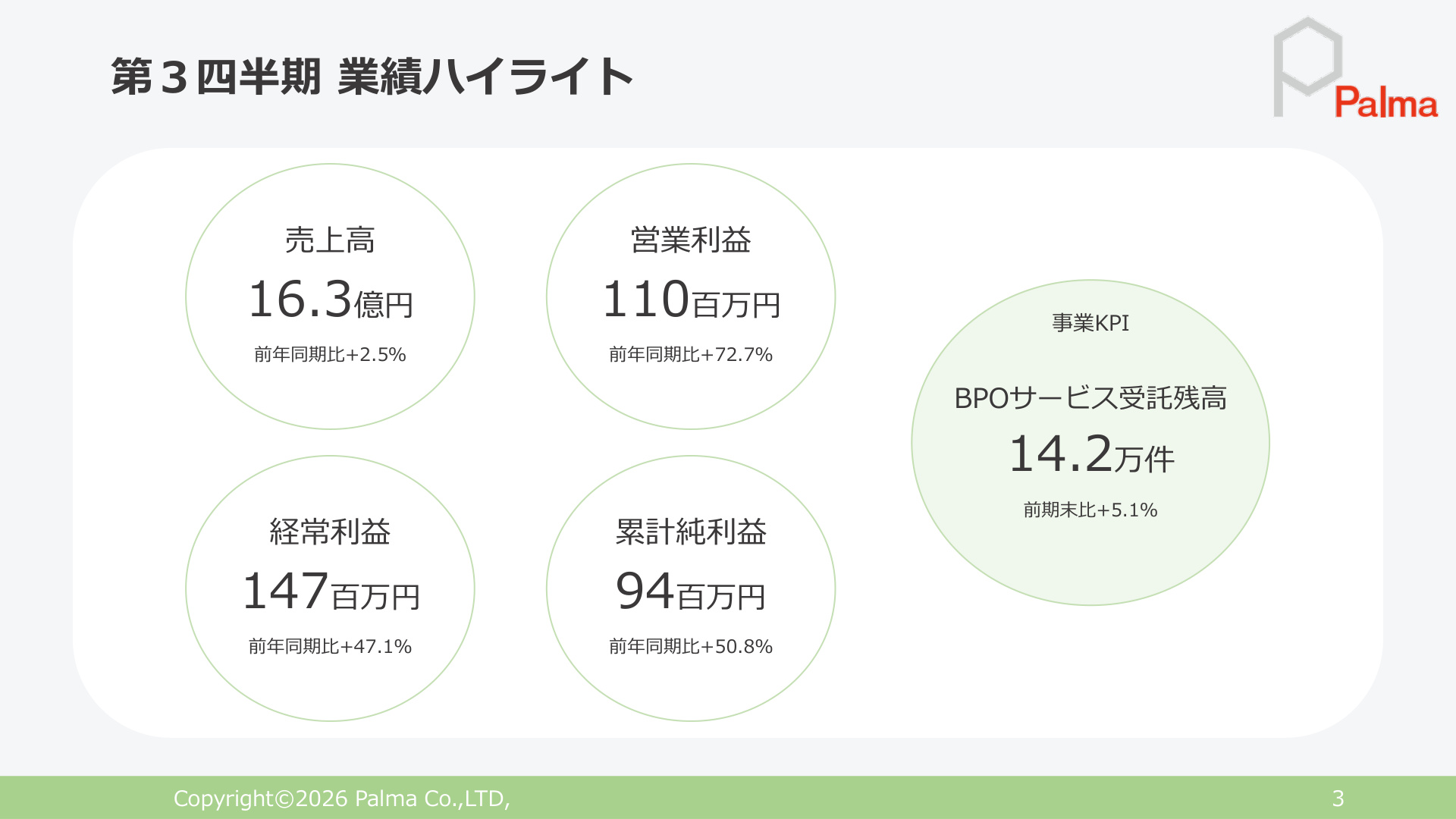
- Net Sales : 1,633 million JPY ( +2.5% YoY)
- Operating Profit : 110 million JPY ( +72.7% YoY)
- Ordinary Profit : 147 million JPY ( +47.1% YoY)
- Quarterly Net Profit : 94 million JPY ( +50.8% YoY)
- Earnings Per Share (EPS) : 14.00 JPY (vs. 9.28 JPY in the same period last year)
Slide Commentary: Significance of Earnings Highlights
The Q3 Earnings Highlights (Slide 2) clearly demonstrate the strength of the company's current revenue base. While net sales remained steady at 1.63 billion JPY , the company saw substantial profit growth, with operating profit reaching 110 million JPY (+72.7% YoY) and quarterly net profit hitting 94 million JPY (+50.8% YoY) . The primary driver behind this surge is the steady accumulation of the key business KPI shown in the circle on the right: "BPO Service Contract Balance: 142,000 units (+5.1% from the end of the previous fiscal year)." The expansion of the BPO service, a stock-based business model, is creating a structure that enhances marginal profit margins.
2. Segment Performance and Key KPI Trends
Palma's business is divided into two main segments: "Business Solution (BS)," which provides operational outsourcing to self-storage operators, and "Turnkey Solution (TKS)," which handles facility development, sales, and leasing.
(1) Business Solution (BS): Expansion of Stock Revenue
The BS segment remains the company's stable revenue source and performed exceptionally well during this period.
- Segment Sales : 1,162 million JPY (vs. 1,085 million JPY in the same period last year)
- Segment Profit : 411 million JPY (vs. 369 million JPY in the same period last year, +11.4% YoY )
The customer base has grown robustly due to expanded service offerings to major operators and increased orders in peripheral areas such as delinquency guarantees, reception services, and payment collection.
Slide Commentary: Importance of Key KPIs (BPO Contract Balance & 'Claris' Registered Units)
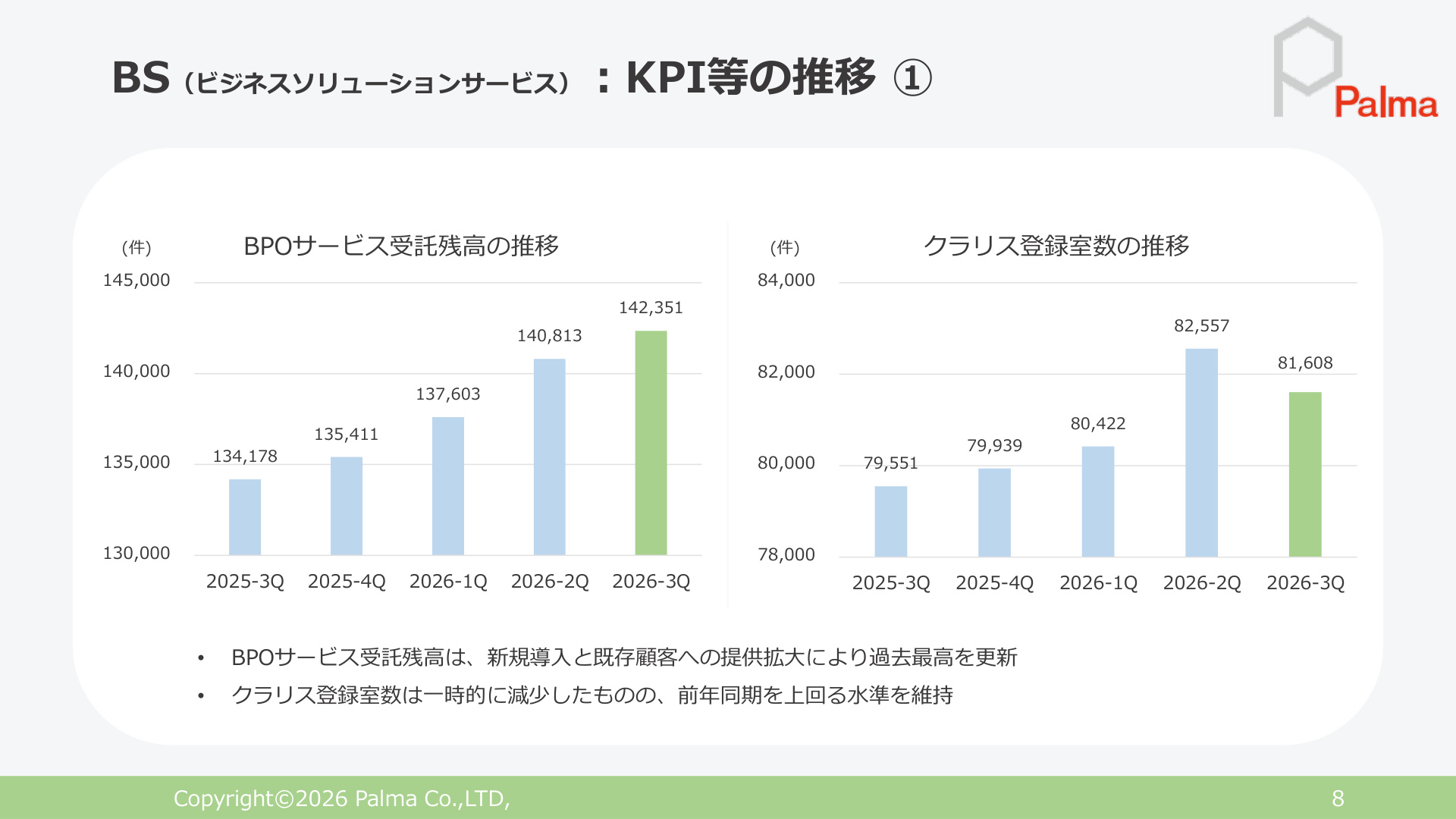
Slide 7 (BS: KPI Trends ①) provides the most critical data for assessing the growth potential of the BS segment. As shown in the left-hand graph, the BPO service contract balance has reached 142,351 units , continuing to hit record highs. This proves that the company is successfully acquiring new clients while also securing additional contracts as existing clients expand their store counts. Furthermore, the number of units registered on the property inventory management system "Claris" reached 81,608 , maintaining a high level that exceeds the same period last year despite temporary fluctuations. These accumulations form the foundation for the company's continuous and stable commission income.
Additionally, call center contract volume remains high at 5,717 cases (Slide 8). Through peripheral tasks such as "collection, transportation, and demolition services" for abandoned items, the company is successfully increasing unit prices per customer and accumulating specialized know-how.
(2) Turnkey Solution (TKS): Development, Sales, and Improved Rental Profitability
The TKS segment involves the development of self-storage facilities, container sales, and the trading and leasing of investment real estate.
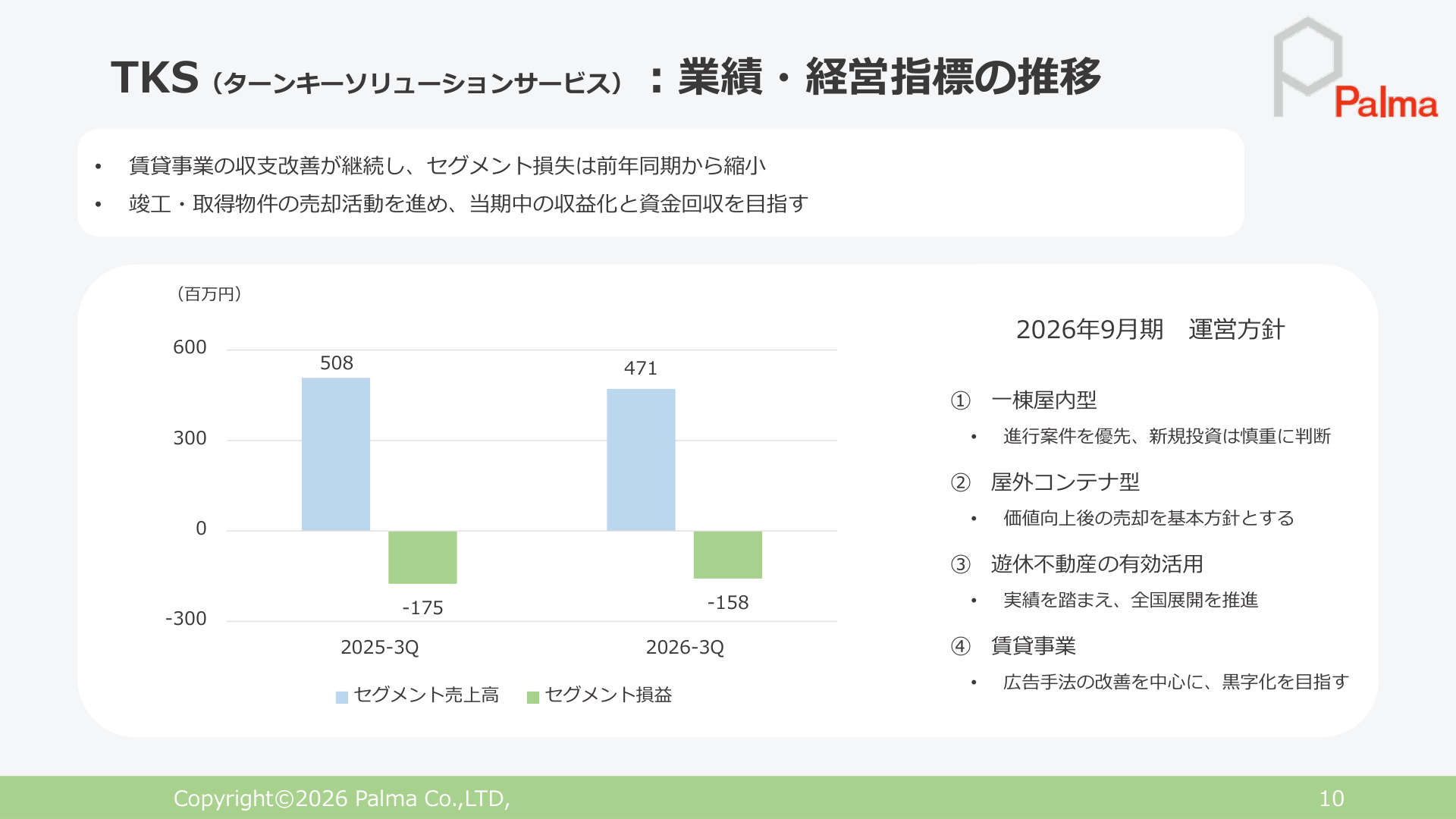
- Segment Sales : 471 million JPY (vs. 508 million JPY in the same period last year)
- Segment Profit/Loss : -158 million JPY (vs. -175 million JPY in the same period last year)
Slide Commentary: TKS Segment Profit Structure and Improvement Process
Slide 9 (TKS: Performance and Management Indicator Trends) illustrates the profit trends of the company's flow-based business and its future operational policy. Although sales were 471 million JPY, lower than the same period last year, the segment loss was 158 million JPY, an improvement of 17 million JPY from the 175 million JPY loss in the previous year . The primary reason for this narrowing deficit is the improvement in rental business profitability due to higher occupancy rates in owned rental properties .
As shown in Slide 10, the rental business balance has significantly narrowed from -22 million JPY in the same period last year to -7 million JPY in Q3 FY2026, laying the groundwork for a return to profitability. For indoor facilities, the company is proceeding with sales activities for two properties completed in March 2026. For outdoor container facilities, it has clarified a policy of enhancing facility value before sale, such as installing grid-scale batteries in unused spaces through a business alliance with JB Sustainable .
Furthermore, initiatives utilizing the nationwide network are progressing, including a partnership with Japan Post (Slide 11). In April 2026, the company signed new opening contracts for sites at the "Chojabaru Post Office (Fukuoka Prefecture)" and "Shiraoka Post Office (Saitama Prefecture)," both scheduled to open in July 2027, building a highly unique development pipeline.
3. Balance Sheet Analysis and Progress Toward Full-Year Targets
(1) Balance Sheet (B/S) Status
As of the end of June 2026, the financial position shows an accumulation of assets intended for future sale.
- Current Assets : 3,594 million JPY (+42 million JPY from the end of the previous fiscal year)
- Fixed Assets : 247 million JPY (+8 million JPY from the end of the previous fiscal year)
- Total Assets : 3,841 million JPY
- Total Liabilities : 1,408 million JPY (+38 million JPY from the end of the previous fiscal year)
- Net Assets : 2,434 million JPY (+14 million JPY from the end of the previous fiscal year)
Regarding major account fluctuations, inventories increased by 367 million JPY and indemnity receivables increased by 116 million JPY due to the completion of indoor facilities and the acquisition of investment real estate, while cash and deposits decreased by 294 million JPY. On the liability side, interest-bearing debt increased by 96 million JPY due to financing activities.
(2) Perspective on Full-Year Targets and Progress
The company's initial operating profit target for the fiscal year ending September 2026 is 370 million JPY . Cumulative operating profit for the third quarter is 110 million JPY , which may appear to be at a progress rate of only 29.7%.
However, the TKS segment has the characteristic that "earnings fluctuate significantly depending on the sales trends of self-storage facilities." Since the sale of completed and acquired properties tends to concentrate in the fourth quarter (year-end), the company has maintained its full-year earnings targets based on the initial plan . The business environment is generally proceeding as expected, and sales activities are being deployed to achieve the planned targets.
4. Shareholder Return Policy and Mid-to-Long-Term Growth Scenario
(1) Shareholder Return Policy
Palma positions shareholder returns as a key management priority, demonstrating a proactive stance in both dividends and shareholder benefits.
- Dividend Policy : Aiming for a dividend payout ratio of 40% or higher , with plans for sustainable and stable dividend increases.
- Annual Dividend Per Share : 13 JPY (planned) (vs. 11 JPY in the previous fiscal year).
- Shareholder Benefits : Presentation of "QUO Cards" based on the number of shares held and the holding period (1,000 JPY for 100–999 shares held less than 1 year / 2,000 JPY for 1 year or more; 5,000 JPY for 1,000+ shares held less than 1 year / 10,000 JPY for 1 year or more).
(2) Mid-to-Long-Term Growth Scenario and Market Opportunities
The Japanese self-storage market is expanding due to urbanization, shrinking residential space, increased storage needs due to the normalization of remote work, and small-lot logistics demand driven by the growth of e-commerce. According to research by Yano Research Institute, the market size is projected to grow to over 110 billion JPY by 2030 (up from approximately 80 billion JPY in 2023) .
Palma has established a strong position in this market:
- Building an Industry Platform : The customer acquisition platform "Nico Nico Trunk" boasts over 7,700 registered facilities and 320,000 units.
- Overwhelming Market Share : BPO and systems have been introduced to more than half of all self-storage operators nationwide ( over 400 companies ).
As a growth scenario (Slide 17), the company aims to maximize corporate value by expanding and streamlining the BS segment (service and IT system business) through DX, promoting profit improvement and capital recovery through sales in the TKS segment (facility development and leasing), and expanding into peripheral markets (such as rental offices and storage organization).
5. Conclusion
Palma's Q3 FY2026 earnings report showed a dramatic turnaround, with operating profit up 72.7% YoY, driven by the accumulation of stock revenue from a record-high 142,000 BPO contracts and the narrowing deficit in the TKS rental business.
While the progress of property sales in the TKS segment during the fourth quarter will be key to achieving the full-year target, the expansion of the stock business—the company's mid-to-long-term foundation—its high market share, and its shareholder return policy of a 40%+ payout ratio underscore the company's solid management foundation.
This content is not intended as investment advice or a recommendation. Any opinions expressed are solely the personal views of each article.