


Toabo Corporation FY2026 Q2 Earnings Deep Dive: Business Portfolio Transformation and Strategy for a Full-Year V-Shaped Recovery

StockClub
Published: Aug 10, 2026, 09:59 AM
Sentiment Analysis
Toabo Corporation FY2026 Q2 Earnings Deep Dive: Business Portfolio Transformation and Strategy for a Full-Year V-Shaped Recovery
1. FY2026 Q2 Earnings Highlights
Toabo Corporation’s consolidated financial results for the second quarter (interim period) of the fiscal year ending December 2026 showed net sales of 8,672 million yen (down 1.2% YoY) , operating profit of 324 million yen (down 21.3% YoY) , and ordinary profit of 372 million yen (down 26.3% YoY) . Both top-line sales and core operating profit fell short of the same period last year. The operating profit margin declined by 1.0 percentage point, from 4.7% in the previous year to 3.7% .
Conversely, profit attributable to owners of parent, representing the bottom line, surged to 437 million yen (up 73.9% YoY) . This sharp increase was primarily driven by the booking of extraordinary gains resulting from the reduction of cross-shareholdings —part of the company’s broader efforts to optimize management resources and reform corporate governance—as well as the sale of subsidiary shares.
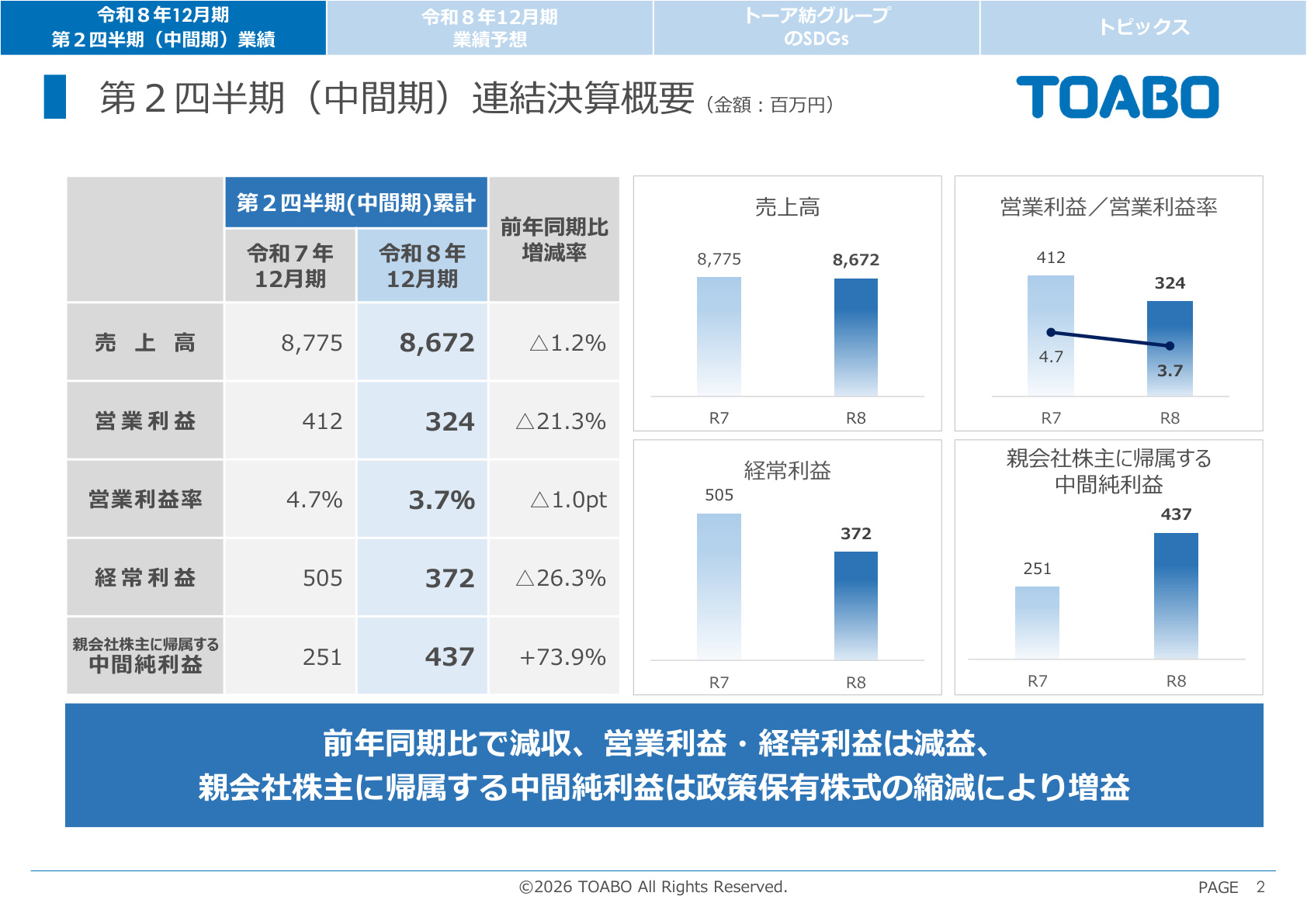
As illustrated in the consolidated financial summary slide above, this interim period was characterized by a contrasting dynamic of "declining operating/ordinary profit versus rising net profit." The downward pressure on sales and operating profit was attributed to factors such as soaring wool prices affecting the core apparel business, inventory adjustments in the school uniform market, and equipment issues at customer sites in the fine chemicals business. However, looking at the business portfolio as a whole, positive indicators of potential are evident, including significant profit improvements in the interior industrial materials business and double-digit sales growth in the electronics business.
2. Comprehensive Analysis of Segment Performance
Breaking down the interim results by segment reveals a structure where traditional businesses are struggling under external environmental pressures, while growth areas and businesses undergoing structural reform provide a buffer.
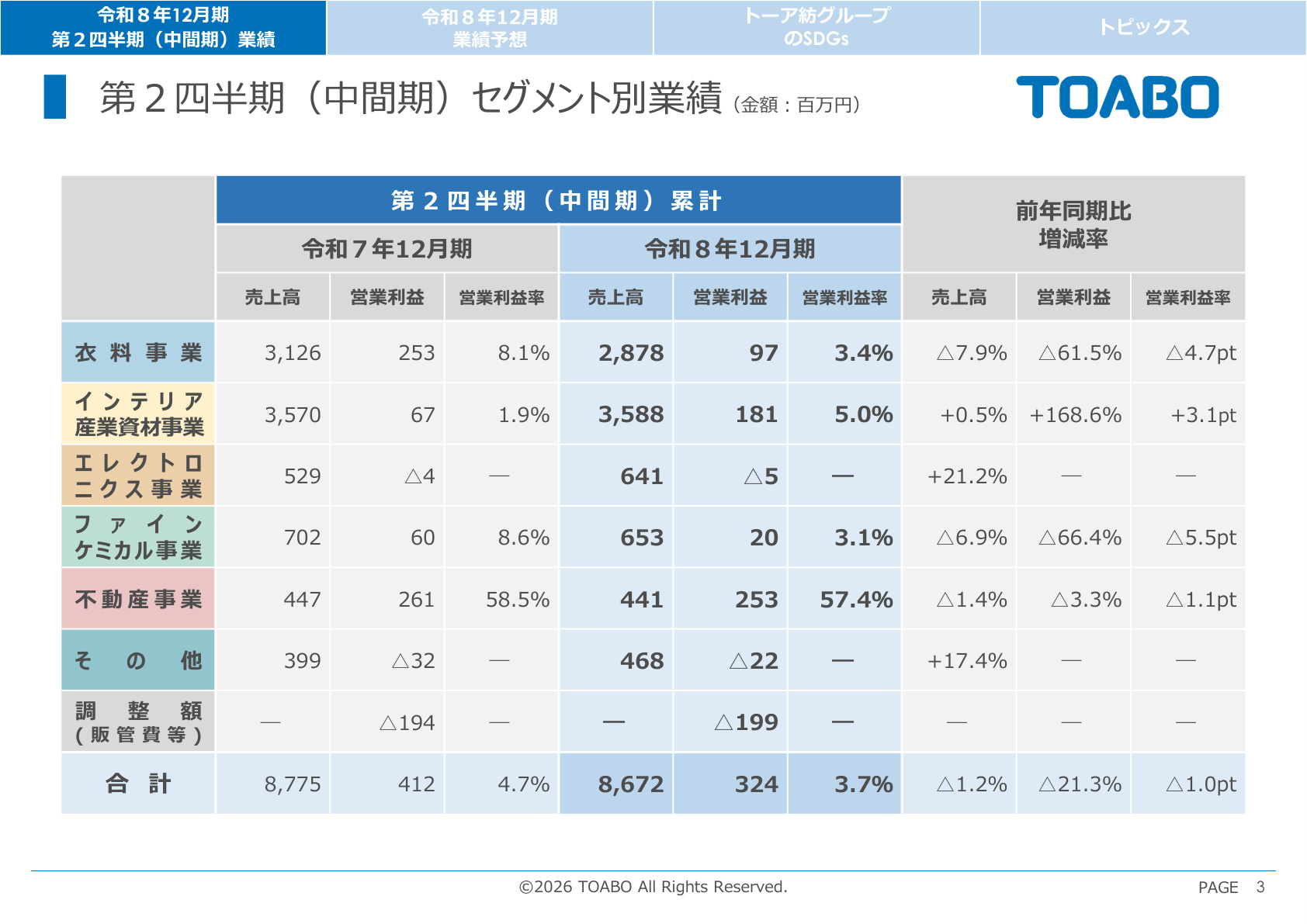
The slide above provides a comprehensive comparison of net sales, operating profit, and operating profit margins by business segment against the previous year. While the apparel and fine chemicals businesses saw significant profit declines, the interior industrial materials business achieved explosive growth with an operating profit of 181 million yen (up 168.6% YoY) , compensating for the profit balance of the entire segment.
(1) Apparel Business: Significant Profit Decline Due to High Raw Material Costs and Inventory Adjustments
- Net Sales : 2,878 million yen (down 7.9% YoY)
- Operating Profit : 97 million yen (down 61.5% YoY)
- Operating Profit Margin : 3.4% (down 4.7pt YoY)
In the Yarn Division , global surges in wool prices led to cautious buying and sluggish orders from customers, resulting in lower sales. In the Uniform Division , the impact of front-loaded production and inventory adjustments in the school apparel market has yet to subside, leading to stagnant shipments of school uniform materials and knit products. This was compounded by a decrease in custom projects for government agencies and weak follow-up orders for corporate uniforms. While the Textile Division achieved sales growth through new project acquisitions, the historic weakness of the yen and high wool prices pressured profit margins, preventing a recovery in profitability. Additionally, the Chinese subsidiary also faced headwinds from a decline in orders destined for Japan.
(2) Interior Industrial Materials Business: Significant Profit Growth Driven by Price Pass-Through
- Net Sales : 3,588 million yen (up 0.5% YoY)
- Operating Profit : 181 million yen (up 168.6% YoY)
- Operating Profit Margin : 5.0% (up 3.1pt YoY)
This segment served as the primary profit driver for the period. In the Automotive Interior Materials Division , while sales increased due to strong production and sales of target vehicle models, profit was partially impacted by a time lag in passing on rising raw material, electricity, and utility costs. However, the Polypropylene Fiber Division saw strong orders for automotive interior and carpet raw fibers, and the successful implementation of price pass-throughs led to a significant increase in both sales and profit. Furthermore, the Non-Woven Fabrics Division performed well across weed control, bedding, and greening applications, rapidly pushing the segment’s overall operating profit margin to 5.0%.
(3) Electronics Business: Double-Digit Sales Growth Backed by AI and Data Center Demand
- Net Sales : 641 million yen (up 21.2% YoY)
- Operating Profit/Loss : -5 million yen (vs. -4 million yen in the previous year)
While sales of controllers for power tools remained on par with the previous year, standalone IC sales saw a major leap . Specifically, in the industrial equipment sector, sales of semiconductors and electronic components for AI data centers , which are experiencing global demand expansion, performed strongly, driving a robust 21.2% YoY increase in net sales. In terms of profit, the segment remained at a slight operating loss, similar to the previous year, but the expansion of sales scale through a shift toward advanced fields provides a crucial foothold for future profitability.
(4) Fine Chemicals Business: Earnings Pressured by Temporary Disruptions
- Net Sales : 653 million yen (down 6.9% YoY)
- Operating Profit : 20 million yen (down 66.4% YoY)
- Operating Profit Margin : 3.1% (down 5.5pt YoY)
Although production and sales in the electronic materials field remained steady for semiconductor-related applications, the functional materials field was forced to reduce production due to equipment trouble at a major customer’s site and difficulties in procuring overseas raw materials . This decline in capacity utilization and supply constraints led to lower sales and profit for the segment as a whole.
(5) Real Estate Business: Maintaining a Stable, High-Profit Base
- Net Sales : 441 million yen (down 1.4% YoY)
- Operating Profit : 253 million yen (down 3.3% YoY)
- Operating Profit Margin : 57.4% (down 1.1pt YoY)
Despite a slight decline in sales and profit due to the departure of some tenants from a shopping center, the business maintained an extremely high operating profit margin of 57.4% , functioning as a stable source of cash flow for the entire group.
(6) Other Businesses (Driving Schools, Healthcare, Confectionery, etc.)
- Net Sales : 468 million yen (up 17.4% YoY)
- Operating Profit/Loss : -22 million yen (vs. -32 million yen in the previous year)
While the driving school business (Kosai School) saw sluggish enrollment, contributions from healthcare product sales (Musashi Seiyaku) and increased sales at confectionery stores helped boost overall segment sales, and the operating loss improved by 10 million yen compared to the same period last year.
3. Structural Changes in Financial Position and Cash Flow
The balance sheet and cash flow statements reflect proactive efforts toward asset efficiency and improved financial health.
Improvement in Financial Position (BS Summary)
Total assets at the end of the second quarter stood at 34,236 million yen , a slight decrease of 73 million yen from the end of the previous fiscal year. While current assets decreased to 10,353 million yen (down 397 million yen) due to fluctuations in trade receivables, fixed assets increased to 23,882 million yen (up 324 million yen). On the liabilities side, total liabilities shrank to 19,700 million yen (down 632 million yen) due to the repayment of short-term borrowings. Meanwhile, total net assets expanded to 14,535 million yen (up 559 million yen) , resulting in an equity ratio improvement of 1.8 percentage points, from 40.7% at the end of the previous fiscal year to 42.5% . Steady progress is evident in both capital efficiency and stability.
Cash Flow Trends (CF Summary)
- Operating Cash Flow : -77 million yen (an improvement of 417 million yen YoY)
- Despite the burden of working capital (411 million yen increase in trade receivables, 61 million yen increase in inventories), this was a significant improvement from the -494 million yen recorded in the same period last year.
- Investing Cash Flow : +602 million yen (vs. +139 million yen in the previous year)
- While proceeding with the acquisition of tangible fixed assets (231 million yen), the company recorded significant inflows from the sale of subsidiary shares (511 million yen) and the sale of investment securities (381 million yen) .
- Financing Cash Flow : -1,033 million yen (vs. -102 million yen in the previous year)
- Utilizing generated cash, the company executed a net reduction in short-term borrowings (840 million yen) , dividend payments (123 million yen), and share buybacks (103 million yen) , simultaneously advancing interest-bearing debt reduction and shareholder returns.
4. Full-Year Earnings Forecast and Growth Scenario for FY2026
Toabo Corporation has maintained its full-year earnings forecast for the fiscal year ending December 2026 in line with its medium-term management plan .
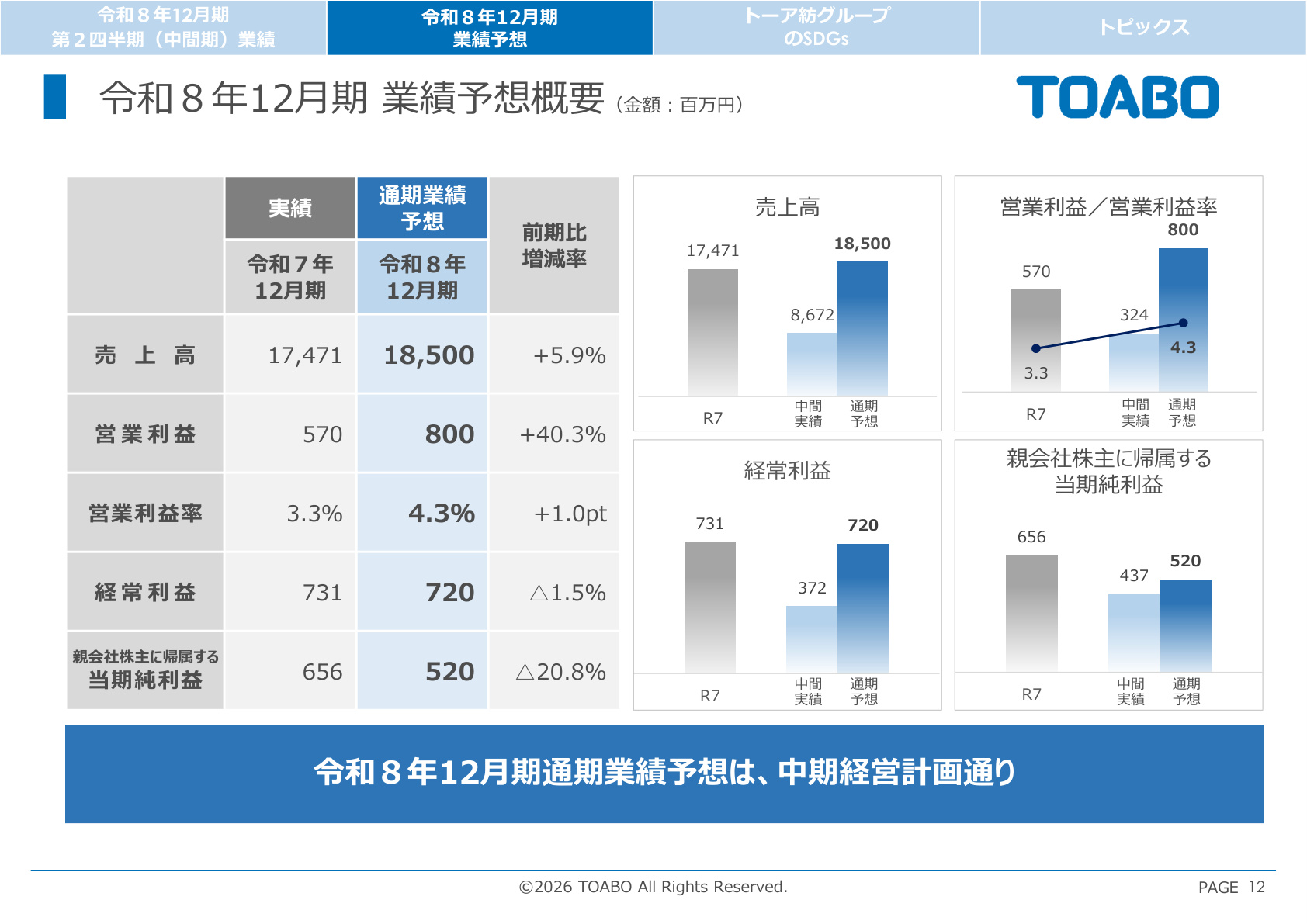
The slide above clarifies the overall full-year earnings forecast and its positioning relative to interim results. Achieving the full-year plan requires a rapid recovery in operating profit during the second half (approximately 476 million yen in operating profit for the second half alone).
Key Full-Year Forecast Figures
- Net Sales : 18,500 million yen (up 5.9% YoY)
- Operating Profit : 800 million yen (up 40.3% YoY)
- Operating Profit Margin : 4.3% (up 1.0pt YoY)
- Ordinary Profit : 720 million yen (down 1.5% YoY)
- Net Income : 520 million yen (down 20.8% YoY)
Scenario and Background for Second-Half Weighted Achievement
Although the progress rate against the interim operating profit (324 million yen) is only 40.5%, the company’s decision to maintain its full-year plan is based on the following grounds:
- Catching up on Price Pass-Throughs : Penetration of price increases in the automotive interior and apparel sectors, which had been delayed in the first half due to rising raw material and energy costs.
- Seasonality of Demand and Conclusion of Inventory Adjustments : Stabilization of inventory levels in the apparel (uniform) market and increased shipments ahead of the peak demand season in the second half.
- Further Expansion of Growth Areas : Recovery in the electronics business driven by AI data center-related semiconductors and the resolution of customer equipment issues in the fine chemicals business.
5. Mid-to-Long-Term Growth Strategy and SDGs/Technological Innovation Topics
The company is focusing on cultivating mid-to-long-term growth drivers that integrate sustainability with advanced technological innovation, beyond merely strengthening its existing business base.
(1) Carbon Fiber Recycling Technology and Patent Acquisition (Go-Tech Project)
Toabo Material Co., Ltd., through joint research with Gifu University and the Mie Industrial Research Institute, has developed a pseudo-continuous fiber technology from recovered carbon fiber (CF). On June 10, 2026, the company acquired a patent for this technology (Patent No. 7876045) . By expanding the previously limited recycling applications for carbon fiber, the company is advancing the development of UD (unidirectional continuous fiber reinforced) tapes through a non-woven fabric approach, aiming for high-value-added deployment in automotive and various industrial materials.
(2) Biomass PP Fiber Utilizing Waste Cooking Oil and International Certification
Toabo is promoting the development and manufacturing of polypropylene (PP) fiber using recovered waste cooking oil as a raw material. To realize decarbonization and upcycling across the entire value chain, the company is building a strict management system with an eye toward obtaining international biomass certifications such as ISCC PLUS .
(3) GREENWOOL VALUE CHAIN and Participation in Advanced Chemical Exhibitions
Aiming to establish new environmental standards in the wool industry, the company is promoting the operation of the "GREENWOOL Value Chain." It is advancing the creation of an environmental impact index centered on CO2 emissions and brand development. Additionally, the group’s Osaka Shinyaku Co., Ltd. exhibited at "Chemical Material Japan" to promote its contract manufacturing services and actively cultivate customers in the cutting-edge chemical materials field.
Summary
In the second quarter of the fiscal year ending December 2026, Toabo Corporation faced an operating profit decline due to a deteriorating external environment in the apparel business and temporary setbacks in the chemical business. However, it achieved a sharp increase in net profit and an improvement in its equity ratio (42.5%) through the reduction of cross-shareholdings and asset efficiency improvements .
Achieving the full-year target of 800 million yen in operating profit (up 40.3% YoY) hinges on the penetration of price pass-throughs in the second half and growth in high-value-added fields (electronics, polypropylene fiber, non-woven fabrics, etc.). The focus moving forward will be on whether technological innovations, such as eco-friendly materials (recycled carbon fiber and waste cooking oil-based fibers), will bear fruit and lead to mid-term corporate value enhancement.
This content is not intended as investment advice or a recommendation. Any opinions expressed are solely the personal views of each article.