


LA Holdings: Q2 FY2026 Earnings Deep Dive Report

StockClub
Published: Aug 10, 2026, 09:56 AM
Sentiment Analysis
1. Earnings Overview: H1 Results and the H2-Weighted Business Model
LA Holdings' consolidated financial results for the second quarter (interim period) of the fiscal year ending December 2026 showed net sales of ¥16.833 billion (down 3.1% YoY), operating profit of ¥2.033 billion (down 49.1% YoY), ordinary profit of ¥1.239 billion (down 63.7% YoY), and net profit attributable to owners of the parent of ¥81 million (down 65.9% YoY).
While this appears to be a significant decline in profit at first glance, it is entirely due to the company's business structure, which is "heavily weighted toward the second half of the fiscal year in terms of sales and profit." For the fiscal year ending December 2026, the company has planned for the delivery and revenue recognition of large-scale projects in its core DX Real Estate Value-Up Business to be concentrated in the second half. Therefore, the low progress rate in the first half was a scenario fully anticipated by the company. Regarding gross profit margins by segment, the DX New Construction Real Estate Business maintained a first-half margin exceeding the full-year plan, confirming that the profitability of individual projects remains sound.
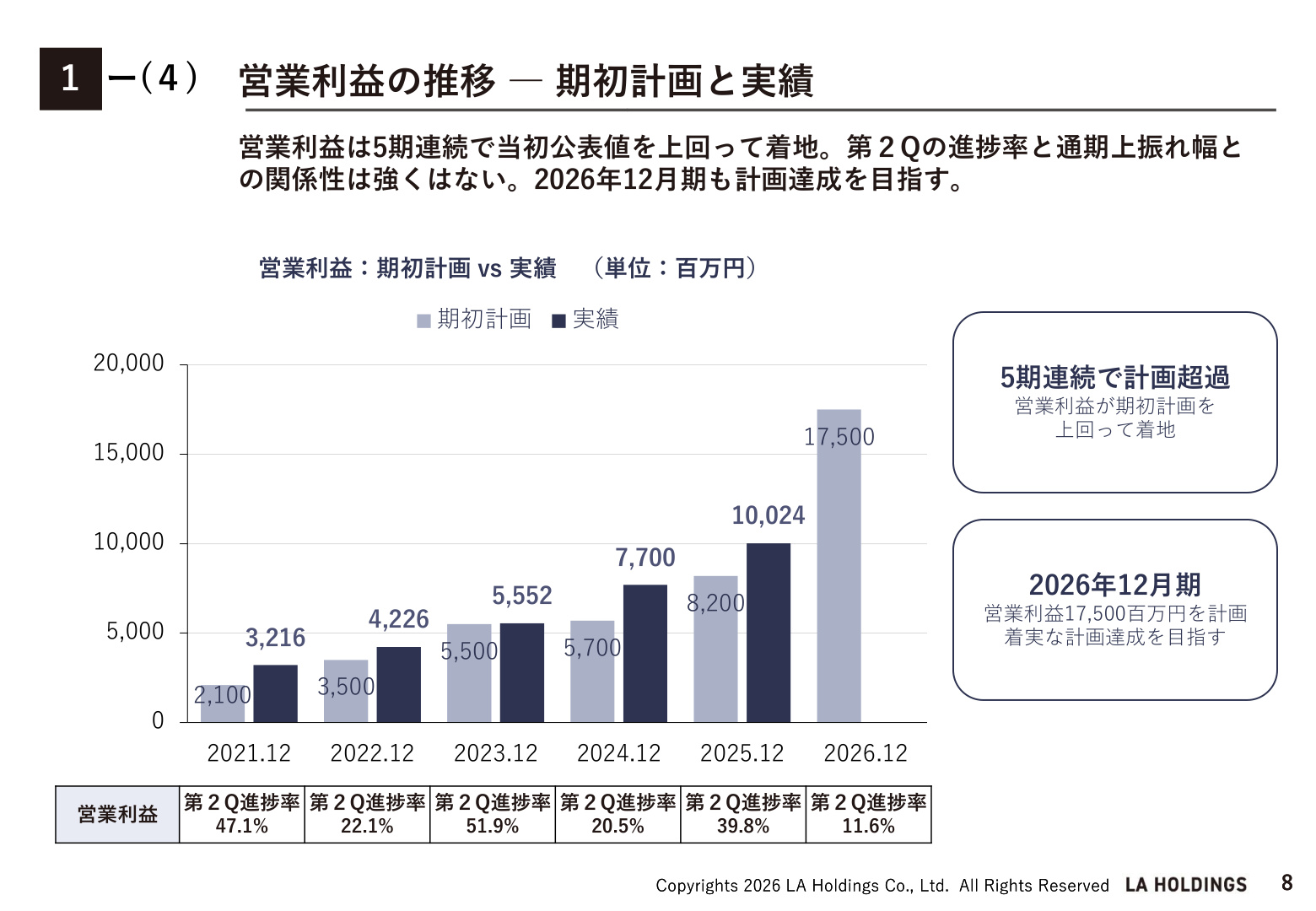
[Slide Commentary: Operating Profit Trends and Predictability of Plan Achievement]
The slide above (Page 7) illustrates the "Initial Plan vs. Actual Results" for the company's operating profit, as well as historical quarterly progress rates. This slide is critical because it clearly demonstrates, based on past performance patterns, that "a low progress rate in the second quarter does not imply a failure to meet full-year targets." While the second-quarter progress rate has fluctuated significantly over the years—47.1% in 2021, 22.1% in 2022, 51.9% in 2023, 20.5% in 2024, and 39.8% in 2025—the company has surpassed its initial full-year operating profit plan for five consecutive years. Although the progress rate for the current second quarter stands at 11.6%, this is attributed to project-specific timing shifts in the delivery of large-scale properties, and management confirms that progress remains on track to meet the full-year plan.
2. Strengthening the Asset Base: Record-High Inventory of ¥74.1 Billion
The most important leading indicator supporting the company's future growth is the accumulation of inventory (real estate for sale in process + real estate for sale). As of the end of June 2026 (end of Q2), inventory reached a record high of ¥74.1 billion (an increase of ¥8.8 billion compared to the end of December 2025).
For real estate developers and revitalization firms, inventory is the "source of future sales and profit." A breakdown of the inventory shows ¥46.9 billion in "real estate for sale in process," which requires a lead time of approximately two years from acquisition to completion, and ¥27.2 billion in "real estate for sale," which takes approximately 0.5 to 1 year to recognize as revenue. This confirms a robust development pipeline secured not only for the second half of 2026 but also for 2027 and beyond.
In terms of the asset portfolio, the company maintains a well-balanced mix of products, including individual renovation condominiums (36 properties), commercial facilities (20 properties), for-sale residences (11 properties), rental residences (9 properties), and investment properties (9 properties), realizing a risk-diversified business model that is not overly dependent on any single asset class.
3. Full-Year Earnings Forecast: A Scenario of Significant Revenue and Profit Growth Targeting ¥17.5 Billion in Operating Profit
The full-year consolidated earnings forecast for the fiscal year ending December 2026 remains unchanged from the initial plan, reflecting an aggressive growth strategy aimed at achieving record-high profits.
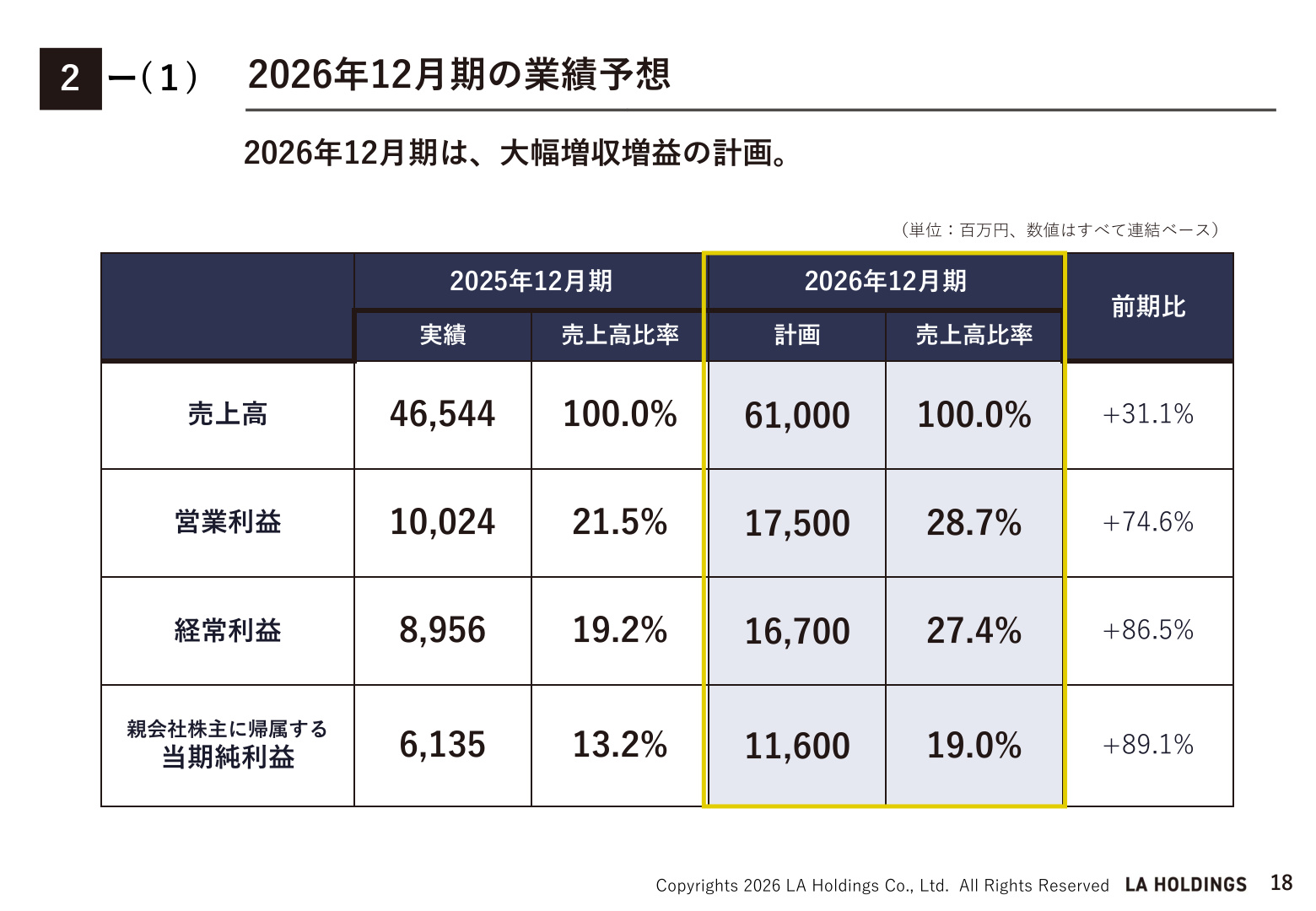
[Slide Commentary: Overview of Full-Year Earnings Forecast for FY2026]
The slide above (Page 17) provides a summary of the full-year consolidated earnings forecast for the fiscal year ending December 2026. This data indicates that the company's growth phase has entered a new, higher stage. The full-year plan projects net sales of ¥61.0 billion (up 31.1% YoY) , operating profit of ¥17.5 billion (up 74.6% YoY) , ordinary profit of ¥16.7 billion (up 86.5% YoY) , and net profit attributable to owners of the parent of ¥11.6 billion (up 89.1% YoY).
With the expansion of sales, the operating profit margin is expected to rise significantly from 21.5% in the previous fiscal year to 28.7%. This is driven by the revenue recognition of high-margin, large-scale development and revitalization projects, symbolizing an evolution into a high-profit structure where the bottom line grows even faster than the top line.
4. Segment Trends: Dramatic Profit Growth Driven by the DX Real Estate Value-Up Business
The dramatic earnings growth for the fiscal year ending December 2026 is led by the "DX Real Estate Value-Up Business (Segment III)."
Details of the full-year plan by segment are as follows:
- DX New Construction Real Estate Business (I): Net sales of ¥17.5 billion (down 13.5% YoY), gross profit of ¥3.6 billion (down 57.4% YoY). The decline in profit margin is a reaction to the concentration of high-margin projects in the previous year; the business itself is operating stably.
- DX Real Estate Revitalization Business (II): Net sales of ¥15.0 billion (up 13.3% YoY), gross profit of ¥2.25 billion (up 12.8% YoY). Sales of high-end renovation condominiums, including the "BILLION RESIDENCE" series, are contributing steadily.
- DX Real Estate Value-Up Business (III): Net sales of ¥27.6 billion (up 131.3% YoY) , gross profit of ¥15.5 billion (up 597.3% YoY). With the delivery of large-scale, high-profit development projects (such as industrial park development in Koga City, Fukuoka Prefecture) scheduled for the second half, this segment is expected to generate the majority of the company's total profit growth.
- Real Estate Leasing Business (IV): Net sales of ¥0.9 billion (down 19.5% YoY), gross profit of ¥0.45 billion (down 34.4% YoY). This provides stable cash flow as a stock-type revenue source.
Thus, the realization of large-scale projects in Segment III is the structure driving the overall earnings growth for the fiscal year ending December 2026.
5. Deepening Growth Areas and New Topics: Hotels, Healthcare, and Regional Revitalization
The company is moving beyond simple real estate trading to promote differentiation strategies that capture social needs.
- Focus on Residential Hotels: To address the rise in inbound demand and the need for long-term stays by families and groups, the company has positioned "residential hotels" equipped with kitchens as a growth area. Projects are underway in prime central locations such as Shibuya-ku and Ginza 1-chome, leveraging the ability to pass on inflation and rising costs to room rates.
- Healthcare and Social Infrastructure Cooperation in Hokkaido: In response to social issues such as the shortage of housing for end-of-life care and disability welfare, the company is collaborating with Japan Hospice Holdings and Fibergate. It has initiated its first complex development project in Higashi-ku, Sapporo, featuring "hospice housing and group homes for the disabled."
- Regional Revitalization and Wide-Area Development: In Koga City, Fukuoka Prefecture, the company is promoting its largest-ever industrial park development (Shinbaru-Takagi district development), with the project progressing toward completion in late August 2026 and delivery in the second half.
6. Dramatic Expansion of Shareholder Returns: Significant Dividend Increase and Introduction of Shareholder Perks
In line with the company's rapid growth, the shareholder return policy has been significantly strengthened.
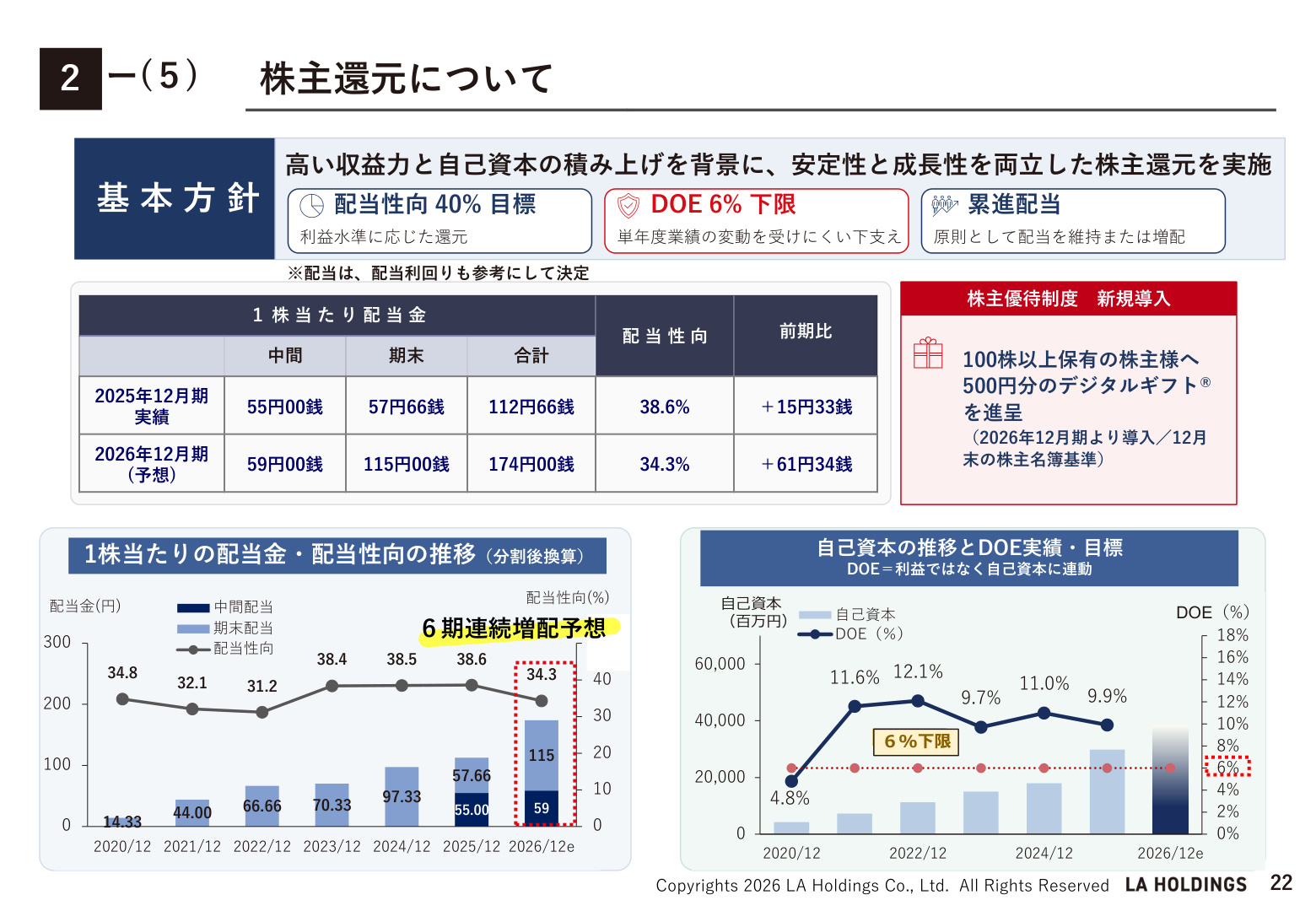
[Slide Commentary: Changes to Shareholder Return Policy and Accumulation of Equity]
The slide above (Page 21) outlines the company's basic policy of a "40% dividend payout ratio target," "6% minimum DOE (Dividend on Equity)," and "progressive dividends," along with specific return details. The annual dividend forecast for the fiscal year ending December 2026 is ¥174.00 per share , representing a significant increase of ¥61.34 from the previous fiscal year (FY2025 actual: ¥112.66), marking a projected sixth consecutive year of dividend increases. Supported by a plan to rapidly expand EPS to ¥506.8, a high level of returns will be maintained. Furthermore, the company has introduced a "6% minimum DOE" to ensure stable returns regardless of annual earnings fluctuations, and has established a new shareholder perk system offering digital gifts (worth ¥500) for shareholders holding 100 shares or more, creating a comprehensive return policy to expand the individual investor base.
7. Mid-to-Long-Term Strategy and Summary: Growth Roadmap Aiming for a Market Capitalization of Over ¥100 Billion
The company has set forth a long-term management plan, "LA Next Stage 2031," aiming to achieve EPS growth and PER expansion simultaneously through the three pillars of "Business Strategy," "IR Strategy," and "Shareholder Returns," with the goal of reaching a market capitalization of over ¥100 billion at an early stage.
As part of its IR strategy, the company has achieved strategic multiple listings on four domestic markets —the Tokyo Stock Exchange Growth Market, Nagoya Stock Exchange Premier Market, Fukuoka Stock Exchange Main Board, and Sapporo Stock Exchange Main Board. This unique model builds networks and enhances brand recognition in each region, which in turn facilitates fundraising and project acquisition.
In summary, while the Q2 FY2026 earnings progress may appear low on paper, the results confirm that, backed by a record-high inventory of ¥74.1 billion, the company is steadily progressing as planned toward the recognition of large-scale projects in the second half, the achievement of record-high profits, and a significant dividend increase.
This content is not intended as investment advice or a recommendation. Any opinions expressed are solely the personal views of each article.