


Shimadaya (250A) Q1 FY2027 Earnings Deep Dive: A Comprehensive Look at the Profit Recovery Scenario Through Food Service Expansion and Price Revisions

StockClub
Published: Aug 10, 2026, 09:55 AM
Sentiment Analysis

1. Executive Summary (Earnings Overview and Big Picture)
Shimadaya Corporation (Securities Code: 250A) reported its financial results for the first quarter of the fiscal year ending March 2027 . While net sales showed steady growth at 10,857 million yen (+1.0% YoY) , the company recorded a decline in profits , with operating profit at 825 million yen (-21.0% YoY) , ordinary profit at 840 million yen (-21.2% YoY) , and quarterly net profit attributable to owners of the parent at 593 million yen (-20.1% YoY) .
The primary theme of this quarter is the contrast between the "strong demand expansion in the food service business" and "margin pressure due to rising costs across the board." While the food service business significantly boosted the top line, supported by a recovery in dining-out demand, the increase in costs—including raw materials, labor, fixed manufacturing costs, and logistics—outpaced cost-control efforts, resulting in lower profits compared to the same period last year.
However, the company has maintained its full-year earnings forecast (net sales of 43,400 million yen, operating profit of 3,700 million yen, and net profit of 2,600 million yen) as originally planned. This is underpinned by a profit recovery scenario for the second half, driven by the implementation of price revisions effective from deliveries on October 1, 2026, and self-help efforts to improve production and logistics efficiency.
2. Detailed Analysis of Consolidated Operating Results: Top-Line and Profit Trends
Comparing the first-quarter results with the same period last year highlights the expansion of the top line and the downward pressure on profit margins at each level.
- Net Sales : 10,857 million yen (Previous Q1: 10,749 million yen, +108 million yen / +1.0% )
- Operating Profit : 825 million yen (Previous Q1: 1,045 million yen, -220 million yen / -21.0% )
- Ordinary Profit : 840 million yen (Previous Q1: 1,066 million yen, -226 million yen / -21.2% )
- Quarterly Net Profit Attributable to Owners of the Parent : 593 million yen (Previous Q1: 742 million yen, -149 million yen / -20.1% )
- Earnings Per Share (EPS) : 41.45 yen (Previous Q1: 48.81 yen)
In terms of net sales, the decline in the household-use business (down 1.3% YoY), which was affected by poor weather, was offset by the food service business (up 5.2% YoY), where dining-out demand is recovering. Overall, the company achieved record-high sales. However, the operating profit margin fell by 2.1 percentage points, from 9.7% in the previous year to 7.6% , reflecting the direct impact of changes in the cost structure.
3. Analysis of Operating Profit Fluctuations: The Structure of Rising Costs
A detailed breakdown of the 220 million yen decline in operating profit (from 1.05 billion yen to 0.83 billion yen, rounded) reveals that the increase in costs outweighed the positive impact of higher sales.
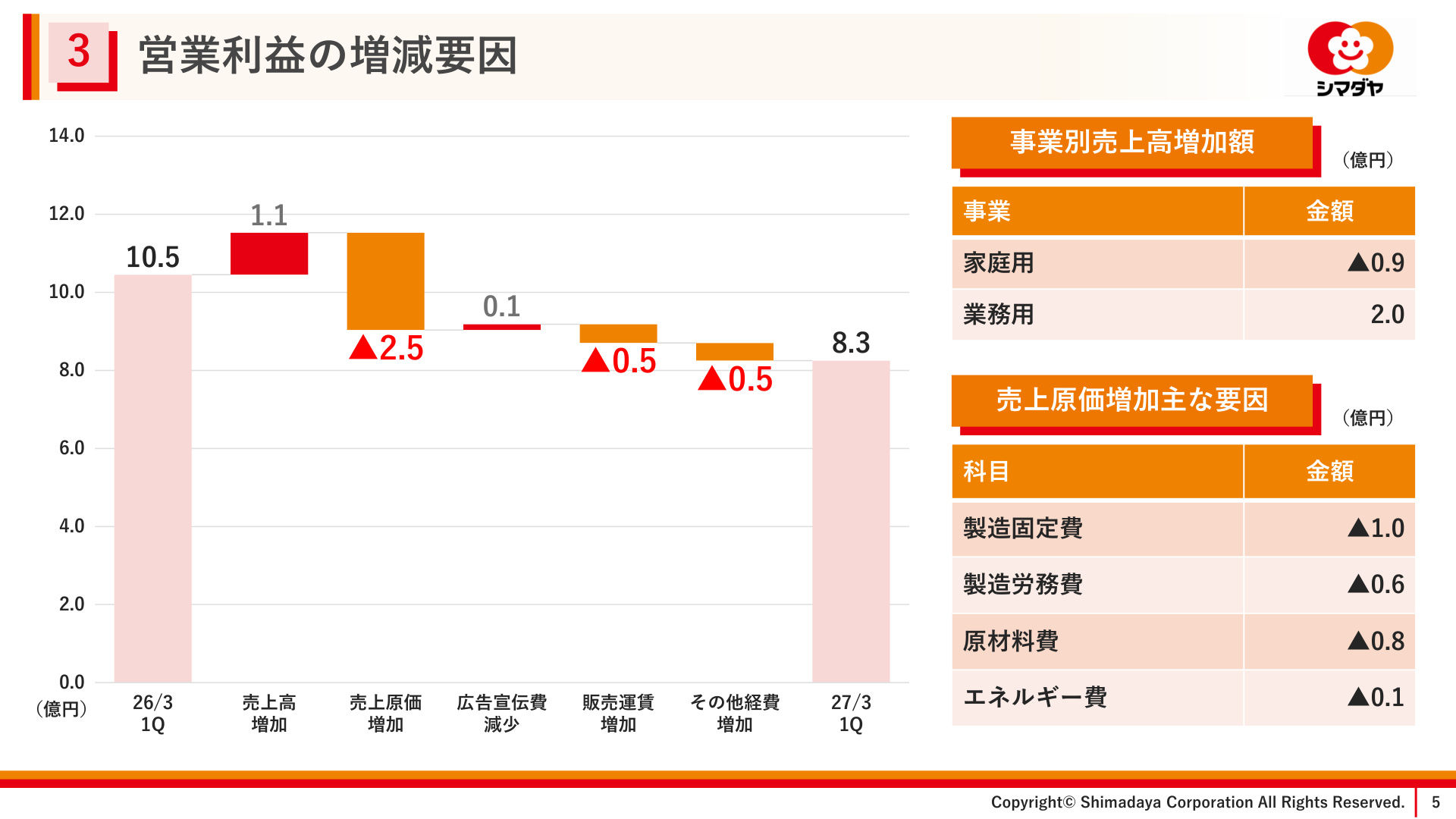
[Slide 5 Commentary: Background of Operating Profit Fluctuations]
The slide above visualizes the factors behind the operating profit changes in the first quarter. The primary drivers are as follows:
- Profit Contribution from Sales Growth (+110 million yen) : Although sales in the household-use business decreased by 90 million yen, the food service business achieved a sales increase of 200 million yen, resulting in a net positive impact of 110 million yen on profit.
- Increase in Cost of Sales (-250 million yen) : The main factors for the deterioration in costs include fixed manufacturing costs (-100 million yen) , raw material costs (-80 million yen) , manufacturing labor costs (-60 million yen) , and energy costs (-10 million yen) . In addition to rising fixed costs such as depreciation, the surge in prices for wheat and other raw materials, as well as rising labor costs due to labor shortages, collectively pressured profits.
- Increase in SG&A Expenses (-90 million yen) : Despite efforts to reduce advertising expenses (+10 million yen), the company could not fully absorb the increase in delivery freight (-50 million yen) and other expenses (-50 million yen) caused by the shortage of logistics drivers and rising labor costs.
As this analysis shows, the decline in profit is primarily due to unavoidable external cost hikes rather than a decline in demand itself.
4. Financial Position and Soundness (Balance Sheet Analysis)
The consolidated financial position at the end of the first quarter of the fiscal year ending March 2027 shows that the company is maintaining high financial soundness while continuing growth investments.
- Total Assets : 27,908 million yen ( +1,904 million yen from the end of the previous fiscal year)
- Current Assets : 12,463 million yen (+1,302 million yen. Accounts receivable increased by 1,648 million yen, while cash and deposits decreased by 709 million yen)
- Non-current Assets : 15,445 million yen (+602 million yen. Property, plant, and equipment increased by 756 million yen due to new acquisitions of machinery and buildings)
- Liabilities : 9,237 million yen ( +1,695 million yen from the end of the previous fiscal year)
- Long-term borrowings increased by 1,277 million yen to meet funding needs for capital investment (Non-current liabilities: 2,843 million yen)
- Net Assets : 18,671 million yen ( +209 million yen from the end of the previous fiscal year)
- Equity Ratio : 66.9% (Previous fiscal year-end: 71.0%)
Due to the increase in liabilities associated with capital investment, the equity ratio fell by 4.1 percentage points to 66.9%. However, this remains at a very healthy level for a manufacturing company, providing a solid foundation for business operations and future investment.
5. Sales Performance and Volume Trends by Business Segment and Major Brand
Total sales volume for the first quarter reached 215 million units , exceeding the 213 million units recorded in the same period last year. Trends by business and major brand performance are as follows:
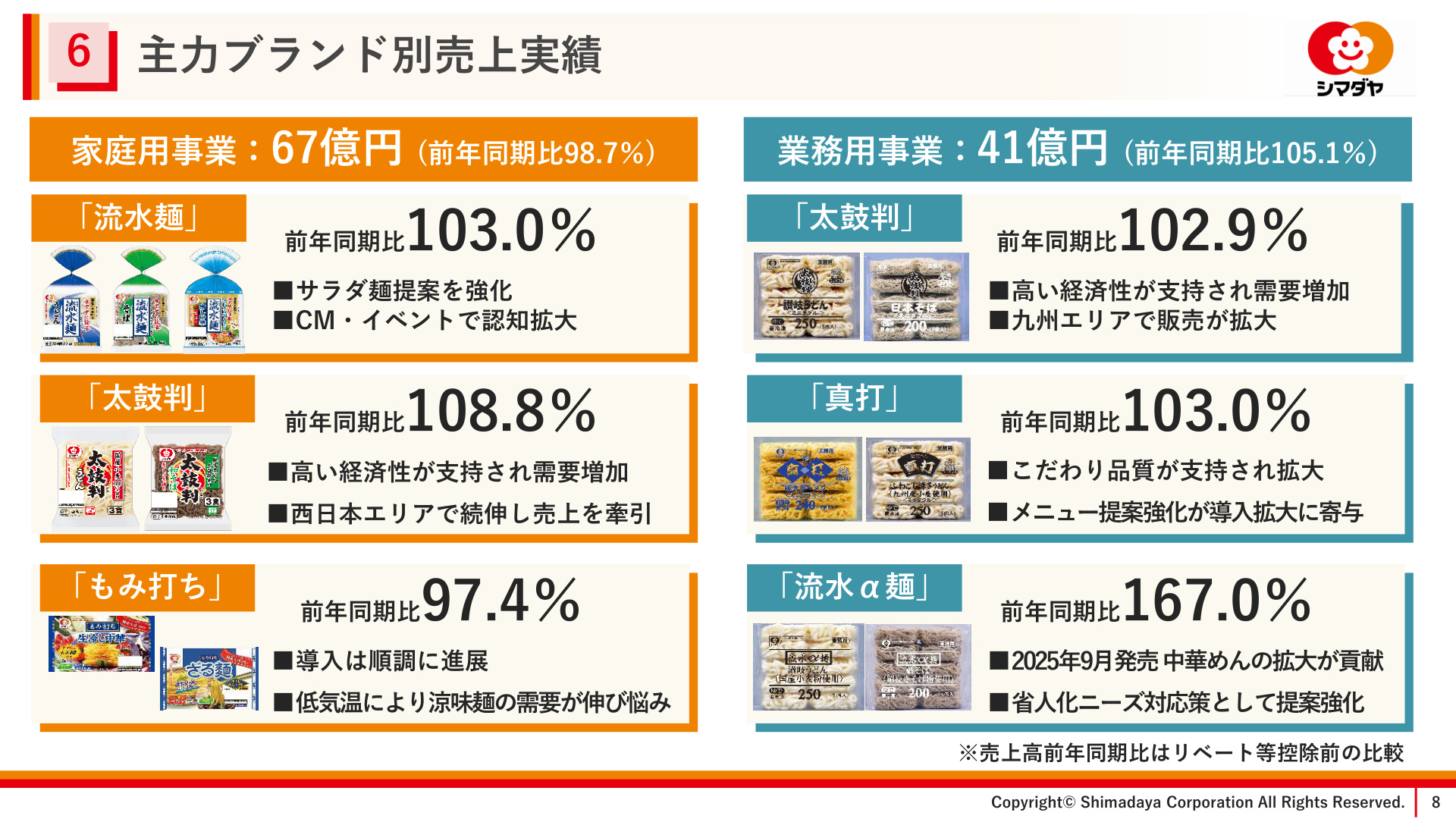
[Slide 8 Commentary: Significance of Sales Performance by Major Brand]
This slide shows the year-on-year sales performance of major brands in both the household and food service segments. A clear contrast is evident between consumer-facing (household) and restaurant/food service-facing (food service) products.
① Household-Use Business (Sales: 6.7 billion yen / 98.7% YoY)
The household-use business saw a slight decline overall due to poor weather leading up to the peak season for chilled noodles in early summer.
- "Ryusui-men" : 103.0% YoY . Efforts to promote the product as a "salad noodle" and increased brand awareness through TV commercials and events were successful, leading to steady growth despite the poor weather.
- "Taikoban" : 108.8% YoY . As consumers become more budget-conscious, the product's high economic value and quality were well-received, driving sales significantly, particularly in the western Japan region.
- "Momi-uchi" : 97.4% YoY . While store adoption progressed smoothly, the demand for chilled noodles as a whole remained sluggish due to low temperatures, resulting in a decline compared to the previous year.
- Household Frozen Noodles : High-value-for-money 5-pack material noodles and "Frozen Hoto" with ingredients performed well.
② Food Service Business (Sales: 4.1 billion yen / 105.1% YoY)
Driven by labor shortages and robust demand in the food service sector, the food service business continues to maintain strong growth.
- "Taikoban" : 102.9% YoY . Highly valued for its cost-performance, sales expanded in regions such as Kyushu.
- "Shin-uchi" : 103.0% YoY . The company's unique commitment to quality and enhanced menu proposals led to wider adoption.
- "Ryusui Alpha-men" : 167.0% YoY . A major hit as a solution for simplifying operations and labor-saving in restaurants. The expansion of the Chinese noodle lineup launched in September 2025 also contributed to a significant increase in sales.
6. Full-Year Earnings Forecast and Key Strategies for Profit Improvement
Shimadaya has not changed its full-year earnings forecast for the fiscal year ending March 2027 from the initial plan:
- Net Sales : 43,400 million yen (+5.7% YoY)
- Operating Profit : 3,700 million yen (-1.8% YoY)
- Ordinary Profit : 3,730 million yen (-3.7% YoY)
- Net Profit : 2,600 million yen (+0.2% YoY)
- Earnings Per Share (EPS) : 181.66 yen
Although operating profit progress is currently behind the previous year's pace, the company has presented a clear improvement plan to achieve its full-year targets.
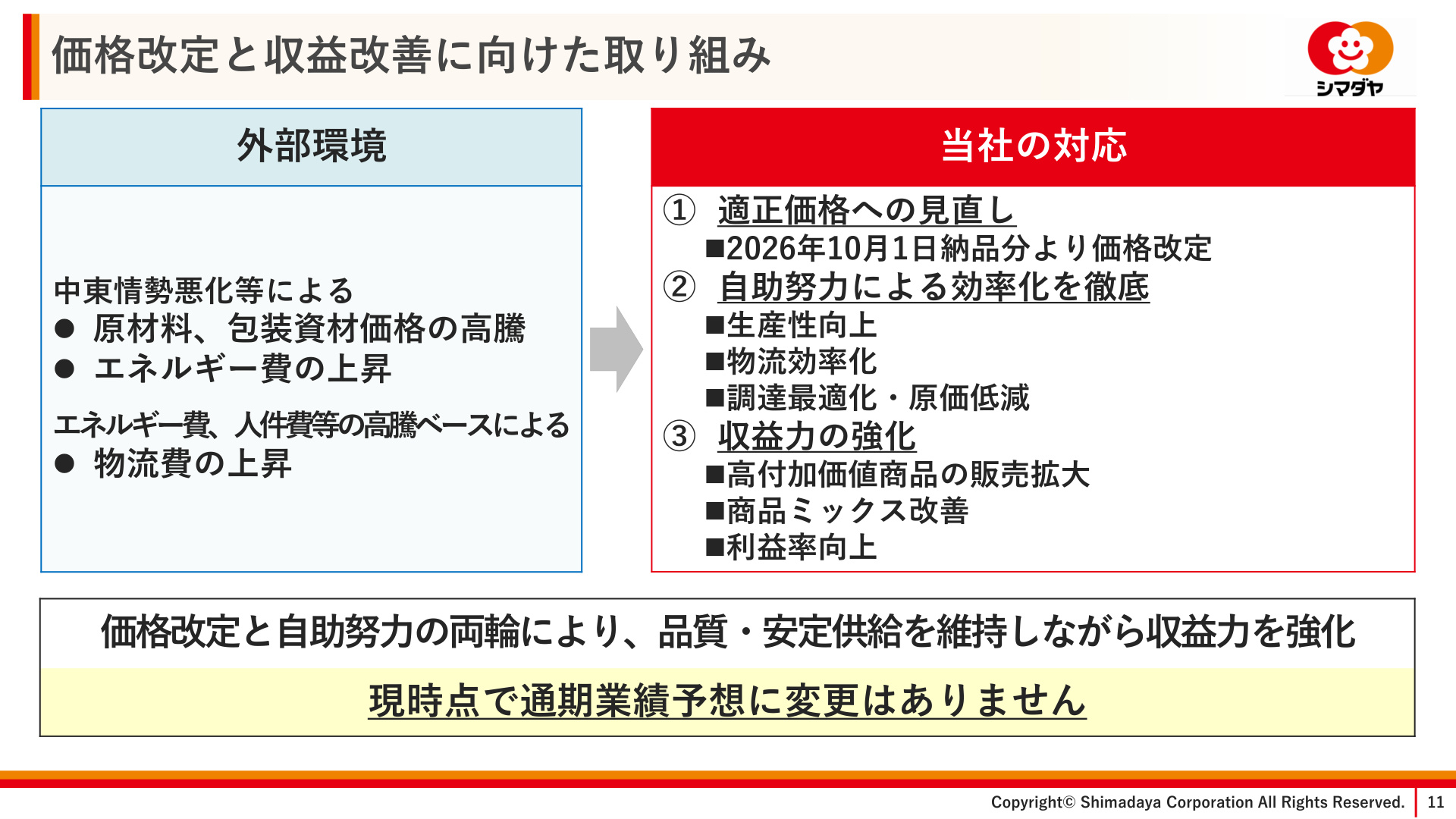
[Slide 11 Commentary: Roadmap for Price Revisions and Profit Improvement]
This slide outlines the company's specific countermeasures against the deteriorating external environment and is one of the most important pieces of information for gauging the confidence in future earnings recovery.
- Reviewing to Appropriate Prices (Implementation of Price Revisions) : In response to rising prices for raw materials and packaging materials due to the worsening situation in the Middle East, as well as rising energy, labor, and logistics costs, the company will implement price revisions effective from deliveries on October 1, 2026 . Gross margins, which were pressured in the first half, are expected to improve significantly in the second half due to these revisions.
- Thorough Efficiency Through Self-Help Efforts : Rather than relying solely on price revisions, the company will promote cost reductions through improved productivity, logistics efficiency, and optimized procurement.
- Enhancing High Value-Added Products and Profitability : The company aims to shift to a higher-margin product portfolio by expanding sales of high-value-added products, represented by "Ryusui Alpha-men," and improving the product mix.
By promoting these "dual-track" efforts—price revisions and self-help measures—the company plans to boost profitability while maintaining quality and stable supply.
7. Shareholder Return Policy (Dividends and Shareholder Perks)
The company considers returning profits to shareholders a key management priority and maintains a basic policy of "stable dividends with a target consolidated payout ratio of 30-40%."
-
Annual Dividend Forecast : 54.00 yen per share (Interim: 27.00 yen, Year-end: 27.00 yen)
- This represents a real increase of 2.00 yen compared to the fiscal year ended March 2026 (annualized 52.00 yen: 26.00 yen interim, 26.00 yen year-end).
- The payout ratio is approximately 29.7% against the forecasted EPS of 181.66 yen, which is in line with the policy.
-
Shareholder Perk System : Shareholders of record as of the end of March each year (who have held 100 shares or more for at least 6 months under the same shareholder number) receive a gift set of company products.
- 100 to 299 shares : 1,000 yen worth of company products
- 300 shares or more : 3,000 yen worth of company products (or the option to donate)
8. Conclusion and Future Focus Points
Although Shimadaya's Q1 FY2027 results showed a temporary decline in profit due to rising costs, the company's business foundation remains strong, as evidenced by the growth of the food service business, centered on "Ryusui Alpha-men," and the steady maintenance of market share for major brands .
Key points to watch moving forward include how smoothly the price revisions scheduled for October 2026 will be accepted and whether the expansion of labor-saving products like "Ryusui Alpha-men" can be maintained in the food service market amid labor shortages . Attention is focused on the company's recovery trajectory for the second half, supported by a solid financial base and clear cost-pass-through measures.
This content is not intended as investment advice or a recommendation. Any opinions expressed are solely the personal views of each article.