

![[Earnings Deep Dive] Totech Corporation (9960) Q1 FY2027 Results: Record-High Orders and Backlog, Balancing Growth Investment with Robust Shareholder Returns](https://news-images.stock-club.net/market_news/images/9960/140120260806511730/slide_eyecatch_en_69e26abb.webp)
[Earnings Deep Dive] Totech Corporation (9960) Q1 FY2027 Results: Record-High Orders and Backlog, Balancing Growth Investment with Robust Shareholder Returns

StockClub
Published: Aug 07, 2026, 12:53 PM
Sentiment Analysis
This report provides a comprehensive analysis of the Q1 FY2027 earnings for Totech Corporation (Securities Code: 9960), covering performance highlights, segment-specific trends, order dynamics, full-year forecasts, and mid-to-long-term growth strategies.
1. Overview of Q1 FY2027 Financial Results
In the first quarter (Q1) of the fiscal year ending March 2027, the Totech Group achieved net sales of 36.6 billion yen, a 1.5% increase year-on-year , marking a record high for a first quarter . This growth was driven by steady demand from new construction projects linked to urban redevelopment, private sector investments in data centers, factories, and hotels, as well as public sector projects.
Conversely, operating profit fell 12.4% year-on-year to 2.6 billion yen , ordinary profit declined 11.3% to 2.9 billion yen , and net profit attributable to owners of the parent decreased 8.6% to 1.9 billion yen . While the company saw revenue growth and improved gross profit margins, the temporary decline in profit is attributed to proactive human capital investment —including personnel costs and recruitment/training expenses—aimed at strengthening the management foundation under the Second Mid-Term Management Plan.
2. Performance Trends and Progress Evaluation
At the end of Q1, the progress against full-year targets stood at 20.4% for net sales (full-year forecast: 180 billion yen) and 14.5% for operating profit (full-year forecast: 18 billion yen). Totech’s business is subject to seasonal fluctuations, with construction completions and product deliveries typically concentrated in the second half of the fiscal year, particularly in Q4.
Furthermore, this fiscal year involves larger and longer-term instrumentation projects, causing a shift in revenue recognition to Q2 and beyond. Consequently, the decline in the operating profit margin to 7.1% (compared to 8.2% in the same period last year) is within expectations, and the company remains on a steady path toward achieving its annual targets.
3. Segment and Business-Specific Trends
Performance by segment and business is as follows:
- Product Sales Business : Net sales reached 20.5 billion yen, up 0.2% year-on-year . The core air conditioning equipment sales remained solid, while the maintenance and service sector expanded by 7.8% year-on-year.
- Construction Business : Net sales reached 16.1 billion yen, up 3.1% year-on-year . Alongside the progress of construction projects, the maintenance and service division saw significant growth of 13.3% year-on-year, supporting overall business expansion.
- Breakdown by Business :
- Air Conditioning : Net sales of 16.4 billion yen (+3.4% YoY) , driven by equipment sales.
- Instrumentation : Net sales of 6.4 billion yen (-2.3% YoY) , a slight decline due to the timing shift of construction projects.
- Energy : Net sales of 3.8 billion yen (+0.4% YoY) , with maintenance and service expanding by 64.2%.
- Affiliates (Domestic/Overseas) : Domestic affiliates recorded 10.1 billion yen (+4.4% YoY) , and overseas affiliates recorded 1.2 billion yen (+9.4% YoY) , both maintaining steady growth.
4. Factors Behind Operating Profit Changes and Gross Margin Improvement
The 300 million yen year-on-year decline in operating profit (from 2.9 billion to 2.6 billion yen) can be broken down as follows:
- Revenue Growth Effect : Increased sales of 500 million yen contributed +500 million yen to profit .
- Rising Costs : Higher material prices and other factors had a -100 million yen impact .
- Increase in SG&A Expenses : Higher selling, general, and administrative expenses due to human capital investment and management infrastructure upgrades resulted in a -700 million yen impact .
Although profit margins are temporarily pressured, the gross profit margin itself improved by 0.5 percentage points, from 27.9% to 28.4% . This was achieved because the improvement in the gross margin of the product sales business (21.4% to 22.5%), which accounts for a large share of revenue, offset the decline in the construction business margin (35.3% to 34.4%).
5. Surge in Orders and Acquisition of Large Overseas Projects
The most notable achievement in this quarter was in order intake.
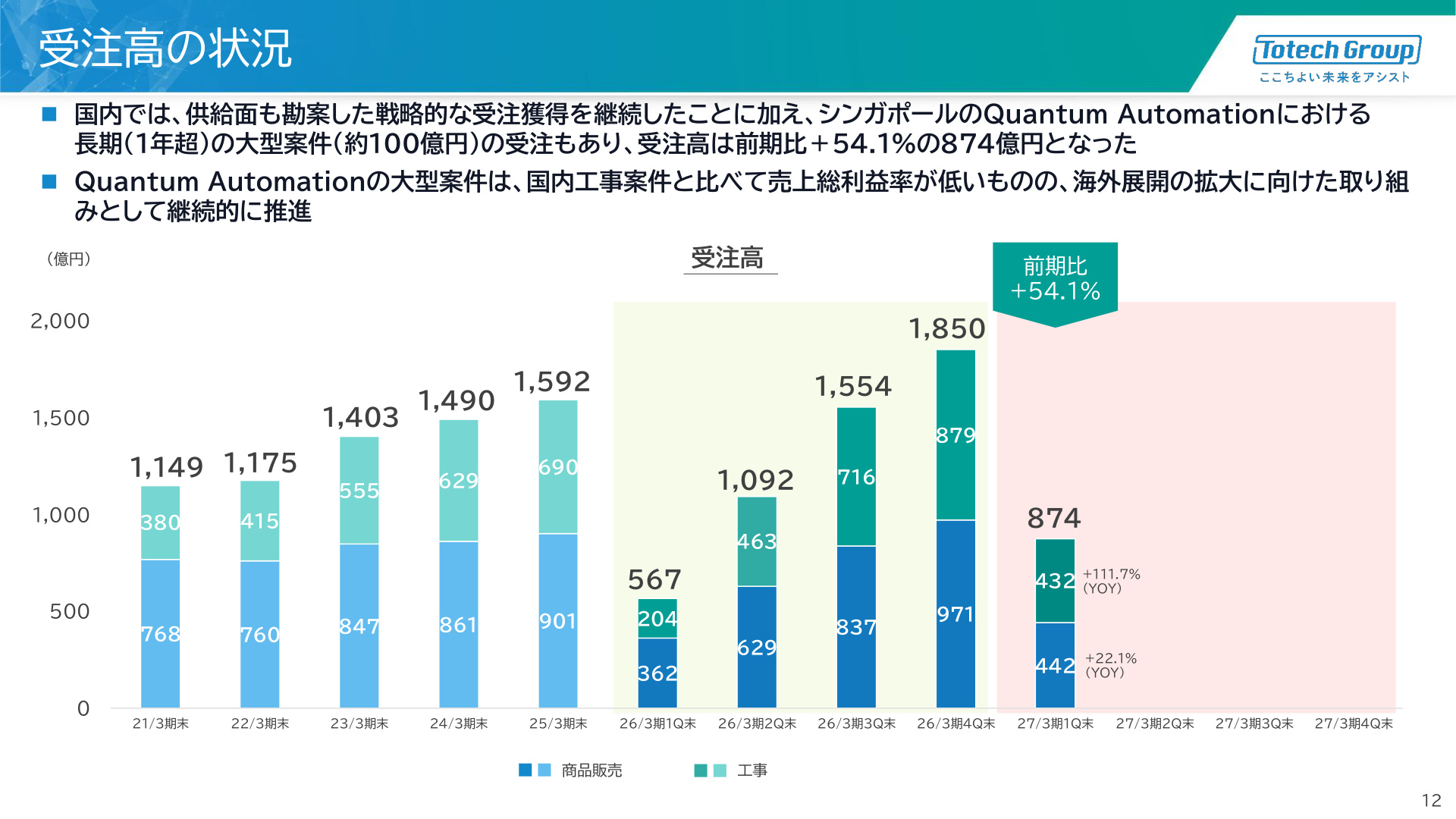
As shown in the "Order Intake" chart above, consolidated orders in Q1 saw a dramatic increase of 54.1% year-on-year to 87.4 billion yen . This jump was driven by successful strategic order-taking activities in Japan and the acquisition of a long-term, large-scale project worth approximately 10 billion yen with a duration exceeding one year by the Singapore-based subsidiary, Quantum Automation Pte. Ltd.
While the Quantum Automation project has a lower gross profit margin compared to domestic construction projects, it represents a significant milestone in the context of the Totech Group's mid-to-long-term strategy of expanding its global footprint. Orders surged in both the Product Sales segment (44.2 billion yen, +22.1% YoY) and the Construction segment (43.2 billion yen, +111.7% YoY).
6. Order Backlog and Future Revenue Visibility
Acquired orders are steadily being converted into a foundation for future revenue.
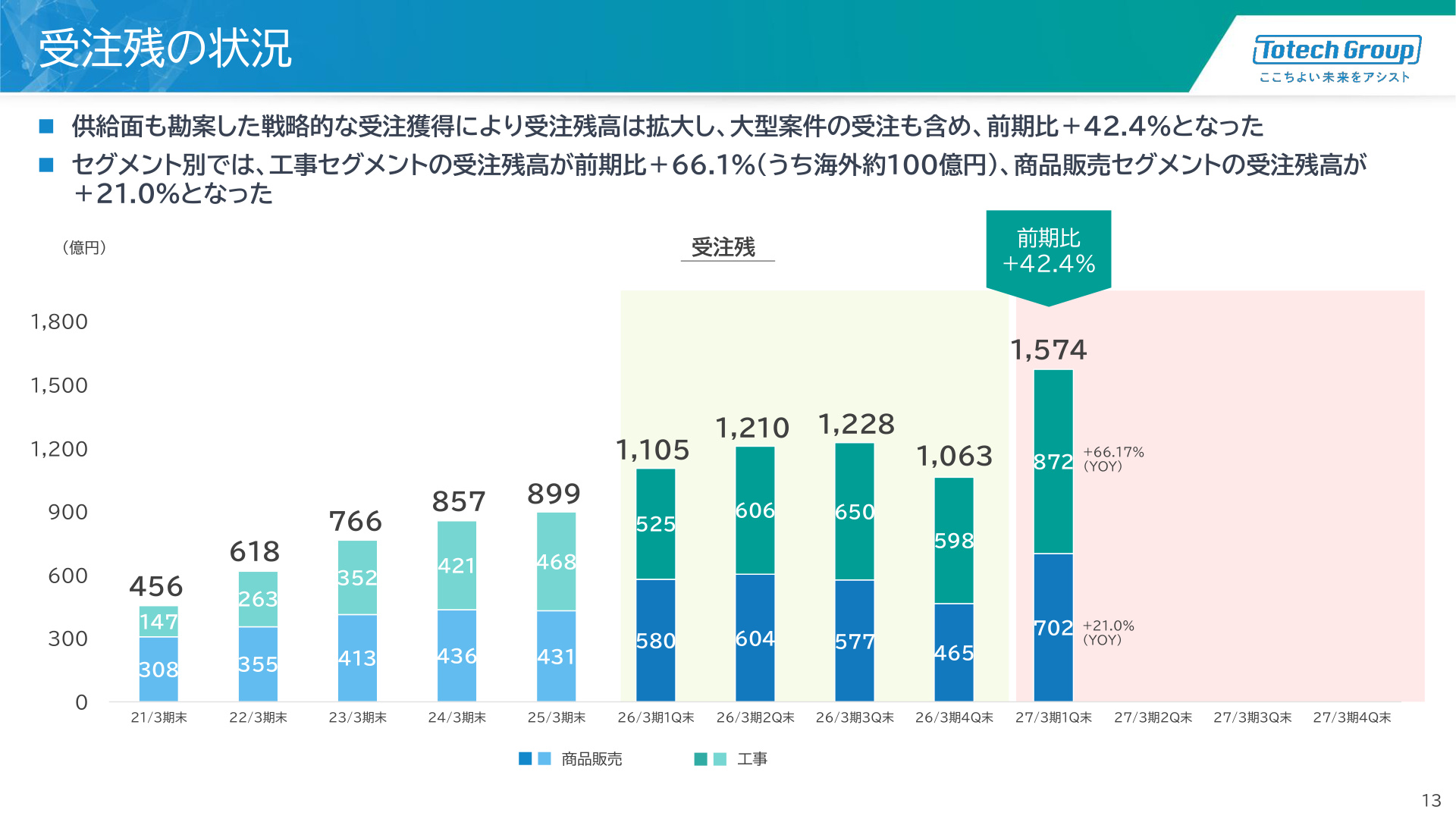
As shown in the "Order Backlog" chart above, the consolidated order backlog at the end of Q1 reached 157.4 billion yen, a 42.4% increase year-on-year , hitting a record high. Segment trends are as follows:
- Product Sales Segment : Backlog of 70.2 billion yen (+21.0% YoY)
- Construction Segment : Backlog of 87.2 billion yen (+66.1% YoY) (including approximately 10 billion yen from overseas)
The fact that the construction segment's backlog has increased by more than 60% indicates that the construction and delivery pipeline for Q2 and beyond is extremely robust. Supported by favorable demand, the company has built a structure with high visibility for revenue recognition.
7. Financial Foundation and Cash Flow Safety
Total assets at the end of Q1 decreased by 2.1 billion yen from the end of the previous fiscal year to 113.0 billion yen , primarily due to a seasonal decrease in notes and accounts receivable. Net assets increased by 900 million yen year-on-year to 74.6 billion yen , resulting in an equity ratio of 66.1% (+2.1 percentage points from the end of the previous fiscal year).
This high level of financial soundness, maintaining an equity ratio in the mid-60% range, provides strong risk resilience against future growth investments and unexpected environmental changes.
8. Full-Year Forecast and Management Environment
The full-year earnings forecast for the fiscal year ending March 2027 remains unchanged from the initial plan:
- Net Sales : 180 billion yen (+5.9% YoY)
- Operating Profit : 18 billion yen (+5.1% YoY)
- Ordinary Profit : 18.5 billion yen (+2.9% YoY)
- Net Profit : 13.7 billion yen (+4.3% YoY)
Although the construction industry faces challenges such as rising material prices, increased logistics costs, and a severe labor shortage, demand for urban redevelopment remains strong. Totech aims to achieve full-year revenue and profit growth by strategically investing in human capital—including salary increases—while securing high-value-added projects and promoting operational efficiency.
9. Capital Efficiency and Corporate Value Enhancement
Totech has presented a clear governance and capital policy aimed at improving capital efficiency and maximizing shareholder value.
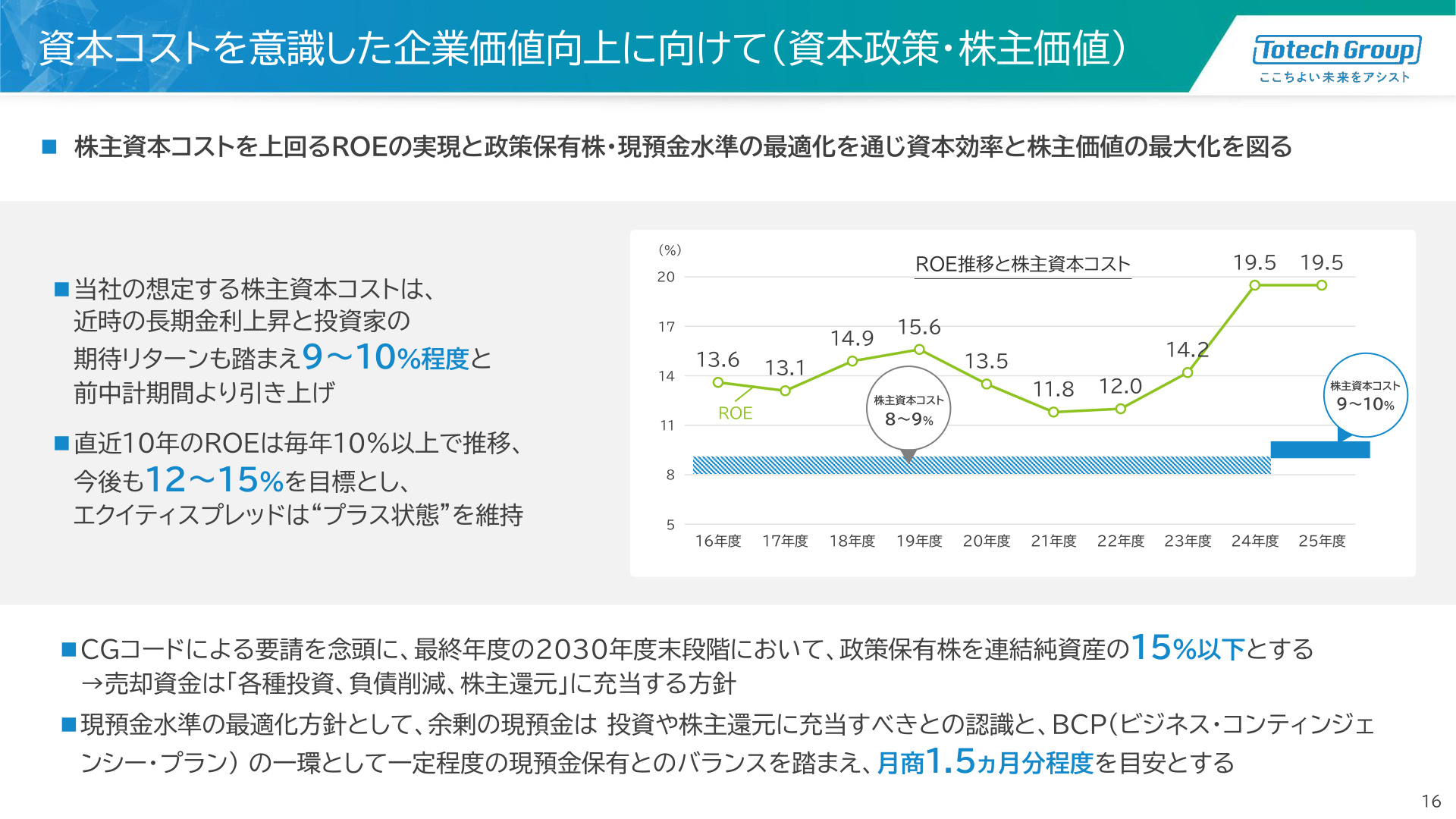
As shown in the chart "Toward Enhancing Corporate Value with Awareness of Cost of Capital," the company has raised its assumed cost of shareholders' equity to approximately 9–10% in light of recent interest rate hikes. Against this, it has set an ROE target of 12–15% . Backed by a track record of maintaining an ROE of over 10% for the past decade, the company is clearly committed to maintaining a positive equity spread .
Specific measures include:
- Reduction of Cross-Shareholdings : In accordance with the Corporate Governance Code, the company plans to reduce cross-shareholdings to less than 15% of consolidated net assets by the end of FY2030. Proceeds from sales will be allocated to growth investments, debt reduction, and shareholder returns.
- Optimization of Cash and Deposits : Based on Business Continuity Planning (BCP), the company is promoting the optimization of cash and deposits, targeting a level equivalent to approximately 1.5 months of monthly sales.
10. Shareholder Return Policy and Mid-Term Management Plan Outlook
Regarding shareholder returns, the company has adopted a policy of "DOE (Dividend on Equity) of 6% + Progressive Dividends" for the duration of the Second Mid-Term Management Plan. This demonstrates a commitment to stable returns unaffected by short-term performance fluctuations. The annual dividend forecast for the fiscal year ending March 2027 is 128 yen per share (42 yen interim, 86 yen year-end), the same as the previous year.
In the Second Mid-Term Management Plan , the company has set a long-term vision for FY2030 (the final year of the plan) of 220 billion yen in net sales and 22 billion yen in ordinary profit . By placing the strengthening of human capital management at the core and concentrating management resources on high-profit businesses (instrumentation, air conditioning, energy, overseas, etc.), the company is charting a path for sustainable growth as a pillar of social infrastructure.
This content is not intended as investment advice or a recommendation. Any opinions expressed are solely the personal views of each article.