


ISB Corporation (9702) Q2 FY2026 Earnings Analysis: Record-High First-Half Sales Driven by Recurring Growth and AI-Powered Business Model Transformation Toward the ¥50 Billion Mid-Term Goal

StockClub
Published: Aug 07, 2026, 12:51 PM
Sentiment Analysis
Earnings Overview
ISB Corporation (Securities Code: 9702) delivered a robust performance in the second quarter of the fiscal year ending December 2026, achieving record-high first-half sales supported by steady growth in its core security systems and IT solutions for the financial and public sectors. The company is making solid progress against its full-year targets, while simultaneously increasing dividend forecasts and accelerating human capital investment and structural reforms in line with its "Mid-Term Management Plan 2030."
This report provides a comprehensive analysis of the company's earnings highlights, segment-specific trends, the expansion of recurring products, and the strategic shift away from "man-month" business models toward AI-driven development.
1. Earnings Highlights: Sales and Profits Significantly Exceed Targets
For the first half of the fiscal year ending December 2026, the company reported consolidated results that surpassed both year-on-year figures and internal company plans across all key metrics: sales, operating profit, ordinary profit, and net income.
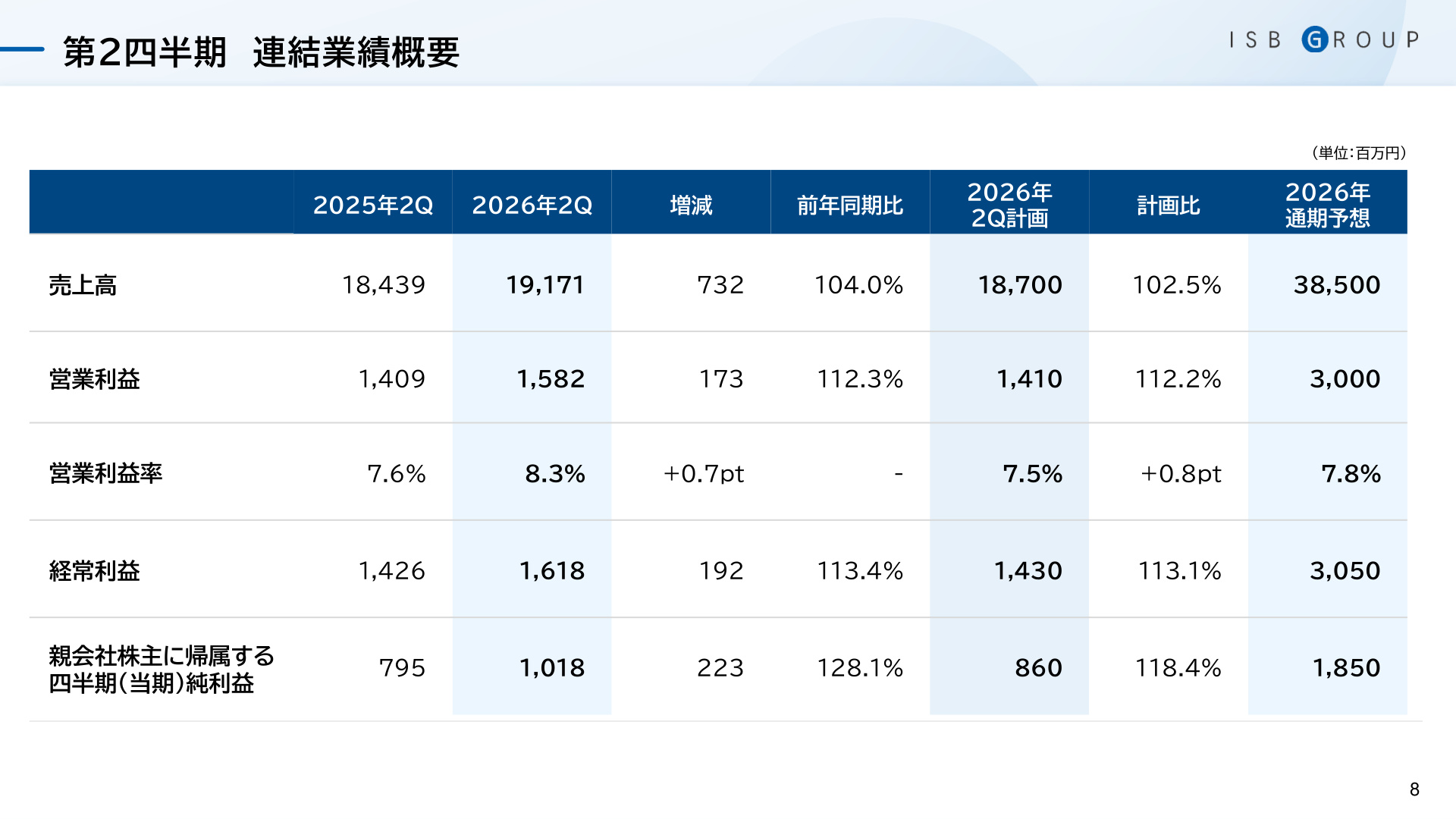
As shown in the slide above, cumulative second-quarter sales reached ¥19.171 billion (up 4.0% YoY, 102.5% of the plan) , and operating profit reached ¥1.582 billion (up 12.3% YoY, 112.2% of the plan) . The operating profit margin improved by 0.7 percentage points to 8.3% , up from 7.6% in the same period last year, confirming steady profitability improvements alongside top-line growth.
Progress against full-year forecasts stands at 49.8% for sales , 52.7% for operating profit , and 55.0% for net income attributable to owners of the parent , maintaining an ideal pace for the second half of the year.
Analysis of Sales and Operating Profit Variance
In terms of sales, the Product segment (+¥524 million) and the Enterprise segment (+¥266 million) were the primary contributors. While the Mobility segment (+¥10 million) saw sluggish growth in the automotive sector, the overall performance more than offset this weakness.
Key drivers for operating profit included profit growth from increased sales ( +¥182 million ) and a reduction in one-time costs related to office relocation incurred in the previous year ( +¥30 million ). These factors successfully absorbed the impact of increased costs from human capital investments, such as ¥270 million allocated for compensation improvements (base pay increases), resulting in double-digit operating profit growth.
2. Performance Trends by Business Segment
The company's operations are categorized into four main segments. Progress and background for each are as follows:
- Product Segment (Sales: ¥3.615 billion, up 17.0% YoY)
- Security Systems Business : Driven by the acquisition of renewal projects for access control systems and the growth of recurring products, this segment expanded significantly from ¥2.910 billion to ¥3.377 billion.
- Information Services Business (MDM, etc.) : Supported by a comprehensive support structure including kitting, the segment secured continuous projects from existing clients, maintaining high growth at ¥238 million (up 31.5% YoY).
- Enterprise Segment (Sales: ¥6.163 billion, up 4.5% YoY)
- Financial Sector : Successfully expanded projects by increasing personnel capable of handling upstream processes for major clients.
- Public Sector : Standardized municipal system projects performed steadily, and regional expansion progressed as planned.
- Mobility Segment (Sales: ¥2.665 billion, up 0.4% YoY)
- While mobile wireless infrastructure such as Wi-SUN-related products performed well, the automotive sector was impacted by market conditions, resulting in flat overall growth.
- Business Industry Segment (Sales: ¥6.728 billion, down 1.0% YoY)
- Despite steady performance in AI-related projects such as image and video analysis, the segment saw a slight decline due to development personnel adjustments during the transition period of large-scale projects. Future plans include expanding projects in cloud technology, medical, and DX fields.
3. Topics: Continuous Expansion of Recurring Products and Strengthening of Stock Revenue
One of the growth engines the company is focusing on is the recurring (stock-type) business model , which generates continuous revenue.
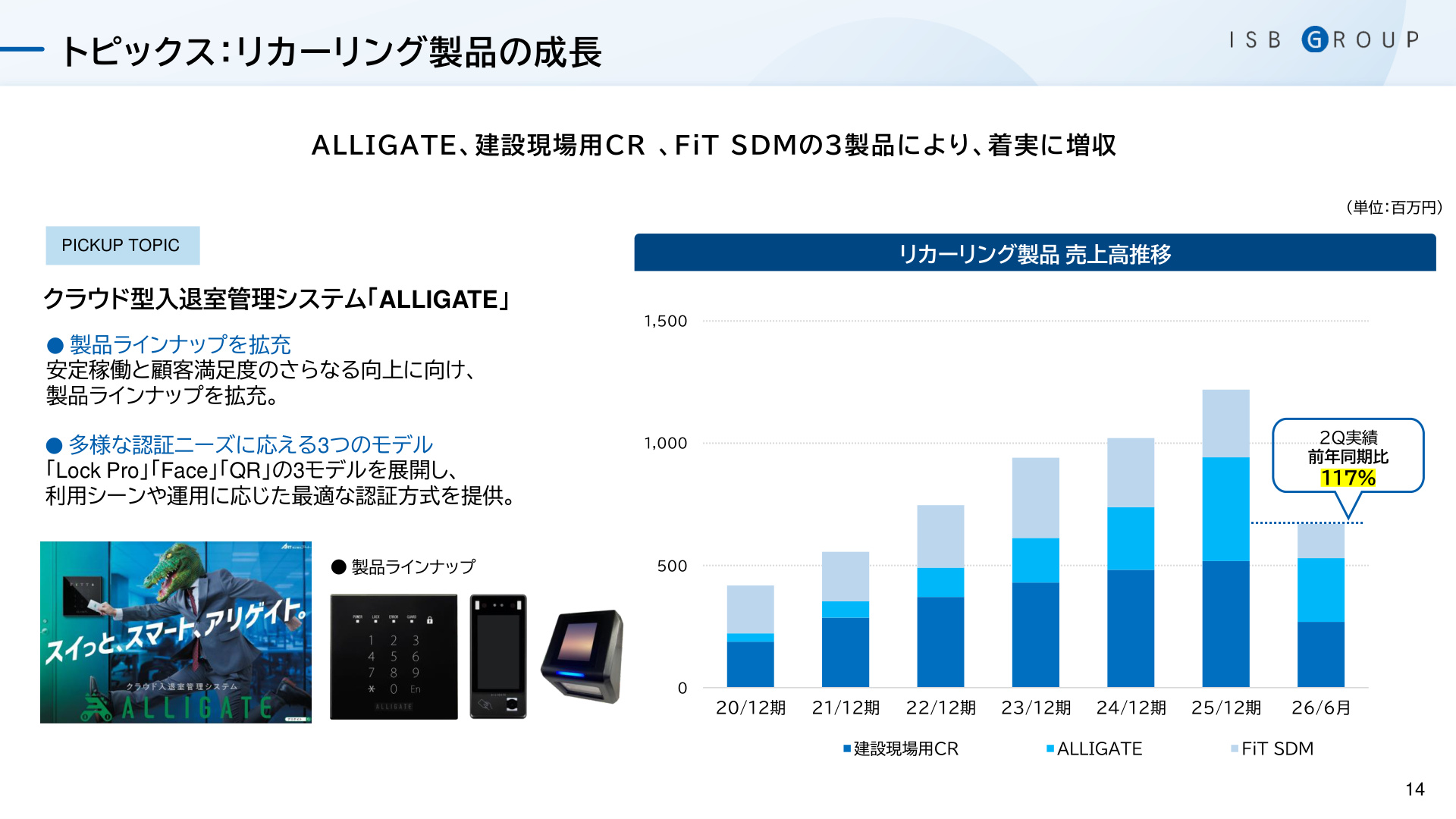
This slide illustrates the sales trends for the company's key recurring products: the cloud-based access control system "ALLIGATE," "CR for Construction Sites," and the mobile device management solution "FiT SDM." Sales of recurring products in the first half of the fiscal year ending June 2026 grew by 117% year-on-year , contributing to the stabilization of the mid-to-long-term revenue base.
In particular, "ALLIGATE" has expanded its lineup to meet diverse authentication needs with three models—"Lock Pro," "Face," and "QR"—thereby increasing customer satisfaction and the number of contracts. Shifting from one-off construction-based business to these high-margin recurring revenue streams is supporting the improvement of the company-wide operating profit margin.
4. Full-Year Earnings Forecast and Proactive Shareholder Return Policy
The full-year consolidated earnings forecast for the fiscal year ending December 2026 remains unchanged from the initial plan.
- Sales : ¥38.500 billion (+¥1.48 billion YoY)
- Operating Profit : ¥3.000 billion (+¥680 million YoY)
- Ordinary Profit : ¥3.050 billion (+¥660 million YoY)
- Net Income Attributable to Owners of the Parent : ¥1.850 billion (+¥410 million YoY)
The company has demonstrated a strong commitment to shareholder returns. The annual dividend is planned at ¥70 per share (¥35 interim, ¥35 year-end), an increase of ¥15 from the ¥54 paid in FY2024 and ¥55 in FY2025. The projected dividend payout ratio is 43.4% , maintaining a level consistent with the return policy outlined in the mid-term management plan.
5. Progress on Mid-Term Management Plan 2030: Moving Away from Man-Month Business and Transitioning to AI-Driven Development
The company is promoting its "Mid-Term Management Plan 2030," aiming for ¥50 billion in sales as a milestone on the path to ¥100 billion. A top priority is the "shift away from man-month business," a challenge common to the entire system integrator (SIer) industry.
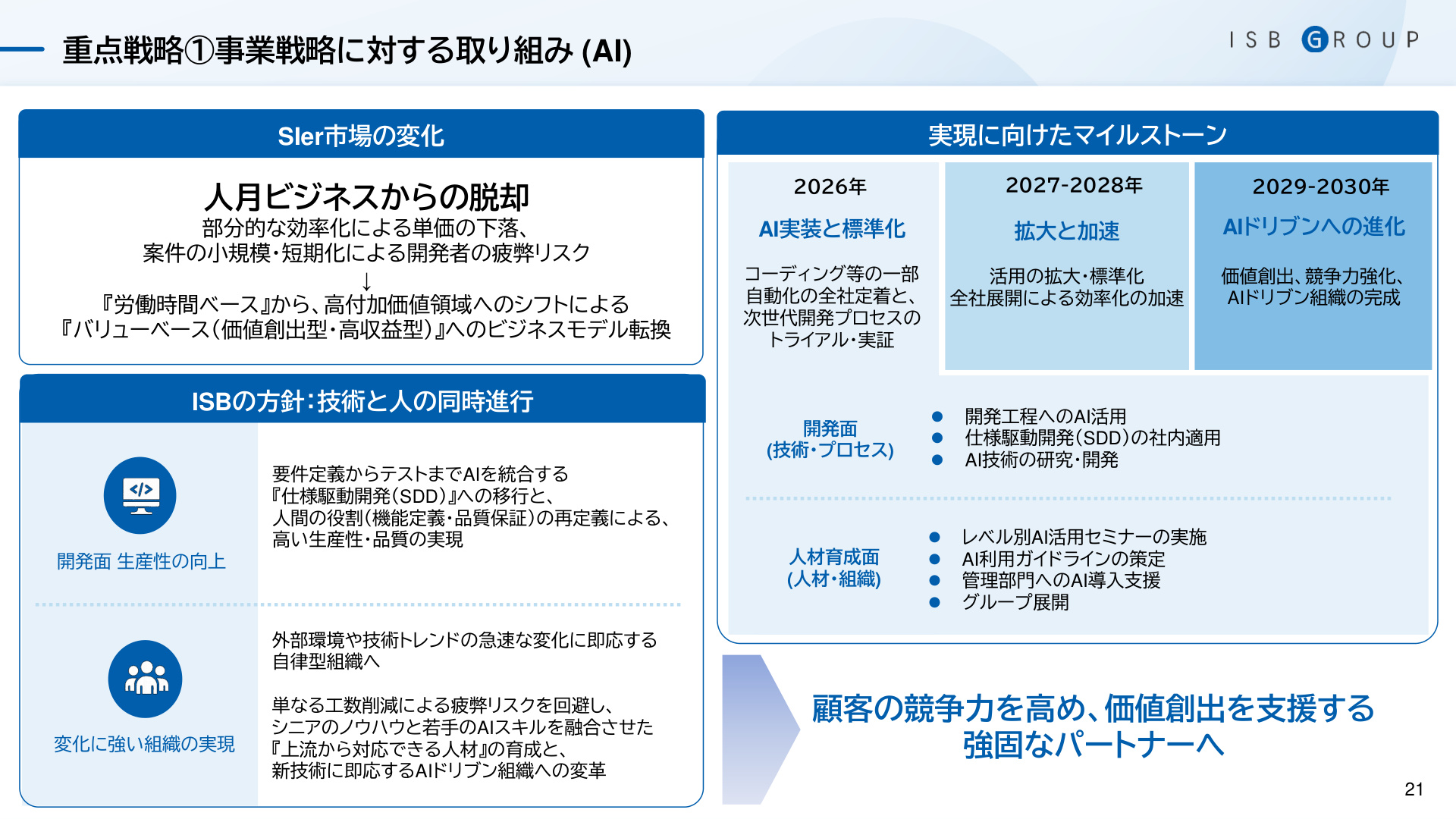
This slide is a key document defining the structural reforms and milestones for the development organization the company aims to achieve.
The traditional "man-hour/time-based" business model carries risks, such as downward pressure on unit prices due to partial efficiency gains and developer burnout from shortened project timelines. In response, the company has clearly set a goal to transition to a "Value-Based" (value-creation/high-profitability) business model.
Roadmap for Realization
- 2026 (AI Implementation and Standardization) : Institutionalize automation for tasks like coding, and conduct trials and verification of Specification-Driven Development (SDD) and next-generation development processes.
- 2027–2028 (Expansion and Acceleration) : Scale the use of these processes company-wide and accelerate development efficiency through standardization.
- 2029–2030 (Evolution to AI-Driven) : Complete the transformation into an "AI-driven organization" equipped with value-creation capabilities and high competitiveness.
Beyond mere cost and man-hour reduction, the company is building a structure that provides one-stop support from upstream processes like requirements definition by fusing the deep domain expertise of senior staff with the latest AI skills of younger employees.
Human Capital Strategy and Growth Investment
To support this transformation, the company is further strengthening its investment in human resources. In the first half of 2026, it executed ¥650 million in growth investments , allocating ¥270 million for compensation improvements, ¥270 million for office environment upgrades, and ¥50 million for recruitment and training. The company plans a total of ¥3.78 billion in investments over three years , and with an 82% progress rate as of the first half, the foundation is being built ahead of schedule.
Key KPI Targets for FY2030
Key KPIs for the fiscal year ending December 2030 are as follows:
- Sales : ¥50 billion or more (FY2025: ¥37 billion)
- Operating Profit : ¥4.5 billion or more (FY2025: ¥2.3 billion)
- Sales per Employee : ¥17.6 million or more (FY2025: approx. ¥16.5 million)
- Operating Profit per Employee : ¥1.6 million or more (FY2025: approx. ¥1.0 million)
- ROE : 14% or more (FY2025: 10.2%)
- Dividend Payout Ratio : 50% or more / DOE : 4% floor
Summary
ISB Corporation's Q2 FY2026 earnings showed strong progress, with record-high sales driven by the robust performance of its core IT services and security segments . Beyond mere earnings growth, the company is steadily and rapidly executing mid-to-long-term competitiveness enhancement measures for 2030. These include the expansion of high-profit recurring products like "ALLIGATE," the structural transformation of development toward a "value-based" model through AI utilization , and human capital investments centered on significant compensation improvements.
This content is not intended as investment advice or a recommendation. Any opinions expressed are solely the personal views of each article.