


Koa Shoji Holdings (9273) FY2026 Financial Results & Mid-to-Long-Term Growth Strategy Deep Dive Report

StockClub
Published: Aug 07, 2026, 12:22 PM
Sentiment Analysis
1. Financial Summary: Record-High Sales and Profits Across All Levels
Koa Shoji Holdings Co., Ltd. reported its full-year financial results for the fiscal year ending June 2026 , achieving record highs in both net sales and all profit categories. Net sales reached 24.678 billion yen (+6.1% YoY) , operating profit was 5.476 billion yen (+2.3% YoY) , ordinary profit stood at 5.521 billion yen (+2.7% YoY) , and net profit attributable to owners of the parent company was 3.748 billion yen (+3.0% YoY) .
The core Active Pharmaceutical Ingredient (API) segment was a major growth driver, bolstered by the expansion of recently launched APIs for new and generic drugs, as well as increased demand for generics following the introduction of the "Selected Medical Services" system. Meanwhile, in the Pharmaceuticals segment , while pre-filled syringe products and anti-cancer vial formulations manufactured at the Zao Plant performed exceptionally well, the existing solid dosage forms (tablets) handled at the head office plant saw a decline in revenue due to increased competition, resulting in overall flat profit growth for the segment.
2. Analysis of Performance Trends and Revenue Structure
The company has maintained a long-term upward trend, demonstrating exceptional growth and stability with eight consecutive years of sales growth and seven consecutive years of record-high profits from operating profit downward.
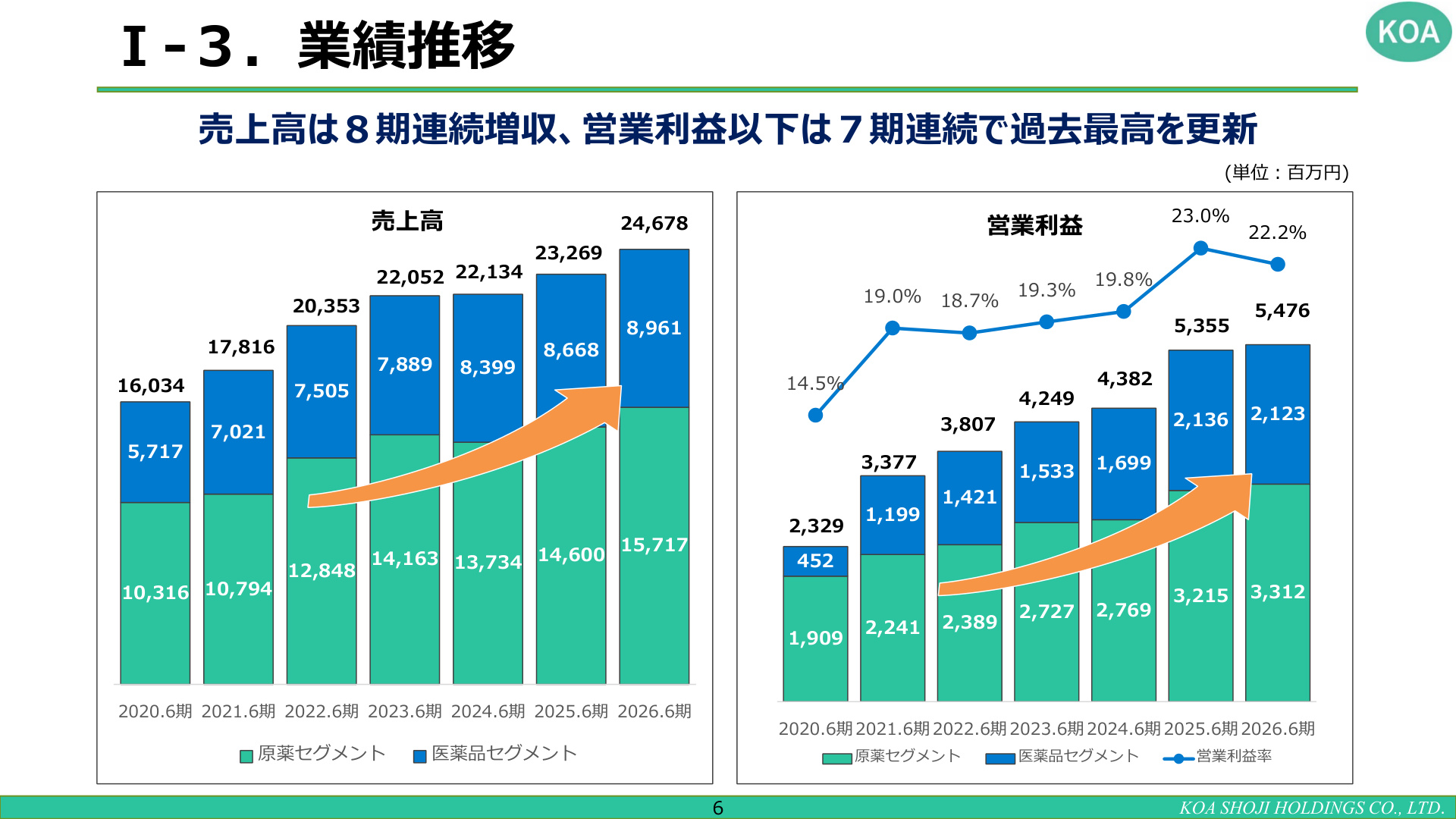
[Significance and Data Insights of the Slide Above]
This slide is one of the most critical pieces of data, succinctly illustrating the company's long-term trajectory of sustainable growth and its robust revenue base . As the bar chart indicates, the API segment (green) continues to expand as a stable revenue foundation, while the Pharmaceutical segment (blue) serves as a growth driver, steadily boosting both sales and profits.
Notably, the company maintains a high operating profit margin , which stood at 22.2% for the fiscal year ended June 2026. Despite a challenging industry environment characterized by rising raw material costs, currency fluctuations, and annual drug price revisions, the company’s ability to consistently secure profit margins exceeding 20% through high-value-added API procurement and manufacturing efficiencies is a significant strength of its business model.
3. Segment Performance and Market Environment
(1) API Segment
- Net Sales : 16.958 billion yen (+6.5% YoY)
- Segment Profit : 3.312 billion yen (+3.0% YoY)
Relatively new items launched since 2025, including drugs for allergies, central nervous system disorders, and other metabolic conditions, expanded steadily . Furthermore, the introduction of the Selected Medical Services system regarding patient co-payments has accelerated the shift to generic drugs in clinical settings, leading to a further increase in transaction volumes for the company's APIs.
(2) Pharmaceuticals Segment
- Net Sales : 8.961 billion yen (+3.4% YoY)
- Segment Profit : 2.123 billion yen (-0.6% YoY)
Shipments of pre-filled syringe products and anti-cancer vial formulations contract-manufactured at the Zao Plant were extremely strong. However, segment profit saw a slight decline due to the impact of competition on the main tablet products manufactured at the head office plant, as well as an increase in SG&A expenses, including labor costs.
4. FY2027 Earnings Forecast and Accelerated Operation of Zao Plant No. 2
[FY2027 Full-Year Earnings Forecast]
- Net Sales : 26.7 billion yen (+8.2% YoY)
- Operating Profit : 5.27 billion yen (-3.8% YoY)
- Net Profit Attributable to Owners of the Parent : 3.59 billion yen (-4.2% YoY)
For the fiscal year ending June 2027, the company expects sales growth in both segments but projects a temporary decline in consolidated operating profit . While the API segment is expected to maintain sales and profit growth (+1.1% in operating profit) due to a recovery in customer purchasing timing, the Pharmaceutical segment faces a projected temporary profit decline (-8.1% in operating profit). This is due to upfront investment costs, including annual drug price revisions , increased labor costs from wage hikes, higher R&D expenses , and depreciation costs associated with the opening of the new plant.
[Accelerated Operation Plan for Zao Plant No. 2]
Zao Plant No. 2 , which holds the key to future growth, was completed on June 30, 2026 . To meet strong market demand (specifically for injectable and syringe products), the company announced plans to accelerate the start of full-scale operations to March 2027 , ahead of the original schedule. This early start aims to establish a mass-production system for pre-filled syringe products, leading to mid-term revenue expansion.
5. Mid-to-Long-Term Growth Strategy: Roadmap to "8 Billion Yen Operating Profit" by FY2030
The company is committed to sustainable corporate value enhancement based on its 10-year long-term business plan formulated in 2020.
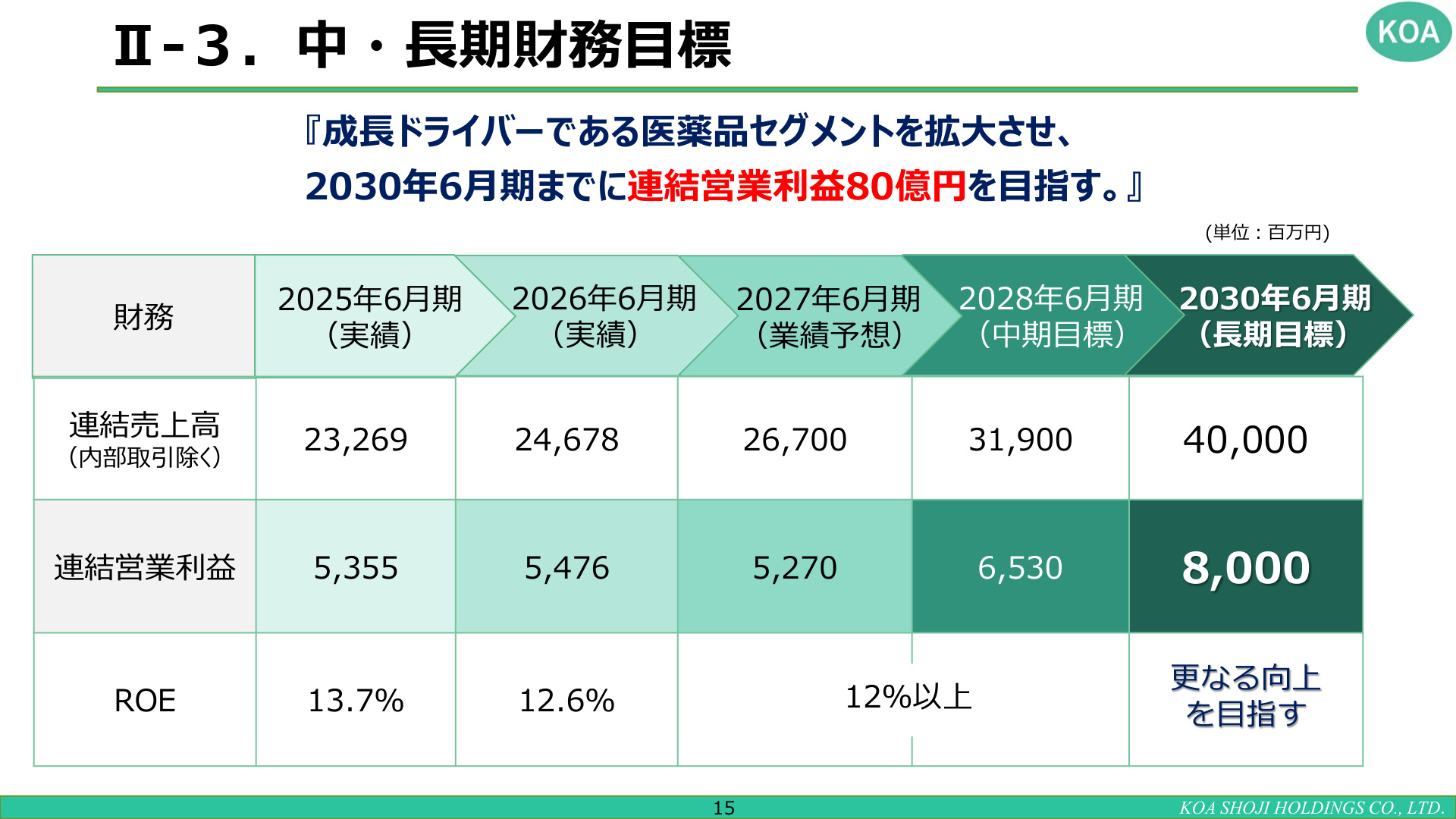
[Significance and Data Insights of the Slide Above]
This slide is a vital document outlining the company's mid-to-long-term financial goals and growth steps . Despite a temporary profit slowdown in FY2027 due to upfront investments (5.27 billion yen in operating profit), the company presents a powerful vision: reaching 6.53 billion yen in operating profit by FY2028 , and ultimately achieving 40 billion yen in sales and 8 billion yen in operating profit by FY2030 .
The drivers for this goal are the stable expansion of the API segment (4 billion yen in segment profit by 2030) and the dramatic growth of the Pharmaceutical segment (4 billion yen in segment profit by 2030). This strategy structure shows a path to significantly scaling up revenue while maintaining an ROE of 12% or higher after overcoming temporary profit-dampening factors such as increased depreciation and labor costs.
6. CDMO Structure and Zao Plant Features in the Pharmaceutical Segment
The company is establishing its position as a CDMO (Contract Development and Manufacturing Organization) , providing integrated services from the development stage through to manufacturing.
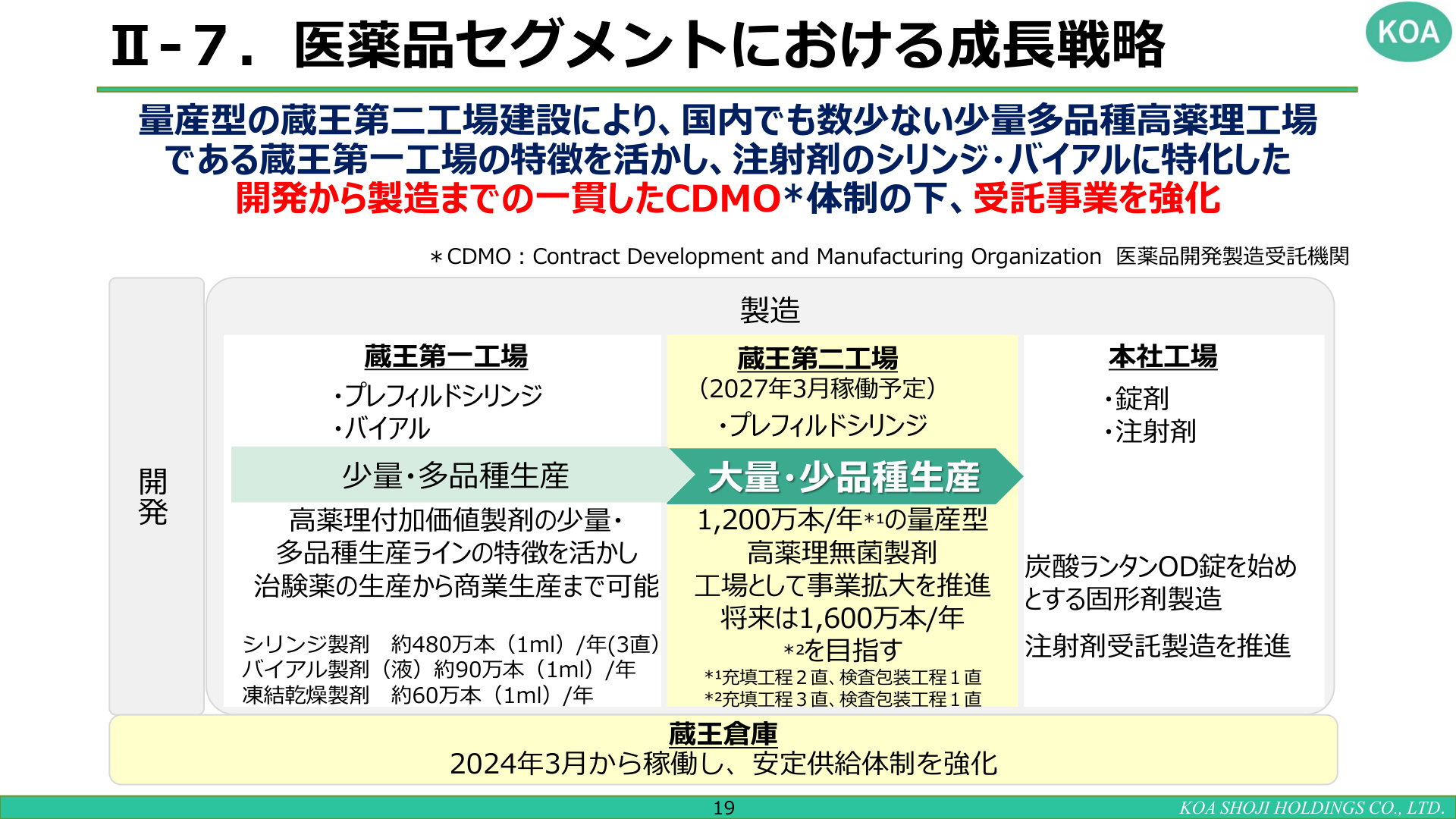
[Significance and Data Insights of the Slide Above]
This slide is a crucial structural diagram explaining the division of roles by plant and the CDMO contract system , which will allow the company to leap forward as a top-tier domestic manufacturer of injectables.
With the Zao Plant No. 1 (4.8 million syringes/year, 0.9 million vials/year, etc.) handling high-potency, small-lot, multi-product manufacturing—a rarity in Japan—for clinical trial drugs and high-value-added formulations, and the newly completed Zao Plant No. 2 (syringe-dedicated, initial 12 million/year, future 16 million/year) handling large-scale mass production, a perfectly complementary and integrated CDMO system has been built. This infrastructure enables the efficient acquisition of contracts for high-potency injectable drugs, including new modalities (with approximately 10 CDMO projects currently underway).
7. Cash Allocation and Shareholder Return Policy
[Three-Year Cash Allocation Plan]
The company has established a clear distribution policy for the approximately 17 billion yen in cash (operating CF and debt financing) to be generated over the three years of the mid-term management plan (FY2026–FY2028):
- Growth Investment (approx. 12 billion yen) : Construction of Zao Plant No. 2, upgrading the head office plant, updating the Yokohama Pharmaceutical Analysis Center, and R&D expenses (approx. 600 million yen).
- Shareholder Returns (approx. 2.5 billion yen) : Dividends based on the policy of "increasing dividends every year in principle."
- Debt Repayment, etc. (approx. 1 billion yen)
[Shareholder Returns: Commitment to "Increasing Dividends Every Year"]
The company maintains a policy of "increasing dividends every year in principle." The annual dividend for FY2026 was 18 yen per share (payout ratio of 20.2%), and the company forecasts an annual dividend of 19 yen for FY2027 (payout ratio of 22.3%), representing a 1-yen increase. Regardless of profit fluctuations or investment phases, the company clearly demonstrates its commitment to stable and continuous returns to shareholders, targeting a payout ratio of 20% or higher.
8. Summary and Future Outlook
Koa Shoji Holdings not only achieved record-high performance in FY2026 but is also steadily laying the groundwork for future leaps. While FY2027 is expected to see a temporary decline in operating profit due to depreciation and upfront investments related to the operation of Zao Plant No. 2, this is an essential investment phase to achieve the long-term goal of 40 billion yen in sales and 8 billion yen in operating profit by FY2030 .
Moving forward, key points to watch that will influence the company's growth speed include the operational status of Zao Plant No. 2 (accelerated to March 2027) , the progress in acquiring CDMO projects centered on injectables , and the expansion of API market share in a pharmaceutical market undergoing regulatory reforms.
This content is not intended as investment advice or a recommendation. Any opinions expressed are solely the personal views of each article.