

![[Katitas] Q1 FY2027 Earnings Deep Dive: A Record-Breaking Start and Progress on the 4th Mid-Term Management Plan](https://news-images.stock-club.net/market_news/images/8919/140120260807514986/slide_eyecatch_en_c2361763.webp)
[Katitas] Q1 FY2027 Earnings Deep Dive: A Record-Breaking Start and Progress on the 4th Mid-Term Management Plan

StockClub
Published: Aug 07, 2026, 12:16 PM
Sentiment Analysis
Katitas Co., Ltd. (Securities Code: 8919) reported an exceptionally strong performance for the first quarter of the fiscal year ending March 2027 , achieving record-high profits driven by favorable external tailwinds, such as soaring new home prices and a decline in new housing supply.
This report provides a comprehensive analysis and commentary on the earnings highlights, business environment, sales structure, and the growth narrative of the upwardly revised 4th Mid-Term Management Plan.
1. Q1 FY2027 Earnings Overview and Highlights
In the first quarter (April–June 2026), the company saw significant growth in both revenue and profit at all levels, achieving the highest profit ever recorded for a first quarter.
- Net Sales : 43,961 million JPY (+25.4% YoY)
- Number of Units Sold : 2,381 units (+20.5% YoY)
- Gross Profit : 10,325 million JPY (+22.7% YoY)
- Gross Profit Margin : 23.5% (-0.5pt YoY; Adjusted Gross Margin 24.4%)
- Operating Profit : 5,562 million JPY (+28.4% YoY)
- Operating Profit Margin : 12.7% (+0.3pt YoY)
- Net Income Attributable to Owners of Parent : 3,678 million JPY (+28.7% YoY)
- ROE (LTM) : 26.6% (+2.7pt YoY)
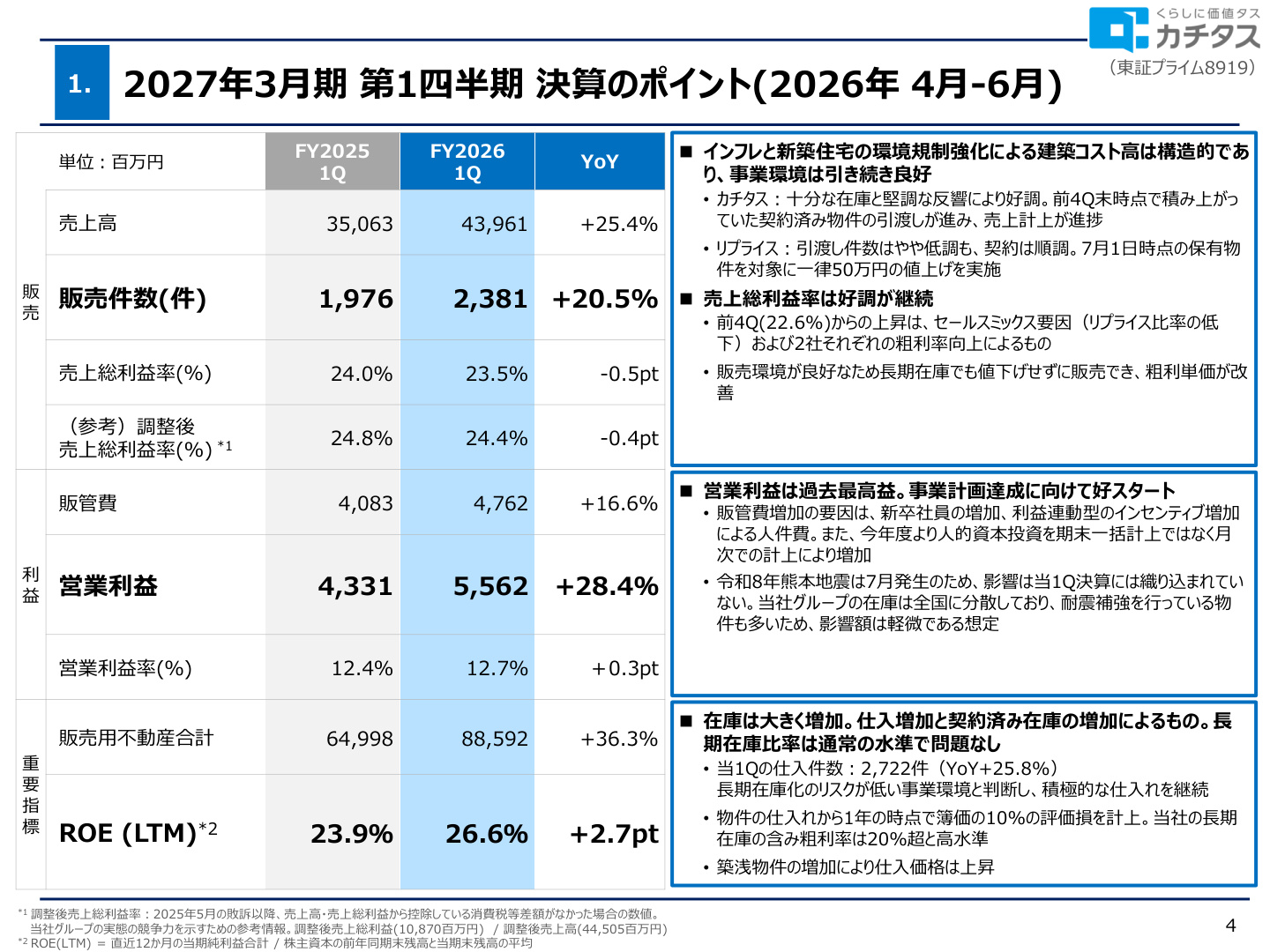
Slide Commentary (PAGE_3: Q1 Earnings Key Points)
The slide above summarizes the factors behind the strong quarterly performance and the trends in financial KPIs. The significant growth in net sales (+25.4%) and operating profit (+28.4%) is attributed to the following:
- Smooth delivery of contracted properties from the end of the previous Q4 : Revenue recognition proceeded smoothly, supported by sufficient inventory and robust customer demand.
- Aggressive accumulation of real estate for sale : Acquisitions remained strong at 2,722 units (+25.8% YoY), bringing the total real estate for sale to 88,592 million JPY (+36.3% YoY).
- Maintenance of gross margins and pricing power : The company successfully sold properties without discounting long-term inventory, even amidst inflation, leading to continued improvement in gross profit per unit.
2. Progress Against Full-Year and First-Half Plans
The Q1 results demonstrate extremely steady progress against the announced full-year and first-half business plans for the fiscal year ending March 2027.
- Progress against full-year plan : Net sales 24.8%, Operating profit 26.5%
- Progress against first-half plan : Net sales 50.7%, Operating profit 52.0%
Notably, the first-half progress rate for operating profit reached 52.0% , confirming that performance is trending above plan even when accounting for seasonality. There have been no significant changes in cancellation rates due to stricter mortgage screenings or rising interest rates, indicating that the company is effectively capturing external tailwinds.
3. Macro Environment and Regional Market Trends
In the broader housing market, the decline in new housing starts (at the lowest level in 61 years) continues due to rising material costs, soaring construction costs, and stricter environmental regulations. This structural change serves as a major positive factor for the Katitas Group’s renovated pre-owned housing business.
Regional Areas (Katitas Domain)
- Average New Detached Home Price : 31.07 million JPY (April–June 2026, +17% vs. pre-COVID)
- Average Pre-owned Detached Home Price : 19.36 million JPY
- Price Gap : Expanded to 11.71 million JPY (an increase of 2.12 million JPY compared to 2020)
Urban Areas (Reprice Domain)
- Average New Detached Home Price : 45.17 million JPY (+33% vs. pre-COVID)
- Reprice Property Price : 24.68 million JPY
- Price Gap : A price advantage of 9.37 million JPY compared to the average pre-owned home price (35.81 million JPY)
As buyers' options narrow due to declining new home inventory and soaring prices, demand for "high-quality, renovated pre-owned homes available for about half the price of new homes" continues to rise.
4. Progress of Growth Drivers (Personnel Expansion and Productivity Improvement)
The pillars supporting Katitas' mid-to-long-term growth are "increasing sales personnel" and "improving productivity per capita."
- Expansion of Sales Personnel : As of April 1, 2026, the number of sales staff reached 865 (+10.1% YoY). The company continues to invest actively in human capital, hiring 186 new graduates (152 for Katitas, 34 for Reprice).
- Maintenance and Improvement of Productivity : Annual transactions per person (acquisitions + sales) remain high at 20.6 units (Katitas standalone). The increase in store manager-level talent and enhanced training programs have solidified the early ramp-up of new graduates (reaching 26.7 units by their third year).
5. Positioning of the 4th Mid-Term Management Plan and Upward Revision of Financial KGI
Following a period of strengthening its management foundation, Katitas is aiming to re-accelerate growth under its 4th Mid-Term Management Plan. Reflecting strong external tailwinds and organizational expansion, the company has upwardly revised its targets (Financial KGI) for the fiscal year ending March 2028.
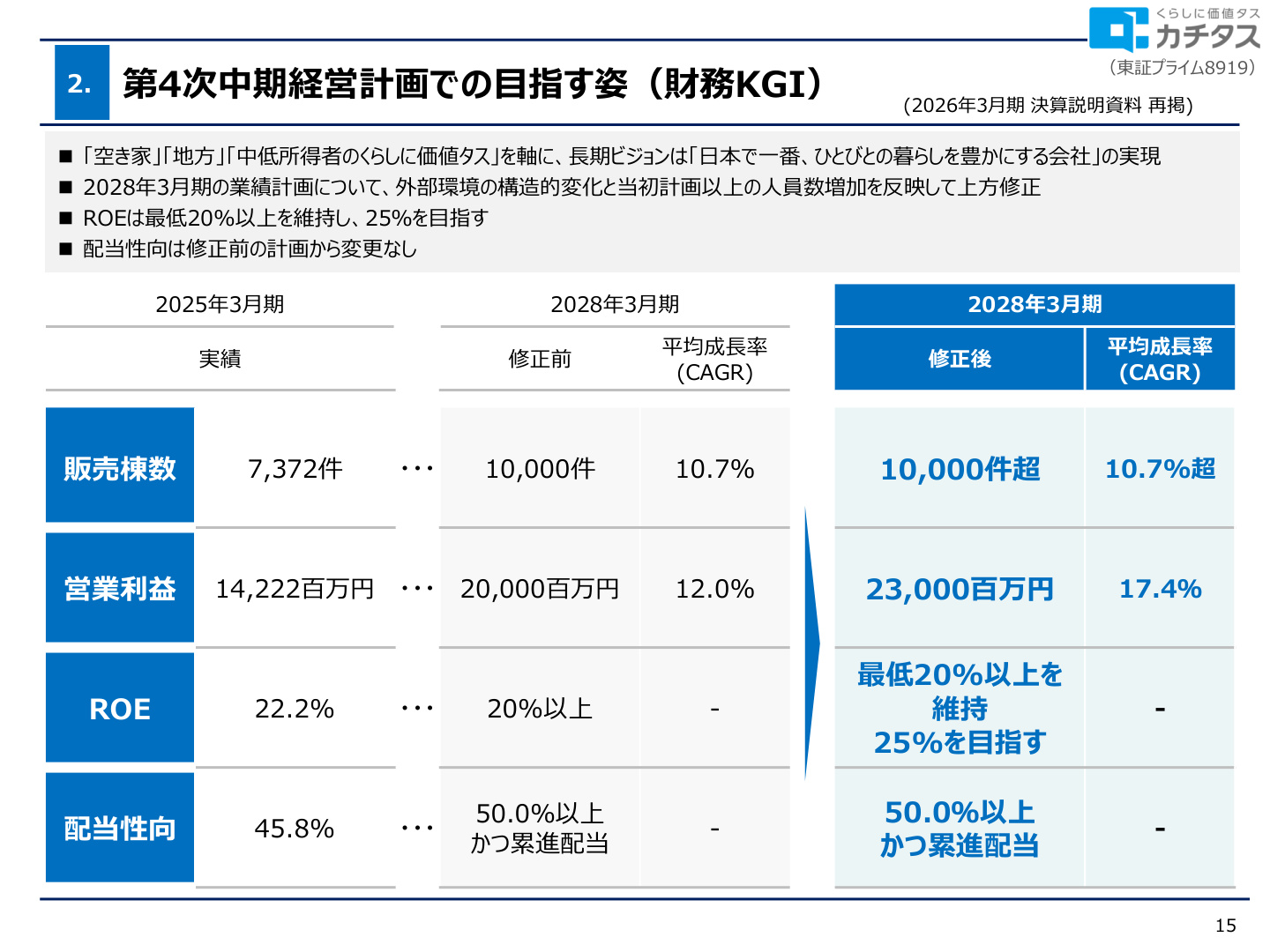
Slide Commentary (PAGE_14: Vision for the 4th Mid-Term Management Plan)
The slide above compares the financial KGI and growth indicators before and after the revision:
- Annual Sales Volume : Aiming for over 10,000 units by FY2028, up from 7,372 units in FY2025 (CAGR over 10.7% ).
- Operating Profit : Upwardly revised from the initial target of 20,000 million JPY to 23,000 million JPY (revised CAGR 17.4%) .
- ROE : Continuing high capital efficiency management, maintaining a minimum of 20% and aiming for 25% .
- Shareholder Return Policy : Maintaining a policy of a 50.0% or higher dividend payout ratio and progressive dividends .
The strategy aims to significantly expand growth potential by entering untapped regions (opening small-format stores) and acquiring new customer segments, such as single-person and two-person households, beyond the traditional family demographic.
6. Business Model Strengths and Market Expansion Potential
Katitas' business model specializes in a unique niche where competitors find it difficult to enter.
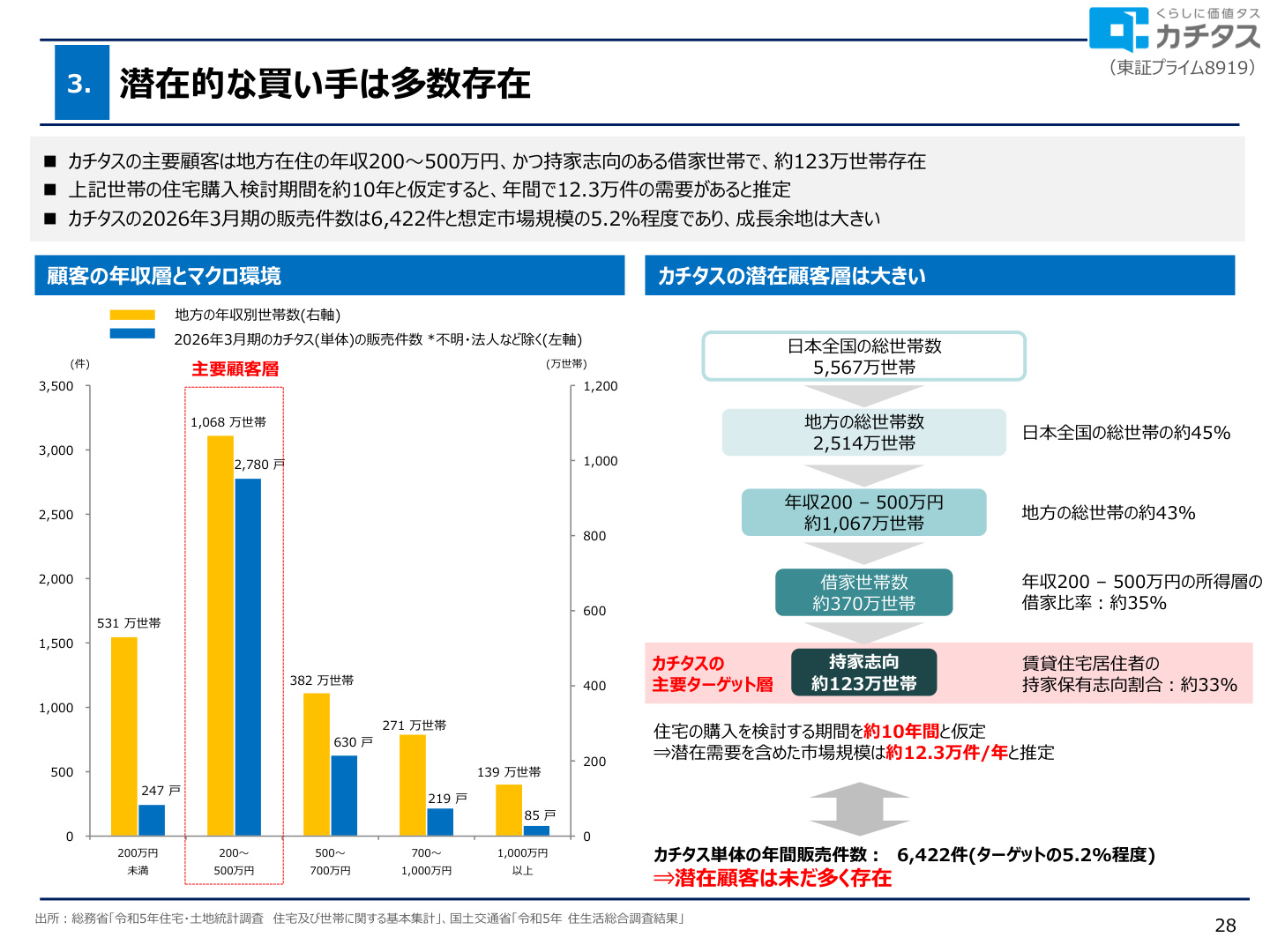
Slide Commentary (PAGE_27: Numerous Potential Buyers Exist)
The slide above illustrates the target household count and market development potential in Japan:
- Target Customer Segment : Households living in rental properties in regional areas with an annual income of 2–5 million JPY (approx. 1.23 million households ).
- Estimated Annual Demand : Assuming a 10-year home-buying consideration period, there is a potential demand of approx. 123,000 units per year .
- Katitas' Market Share : The sales volume for FY2026 (6,422 units) represents only 5.2% of the target market, leaving over 90% of the massive market untapped.
Driven by the increase in vacant housing stock (9 million units nationwide), the structure for acquisition opportunities is set to continue expanding over the mid-to-long term.
7. Capital Allocation and Shareholder Returns
The company has established a capital allocation policy that balances growth investment with shareholder returns.
- Equity Ratio : A minimum threshold of around 30% is maintained, with surplus capital prioritized for "strategic inventory investment" and "M&A" that can achieve high turnover.
- Dividend Forecast : Following an increase in the year-end dividend for FY2026 to 41.0 JPY, the plan for FY2027 is an annual dividend of 90.0 JPY (45.0 JPY interim + 45.0 JPY year-end) , which is approximately 3.5 times the level immediately after listing (26.0 JPY) (expected payout ratio 50.3% ).
8. Conclusion
The Q1 FY2027 earnings report not only achieved growth in both revenue and profit but also demonstrated that the essential elements for growth— inventory accumulation, personnel expansion, and maintenance of gross margins —are all in place.
Against the backdrop of soaring new home prices, the company is successfully balancing a robust renovation business model with high capital efficiency (targeting 25% ROE), showing steady progress toward achieving its Mid-Term Management Plan.
This content is not intended as investment advice or a recommendation. Any opinions expressed are solely the personal views of each article.