

eGuarantee (8771) Q1 FY2027 Earnings Deep Dive Analysis Report

Sentiment Analysis
eGuarantee, Inc.'s financial results for the first quarter of the fiscal year ending March 2027 showed record-high levels in both revenue and profit at all stages , demonstrating steady progress toward the full-year targets. This report provides a multi-faceted analysis of the company's performance trends, growth drivers, the progress of new business models, and its proactive shareholder return policy, based on the officially released earnings presentation materials.
1. Q1 FY2027 Earnings Highlights and Full-Year Progress
In the first quarter (Q1) of the fiscal year ending March 2027, consolidated results were as follows: revenue increased by 2.1% year-on-year to 2,800 million yen , operating profit rose by 5.7% to 1,334 million yen , ordinary profit grew by 9.1% to 1,412 million yen , and net profit attributable to owners of the parent increased by 10.8% to 953 million yen .
Revenue and all profit metrics reached record highs. The company maintains extremely high profitability, with an operating margin of 47.6% (+1.5pt YoY) and a gross margin of 74.1% . Selling, general, and administrative (SG&A) expenses decreased by 3.6% year-on-year to 740 million yen; while there were increases in personnel and base salaries, this was offset by a temporary factor regarding the timing of bonus payments (paid in Q1 last year, but scheduled for Q2 this year).
Progress toward the full-year consolidated earnings forecast stands at 23.5% for revenue, 24.3% for operating profit, 25.2% for ordinary profit, and 25.1% for net profit . This represents an ideal pace (around 25%), marking a strong start toward the company's goal of achieving its 20th consecutive year of meeting full-year targets .
2. Accumulating Stock Revenue: Trends in Guarantee Obligations and Balances
The foundation of the company's revenue structure is the accumulation of "guarantee obligations," where the company assumes credit risk. With a contract renewal rate consistently above 90% , the acquisition of new contracts directly translates into the long-term expansion of stock revenue.
As of the end of Q1, the balance of guarantee obligations reached 931.7 billion yen, a 9.9% increase year-on-year , marking a new record high on a quarterly basis.
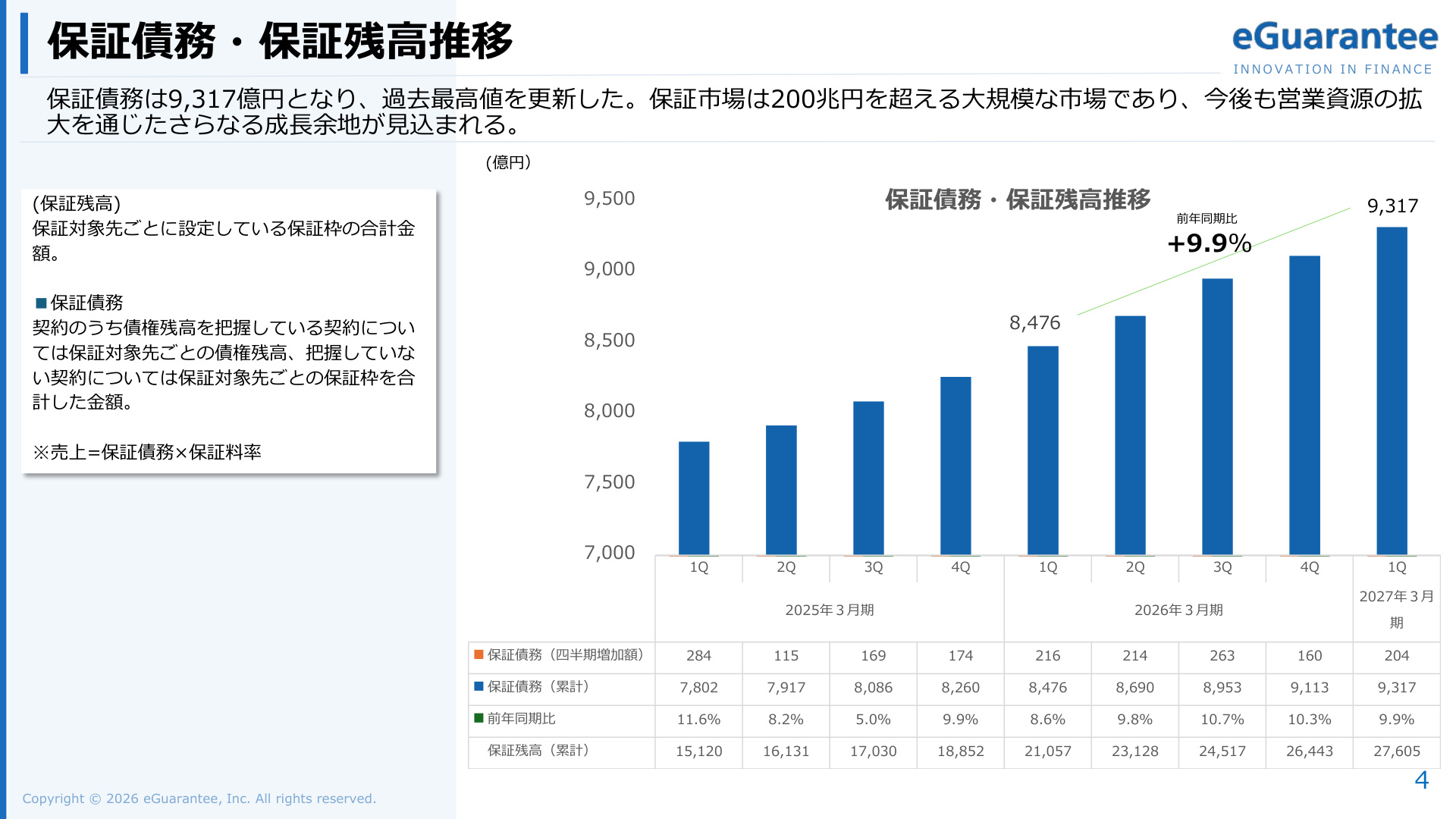
Slide Commentary: The Importance of Guarantee Obligation and Balance Trends
This slide illustrates the "layered structure of guarantee obligations," the most critical KPI for measuring the company's growth. As shown in the graph, guarantee obligations have trended upward without any temporary dips, with a solid quarterly increase of 20.4 billion yen in Q1. Furthermore, the "total guarantee balance" (cumulative), which represents the total guarantee limit, has reached 2.7605 trillion yen . Since the revenue formula is " Revenue = Guarantee Obligations × Guarantee Fee Rate ," the 9.9% year-on-year growth in guarantee obligations guarantees stable top-line growth for the future. The reason the current revenue growth rate (+2.1%) is more moderate than the growth rate of guarantee obligations (+9.9%) is due to a temporary decline in average unit prices resulting from an increased ratio of new and young employees in the second half of the previous fiscal year; however, the base of the outstanding balance itself is steadily expanding.
3. Expansion of Sales Resources and Initiatives for Early Productivity
To accelerate long-term growth, the company has implemented its largest-ever recruitment drive, hiring over 30 new graduates and mid-career professionals . As a result, the number of sales personnel is expected to increase significantly from 113 at the end of the previous fiscal year to 140–150 , with a target of 185 by the fiscal year ending March 2028.
To address the challenges of training costs and maintaining productivity amid rapid personnel growth, the company is implementing the following measures to achieve "early productivity" and "operational efficiency":
- Efficiency in Quote Meetings via AI : Introducing AI into meetings where sales and credit assessment staff discuss proposals to accelerate decision-making.
- Development of Reproducible Sales Flows : Enhancing on-demand training environments and fully utilizing sales KPI systems to improve the consulting capabilities of younger staff.
- Hiring External AI Specialists : Appointing three new AI experts to drive in-house development of credit assessment and sales support systems.
Data shows that the "quote request acquisition rate" for second-year employees has reached 27.5%, surpassing that of veteran employees with 3–10 years of experience (22.7%), indicating that early productivity measures are beginning to yield measurable results.
4. Expansion of Sales Networks and the New "Sales Partner Model"
Traditionally, the company has focused on a "matching model" where it receives customer "introductions" from partners such as regional banks and credit unions, followed by direct negotiations by its own sales staff. In Q1, the company continued to strengthen its financial institution network, announcing new business alliances with Tama Shinkin Bank and Kyoto Chuo Shinkin Bank.
However, to accelerate growth without being constrained by the number of sales personnel, the company has fully launched a new growth engine: the "Sales Partner Model."
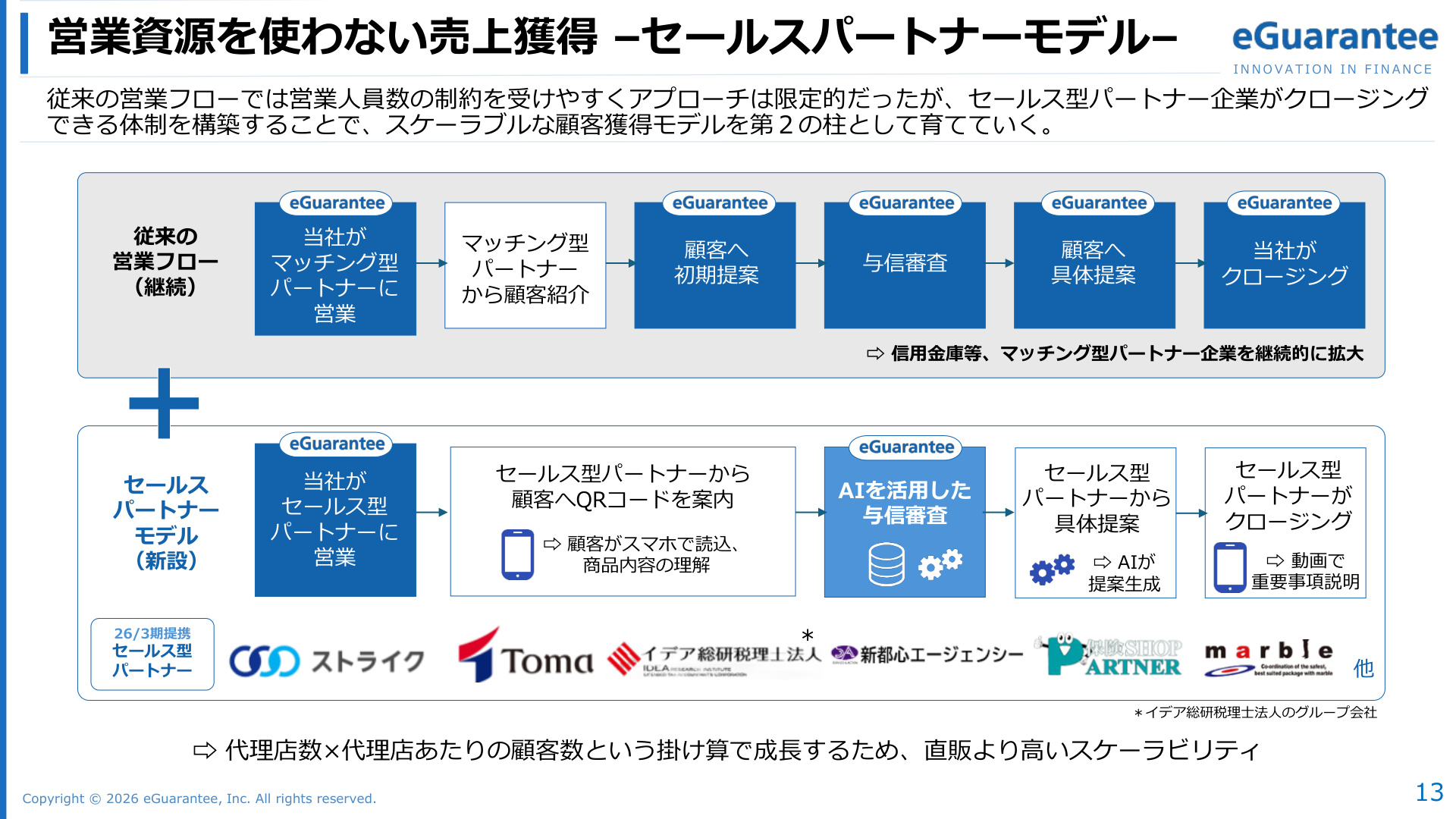
Slide Commentary: Structure of the Sales Partner Model (Leveraged Type)
This slide is a crucial diagram presenting the company's shift away from "direct sales and referral dependence." In the traditional sales flow (top), the company's sales staff handles the entire process—initial proposal, credit assessment, specific proposal, and closing—after receiving a referral, making the number of sales staff a bottleneck for growth. In the newly established Sales Partner Model (bottom), partner companies (tax accounting firms, M&A intermediaries, insurance agencies, etc.) handle the proposal and closing process themselves using QR codes and video content. By specializing in AI-driven credit assessment and automated proposal generation , eGuarantee can acquire revenue with minimal internal sales effort. The number of sales-type partner companies has already exceeded 10 (including Strike, Toma, etc.), signaling a shift toward a high-leverage revenue structure that scales through the multiplication of "number of agencies × number of customers per agency."
5. Massive Total Addressable Market (TAM) and Sources of Competitive Advantage
The market for trade loan guarantees and accounts receivable guarantees targeted by the company remains largely untapped.
- TAM (Total Addressable Market) : The Japanese accounts receivable transaction market is approximately 219 trillion yen .
- SAM (Serviceable Addressable Market) : If guarantee utilization reaches European levels (approx. 10%), the market size would be approximately 22 trillion yen .
- Indirect Finance Market : The market size targeted by loan guarantees is approximately 543 trillion yen .
Against this, the company's guarantee obligations stand at 931.7 billion yen (less than 1% penetration), indicating significant room for market expansion.
The barrier to entry and source of competitive advantage is the large-scale corporate credit big data the company has accumulated. By leveraging proprietary data covering 360,000 annual assessments, 580,000 guaranteed companies, and 2.6 million daily information registrations (including payment delays for electricity/gas, online reputation, and management information), the company can statistically calculate the bankruptcy probability for each company with high precision and set appropriate guarantee fee rates.
6. Capital Allocation Policy and Shareholder Returns
Backed by a solid financial foundation and high cash-generating capability, the company has adopted a highly proactive shareholder return policy.
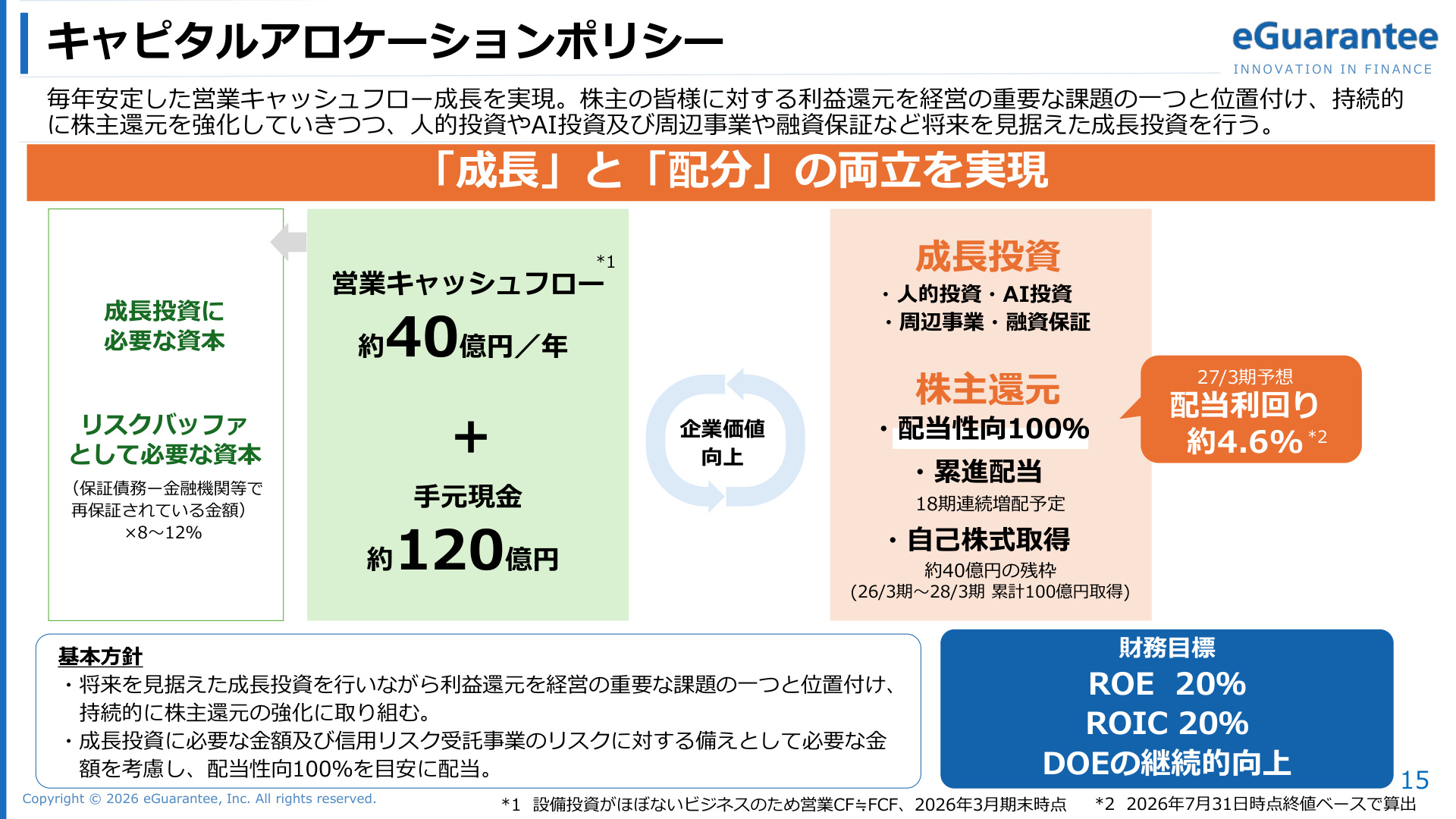
Slide Commentary: Overview of Capital Allocation Policy
This slide summarizes management's policy regarding the use of funds and capital efficiency (ROE/ROIC). Since the business model requires almost no capital expenditure, approximately 4 billion yen in annual operating cash flow becomes almost entirely free cash flow. While maintaining about 12 billion yen in cash on hand and securing a risk buffer, the company optimally allocates surplus funds to growth investments and shareholder returns.
Specifically, the three main points of focus are:
- Dividend Policy Targeting a 100% Payout Ratio : A clear policy to return almost all profits to shareholders.
- Planned 18th Consecutive Dividend Increase : The forecast for the fiscal year ending March 2027 is 84 yen per share , continuing the streak of dividend increases.
- 10 Billion Yen Share Buyback Program : The company plans to conduct a cumulative 10 billion yen in share buybacks by the fiscal year ending March 2028 (approx. 6 billion yen already acquired).
Through these measures, the company aims to achieve its long-term goals of 20% ROE and 20% ROIC .
7. Conclusion and Future Outlook
eGuarantee's Q1 FY2027 results fully demonstrated the strengths of its stock-based business model , characterized by the steady accumulation of guarantee obligations and record-high profits.
Investors should focus on the following points moving forward:
- Productivity Changes from Personnel Increases : The progress in unit price improvement and early productivity of the large cohort of newly hired young employees.
- Scaling Speed of the Sales Partner Model : The growth rate of partner companies and the increase in acquisitions independent of direct sales.
- Process Toward Capital Efficiency Targets (20% ROE/ROIC) : The sustainability of enhancing shareholder value through a 100% payout ratio and share buybacks.
Against the backdrop of a massive, untapped market exceeding 200 trillion yen, the company's business development, armed with proprietary big data and an evolving sales model, remains a key point of interest.
Correction (September 29, 2026): Corrected the specified amounts, rates or reporting periods against the original company disclosure; the verified changes are recorded in the correction ledger. Source
This content is not intended as investment advice or a recommendation. Any opinions expressed are solely the personal views of each article.