


Seven Bank Q1 FY2027 Earnings Deep Dive: Analyzing the Drivers of Significant Profit Growth and the Impact of the FamilyMart Partnership and Accounting Changes

StockClub
Published: Aug 07, 2026, 12:14 PM
Sentiment Analysis

1. Executive Summary: Earnings Overview and Key Highlights
Seven Bank (Securities Code: 8410) delivered a robust performance for the first quarter (Q1) of the fiscal year ending March 2027, achieving significant year-on-year growth in both revenue and profit on both a consolidated and non-consolidated basis. Consolidated ordinary income rose 6.5% year-on-year to 56.8 billion yen , consolidated ordinary profit surged 63.6% to 10.8 billion yen , and net income attributable to owners of the parent reached 6.5 billion yen , a 58.5% increase year-on-year.
The most critical takeaways from these results are summarized in the following ten points:
- Substantial Consolidated Profit Growth : Driven by strong performance from both Seven Bank (non-consolidated) and its U.S. subsidiary.
- Resilient Domestic ATM Usage : Average daily transactions per ATM increased to 110.5 , up from 109.3 in the same period last year.
- Strategic Partnership with FamilyMart : Commenced the phased installation of approximately 16,000 Seven Bank ATMs across FamilyMart stores nationwide.
- Expansion of Domestic Retail Accounts and Deposits : Individual accounts grew steadily to 3.502 million , with individual deposits reaching 642.9 billion yen .
- Growth in Personal Loans and BNPL : Loan balances increased by 17.1 billion yen year-on-year to 83.1 billion yen , while BNPL transaction volume expanded to 27.6 billion yen .
- Card Business Foundation Renewal : Strengthened the foundation through the launch of the nanaco credit card and a revamped rewards program.
- Improved Profitability in U.S. Operations : Secured ordinary income of 7.95 billion yen and ordinary profit of 1.06 billion yen due to an increase in installed units.
- Progress in Asian Markets and Regional Strategy : Increased unit counts in the Philippines and Malaysia, while maintaining profitability in Indonesia.
- Change in Useful Life of Domestic ATMs : Extended the useful life from 5 years to 7 years , resulting in reduced depreciation expenses.
- Upward Revision of Full-Year Forecast : Factoring in the impact of the change in useful life, the consolidated ordinary profit forecast was revised from 29.5 billion yen to 33.5 billion yen (+13.5%) .
2. Structural Analysis of Consolidated and Non-Consolidated Earnings
First, we examine the Q1 earnings structure in detail. The summary of consolidated profit and loss is as follows:
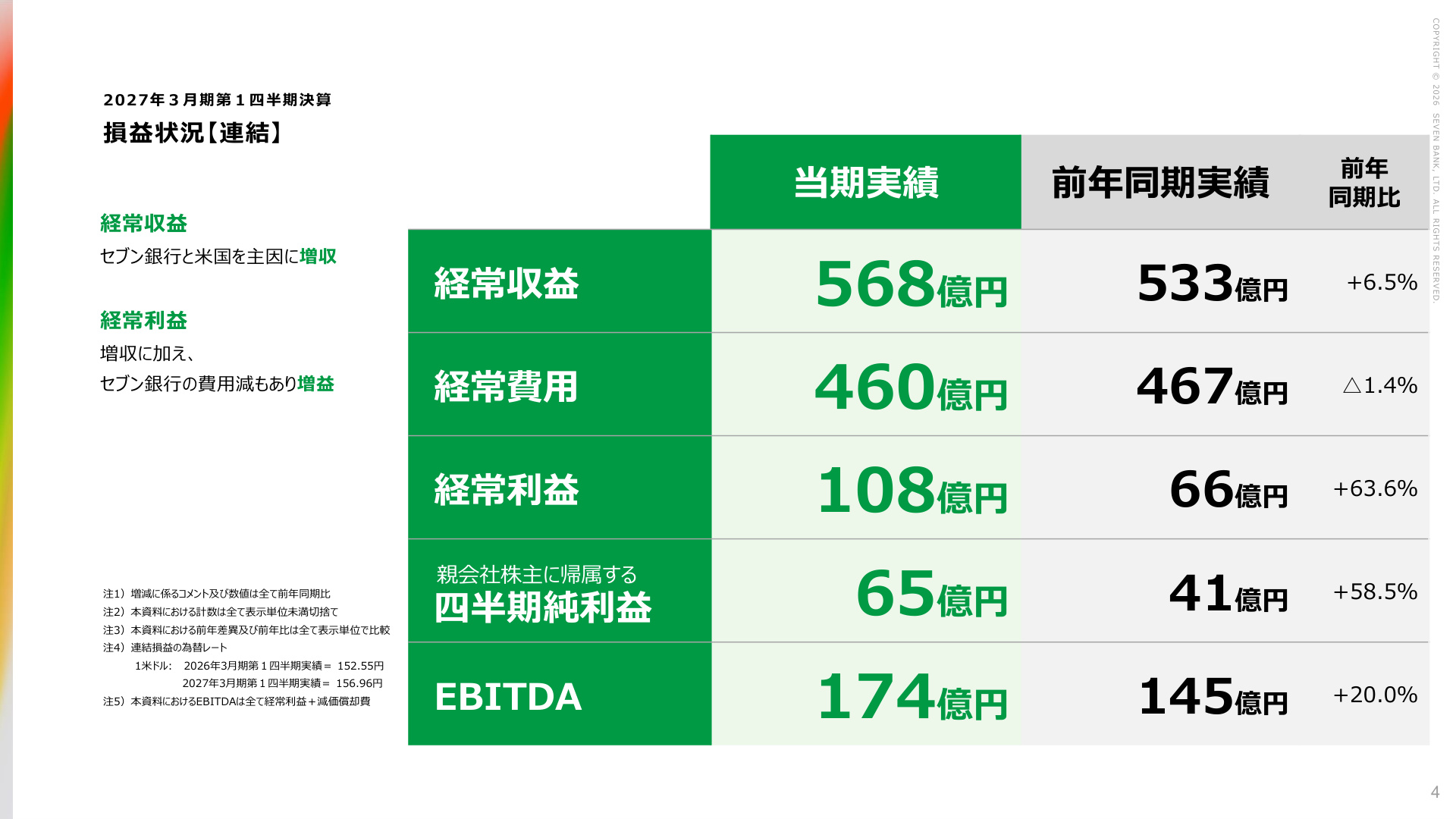
As shown in the slide above, against consolidated ordinary income of 56.8 billion yen (+3.5 billion yen YoY), consolidated ordinary expenses were 46.0 billion yen (down 0.7 billion yen YoY). The simultaneous achievement of revenue growth and cost containment led to a significant improvement in profit margins. EBITDA also rose 20.0% year-on-year to 17.4 billion yen , highlighting the company's strong cash-generating capability.
The primary drivers of this strong performance were the increase in commission income and loan interest at Seven Bank (non-consolidated) and revenue and profit growth in the U.S. business . Additionally, the reduction in domestic ATM depreciation expenses, discussed later, contributed significantly to cost control.
Looking at Seven Bank's non-consolidated performance, ordinary income rose 5.6% year-on-year to 37.2 billion yen , ordinary profit increased 44.6% to 9.4 billion yen , and quarterly net income grew 45.4% to 6.4 billion yen . The combination of increased commission income and lower depreciation expenses due to the change in useful life directly boosted profits.
3. Domestic ATM Business: Transaction Trends and the Impact of FamilyMart Installations
The domestic ATM business remains the pillar of Seven Bank's revenue. Total domestic transactions in Q1 reached 286 million , an increase of 8 million year-on-year. The average daily transactions per ATM remained high at 110.5 (+1.2 YoY), proving that despite the shift toward a cashless society, demand for ATM services remains robust due to their high convenience.
At the end of the quarter, the number of domestic ATMs installed was 28,614 (+532 YoY). This includes not only those in 7-Eleven stores (23,175 units) but also a steady expansion of off-site ATMs to 5,439 units .
Furthermore, a landmark development in the growth story of the domestic ATM business is the project to install ATMs in FamilyMart stores .
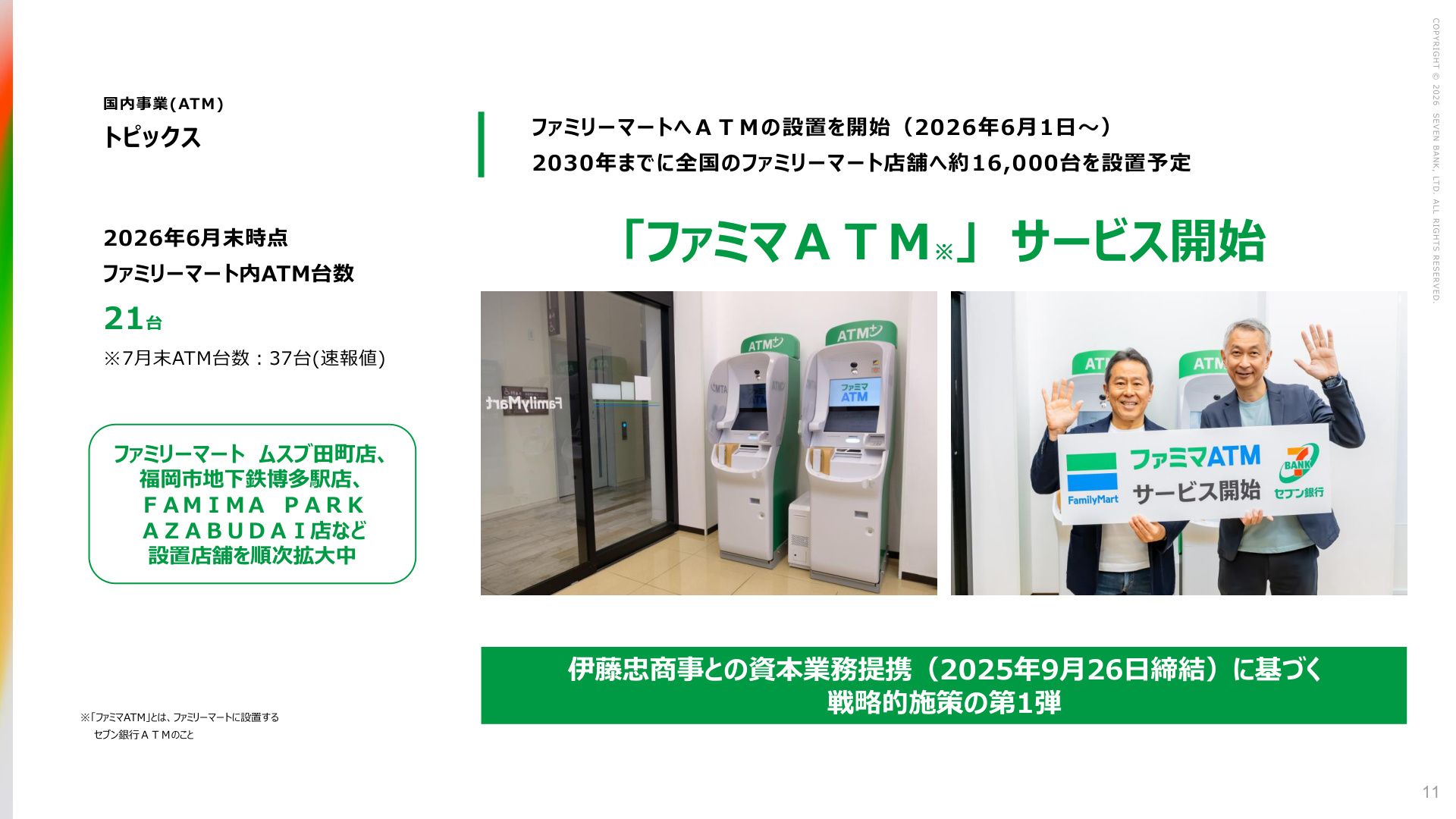
The slide above illustrates the initiative to install Seven Bank ATMs in FamilyMart stores, which began on June 1, 2026, as the first strategic measure under the capital and business alliance with ITOCHU Corporation. The plan is to install approximately 16,000 ATMs in FamilyMart stores nationwide by 2030 , with 21 units already installed by the end of June 2026 (37 units as of the end of July).
The significance and background of this initiative are profound; it signifies an evolution into a payment and ATM platform that covers the majority of domestic convenience store infrastructure , transcending the traditional Seven & i Group framework. This is a critical initiative expected to drive a long-term increase in commission income through a dramatic expansion in the number of units and increased foot traffic.
4. Domestic Retail Business: Expansion of Account Base and Financial Services
In the retail business, various products are showing steady growth:
- Individual Accounts and Deposit Balances : Individual accounts increased by 65,000 year-on-year to 3.502 million , and individual deposits rose by 31.7 billion yen to 64.29 billion yen . Ordinary deposits account for the majority at 500.8 billion yen, forming a stable funding base.
- Personal Loan Service : The balance at the end of the quarter showed strong growth, increasing by 17.1 billion yen year-on-year to 83.1 billion yen , directly contributing to non-consolidated profit through increased interest income.
- BNPL Service : Transaction volume reached 1.609 million (+95,000 YoY), and transaction value grew to 27.6 billion yen (+4.0 billion yen YoY).
- Seven Card Service : Credit card members reached 3.05 million, shopping transaction volume was 188.8 billion yen, and the number of nanaco electronic money members grew steadily to 84.99 million . The company is working to further enhance customer engagement through new account opening campaigns, the renewal of the "nanaco credit card," and the introduction of a new rewards program.
5. Overseas Business: Regional Trends and Global Expansion
Total transactions in the overseas business for Q1 were 132.9 million (down 1.4 million YoY). Detailed regional trends are as follows:
- United States (FCTI) : The number of units reached 11,651 due to expanded installations at locations such as Speedway. Although average transactions per unit decreased slightly (46.1/day), the increase in the number of units contributed to Q1 ordinary income of 7.95 billion yen and ordinary profit of 1.06 billion yen .
- Indonesia (ATMi) : Despite a decline in average transactions to 39.9 due to a local economic slowdown and intensified competition, the company maintained profitability with ordinary income of 1.66 billion yen and ordinary profit of 0.03 billion yen . The number of units is 9,100 .
- Philippines (PAPI) : The business is showing signs of bottoming out after a temporary slowdown caused by the introduction of fees by partner banks, recording Q1 ordinary income of 2.36 billion yen and ordinary profit of 0.13 billion yen . The number of units has expanded to 4,186 .
- Malaysia (RFMY) : Operations began in January 2025, with 163 units installed as of the end of June 2026. The company plans to install an additional 400 units this fiscal year and is currently in the initial expansion phase.
6. Analysis of Accounting Changes and Upward Revision of Full-Year Forecast
Finally, we examine the upward revision of the full-year earnings forecast, which is of high interest to investors, and the impact of the "change in useful life" behind it.
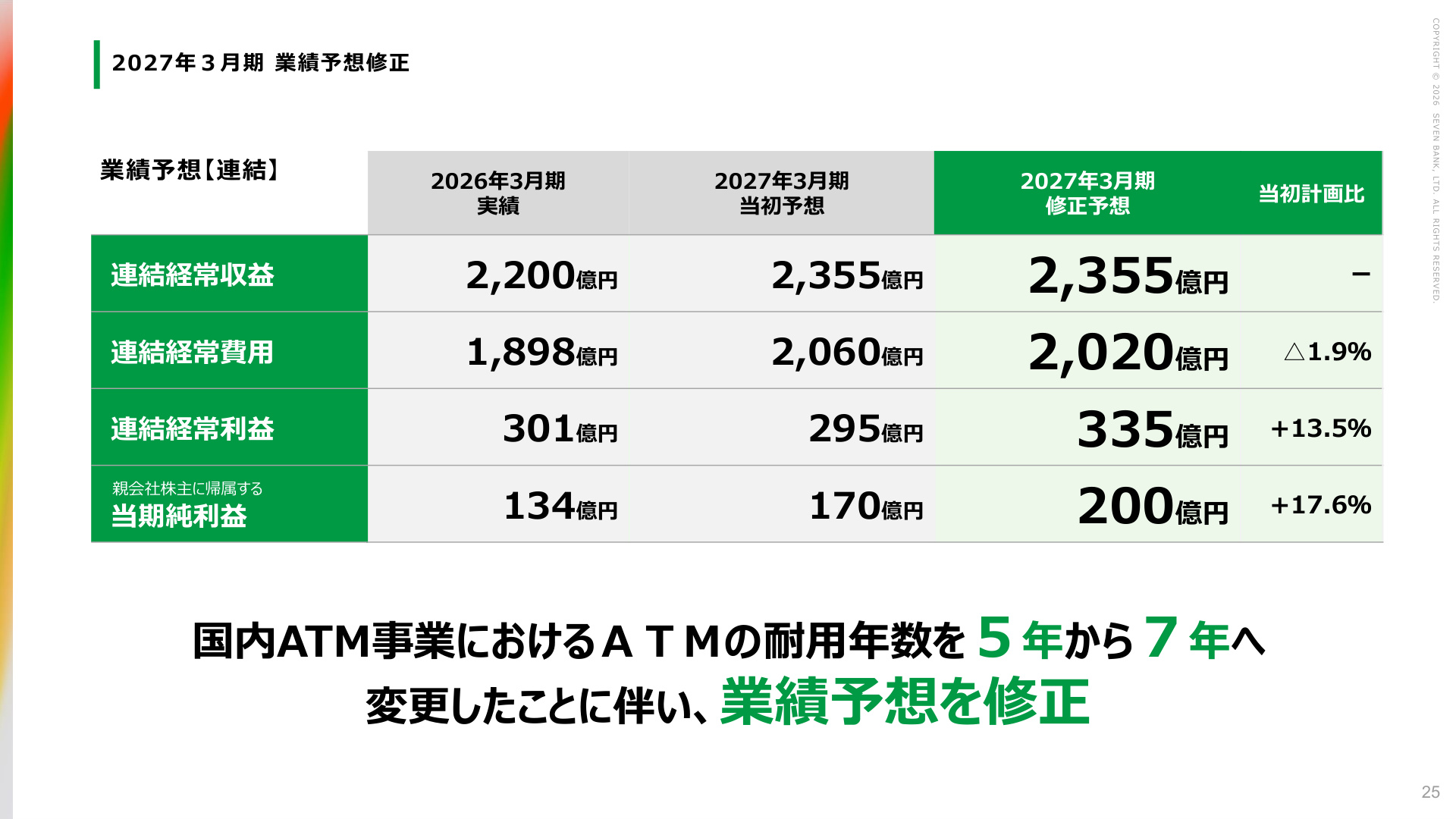
As shown in the slide above, Seven Bank announced an upward revision to its full-year consolidated earnings forecast for the fiscal year ending March 2027. The revisions are as follows:
- Consolidated Ordinary Income : 235.5 billion yen (unchanged from initial forecast)
- Consolidated Ordinary Expenses : 202.0 billion yen (1.9% reduction from initial forecast)
- Consolidated Ordinary Profit : 33.5 billion yen ( +13.5% revision from the initial 29.5 billion yen)
- Net Income Attributable to Owners of the Parent : 20.0 billion yen ( +17.6% revision from the initial 17.0 billion yen)
The primary driver of this revision is the change in the useful life of tangible fixed assets (ATMs) in the domestic ATM business from 5 years to 7 years . This is a rational change in accounting policy based on the actual operational life and technical durability of the ATMs. As a result, non-consolidated depreciation expenses are expected to be reduced by 4.0 billion yen compared to the initial plan (from 24.9 billion yen to 20.9 billion yen, a 16.0% decrease).
Since the accounting cost reduction directly boosts profits while maintaining the planned revenue figures, the results clearly demonstrate improved earnings transparency and profit margins.
7. Conclusion
Seven Bank's Q1 FY2027 earnings report reflects a combination of positive factors: solid performance in its core domestic ATM business, the acquisition of a long-term growth engine through the historic major partnership with FamilyMart, and the rationalization of the profit structure through the change in useful life , which led to an upward revision of the full-year forecast. Coupled with the stabilization of overseas operations and the growth of retail financial products, these results demonstrate that a robust business foundation is being built.
This content is not intended as investment advice or a recommendation. Any opinions expressed are solely the personal views of each article.