


Senshukai FY2026 Q2 Earnings Deep Dive: The Current State of Business Structural Reform and Digital Shift

StockClub
Published: Aug 07, 2026, 12:11 PM
Sentiment Analysis
1. Executive Summary: Performance Overview and Revision of Full-Year Forecasts
In its financial results for the second quarter (interim period) of FY2026, Senshukai Co., Ltd. (TSE Standard: 8165) demonstrated both the challenges and achievements of its transitional phase, as it pushes forward with business structural reforms and a digital shift in its core mail-order business.
While consolidated net sales for the interim period were 19,815 million yen (down 6.9% YoY) , structural reductions in sales promotion and printing costs proved effective. Operating loss narrowed to 1,090 million yen (an improvement of 255 million yen YoY) , and ordinary loss narrowed to 1,088 million yen (an improvement of 396 million yen YoY) . Furthermore, due to gains from the sale of fixed assets such as real estate, the company achieved a return to profitability at the interim net income level, reporting 117 million yen (compared to a loss of 1,920 million yen in the same period last year).
However, due to delays in the progress of digital shift initiatives and their expected impact on sales growth, the company has revised its full-year consolidated earnings forecast (relative to the figures announced on March 30).
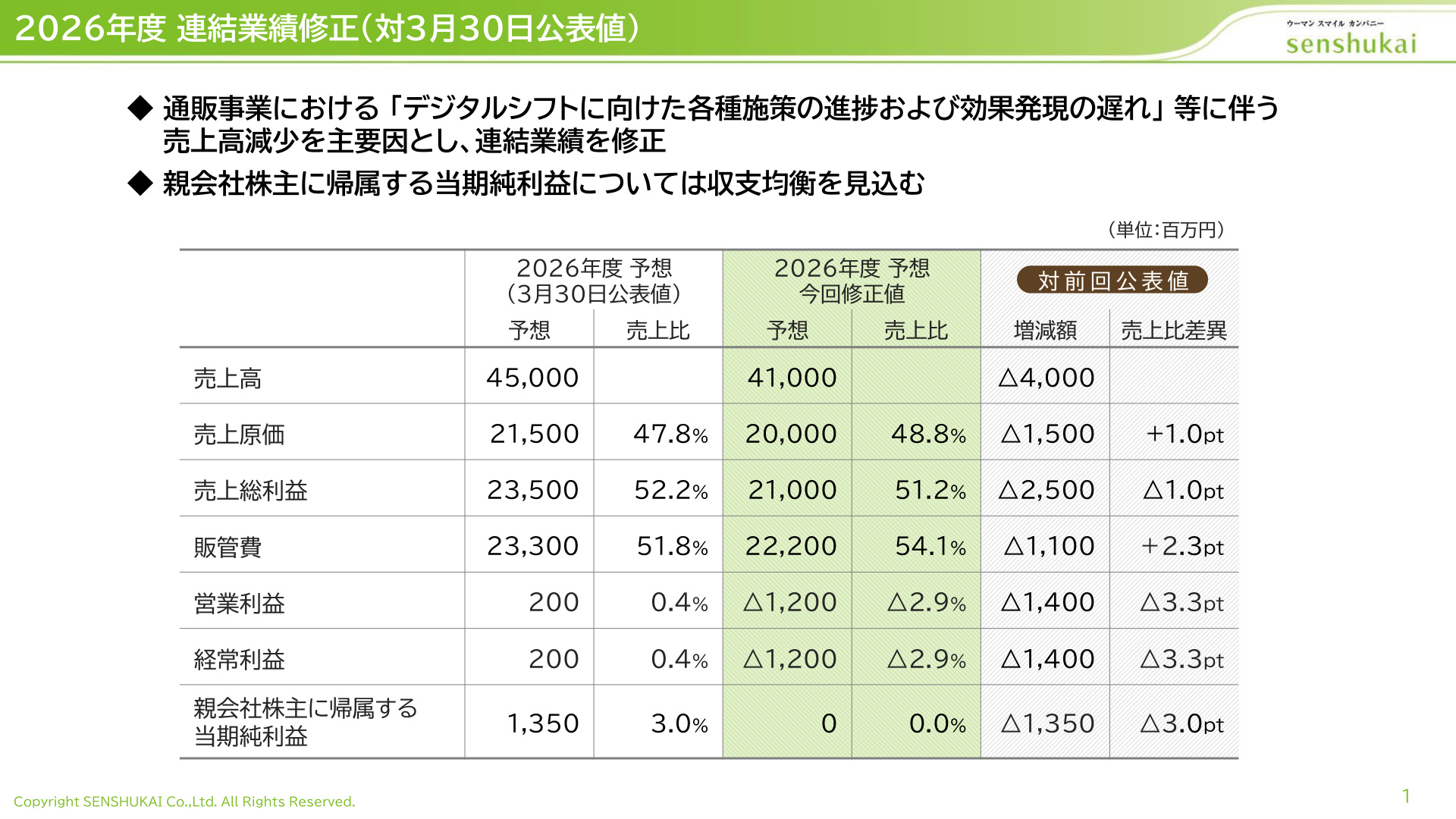
The slide above illustrates the revisions to the FY2026 consolidated earnings forecast . Net sales have been revised downward from the initial plan of 45,000 million yen to 41,000 million yen (a reduction of 4,000 million yen) . Consequently, the operating profit forecast was adjusted from a surplus of 200 million yen to an operating loss of 1,200 million yen , and the ordinary profit forecast was similarly revised to an ordinary loss of 1,200 million yen . Net income attributable to owners of the parent was also revised from 1,350 million yen to 0 million yen (break-even) .
The backdrop for this revision lies in the transition from the long-standing "catalog-centric" sales model to a "digital-centric" one, where customer acquisition and conversion rates (CVR) on the company's own e-commerce platform fell short of expectations. Although the decline in sales pushed gross profit down by 2,500 million yen , the company successfully implemented 1,100 million yen in cost reductions through improved efficiency in SG&A expenses, highlighting both the severity of this transitional period and the company's commitment to rigorous cost control.
2. Financial Position and Cash Flow Trends
Amidst ongoing operating losses, the company is aggressively pursuing the maintenance of financial soundness and the improvement of asset efficiency .
According to the consolidated balance sheet, total assets at the end of Q2 FY2026 stood at 24,190 million yen , a decrease of 1,958 million yen from the 26,149 million yen at the end of the previous fiscal year. This was driven by the collection of accounts receivable (-1,041 million yen) and the reduction of fixed assets through land sales (-1,248 million yen). On the liabilities side, the company achieved a reduction of 2,102 million yen , primarily in current liabilities, through the payment of electronically recorded obligations (-864 million yen) and accounts payable (-510 million yen).
As a result, net assets were maintained at 17,181 million yen (an increase of 143 million yen from the end of the previous fiscal year), and the equity ratio rose by 5.8 percentage points from 65.2% to 71.0% . It can be said that the company has secured a financial cushion to drive its business structural reforms.
Regarding cash flow, while cash flow from operating activities was negative 3,608 million yen (due to factors such as a decrease in trade payables against an interim net income before taxes of 140 million yen), cash flow from investing activities generated a positive 2,726 million yen , primarily from proceeds from the sale of tangible fixed assets ( 2,597 million yen ). Cash flow from financing activities was also positive 396 million yen , and the balance of cash and cash equivalents at the end of the period remained ample at 6,478 million yen (up 342 million yen YoY) .
3. Regeneration Plan Initiatives and Segment Performance
The company is currently promoting a "Regeneration Plan" aimed at sustainable growth and profit improvement. This plan consists of the following three domains:
- Domain A (Fundamental Reform of Existing Mail-Order Business) : Restructuring targets, strengthening product appeal, and improving the cost structure centered on reducing catalog expenses.
- Domain B (Business Expansion Utilizing Mail-Order Assets) : Expanding peripheral businesses such as retail stores, wholesale, corporate outsourcing (logistics, etc.), advertising, and insurance.
- Domain C (Development of New Revenue Sources) : New areas such as childcare support services, ethical products, and IP (Intellectual Property) collaborations.
Performance in Domains B, C, and other businesses for the second quarter is as follows:
- Corporate Business : Net sales of 1,763 million yen (down 68 million yen YoY) , operating profit of 74 million yen (down 27 million yen YoY) . While the acquisition of new logistics outsourcing contracts progressed, the reduction in the scale of outsourcing by some clients had an impact.
- Insurance Business : Net sales of 200 million yen (down 12 million yen YoY) , operating profit of 44 million yen (down 47 million yen YoY) . This was affected by sluggish growth in new contracts from traditional channels.
- Other Businesses (Childcare Support, etc.) : Net sales of 1,015 million yen (up 113 million yen YoY) , operating profit of 89 million yen (down 8 million yen YoY) . The company is expanding its scale, including the opening of a new nursery in Kiyose City, Tokyo, in April 2026, and is advancing peripheral business developments such as childcare-specialized mail order and subscriptions for childcare supplies.
4. Fundamental Reform and Customer Trends in the Mail-Order Business
In the mail-order business , which holds the key to company-wide performance, net sales were 16,836 million yen (down 8.1% YoY) . However, due to the careful selection of sales promotion expenses and a significant cut in the number of catalogs issued, the operating loss was 1,299 million yen (an improvement of 339 million yen YoY) .
The primary focus for the revival of the mail-order business is the "reorganization of business domains by generation" with clearly defined targets .
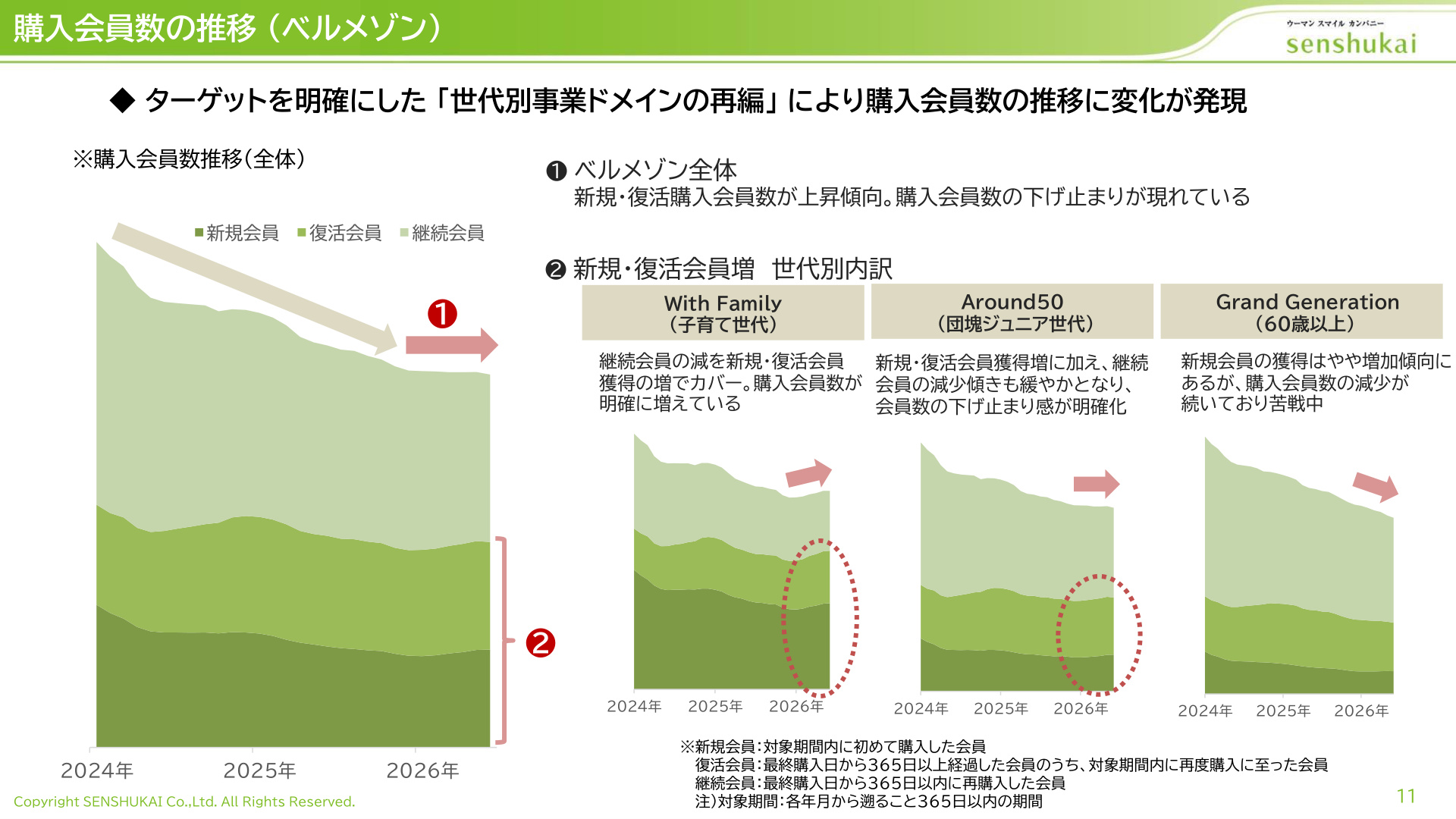
The slide above shows the trends in the number of purchasing members and the breakdown by generation for the core brand, "Belle Maison." While the decline in total membership has been a long-standing issue, the effects of strategic initiatives are beginning to become visible.
Of particular note is the progress of the "With Family" domain , which targets the child-rearing generation. The acquisition of new and returning members has sufficiently covered the decline in continuing members, and the number of purchasing members has clearly turned toward an upward trend . Furthermore, in the "Around50" domain , centered on the baby boomer junior generation, the decline in membership has clearly bottomed out due to an increase in new and returning members. Although the "Grand Generation" (aged 60 and over) continues to struggle, the increase in new and returning members in the focus target segments ( 329,000 in total, an increase of 26,000 YoY ) indicates that the direction of the marketing strategy is yielding certain results.
5. Breaking Away from Catalog Dependency and Transforming into a Digital Attraction Structure
The greatest challenge in Senshukai's structural reform is breaking away from dependency on catalogs —a high-cost paper medium—and transitioning to digital marketing .
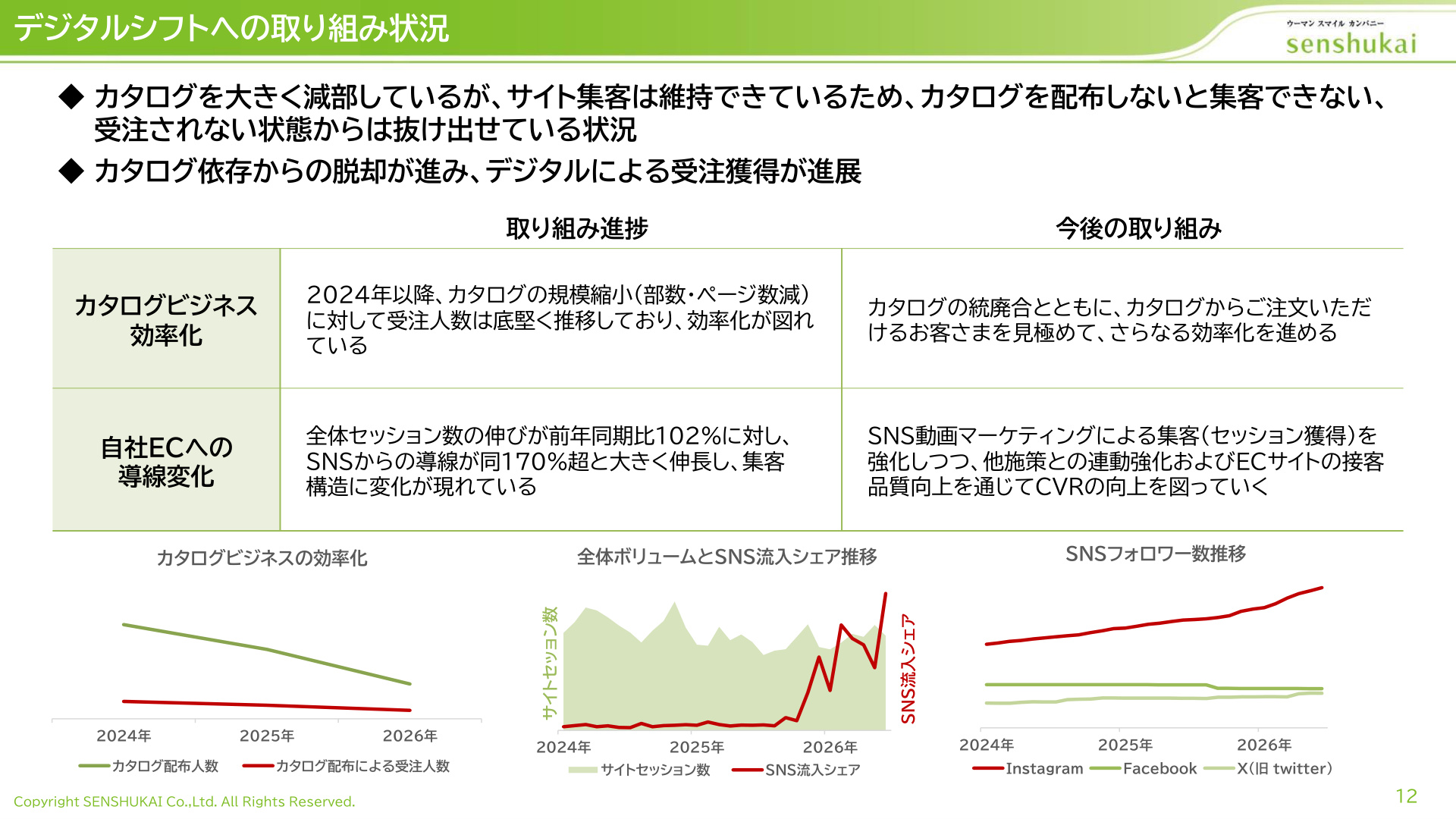
The slide above illustrates the company's progress in its digital shift and the changes in its customer attraction structure.
The company's traditional model relied on distributing large volumes of paper catalogs to generate orders, with printing and mailing costs acting as a heavy burden. However, since 2024, the company has implemented a significant efficiency drive, reducing the number of catalogs issued by 45% YoY . While reducing catalogs generally carries the risk of lower orders, as the graph in the slide shows, the number of orders generated via catalog distribution has remained solid , indicating that the company is successfully breaking away from the structure where "orders cannot be generated without distributing catalogs."
Furthermore, changes in the traffic structure to the company's own e-commerce site are also evident. While total sessions were maintained at 102% YoY, the share of traffic from SNS has grown significantly to over 170% YoY . Through the expansion of SNS followers, particularly on Instagram, and short-video initiatives, a digital-centric customer attraction structure centered on young child-rearing generations is being formed.
6. Creating Hit Products and Growth in External E-commerce Malls
Supporting the digital shift is not just a change in advertising methods, but product development rooted in customer "pain points" and the development of diversified sales channels.
- Hit "Pain-Point Solving" Products :
- "Za-Pants" : Focused on the daily annoyance of "pants feeling tight when sitting down," proposed as a "work-wear reform." It resonated strongly with working women and the child-rearing generation, driving sales.
- "Raku-Dry" : Developed to eliminate the "loss of personal time" in housework, these dryer-compatible, iron-free clothes have been well-received.
- Scene-Making Videos Linked with SNS :
- Rather than just introducing product specs, the company deploys short videos (many with over 1 million views) that propose a context for living, such as "Organizing an 8-tatami mat children's room before summer" (1.4 million views) and "Storage that turns into a desk" (1.22 million views). These have achieved high engagement and driven e-commerce traffic from SNS.
- Growth in External E-commerce Malls :
- While advancing the digital shift of its own e-commerce site, sales at external e-commerce malls such as Amazon, Yahoo! Shopping, Rakuten Ichiba, and ZOZOTOWN have grown strongly to 119% YoY .
- On Rakuten Ichiba, a "neat-looking rack that can be hung on walls with staples," co-developed with popular influencer "saki," recorded sales five times the target, winning the "Rakuten Shop of the Month (March 2026)."
- From April 2026, the company also began opening stores on ZOZOTOWN, expanding into new customer segments in categories where it has strengths, such as kids' fashion, innerwear, and maternity pajamas.
7. Summary and Future Focus
Senshukai's FY2026 Q2 financial results, while facing the challenge of a downward revision to the full-year earnings forecast, demonstrate that structural reforms for business regeneration are progressing .
[Summary of Key Points]
- Performance and Finance : Although the full-year forecast was revised downward due to lower sales, the operating loss narrowed due to cost structure reforms. Interim net income turned profitable due to the sale of fixed assets, and the equity ratio improved to 71.0% .
- Customer Base Trends : New and returning members increased in the child-rearing (With Family) and baby boomer junior (Around50) generations, and a bottoming-out trend in membership has taken hold.
- Digital Transformation : Site traffic was maintained while catalog volume was reduced by 45% , and SNS traffic surged to over 170% YoY .
- Product and Sales Strategy : Hit products (such as "Za-Pants") and SNS video proposals have been successful, and the diversification of sales channels is progressing, with external e-commerce mall sales at 119% YoY .
The future focus is concentrated on how efficiently the traffic acquired digitally can be converted into purchases and retention (improving CVR and repeat rates) , and whether the company can accelerate the speed at which the effects of various digital initiatives manifest to achieve full-year profit structure reform.
This content is not intended as investment advice or a recommendation. Any opinions expressed are solely the personal views of each article.