


Earnings Summary: Global-Dining's Consolidated Operating Profit Surges 3.3x Driven by Strong Domestic Same-Store Sales and Dramatic Turnaround in U.S. Operations

StockClub
Published: Aug 07, 2026, 11:54 AM
Sentiment Analysis
Global-Dining, Inc.'s H1 FY2026 (ending December 2026) financial results demonstrate a significantly strengthened earnings foundation for the group, fueled by a sustained growth trend in domestic same-store sales and a major turnaround to profitability for its U.S. subsidiaries.
This report provides a detailed analysis based on the company's official earnings presentation, focusing on 10 key topics including performance highlights, factor analysis, segment trends, and future growth strategies.
1. Consolidated Earnings Summary: Revenue and Profit Significantly Exceed Budget
In the first half of FY2026, the company achieved substantial year-on-year growth in both revenue and profit across all stages.
- Net Sales : 7,109 million JPY (+11.1% YoY, +5.5% vs. initial budget)
- Operating Profit : 620 million JPY (+231.1% YoY, +27.6% vs. initial budget)
- EBITDA : 857 million JPY (+121.7% YoY)
- Ordinary Profit : 649 million JPY (+459.9% YoY)
- Net Income (H1) : 510 million JPY (+4,634.0% YoY)
Progress against the H1 budget reached 50.7% for net sales, 65.4% for operating profit, and 74.0% for net income, indicating a highly favorable growth trajectory.
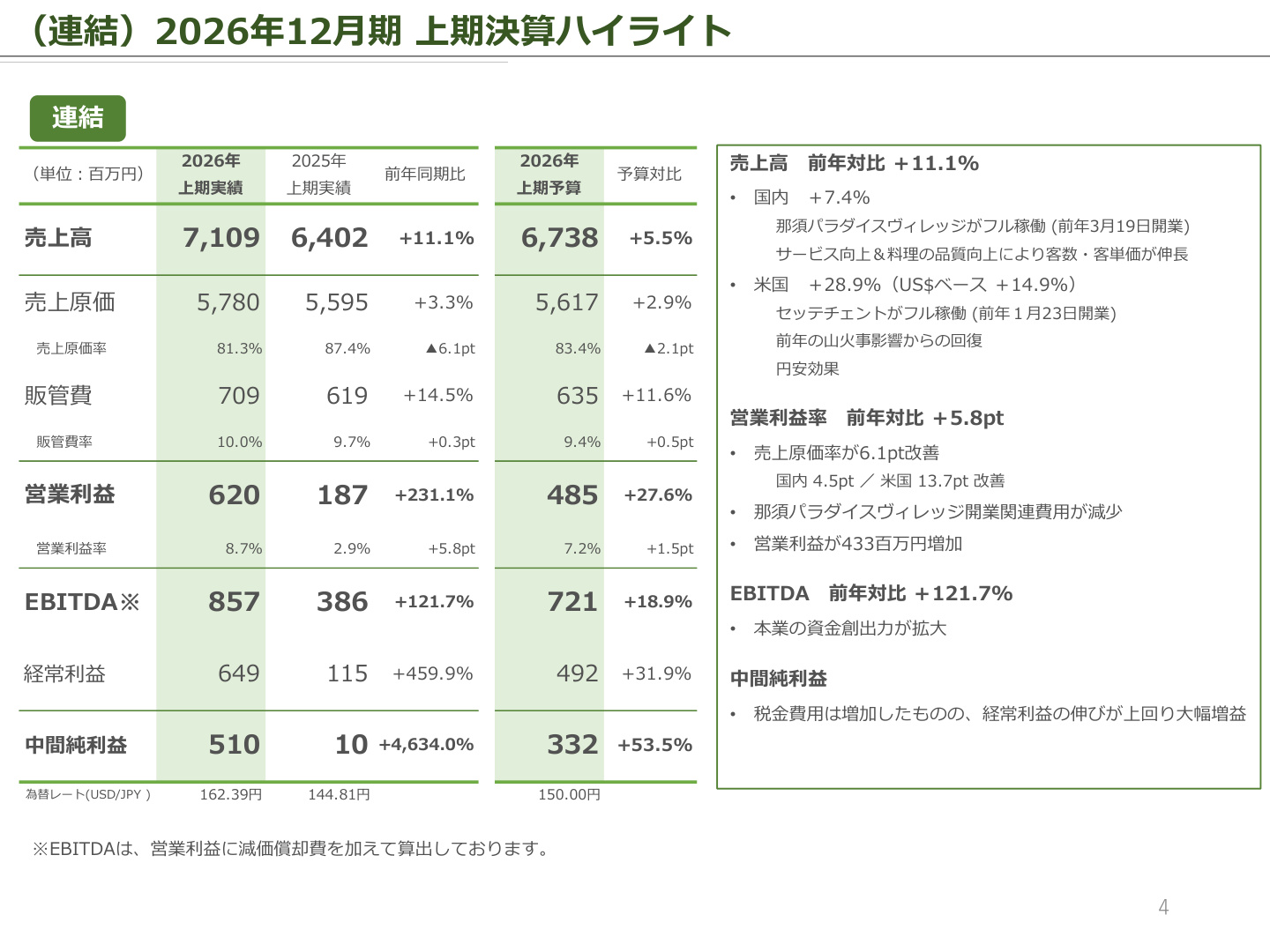
The earnings highlight slide above provides a concise overview of this interim performance. Of particular note is the dramatic improvement in the operating profit margin , which rose by 5.8 percentage points from 2.9% in the same period last year to 8.7% . This confirms that the company's profit-generating capacity is expanding at a pace significantly faster than its revenue growth (+11.1%). The primary drivers for this margin expansion are a 6.1-point improvement in the cost of sales ratio (from 87.4% to 81.3%) and enhanced profitability in the U.S. business, both discussed further below.
2. Domestic Business Trends: Driven by Long-term Same-Store Sales Growth
Domestic business revenue reached 5,693 million JPY (+7.4% YoY), with operating profit hitting 486 million JPY (+99.2% YoY), marking a significant increase in both top and bottom lines. Domestic same-store performance saw a well-balanced growth, with customer traffic up 4.2% and average spend per customer up 3.0% , resulting in a 7.4% increase in sales.
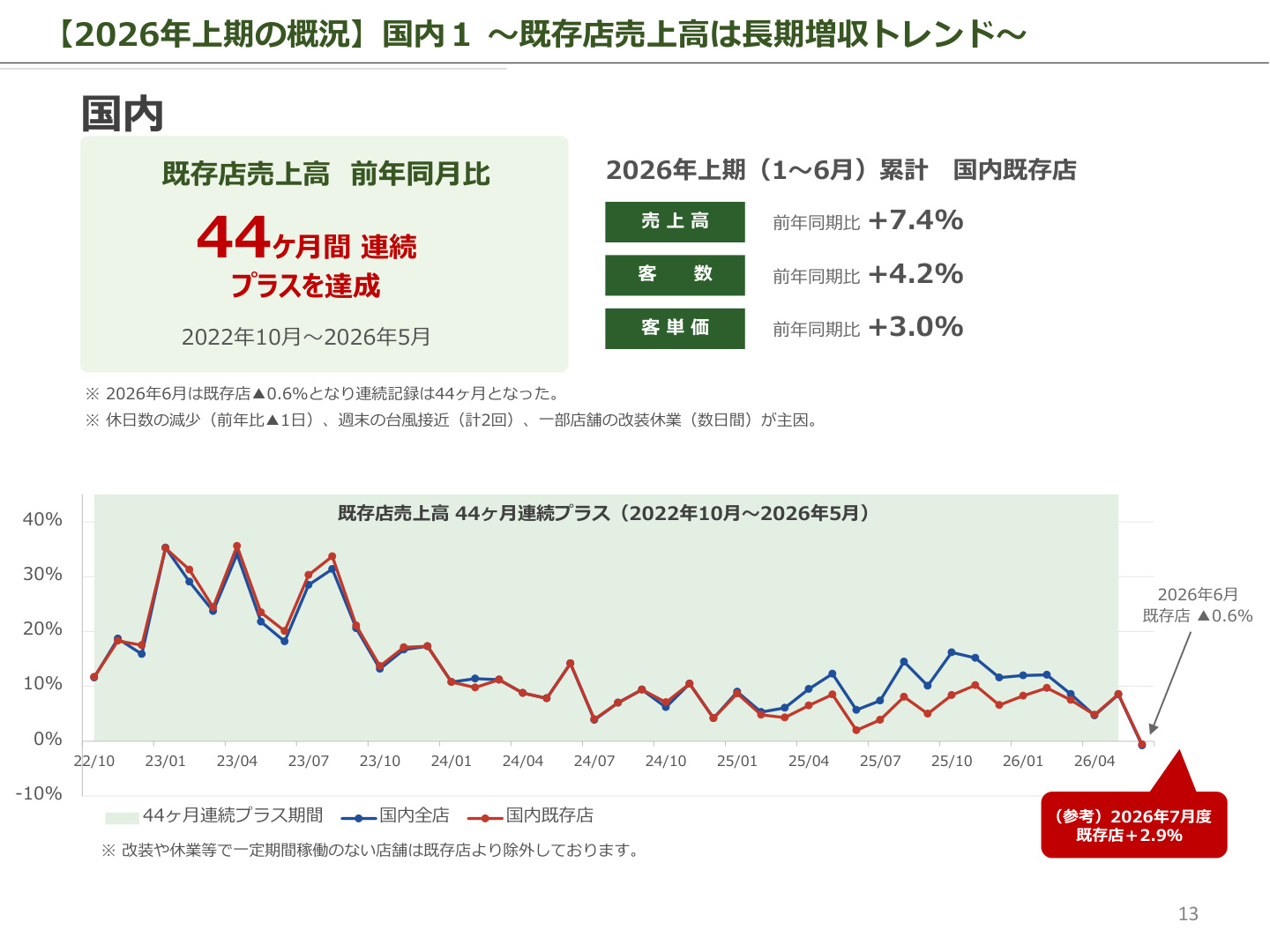
The slide above illustrates the monthly trends in domestic same-store sales. The company has achieved 44 consecutive months of year-on-year growth from October 2022 to May 2026, maintaining a growth rate that consistently outperforms the industry average (based on Japan Food Service Association data). While June 2026 saw a slight dip of 0.6% due to fewer holidays, approaching typhoons, and temporary closures for renovations, the most recent July figures show a swift recovery to +2.9% .
3. Cost Control and Improvement in Cost of Sales Ratio
The increase in domestic operating profit (+242 million JPY YoY) is underpinned by a thorough review of costs and operations. The domestic cost of sales ratio improved by 4.5 percentage points YoY:
- Promotion of Direct Overseas Procurement and Negotiation : Sourcing small-batch, labor-intensive ingredients directly from overseas producers to reduce procurement costs.
- Operational Evolution and Labor Cost Optimization : Improving labor productivity at the store level, resulting in a 1.4-point improvement in the labor cost ratio.
- Reduction in Store Expense Ratio : Spreading fixed costs more efficiently, leading to a 3.0-point improvement in the store expense ratio.
Furthermore, initiatives such as the installation of coffee bean roasters across all stores are underway to simultaneously strengthen product appeal and control costs.
4. Performance by Domestic Concept (Business Segment)
An analysis of the domestic business by concept reveals that core brands are driving profitability.
- Gonpachi (7 stores) : Sales of 1,757 million JPY (+3.7% YoY), Operating Profit of 487 million JPY (27.7% margin). As the group's largest profit contributor, it maintains an exceptionally high margin, supported by a customer base that includes international tourists.
- La Boheme (14 stores) : Sales of 1,748 million JPY (+13.8% YoY), Operating Profit of 381 million JPY (+27.0% YoY, 21.8% margin). Driven by locations such as Shirokane, Hisaya-odori, and Hamamatsucho, the profit margin improved by 2.3 points due to the benefits of overseas procurement.
- Monsoon Cafe (8 stores) : Sales saw a slight decline to 993 million JPY (-1.3% YoY), but due to improvements in labor costs, operating profit reached 177 million JPY (+22.1% YoY, 17.9% margin), with the profit margin improving by 3.4 points .
- Zest (5 stores) : Sales of 260 million JPY (+10.1% YoY), Operating Profit of 40 million JPY (15.6% margin, +4.0pt improvement ).
5. Monetization Strategies for Dinner-Focused (High-End) Stores
Sales for the dinner-focused segment (5 stores), including "Tableaux" (Daikanyama) and "Stellato" (Shirokanedai), reached 530 million JPY (+7.0% YoY), with an operating profit of 59 million JPY (11.2% margin).
To enhance the earning power of these high-difficulty locations, the company has been hosting "Special Dinner Events Featuring Wines from Around the World" from June through November, offering sommelier commentary and rare wine pairings. The first event was fully booked, and the company is actively promoting strategies to increase average spend through improved customer satisfaction and brand awareness.
6. Progress of Nasu Paradise Village (NPV)
In its second year as a complex facility for lodging and dining, "Nasu Paradise Village (NPV)" saw sales grow significantly to 180 million JPY (+63.0% YoY). While the operating loss remains at 164 million JPY , this represents a 129 million JPY reduction in losses compared to the same period last year (164 million JPY vs. 293 million JPY loss).
Attracting more visitors through seasonal events (Koinobori, Tanabata Festival, public viewings, etc.) and expanding the product lineup, the facility is building a foundation for standalone profitability by 2027–2028, in line with its mid-to-long-term "3-stage monetization roadmap."
7. Significant Turnaround and Structural Shift in U.S. Subsidiaries
The most notable positive factor in this interim report is the dramatic performance recovery of the U.S. subsidiaries (3 stores in California).
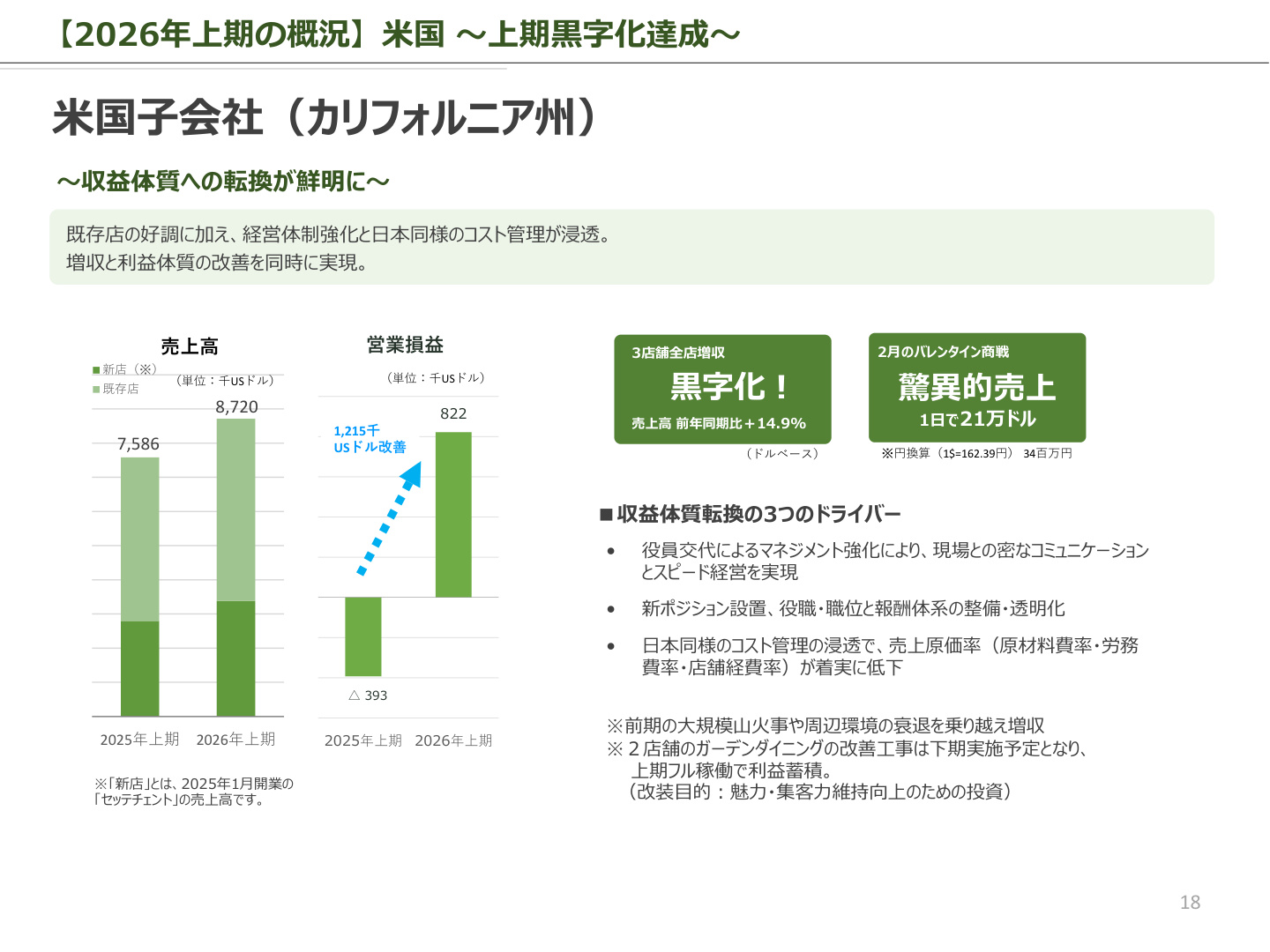
As shown in the slide above, the U.S. subsidiary's operating profit shifted from a 393,000 USD loss in the same period last year to an 822,000 USD profit , marking a dramatic improvement of 1,215,000 USD (approx. 190 million JPY) .
Total store sales in USD reached 8,720,000 USD (+14.9% YoY), and sales in JPY reached 1,416 million JPY (+28.9% YoY), resulting in a consolidated operating profit of 133 million JPY (compared to a 57 million JPY loss in the previous year).
This is driven by three key factors :
- Strengthened Management Structure : Enhanced management oversight by headquarters executives and closer communication with on-site staff.
- Refinement of HR and Compensation Systems : Increased motivation through the creation of new positions and the introduction of incentive programs.
- Implementation of Cost Management Similar to Japan : Achieving comprehensive reductions in material cost ratios (-2.8pt), labor cost ratios (-3.7pt), and store expense ratios (-4.7pt).
By store, "Settecento," which opened in January 2025, saw sales grow by 21.0% YoY due to increased brand awareness, achieving standalone profitability.
8. Asset Soundness and Cash Flow Status
With the rapid expansion of business performance, the financial structure has been steadily strengthened.
- Total Assets : 11,602 million JPY (+436 million JPY from end of previous fiscal year)
- Net Assets : 6,167 million JPY (+534 million JPY from end of previous fiscal year)
- Equity Ratio : Increased by 2.7 points from 50.2% to 52.9%
- Current Ratio : Improved by 45.2 points from 97.2% to 142.4%
- Cash and Cash Equivalents : 1,673 million JPY (+1,012 million JPY YoY)
Cash flow from operating activities resulted in a 737 million JPY cash inflow (compared to 553 million JPY in the same period last year), significantly expanding the company's core fund-generating capacity. With investment cash flow limited to 102 million JPY for kitchen equipment and facility upgrades, free cash flow remains very healthy.
9. Full-Year Earnings Outlook and H2 Forecast
Although H1 performance shows a high progress rate against the full-year plan, the company is maintaining its initial full-year business plan at this time.
【FY2026 Full-Year Consolidated Plan】
- Net Sales : 14,032 million JPY (+2.7% YoY)
- Operating Profit : 948 million JPY (+37.7% YoY, 6.8% margin)
- Net Income : 689 million JPY (+124.2% YoY)
The primary reasons for maintaining the forecast include the following factors incorporated into the second half:
- U.S. Store Renovations : Planned renovations (3-month closure of the garden patio at "La Boheme" and 1-month closure at "Settecento") are expected to cause temporary sales declines.
- U.S. PAGA Litigation Settlement : A settlement for the PAGA (Private Attorneys General Act) lawsuit is scheduled for October, and the company needs to monitor the progress.
- Continued improvement of loss-making domestic stores and development of Nasu NPV .
While there are no new store openings planned for 2026, the company is preparing for the opening of two stores in Tama-Plaza in 2027 and proceeding with renovations of existing stores.
10. Shareholder Return Policy: Continued Stable Dividends and Shareholder Perks
Regarding shareholder returns, following the resumption of a 5 JPY per share dividend at the end of the previous fiscal year (FY2025), the company plans to continue the 5 JPY per share year-end dividend (5 JPY annually) for FY2026 .
Additionally, the company continues its shareholder benefit program, providing shareholders holding 500 shares or more with a discount card twice a year, offering a 15% discount on dining, merchandise, and lodging at domestic directly-managed stores (each valid for 6 months, unlimited usage).
Summary
In the first half of FY2026, Global-Dining saw its operating profit surge to 3.3 times the previous year's level, driven by the dual engines of "strong growth in domestic same-store sales" and "significant structural reform and profitability in U.S. subsidiaries." While carefully monitoring the impact of renovation-related closures and various cost factors in the second half, the company is steadily transitioning toward a high-profit structure.
This content is not intended as investment advice or a recommendation. Any opinions expressed are solely the personal views of each article.