


Hatsuho Shoji (7425) FY2026 Q2 Earnings Deep Dive Report

StockClub
Published: Aug 07, 2026, 11:52 AM
Sentiment Analysis
Hatsuho Shoji (7425) FY2026 Q2 (Interim) Earnings Deep Dive Report
Hatsuho Shoji Co., Ltd. (Tokyo Stock Exchange Standard, Securities Code: 7425), a leading specialized trading company for construction materials and exterior components, has announced its financial results for the second quarter (interim period) of the fiscal year ending December 2026. While the company experienced a year-on-year decline in ordinary profit due to stagnant domestic construction demand and rising costs such as labor expenses, it achieved a higher interim net profit compared to the same period last year, driven by extraordinary income from the sale of policy-held shares . The full-year earnings forecast remains unchanged from the initial guidance.
This report provides a detailed analysis of the company's performance trends, cost structure, segment-specific status, financial foundation, future growth strategies, and shareholder return policies, centered on 10 key topics extracted from the earnings materials.
1. Earnings Summary and Overall Performance
The key consolidated financial figures for the second quarter (interim period) of FY2026 are as follows:
- Net Sales : 17,140 million yen ( 0.3% decrease YoY)
- Operating Profit : 470 million yen ( 19.6% decrease YoY)
- Ordinary Profit : 561 million yen ( 21.8% decrease YoY)
- Interim Net Profit Attributable to Owners of Parent : 404 million yen ( 2.1% increase YoY)
As a result of continued stagnation in the core construction materials market, consolidated net sales remained flat year-on-year (17.14 billion yen), falling short of the initial interim forecast. Furthermore, rising labor costs due to wage hikes pressured profitability, leading to a significant decline in both operating and ordinary profits, which represent the company's core business earnings.
On the other hand, as part of efforts to improve capital efficiency and compress assets, the company recorded a gain on the sale of investment securities of 118 million yen as extraordinary income . Consequently, the final bottom-line profit attributable to owners of the parent reached 404 million yen, achieving a 2.1% increase year-on-year.
2. Analysis of External Environment and Market Trends
Understanding current trends in the construction and housing market is essential to grasping Hatsuho Shoji's business performance. According to the company's analysis based on Ministry of Land, Infrastructure, Transport and Tourism statistics, the market environment remains in a challenging phase.
- New Housing Starts : Decreased by 6.5% YoY to 740,000 units in 2025.
- Private Non-Residential Buildings : Shrank by 5.7% YoY to 33,077 thousand square meters in 2025.
Not only in the housing sector but also in non-residential sectors such as commercial facilities and office buildings, the decline in floor area for new construction continues, casting a direct shadow on the company's building material orders. Furthermore, structural changes such as rising construction material prices, prolonged construction periods, and the narrowing of seasonal fluctuations have contributed to the slowdown in sales growth.
3. Factors Behind the Decline in Ordinary Profit and Cost Structure
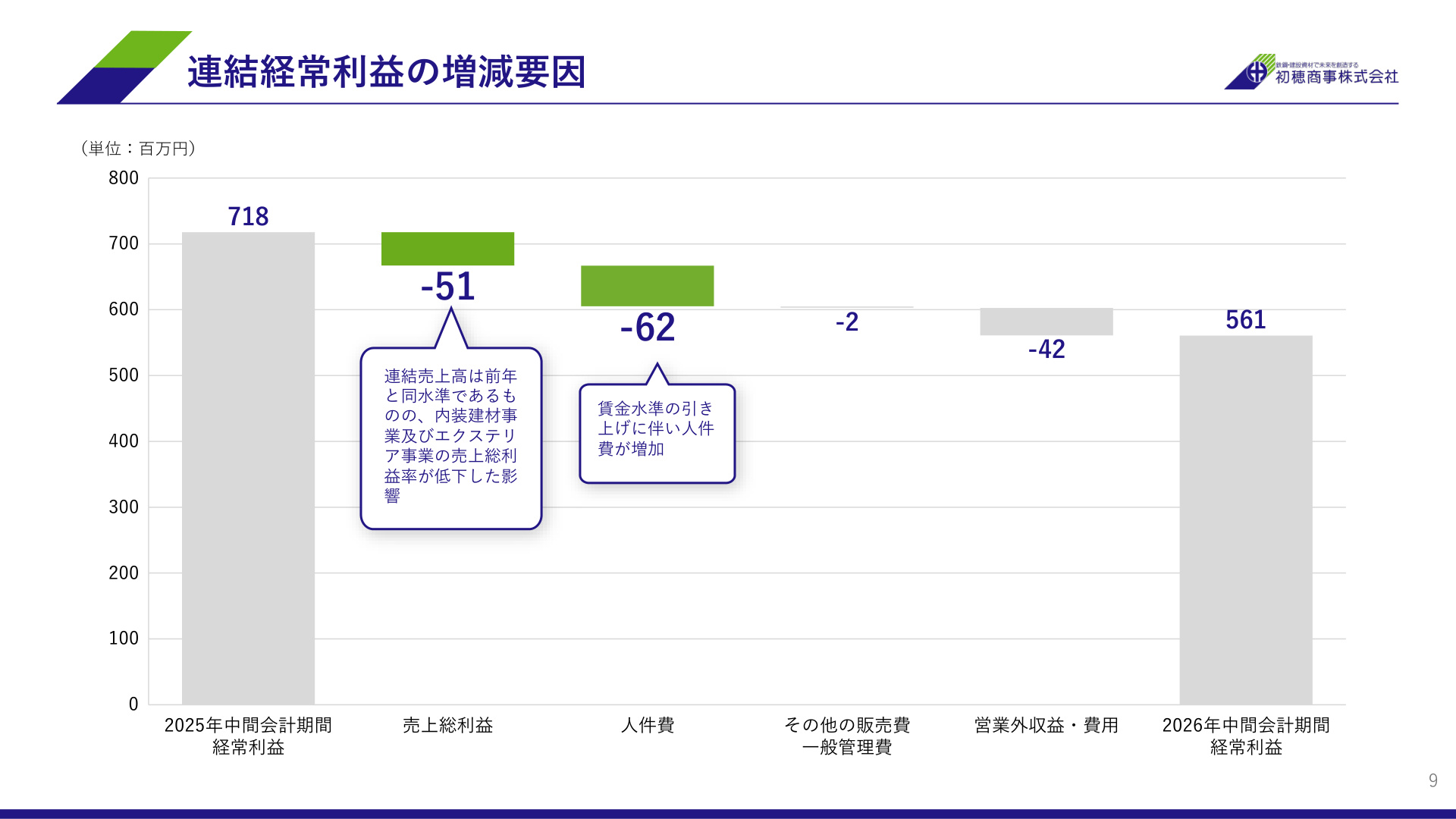
We analyze the factors behind the 157 million yen decrease in ordinary profit (from 718 million yen to 561 million yen) based on the company's published variance analysis.
[Significance of the Slide and Background Commentary]
The waterfall chart above provides a clear answer to the question, "Why did ordinary profit decrease significantly despite flat sales?" This slide is crucial because it visually demonstrates that the primary profit-pressuring factors are concentrated in two areas: "deterioration in gross profit margin" and "increase in fixed costs (labor expenses)."
Specifically, it breaks down into the following elements:
- Decrease in Gross Profit (△51 million yen) : While sales remained on par with the previous year, the decline in gross profit margins in the Interior Building Materials and Exterior businesses had an impact.
- Increase in Labor Costs (△62 million yen) : To respond to the current inflationary environment and labor shortages, the company implemented wage hikes (base-up) , which increased labor costs by 62 million yen compared to the same period last year, pressuring profits.
- Other SG&A Expenses (△2 million yen) : Other expenses such as facility costs remained largely flat, indicating effective control.
- Fluctuations in Non-Operating Income/Expenses (△42 million yen) : The net balance of non-operating items, including derivatives, foreign exchange, and financial income/expenses, contributed negatively.
In this way, the interim decline in profit is attributed to the inability to fully cover the decline in gross profit margins caused by falling demand for building materials, while simultaneously executing "human capital investment (increased labor costs)" to maintain a growth trajectory.
4. Detailed Performance by Segment
Hatsuho Shoji operates three business segments: "Interior Building Materials," "Exterior," and "Living Environment." The trends by segment in the interim period show a clear contrast.
[Significance of the Slide and Background Commentary]
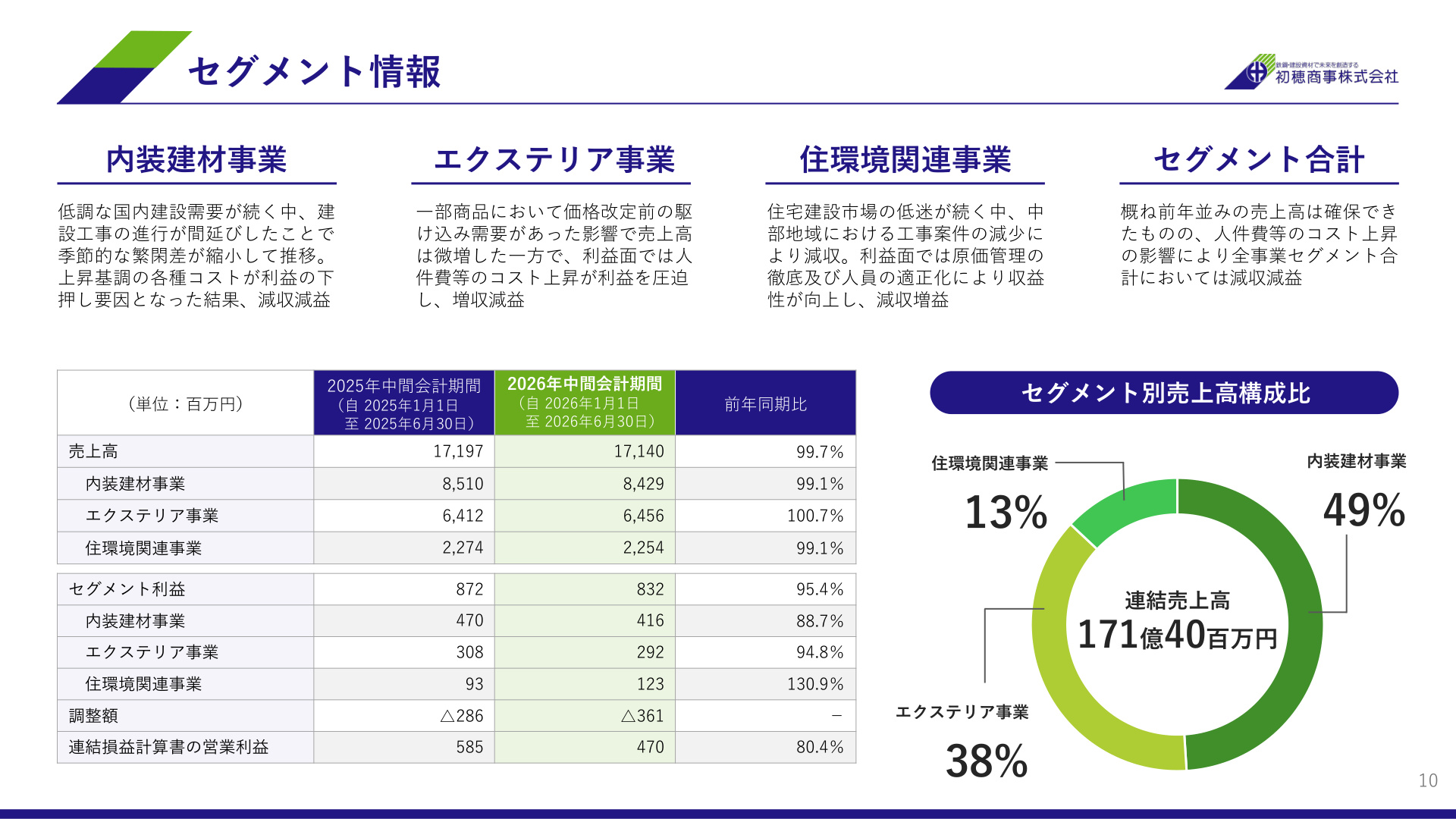
The slide above is essential data covering the company's business portfolio structure (Interior Building Materials 49%, Exterior 38%, Living Environment 13%) and the changes in sales and profit for each business. While the company has a diversified structure that does not rely on a single business, one can discern the reality that the market environment and the effectiveness of profit measures differ significantly by segment .
① Interior Building Materials Business (49% of total sales)
- Net Sales : 8,429 million yen ( 0.9% decrease YoY)
- Segment Profit : 416 million yen ( 11.3% decrease YoY)
- Commentary : This is the core business handling lightweight steel framing and plasterboard. Due to sluggish domestic construction demand, construction delays, and the narrowing of seasonal fluctuations, the segment saw a decline in both sales and profit. The inability to fully pass on various cost increases to prices led to the profit decline.
② Exterior Business (38% of total sales)
- Net Sales : 6,456 million yen ( 0.7% increase YoY)
- Segment Profit : 292 million yen ( 5.2% decrease YoY)
- Commentary : This is the exterior materials field handled by the subsidiary, Aishin Co., Ltd. Although it secured a sales increase by capturing last-minute demand before price revisions for certain products, rising costs such as labor expenses pressured profits, resulting in a slight decline.
③ Living Environment Business (13% of total sales)
- Net Sales : 2,254 million yen ( 0.9% decrease YoY)
- Segment Profit : 123 million yen ( 30.9% increase YoY)
- Commentary : This segment handles roofing, exterior wall materials, and environmental equipment such as solar power and EcoCute. Despite a sales decline due to the sluggish housing construction market, the company achieved a significant profit increase (+30.9% YoY) as a result of thorough cost management and personnel optimization , serving as a model case for profitability improvement.
5. Financial Soundness and Cash Flow Status
The company's financial position is extremely sound, with progress made in tightening the balance sheet and accumulating equity.
- Total Assets : 21,239 million yen ( 1,137 million yen decrease from year-end)
- Net Assets : 11,437 million yen ( 147 million yen increase from year-end)
- Equity Ratio : 48.1% ( 3.0 percentage point increase from 45.1% at year-end)
With the compression of trade receivables and payables (decrease in notes and accounts receivable of △794 million yen, decrease in notes and accounts payable of △990 million yen), the asset scale has become leaner, and the equity ratio has risen to 48.1% .
Meanwhile, the cash flow (CF) status is as follows:
- Operating CF : △143 million yen (vs. +1,213 million yen in the same period last year). Despite recording an interim profit before income taxes of 680 million yen, it was temporarily negative due to working capital factors associated with the decrease in trade payables (△983 million yen).
- Investing CF : +38 million yen (vs. +107 million yen in the same period last year). Proceeds from the sale of investment securities (+135 million yen) exceeded expenditures for the acquisition of tangible fixed assets (△90 million yen).
- Financing CF : △492 million yen (vs. △469 million yen in the same period last year). The company executed repayments of long-term loans (△205 million yen) and dividend payments (△252 million yen).
- Cash and Cash Equivalents at Interim Period End : 5,530 million yen (maintaining strong liquidity).
6. Full-Year Earnings Forecast and Future Growth Strategy
Hatsuho Shoji has left its full-year consolidated earnings forecast for the fiscal year ending December 2026 unchanged from the initial plan announced in February 2026.
- Net Sales : 37,200 million yen ( 5.0% increase YoY)
- Operating Profit : 1,330 million yen ( 9.3% increase YoY)
- Ordinary Profit : 1,510 million yen ( 5.2% increase YoY)
- Net Profit Attributable to Owners of Parent : 880 million yen ( 5.8% increase YoY)
At the interim stage, the progress rates are 46.1% for net sales, 37.2% for ordinary profit, and 46.0% for net profit. At first glance, progress appears delayed. However, the company has a performance structure weighted toward the second half (Q3 and Q4) and aims to achieve its full-year plan through the following growth measures:
- Operation of Large-Scale Projects in the Non-Residential Sector : Large-scale redevelopment projects are expected to begin in earnest from the second half, mainly in the three major metropolitan areas of Tokyo, Nagoya, and Osaka, and the company will reliably capture the demand for construction materials.
- Price Pass-Through and Securing Appropriate Profits : In response to the upward trend in material prices, the company will thoroughly maintain appropriate sales prices in line with market fluctuations to recover gross profit margins.
- Strengthening Logistics and Sales Networks through Facility Development :
- January 2026 : Opened the "Yamaguchi Delivery Center" in Yamaguchi City, Yamaguchi Prefecture (strengthening delivery systems and expanding sales channels in the San-in and San-yo areas).
- February 2026 : Relocated the "Kobe West Sales Office" of subsidiary Aishin and integrated it with the "Kobe Logistics Center" (improving operational efficiency through collaboration between sales and logistics).
7. Capital Efficiency, Shareholder Returns, and Corporate Actions
In recent years, the company has been extremely proactive in improving capital efficiency and strengthening shareholder returns.
[Significance of the Slide and Background Commentary]
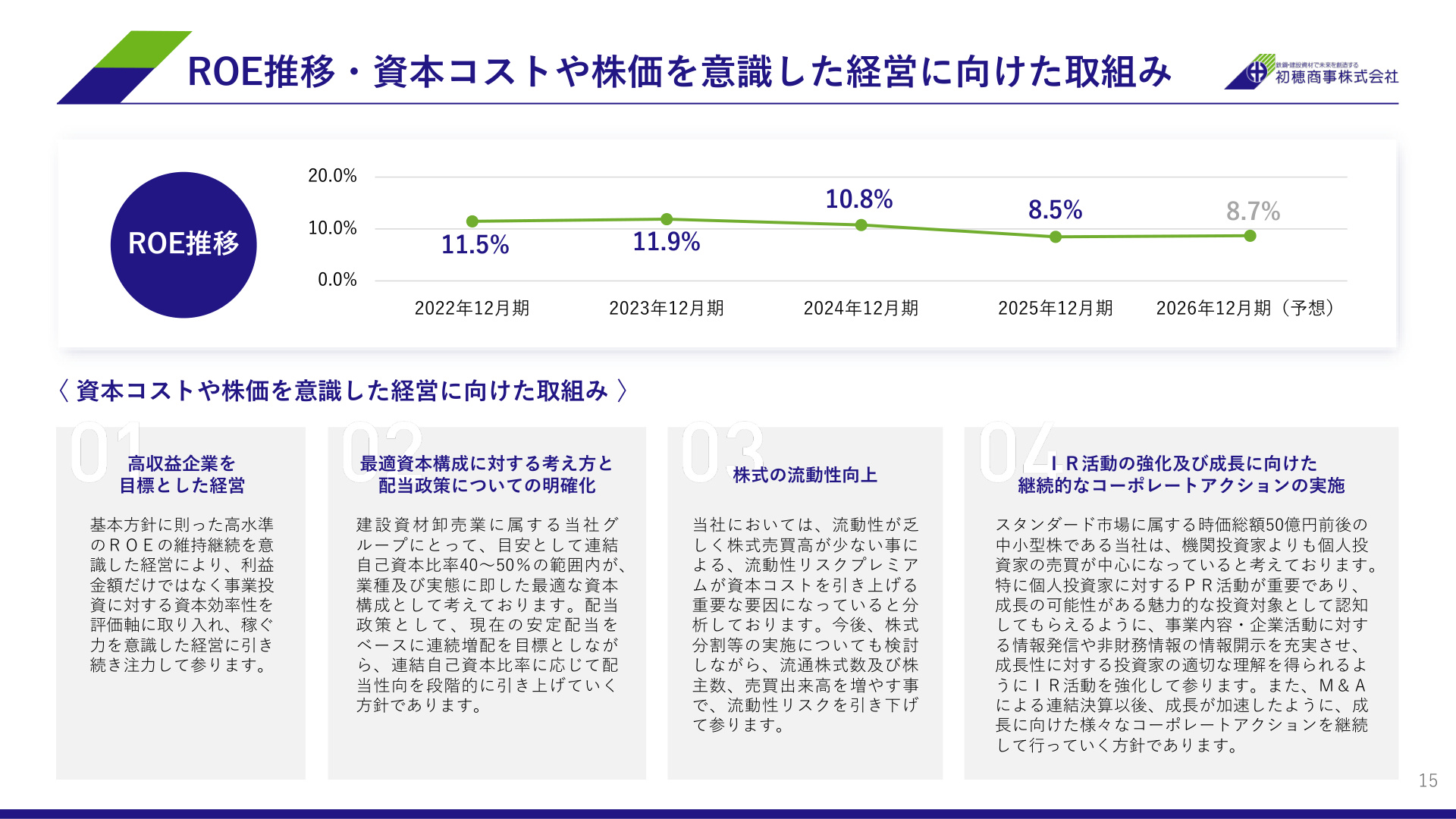
This slide shows the grand design of Hatsuho Shoji's "management conscious of cost of capital and stock price" for medium- to long-term corporate value enhancement , and is one of the most important pages for investors. The four pillars of ROE target setting, optimal capital structure, stock liquidity measures, and IR activities are clearly organized.
Improvement of Capital Efficiency (ROE Target)
Looking at past ROE trends, the company has maintained a high level exceeding 10% , with 11.5% in FY2022, 11.9% in FY2023, and 10.8% in FY2024. Although it is expected to decline slightly to 8.5% for FY2025 and 8.7% for FY2026, the company continues to strive to maintain its earning power with a focus on capital efficiency.
Shareholder Return Policy and Dividend Increase Plan
The company has a policy of "aiming for consecutive dividend increases based on stable dividends, while gradually raising the dividend payout ratio in accordance with the consolidated equity ratio."
- Trends in Dividends per Share (adjusted for stock splits):
- FY2022: 20.0 yen
- FY2023: 27.5 yen
- FY2024: 34.0 yen
- FY2025: 38.5 yen (including a 1.0 yen 80th-anniversary commemorative dividend)
- FY2026 (Forecast) : 40.0 yen ( ordinary dividend increase of +1.5 yen YoY, expected payout ratio 30.0% )
Improvement of Liquidity through Stock Splits
To expand the investor base and improve stock liquidity, the company implemented a 2-for-1 stock split effective July 1, 2026 . This has lowered the investment unit price, creating an environment that is easier for individual investors to invest in.
80th Anniversary and Brand Awareness Expansion
Having celebrated its 80th anniversary on February 1, 2026 , since its founding in 1946, the company is strengthening its IR activities to increase awareness as a small-to-mid-cap stock. Through public relations utilizing the official mascot "Hatchan" and various corporate actions including M&A, the company is building a foundation for sustainable growth toward becoming a 100-year company.
Conclusion
Hatsuho Shoji's FY2026 Q2 earnings can be described as a "period of marking time," influenced by the challenging external environment of stagnant construction demand and rising costs. However, by securing an increase in net profit through asset compression, raising the equity ratio to 48.1%, developing logistics bases in Yamaguchi and Kobe, implementing stock splits, and forecasting continued ordinary dividend increases, the company demonstrates a steadfast commitment to structural reform and shareholder return measures aimed at future re-growth and corporate value enhancement . The progress of earnings recovery accompanying the operation of large-scale redevelopment projects in the second half will be the focus of attention moving forward.
This content is not intended as investment advice or a recommendation. Any opinions expressed are solely the personal views of each article.