


Nihon Plast Q1 FY2027 Earnings Deep Dive: Revenue Growth Offset by Product Mix and Overseas Struggles; Challenges in Structural Reform and Profitability

StockClub
Published: Aug 07, 2026, 11:50 AM
Sentiment Analysis
1. Introduction: Q1 Earnings Overview and Key Topics
Nihon Plast Co., Ltd. (Securities Code: 7291), a leading supplier of automotive interior parts and airbag systems, reported its financial results for the first quarter of the fiscal year ending March 2027. While the company achieved revenue growth driven by increased production of existing vehicle models , rising demand for HOD (Hands-On Detect) steering wheels , and price revisions , it faced a challenging quarter in terms of profitability. The company recorded a significant decline in operating profit and a net loss, primarily due to unfavorable product mix and underperformance at overseas subsidiaries .
This report provides a comprehensive analysis of the company's current status and challenges, based on the disclosed financial materials, covering detailed performance analysis, structural factors by region, product, and customer, full-year outlook, and the structural reform strategies revealed in the Q&A session.
【10 Key Topics in This Earnings Report】
- Q1 Performance : Revenue increased slightly to 29.658 billion yen (+1.3% YoY) , but operating profit plummeted to 86 million yen (down 87.3% YoY) , resulting in a net loss of 154 million yen .
- Factors Behind Operating Profit Decline : Despite achieving rationalization effects (+389 million yen) on the shop floor, the negative impact of product mix and other factors (down 979 million yen) , stemming from a decrease in high-margin vehicle models, severely pressured profits.
- Regional Performance Divergence : While the Japanese market saw a sharp expansion in operating profit to 336 million yen (+600.6% YoY) due to production efficiency and revenue growth, North America and China fell into operating losses.
- Growth in Steering Wheel Business : Driven by the adoption of HOD steering wheels for Advanced Driver Assistance Systems (ADAS), the steering wheel segment grew significantly, with revenue reaching 9.425 billion yen (+23.4% YoY) .
- Decline in Resin Parts and Airbags : Due to a decrease in mold sales and customer production cuts, resin parts (down 7.5% YoY) and airbags (down 4.3% YoY) fell below the previous year's levels.
- Dependency on Specific Customers : The Nissan Group accounts for 64.1% and the Honda Group for 31.8% of sales, with both groups maintaining slight revenue growth in the 1% range YoY.
- Maintenance of Solid Financial Foundation : Total assets stood at 85.719 billion yen , with an equity ratio of 44.0% (+0.1pt from the end of the previous fiscal year) , maintaining financial soundness despite the difficult profit environment.
- Full-Year Outlook Maintained : The company maintains its full-year plan of 118 billion yen in revenue (+2.7% YoY) and 2.4 billion yen in operating profit (down 9.4% YoY) .
- Structural Reform of China Operations (Minimization) : To respond to the rapid deterioration of the local market, the company announced an acceleration of its "minimization" strategy to shrink local operations to the absolute minimum.
- Response to Changes in Customer EV Strategies : The company is currently applying for compensation from customers for past development and capital expenditures incurred due to revisions in major customers' EV development plans.
2. Q1 Earnings Highlights and Profit Structure Deep Dive
In the first quarter of the fiscal year ending March 2027, consolidated revenue was 29.658 billion yen (+366 million yen, +1.3% YoY) , and the cost of sales was 27.148 billion yen (+765 million yen, +2.9% YoY) . With gross profit shrinking to 2.509 billion yen (down 398 million yen, down 13.7% YoY) and selling, general and administrative expenses increasing to 2.423 billion yen (+194 million yen, +8.7% YoY) , operating profit remained at 86 million yen (down 593 million yen, down 87.3% YoY) .
Regarding non-operating income/expenses, due to exchange rate fluctuations and financial costs, ordinary loss was 14 million yen (compared to a profit of 451 million yen in the same period last year) , and the quarterly net loss attributable to owners of the parent was 154 million yen (compared to a profit of 520 million yen in the same period last year) .
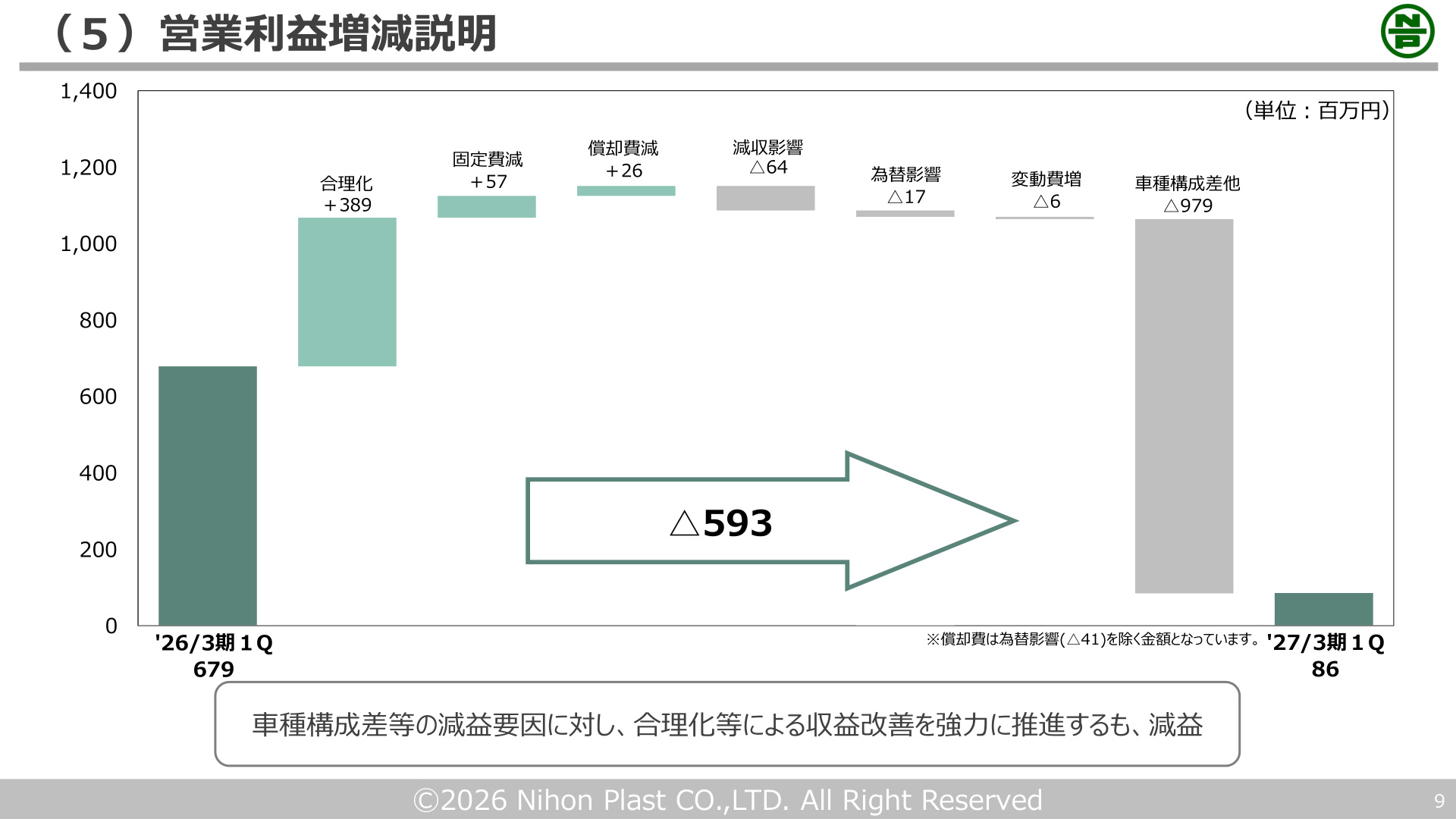
We analyze the background of the sharp decline in operating profit from 679 million yen in the same period last year to 86 million yen based on the following waterfall chart.
【Explanation of Operating Profit Variance】
This slide clearly shows the reasons for the sharp decline in operating profit in the first quarter. The company achieved a profit improvement of +389 million yen through rationalization efforts at manufacturing sites and implemented thorough autonomous cost control, such as fixed cost reductions (+57 million yen) and lower depreciation (+26 million yen). However, these improvements were far outweighed by a negative impact of 979 million yen due to "product mix and other factors." This indicates that the decline was a structural blow that could not be absorbed by internal efforts alone, caused by a combination of reduced production volumes of relatively high-margin vehicle models and changes in product specifications.
3. Detailed Trends by Segment, Product, and Customer
(1) Regional Segments: Strength in Japan and Struggles Overseas
The regional operating profit trends clearly highlight the global geographical challenges the company is facing.
【Importance of the Regional Operating Profit Slide】
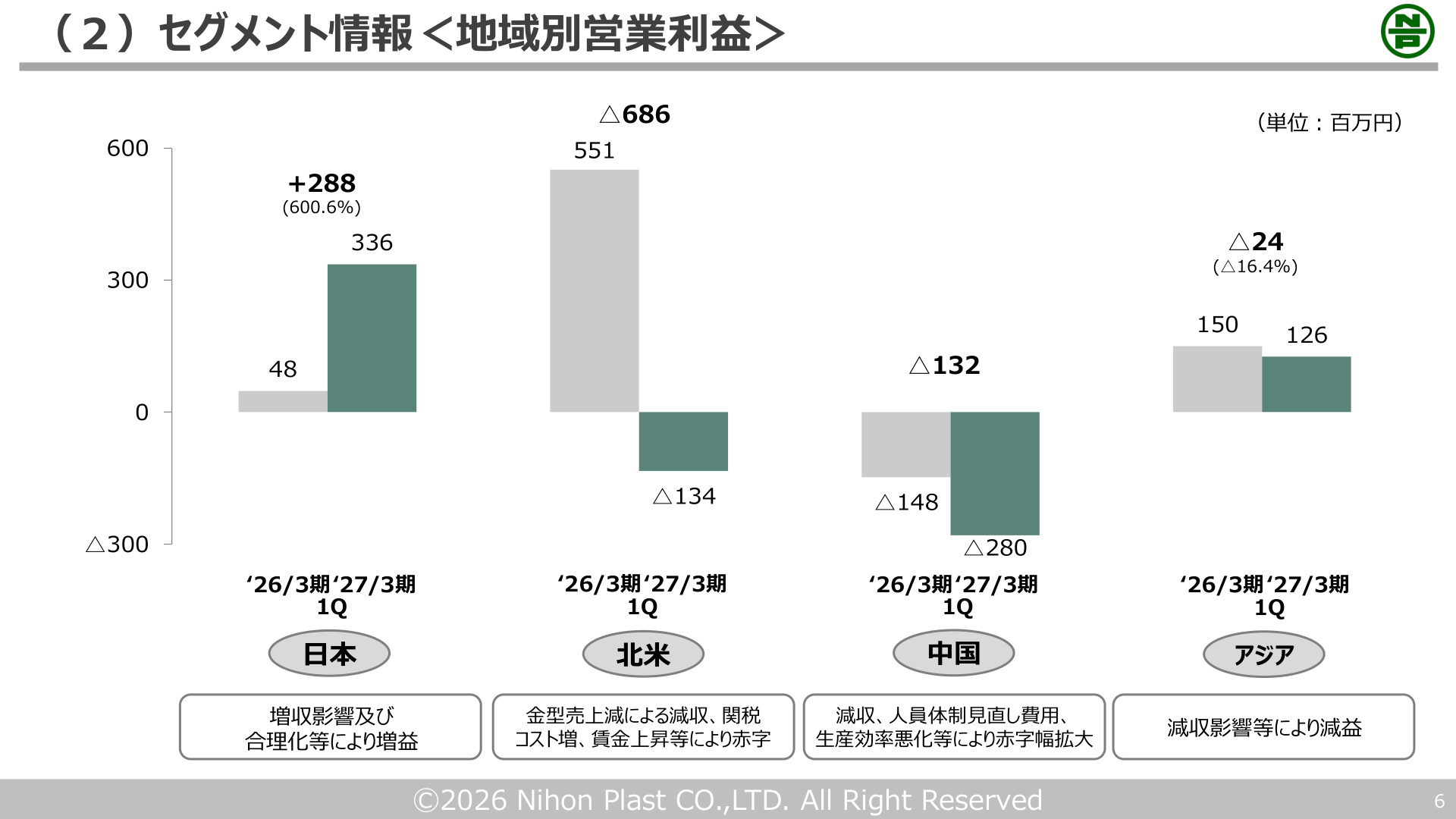
The slide above compares the increase/decrease in operating profit by region, clearly illustrating the contrast in the company's regional portfolio.
- Japan : Driven by increased production of existing models, progress in sales price revision negotiations, and production efficiency (rationalization) at domestic plants, revenue reached 10.916 billion yen (+6.5% YoY) , and operating profit surged from 48 million yen in the same period last year to 336 million yen (+600.6% YoY) .
- North America : While revenue remained flat at 16.008 billion yen (+0.0% YoY) , the segment fell into an operating loss of 134 million yen (compared to a profit of 551 million yen in the same period last year) due to a decrease in mold sales, tariff costs, rising labor costs (wage inflation), and general inflation.
- China : Hit by the sales struggles of Japanese automakers in the local market, revenue decreased to 2.005 billion yen (down 7.3% YoY) . Despite efforts to review personnel structures, the company could not offset the impact of lower revenue and declining production efficiency, causing the operating loss to expand from 148 million yen to 280 million yen .
- Asia : Due to production cuts by customers, revenue was 727 million yen (down 16.3% YoY) , and operating profit decreased to 126 million yen (down 16.4% YoY) .
(2) Revenue Trends by Product
By product, the differences in demand environments are clearly visible.
- Steering Wheels : Achieved significant revenue growth to 9.425 billion yen (+1.785 billion yen, +23.4% YoY) . This was largely driven by the expanded adoption of high-value-added steering wheels with HOD (Hands-On Detect) functions , which are essential for driver assistance systems, and increased production of existing vehicle models.
- Airbags : Revenue decreased to 6.156 billion yen (down 279 million yen, down 4.3% YoY) due to production cuts by major customers.
- Resin Parts : Revenue was 14.077 billion yen (down 1.14 billion yen, down 7.5% YoY) , partly due to the absence of mold sales that existed in the previous year.
(3) Revenue Trends by Customer
The revenue structure by customer remains highly concentrated in the two major groups: Nissan and Honda.
- Nissan Group : Revenue of 19.015 billion yen (+1.4% YoY) , accounting for 64.1% of total sales (same level as the previous year). The decrease in mold sales was covered by increased steering wheel production and exchange rate effects.
- Honda Group : Revenue of 9.438 billion yen (+1.3% YoY) , accounting for 31.8% . Increased production of existing models and exchange rate effects had a positive impact.
- Others : Revenue of 1.205 billion yen (down 0.6% YoY) , accounting for 4.1% .
4. Analysis of Financial Position (Balance Sheet)
Total assets at the end of the first quarter of the fiscal year ending March 2027 increased by 268 million yen from the end of the previous fiscal year to 85.719 billion yen .
- Current Assets : While there was an increase in advance payments (+378 million yen), product inventory decreased (down 229 million yen), resulting in 50.314 billion yen (+60 million yen) .
- Non-current Assets : Increased to 35.404 billion yen (+208 million yen) due to an increase in the valuation of investment securities (+299 million yen).
- Liabilities : While deferred revenue (+2.665 billion yen) and accrued expenses (+1.723 billion yen) increased, there were decreases in short-term borrowings (down 1.092 billion yen), notes and accounts payable (down 1.046 billion yen), and provision for bonuses (down 1.031 billion yen), resulting in total liabilities of 47.965 billion yen (+18 million yen) .
- Net Assets : Despite an increase in foreign currency translation adjustment (+636 million yen), retained earnings decreased (down 539 million yen), resulting in 37.753 billion yen (+249 million yen) .
As a result, the equity ratio is 44.0% , a slight increase of 0.1 percentage points from 43.9% at the end of the previous fiscal year, maintaining a solid financial foundation despite the challenging profit environment.
5. Full-Year Earnings Outlook and Shareholder Return Policy
The company has maintained its full-year consolidated earnings forecast for the fiscal year ending March 2027 as initially announced.
【Importance of the Full-Year Outlook Slide】
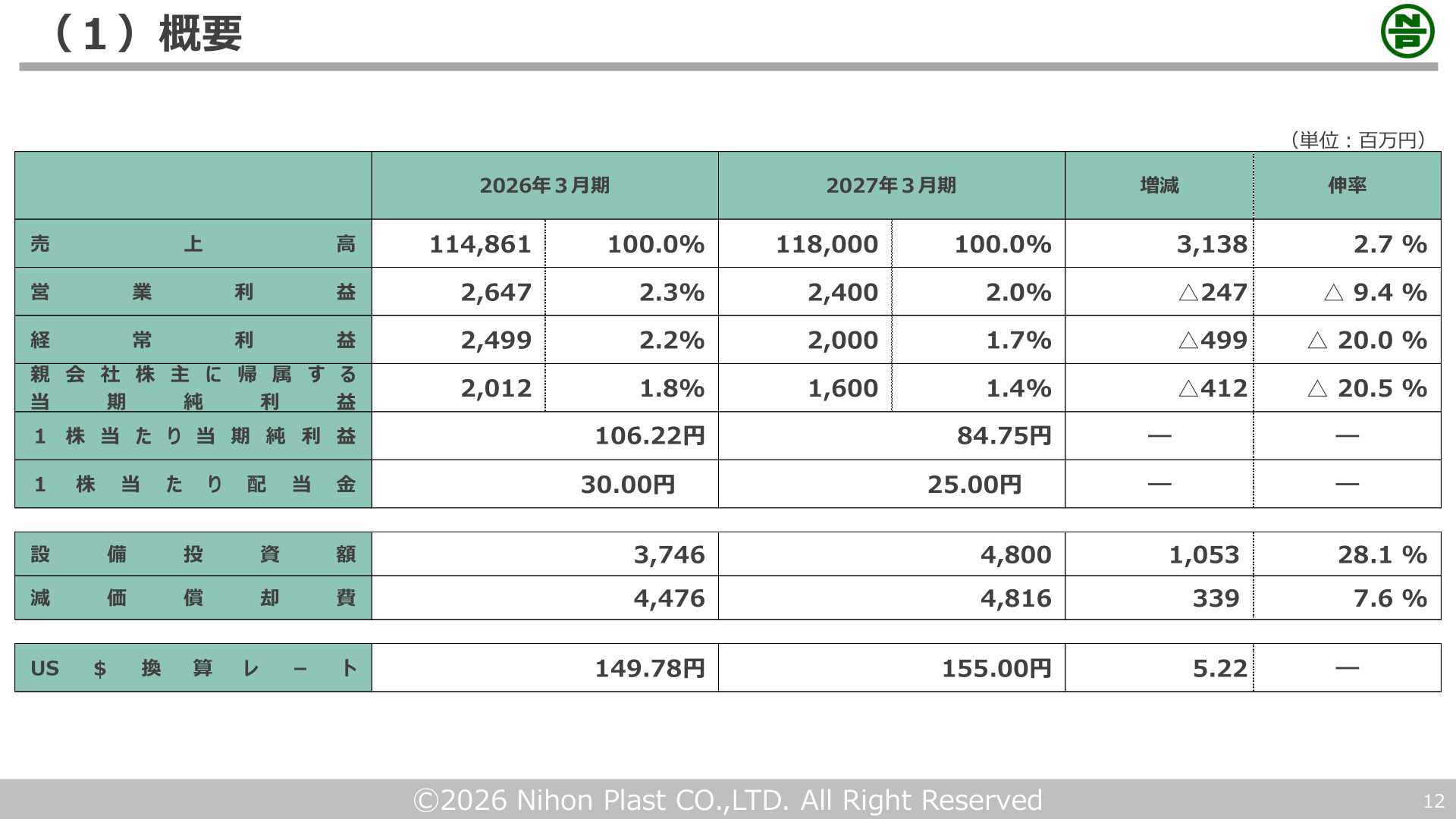
This slide is a key indicator presenting the annual targets, capital investment, and return policy. Although operating profit in the first quarter was only 86 million yen, the company expects a recovery in the second half and has not changed its full-year forecast.
- Revenue : Expected to increase to 118 billion yen (+2.7% YoY) .
- Operating Profit : Expected to decrease to 2.4 billion yen (down 9.4% YoY) .
- Ordinary Profit : 2.0 billion yen (down 20.0% YoY) .
- Net Income Attributable to Owners of the Parent : 1.6 billion yen (down 20.5% YoY) .
- Capital Investment and Depreciation : Capital investment is planned to increase significantly to 4.8 billion yen (+28.1% YoY) from the previous year (3.746 billion yen). Depreciation is also expected to be 4.816 billion yen (+7.6% YoY) , demonstrating a stance of continuing investment in molds and equipment for future growth.
- Annual Dividend Forecast : Planned at 25.00 yen per share (12.50 yen interim, 12.50 yen year-end) . Although this is a decrease from the 30.00 yen annual dividend (including special/commemorative dividends) in the previous fiscal year (FY2026), it maintains a higher dividend level than the 15.00 yen level from two years ago.
6. Key Issues in the Business Environment and Strategic Responses in Q&A
In the "Frequently Asked Questions" section of the explanatory materials, the company's policy regarding structural risks and changes in the external environment, which are of greatest concern to investors, is clearly stated.
- Status of One-time Factors
- No particular one-time factors at the Q1 operating profit level. However, in non-operating income, approximately 48 million yen in "gain on reversal of allowance for doubtful accounts" was recorded as debt collection following the bankruptcy of a bicycle airbag customer.
- Response to US Tariff Costs and Rising Raw Material Prices
- Regarding cost increases due to US tariff measures, there was no significant progress in passing them on or recovering them in Q1, but negotiations with customers are ongoing, including for unagreed portions. The company aims to pass on raw material price increases caused by the Middle East situation through sincere price negotiations.
- Structural Reform (Minimization) in China Operations
- The company maintains and accelerates its "minimization" policy to shrink local operations to the absolute minimum in response to expanding losses in China. With the speed of market deterioration exceeding expectations, the company will not rule out any options to curb profit deterioration.
- Compensation Negotiations for Major Customers' EV Strategy Revisions
- The company is applying for compensation from customers for development and capital expenditures incurred to date, following the revision of EV strategies or the cancellation/change of new vehicle development plans by customers. The company will focus on winning orders for newly introduced vehicle models.
- Announcement Timing of the Medium-Term Management Plan
- Due to high uncertainty in the business environment, the announcement timing remains "undecided." However, the company continues to consider its medium- to long-term strategy internally and plans to announce it promptly once the environment stabilizes.
7. Conclusion: Points to Watch
While Nihon Plast's Q1 FY2027 results showed positive aspects such as profit improvement in domestic operations and the growth of HOD steering wheels , these were significantly offset by temporary gross profit deterioration due to product mix and declining profitability at overseas subsidiaries such as China and North America .
Points to watch for future earnings recovery and long-term corporate value enhancement are as follows:
- Continuation of thorough rationalization effects in Japan and improvement in product mix due to the increased proportion of new products (such as HOD steering wheels).
- Progress speed of the "minimization" (structural reform) of the China subsidiary and the results of price pass-through negotiations for tariff and labor costs at the North American subsidiary.
- Status of recovery of development cost compensation associated with customers' EV plan revisions and progress in winning orders for alternative new vehicle models.
- The content and feasibility of the new medium-term management plan to be presented once the uncertain external environment stabilizes.
The speed at which the company can improve these structural issues will be the key to achieving its full-year plan and returning to growth in the next fiscal year and beyond.
This content is not intended as investment advice or a recommendation. Any opinions expressed are solely the personal views of each article.