

Japan Mortgage Service (7192) Q1 FY2027 Earnings Analysis: The Strength of a Housing Platform Delivering Significant Revenue and Profit Growth Amid Rising Rates and a Sluggish New Construction Market

Sentiment Analysis
Japan Mortgage Service (Securities Code: 7192) achieved significant growth in both revenue and profit across all stages in its first quarter (1Q) of the fiscal year ending March 2027, despite a challenging external environment. While the housing industry at large has been hit hard by soaring construction material costs and rising interest rates, the company has solidified its unique position as a comprehensive supporter of housing business operations by promoting product diversification and cross-selling strategies.
In this deep-dive report, we analyze the company's current performance, segment trends, market outlook, and medium-to-long-term growth strategies, structured around 10 key topics extracted from their earnings materials.
1. Q1 FY2027 Consolidated Earnings Highlights: Strong Revenue Growth and Improved Profitability
Consolidated results for the first quarter were as follows: Operating Revenue of 2.07 billion yen (+12.3% YoY) , Operating Profit of 0.45 billion yen (+34.4% YoY) , Ordinary Profit of 0.45 billion yen (+34.6% YoY) , and Net Income Attributable to Owners of the Parent of 0.29 billion yen (+25.7% YoY) .
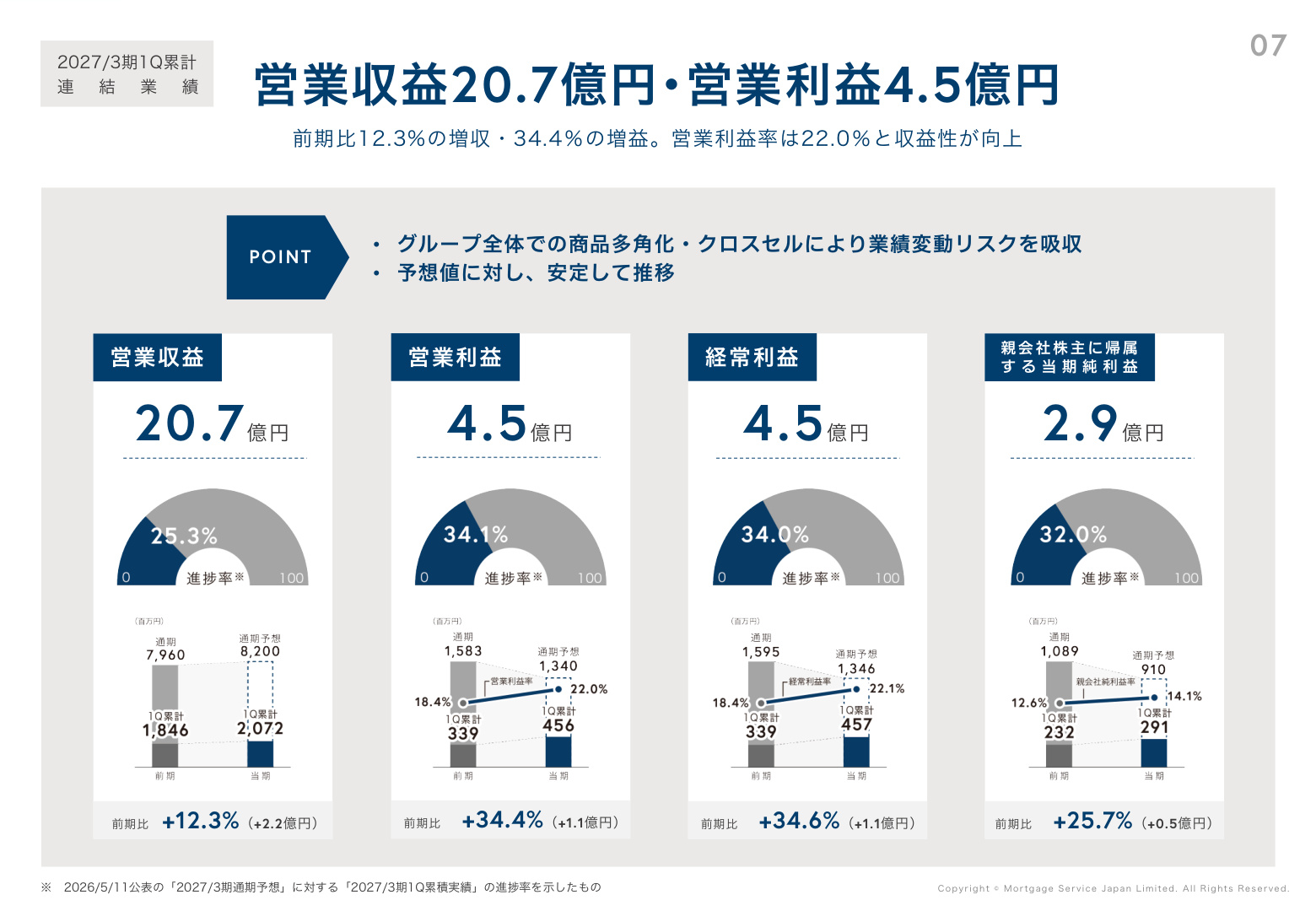
Slide Commentary (Page 7 / Index 6)
The slide above illustrates the key performance indicators for 1Q FY2027 and the progress against full-year forecasts. Notably, the progress toward full-year targets is strong: Operating Revenue has reached 25.3% and Operating Profit has reached 34.1% of the full-year forecast, indicating a very solid start. Furthermore, the Operating Profit Margin improved by 3.6 percentage points, rising from 18.4% in the same period last year to 22.0% , driven largely by group-wide cross-selling expansion and operational efficiencies.
2. Market Environment: Contraction of the New Construction Market and Expansion of the Used Home Market
In the housing market, new home prices continue to surge due to rising construction material and labor costs, leading to a continued slump in new housing starts for both custom-built and subdivision homes . Conversely, the used housing market is clearly expanding as a viable alternative to high-priced new builds. The company group has accurately captured this structural shift, building a portfolio that absorbs the impact of the new construction slump by strengthening guarantee services for used homes and proposing renovation-related loans.
3. Interest Rate Trends and Mortgage Demand: The Recovery of "Flat 35"
With the rise in long-term interest rates in Japan, mortgage rates are generally trending upward. Against a backdrop of rapidly growing expectations for further rate hikes, demand for fixed-rate mortgages (such as Flat 35) remains resilient as borrowers seek to hedge against future interest rate volatility. The company's "MSJ Flat 35" has seen an increase in applications from customers anticipating higher rates, and a recovery in its market share within the Flat 35 segment has been confirmed.
4. Segment Trends (1): Housing Finance Business as a Strong Driver
Looking at performance by segment, the core Housing Finance Business was the primary driver of overall growth .
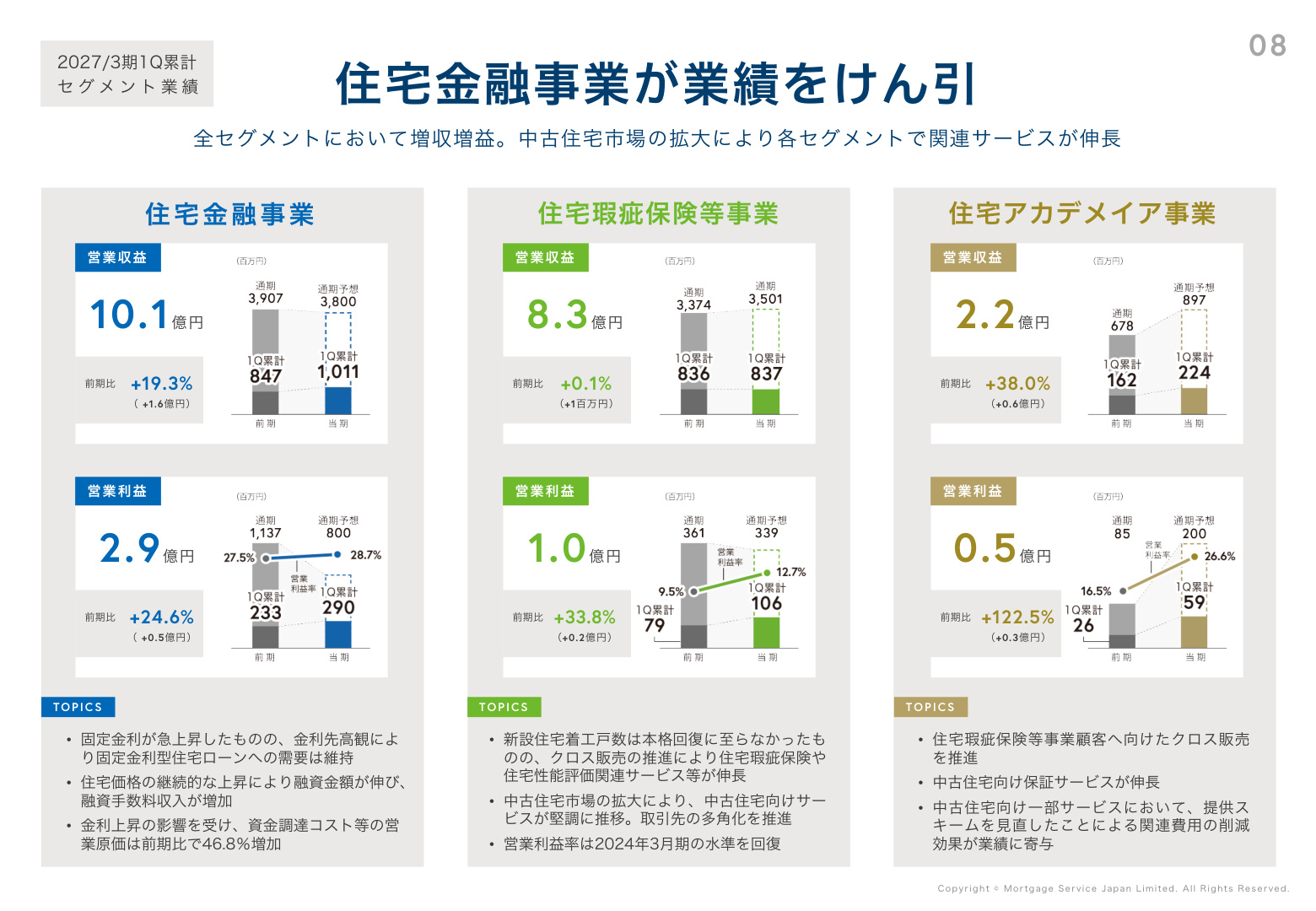
Slide Commentary (Page 8 / Index 7)
The slide above summarizes the revenue and profit growth for each segment:
- Housing Finance Business : Operating Revenue of 1.01 billion yen (+19.3% YoY) , Operating Profit of 0.29 billion yen (+24.6% YoY) . Despite a 46.8% increase in funding costs (cost of sales) due to rising interest rates, the business achieved significant growth in revenue and profit, supported by higher loan amounts per unit due to rising housing prices and an increase in the number of executed loans (loan execution volume +30.0% YoY).
- Housing Defect Insurance Business : Operating Revenue of 0.83 billion yen (+0.1% YoY) , Operating Profit of 0.10 billion yen (+33.8% YoY) . Despite the slump in new housing starts, the operating profit margin improved significantly from 9.5% to 12.7% due to the growth of services for used homes and housing performance evaluations, combined with a review of the cost structure.
- Housing Academeia Business : Operating Revenue of 0.22 billion yen (+38.0% YoY) , Operating Profit of 0.05 billion yen (+122.5% YoY) . This segment showed extremely high growth in both revenue and profit, driven by the promotion of cross-selling and the expansion of guarantee services for used homes.
5. KPI Trends: Strengthening Competitiveness of Core Products
Trends in key KPIs also confirm the improved service delivery capabilities of the group companies:
- MSJ Flat 35 Loan Execution Count : +25.2% YoY (supported by the establishment of product variations such as renovation loans and 50-year mortgages)
- Loan Execution Volume : +30.0% YoY (expanded to 36.69 billion yen)
- Number of Insurance Policies, Guarantees, and Evaluation Reports Issued : +6.1% YoY
- "Suketto Cloud" Registered Properties : +1.5% vs. previous fiscal year-end (increased to 984,000 units)
- Energy-Efficient Design Support Count : +10.8% YoY (achieved higher unit prices against the backdrop of legal revisions and demand for energy-efficient housing)
6. Macro Management Challenges: The "Building Material Shock" and Housing as "Survival Infrastructure"
the company views the rise in energy and material prices (the "building material shock") caused by geopolitical tensions in the Middle East and the weak yen as a serious risk. As real wage growth fails to keep pace with rising housing prices, consumer sentiment is shifting from viewing housing as a "dream or aspiration" to viewing it as "housing as survival infrastructure" that minimizes costs and preserves assets. To address this change, the company is focusing on providing solutions to builders centered on two major themes: "building homes affordably" and "protecting homes and livelihoods."
7. Short-Term Growth Strategy: Platformization through the "Art of Combination"
Beyond providing individual products, the company is pursuing a strategy of offering multiple combined products to builders.
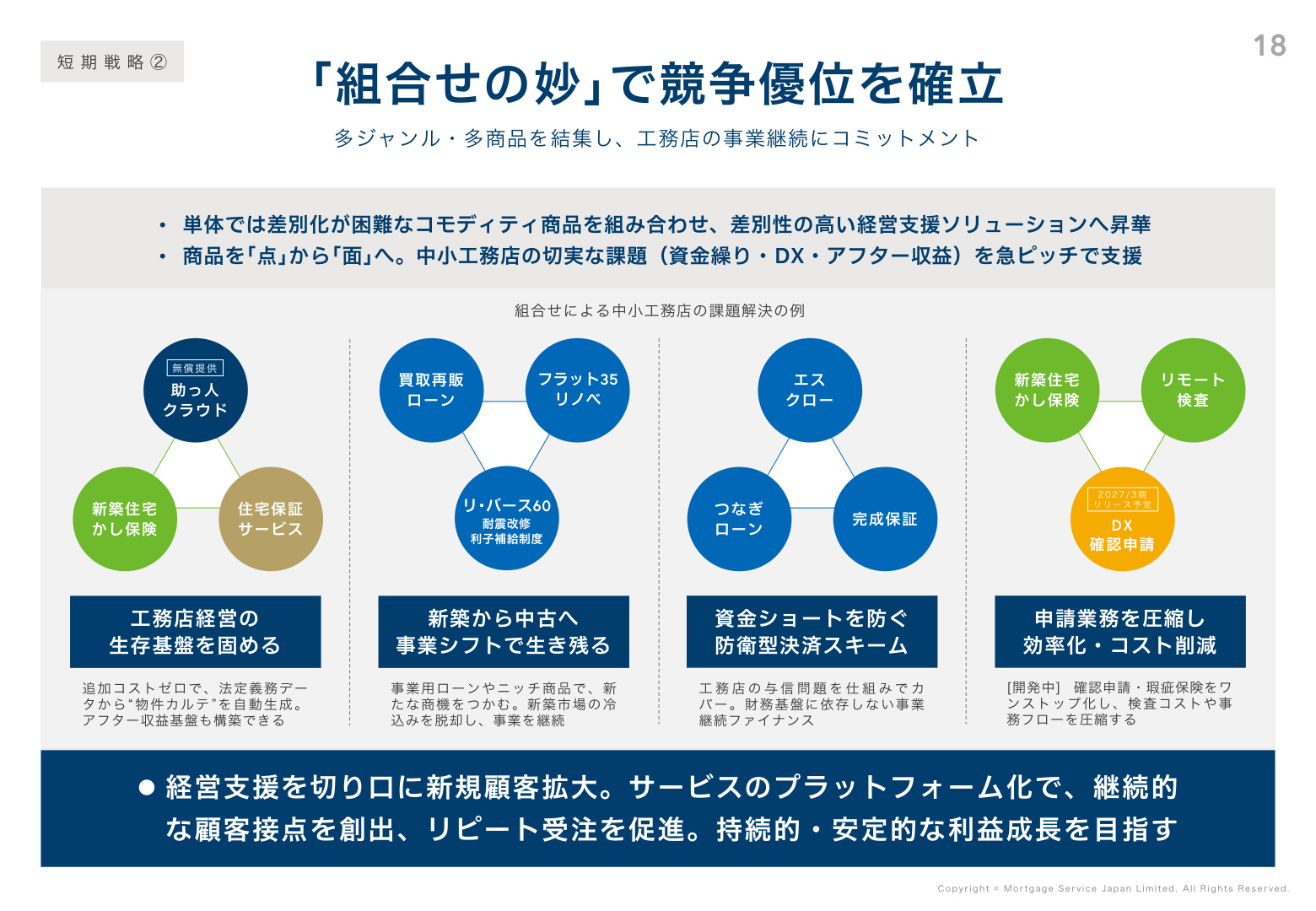
Slide Commentary (Page 18 / Index 17)
This slide illustrates the differentiation strategy through the "art of combination." Instead of providing finance, insurance, and DX tools as isolated "points," the company offers them as a "surface" through combinations such as "Suketto Cloud (free infrastructure) + Housing Defect Insurance + Guarantees" and "Purchase/Resale Loans + Re-Birth 60" or "Bridge Loans + Completion Guarantees." By doing so, the company becomes a "management infrastructure" that solves the cash flow issues, DX delays, and after-sales revenue challenges faced by small and medium-sized builders, creating a mechanism that prevents customer churn and generates repeat orders and recurring stock revenue.
8. Long-Term Growth Strategy: Value Chain Transformation (Separating Materials and Labor)
As a medium-to-long-term innovation, the company is proposing an "Open-Book Material and Labor Separation Ordering Platform." By combining BIM (3D design and estimation data) and BaaS (financial functions such as payments and segregated remittances) , the company aims to reduce intermediate margins in the traditionally multi-layered and complex building material distribution chain (Manufacturer → Trading Company → Wholesaler → Retailer → Builder). This model aims to rationalize the industry, allowing consumers to "buy homes more cheaply" while enabling small and medium-sized builders to "compress construction costs and improve cash flow."
9. Used Home C2C Trading Platform and "Ground DX Map"
Looking further ahead, the company aims to build a highly transparent C2C trading platform for used homes . Through the Housing DX Promotion Association, it has developed and provided a "Ground DX Map" that integrates over 1.3 million pieces of ground data across industry boundaries. Furthermore, benchmarking the MLS (Multiple Listing Service) prevalent in the U.S., the company is working to build a trading environment that eliminates information asymmetry between buyers and sellers by using AI to aggregate and disclose property information, housing history, and ground/disaster data.
10. Full-Year Earnings Forecast and Shareholder Return Policy
- FY2027 Full-Year Forecast : The company plans for Operating Revenue of 8.20 billion yen (+3.0% YoY) , Operating Profit of 1.34 billion yen (-15.4% YoY) , and Net Income of 0.91 billion yen (-16.4% YoY) . While Q1 progress is strong, the company maintains a cautious stance in its full-year outlook, taking into account the uncertainty of the external environment and trends in interest rates and materials.
- Shareholder Returns (Dividends) : The company plans an annual dividend of 30.00 yen per share (ordinary dividend of 30.00 yen) , maintaining the same level as the previous fiscal year. The projected dividend payout ratio is 48.4% , reflecting a policy of balancing stable dividend payments with the securing of investment funds for future growth.
Correction (September 29, 2026): Corrected the specified amounts, rates or reporting periods against the original company disclosure; the verified changes are recorded in the correction ledger. Source
This content is not intended as investment advice or a recommendation. Any opinions expressed are solely the personal views of each article.