


Kawasaki Heavy Industries Q1 FY2026 Earnings Deep Dive: Record-High Q1 Profits Lead to Upward Revision of Full-Year Business Profit to ¥180 Billion

StockClub
Published: Aug 07, 2026, 11:42 AM
Sentiment Analysis
Kawasaki Heavy Industries (KHI) delivered an exceptionally strong start to FY2026, with Q1 results marking record highs for a first quarter across all revenue and profit metrics. Growth in sales volume within the Aerospace Systems and Precision Machinery & Robot segments, combined with U.S. IEEPA tariff refunds and the ongoing depreciation of the yen, provided a powerful boost to performance. Consequently, the company has revised its full-year consolidated earnings forecast upward, raising the business profit target to ¥180 billion (an increase of ¥10 billion from the previous forecast) .
This report provides a detailed analysis of the company's overall performance, segment trends, factor analysis, financial position, and full-year outlook, based on the 10 key topics from the earnings presentation.
1. Q1 FY2026 Consolidated Highlights
For Q1 FY2026, consolidated orders received reached ¥525.7 billion (+¥79.3 billion YoY) , revenue totaled ¥543.5 billion (+¥55.1 billion YoY) , and business profit hit ¥35.7 billion (+¥15.2 billion YoY, a 74.1% increase) . Profit before income taxes reached ¥34.7 billion (+¥17.9 billion YoY) , and quarterly profit attributable to owners of the parent reached ¥15.6 billion (+¥11.4 billion YoY) , with all major indicators setting new Q1 records.
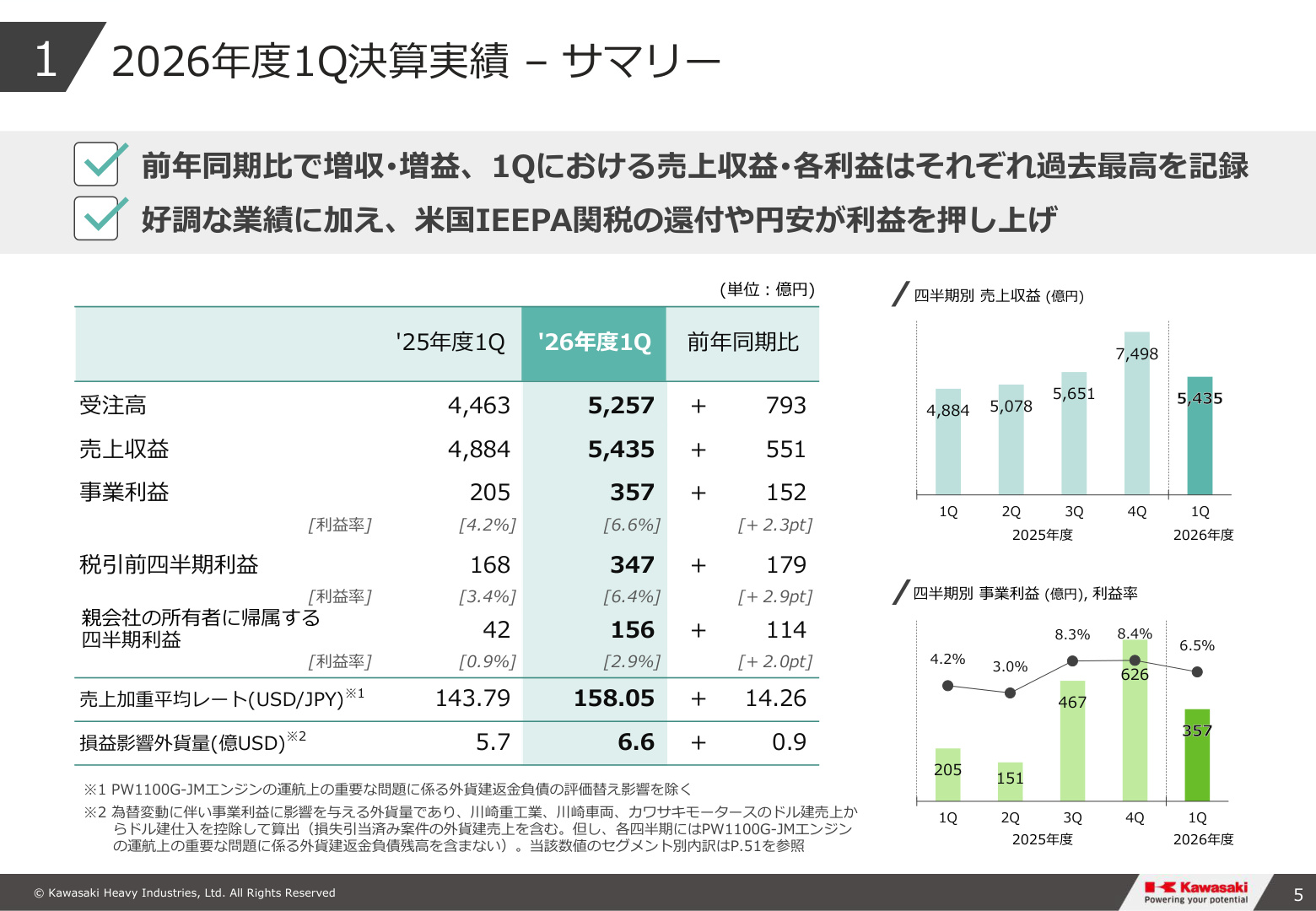
[Significance and Data Context of the Above Slide]
The slide above () is critical as it clearly illustrates the historic start to the current fiscal year. The quarterly trend graph on the right shows that the business profit margin rose by 2.4 percentage points , from 4.2% (¥20.5 billion) in Q1 FY2025 to 6.6% (¥35.7 billion) in Q1 FY2026. This improvement is driven by a combination of factors: growth in core business volumes in Aerospace and Precision Machinery & Robots; a ¥14.26 yen depreciation (sales-weighted average rate of ¥158.05/USD vs. ¥143.79/USD in the same period last year) which boosted foreign-currency-denominated sales; and the one-time tailwind from the U.S. IEEPA (International Emergency Economic Powers Act) tariff refunds.
2. Breakdown of Q1 Business Profit Variance
The primary factors behind the ¥15.2 billion YoY increase in Q1 business profit are as follows:
- Foreign Exchange Impact (+¥9.4 billion) : The weaker yen significantly expanded the converted value of foreign-currency-denominated sales and profits.
- Sales Mix and Other Factors (+¥9.1 billion) : Driven by proactive price optimization (+¥9.0 billion) and U.S. IEEPA tariff refunds (+¥8.0 billion) . These more than offset negative factors such as inflation and unfavorable product mix (-¥7.9 billion).
- Sales Volume (+¥2.7 billion) : Contributed by increased sales volumes in the Aerospace Systems and Precision Machinery & Robot segments.
- Share of Profit of Investments Accounted for Using the Equity Method (+¥1.3 billion) : Contributed by improved performance of affiliated companies.
- U.S. Tariff-Related Cost Increases (-¥3.7 billion) and Higher SG&A Expenses (-¥3.6 billion) : While increased expenses associated with business expansion and customs-related costs acted as headwinds, they were insufficient to derail the overall profit growth trend.
3. Upward Revision of FY2026 Full-Year Earnings Forecast
Following the strong Q1 progress, the full-year earnings forecast has been revised. While maintaining the exchange rate assumptions of ¥150/USD and ¥180/EUR , the company raised its full-year business profit forecast by ¥10 billion to ¥180 billion (up ¥34.9 billion, or 24.1% YoY) . High targets have also been set for revenue (¥2.56 trillion) and the business profit margin (7.0%).
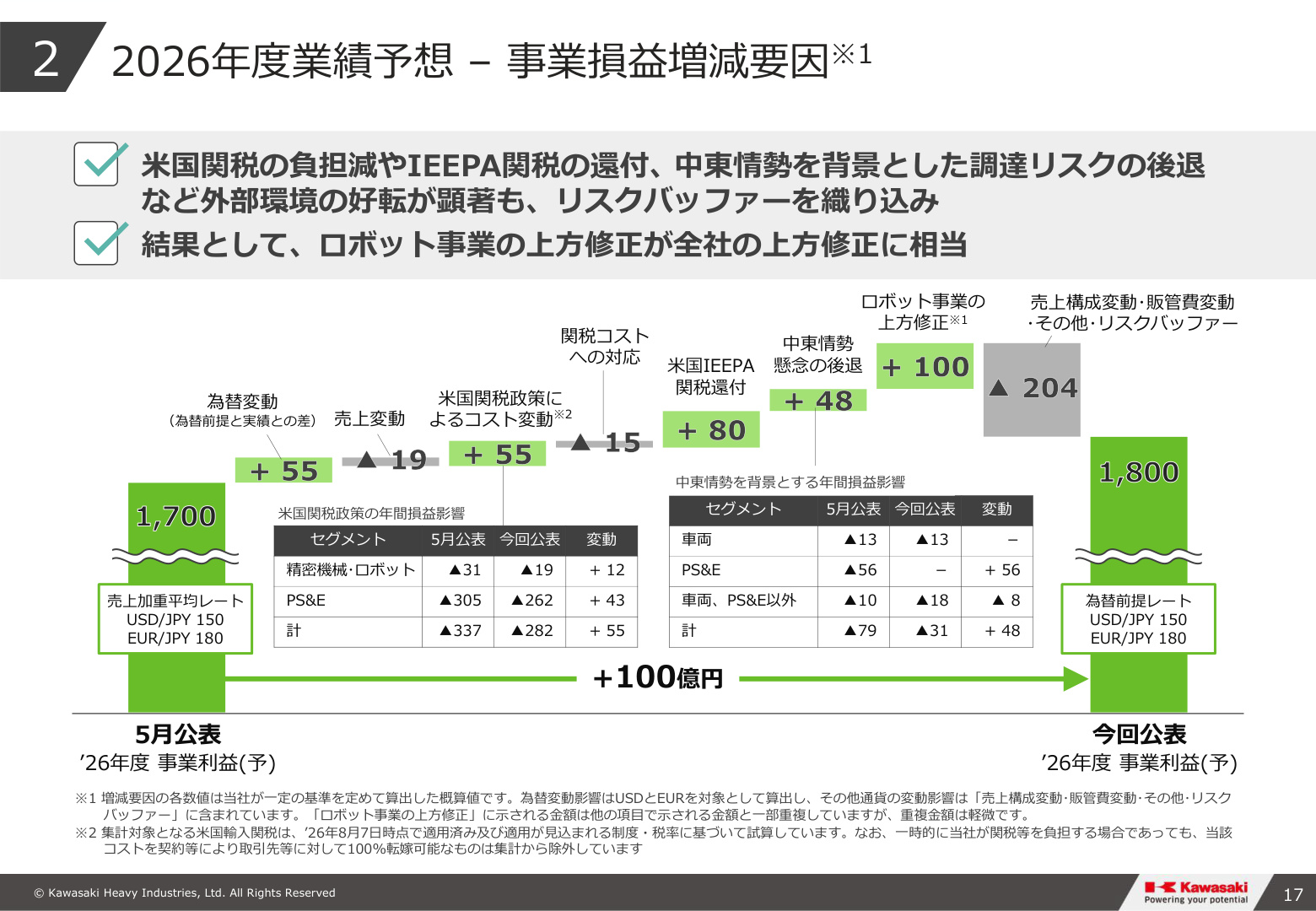
[Significance and Data Context of the Above Slide]
The waterfall chart in the slide above () is essential for understanding how management determined the upward revision. Key drivers for the increase from the May forecast include upward revisions in the Precision Machinery & Robot business (+¥10.0 billion) , reduced cost burdens from U.S. tariff policies (+¥5.5 billion) , confirmation of U.S. IEEPA tariff refunds (+¥8.0 billion) , and mitigated impacts from easing Middle East tensions (+¥4.8 billion) . Notably, the company has incorporated a substantial risk buffer of -¥20.4 billion (covering sales mix, SG&A, and other factors) to account for future uncertainties. This revision, made after fully accounting for risks, demonstrates high transparency and a disciplined planning approach.
4. Full-Year Outlook by Segment
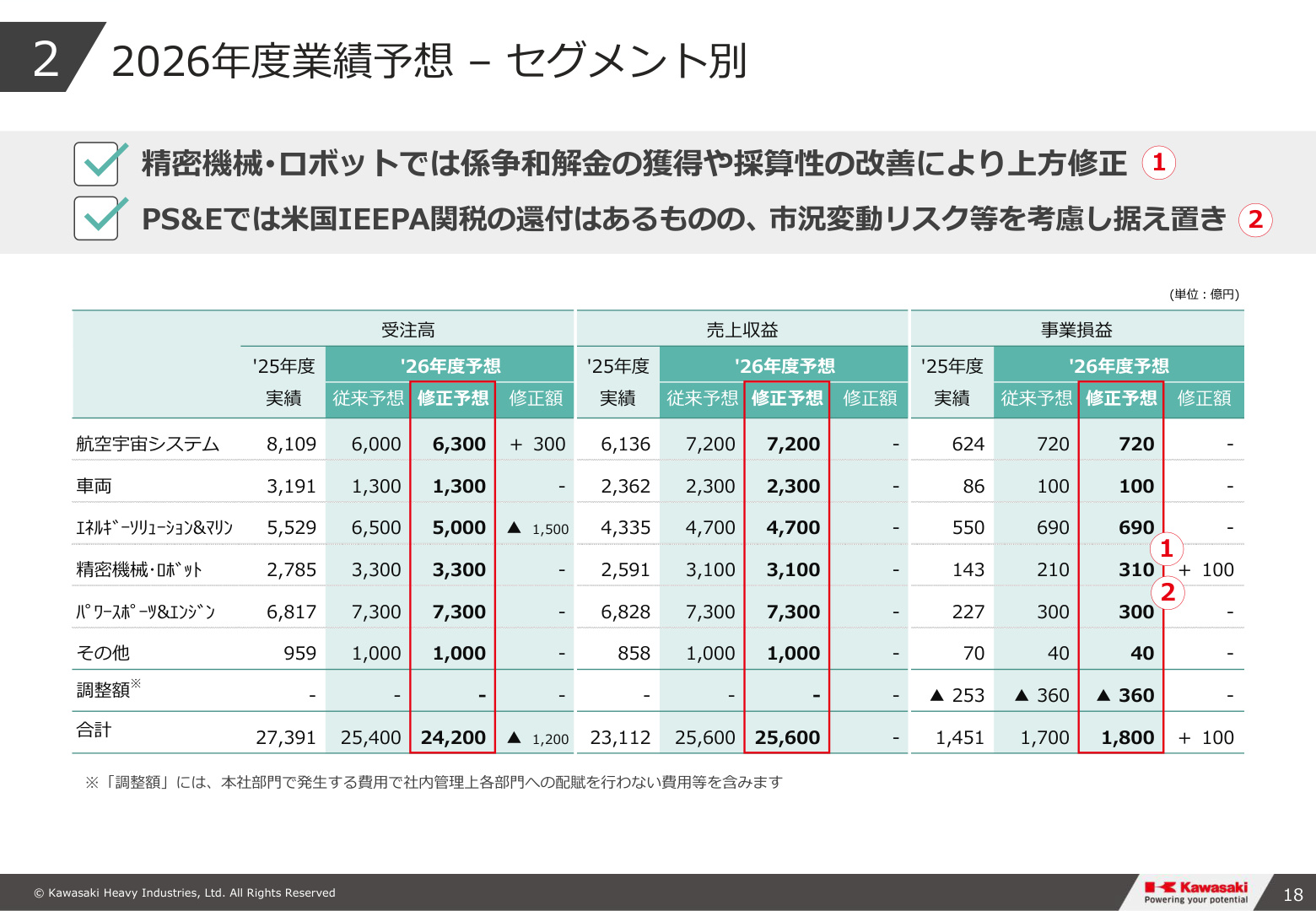
[Significance and Data Context of the Above Slide]
The table in the slide above () provides a comprehensive overview of the original and revised forecasts for "Orders Received," "Revenue," and "Business Profit" across all six segments. It clearly shows which segments are driving the ¥10 billion upward revision in consolidated business profit. While Precision Machinery & Robots is the primary profit driver, other major segments (Aerospace, Rolling Stock, PS&E, etc.) maintain conservative figures, reflecting a strategic approach to risk management.
5. Detailed Segment Trends
① Precision Machinery & Robot (Significant Profit Growth; Full-Year Upward Revision)
- Q1 Results : Revenue of ¥69.5 billion (+¥12.6 billion YoY), business profit of ¥5.2 billion (+¥2.9 billion YoY). Driven by recovering demand for hydraulic equipment and improved profitability in the robot business.
- Full-Year Outlook : Business profit forecast revised from ¥21.0 billion to ¥31.0 billion (+¥10.0 billion) , reflecting the acquisition of litigation settlement funds and fundamental profitability improvements through structural reforms and cost reductions.
② Power Sports & Engine (PS&E) (Dramatic Q1 Profit Growth; Full-Year Forecast Maintained Conservatively)
- Q1 Results : Revenue of ¥170.7 billion (+¥10.4 billion YoY), business profit of ¥19.2 billion (+¥11.1 billion YoY) . Benefited from fixed cost reductions and U.S. IEEPA tariff refunds.
- Full-Year Outlook : Business profit forecast maintained at ¥30.0 billion. Despite strong Q1 performance, the company remains cautious due to uncertainties regarding high interest rates in North America, demand trends, and the competitive environment.
③ Aerospace Systems (Solid Demand; Orders Received Upward Revision)
- Q1 Results : Revenue of ¥137.6 billion (+¥36.0 billion YoY), business profit of ¥1.6 billion (+¥0.8 billion YoY). Increased deliveries for the Ministry of Defense and Boeing commercial aircraft components.
- Full-Year Outlook : Orders received forecast raised to ¥630 billion (+¥30 billion) due to expected large-scale orders from the Ministry of Defense. While the full-year business profit forecast remains at ¥72 billion, the long-term growth foundation is extremely solid due to the recovery in commercial passenger demand.
④ Rolling Stock (Q1 Profit Decline; Full-Year Target Maintained)
- Q1 Results : Revenue of ¥60.1 billion (+¥4.8 billion YoY), business profit of ¥0.4 billion (-¥3.1 billion YoY). Despite revenue growth from North American projects, profit declined due to sales mix changes and Q1-specific expense concentration (e.g., revision of indirect cost allocation).
- Full-Year Outlook : Business profit target of ¥10.0 billion maintained. Production and delivery of subway cars for the New York City Transit Authority (R211 project) are progressing smoothly (430 Option 1 cars delivered), with a recovery planned for the full year.
⑤ Energy Solution & Marine (ES&M) (Stable High Profitability)
- Q1 Results : Revenue of ¥86.9 billion (-¥9.7 billion YoY), business profit of ¥12.0 billion (+¥2.3 billion YoY) . Despite lower revenue, profit increased due to the gain on the sale of shares in a subsidiary (EarthTechnica Co., Ltd.) and increased equity-method investment income.
- Full-Year Outlook : While the orders received forecast was lowered to ¥500 billion (-¥150 billion) to reflect potential timing shifts in large plant projects, the business profit forecast is maintained at ¥69 billion , reflecting a commitment to high profitability.
6. Financial Position and Cash Flow Analysis
- Financial Position : Total assets at the end of Q1 FY2026 were ¥3.2655 trillion (-¥59 billion from the end of the previous fiscal year) . While inventories increased to ¥863.8 billion (+¥41.6 billion) due to business expansion and FX impacts, trade receivables were collected steadily. Interest-bearing debt reached ¥671.3 billion (+¥65.1 billion), but the Net D/E Ratio remains at a healthy 66.1% .
- Cash Flow : Q1 operating cash flow was -¥28.4 billion (-¥20.6 billion YoY) , and free cash flow (FCF) was -¥47.9 billion (-¥2.1 billion YoY) . This was due to temporary working capital expansion from inventory buildup in the Aerospace business and a decrease in contract liabilities. Given the company's business seasonality, where cash outflows are common in Q1, the company expects full-year free cash flow to turn positive .
7. Future Growth Story and Summary
Kawasaki Heavy Industries' performance is driven by three powerful engines: "structural expansion of the defense business," "recovery in commercial aircraft demand," and "profitability improvement in the robot business." In the defense sector, increased budget allocations following Japan's defense reinforcement policy provide a direct tailwind, while in the commercial and industrial sectors, the shift toward high-value-added products and cost structure reforms are progressing.
Management remains cautious and realistic, setting a ¥20 billion risk buffer to address external risks (interest rate/FX fluctuations, Middle East tensions, logistics risks, etc.). The record-high Q1 profits and the upward revision of the full-year forecast serve as proof of the company's strengthened business portfolio and improved underlying profitability.
This content is not intended as investment advice or a recommendation. Any opinions expressed are solely the personal views of each article.