


BALMUDA H1 FY2026 Earnings Analysis: Structural Profitability Reforms and a H2-Weighted Growth Scenario

StockClub
Published: Aug 07, 2026, 11:40 AM
Sentiment Analysis

BALMUDA Inc.'s financial results for the first half of the fiscal year ending December 2026 (January–June) showed a decline in revenue year-on-year ; however, the company successfully narrowed its operating loss through improved gross profit margins and reduced selling, general, and administrative (SG&A) expenses. While cautious consumer sentiment toward home appliances in the domestic market remains a headwind, the company is steadily advancing structural reforms to improve profitability, supported by an increasing overseas revenue ratio and contributions from new product lines.
This report provides a multi-faceted analysis of the company's performance, regional and product-specific factors, the progress of cost structure reforms, and the management strategy for the second half of the year to achieve full-year targets, based on the disclosed financial materials.
1. H1 FY2026 Consolidated Financial Highlights
In the first half, consolidated revenue was 4,365 million yen (a decrease of 15.8% or 822 million yen year-on-year) . Despite the top-line decline, the company narrowed its losses through higher gross margins and rigorous cost control.
- Revenue : 4,365 million yen (H1 previous year: 5,187 million yen, YoY change: -822 million yen)
- Gross Profit : 1,525 million yen (H1 previous year: 1,630 million yen, YoY change: -104 million yen)
- Gross Profit Margin : 35.0% (H1 previous year: 31.4%, YoY change: +3.5 pt )
- SG&A Expenses : 1,839 million yen (H1 previous year: 2,014 million yen, YoY change: -174 million yen )
- Operating Profit : -314 million yen (H1 previous year: -384 million yen, YoY change: +70 million yen improvement )
- Ordinary Profit : -326 million yen (H1 previous year: -395 million yen, YoY change: +69 million yen improvement )
- Net Income Attributable to Owners of Parent : -331 million yen (H1 previous year: -397 million yen, YoY change: +65 million yen improvement )
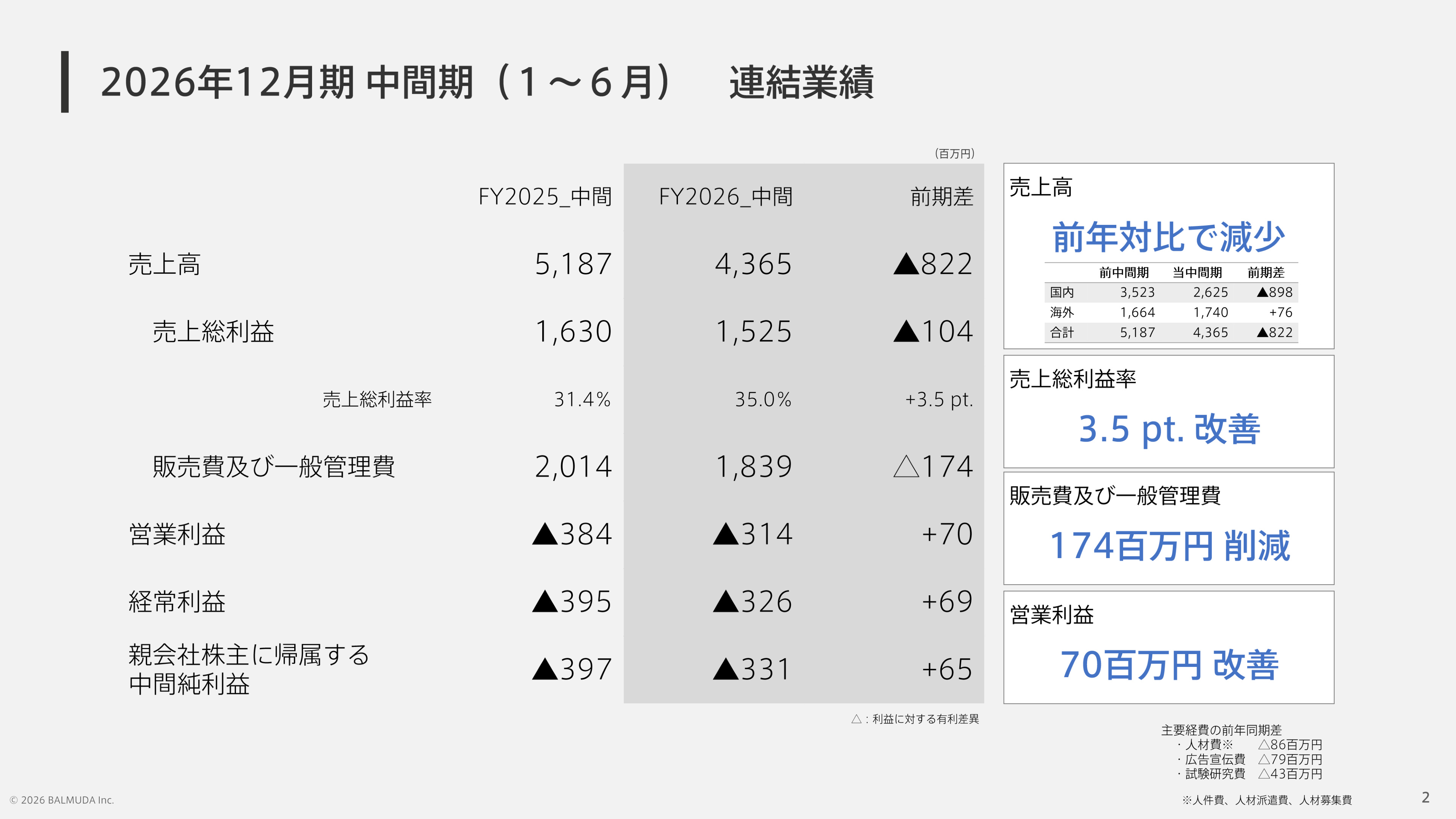
The slide above summarizes the consolidated profit and loss for the first half. Despite the revenue decline, the structure of the 70 million yen improvement in operating profit is clear: the gross profit margin rose significantly by 3.5 points from 31.4% to 35.0% , and SG&A expenses were reduced by 174 million yen (including -86 million yen in personnel costs, -79 million yen in advertising, and -43 million yen in R&D). The gross profit margin has now improved year-on-year for five consecutive quarters , indicating that profitability measures, such as curbing excessive discounting and reviewing costs, are yielding steady results.
2. Domestic Market Challenges and Growth in Overseas and New Products
Looking at regional trends, the decline in the domestic market was the primary factor dragging down overall performance.
Domestic Revenue Challenges and Countermeasures
Domestic revenue was 2,625 million yen (a decrease of 898 million yen year-on-year) . The factors are as follows:
- Impact of Inflation : Consumers have become more cautious in their purchasing behavior for durable consumer goods, including home appliances.
- Decline in Kitchen Category : Reduced sales power in home appliance retail channels, which serve as venues for comparison. Additionally, the perceived lack of novelty in the market due to the company's long-selling product strategy has had an impact.
- Rise of Air Conditioning Demand and Similar Products : The emergence of low-priced similar products from competitors and the diversification of retail shelves.
In response, the company plans to maintain relationships with loyal customers through its own online store and direct brand shops (such as the Aoyama store), while promoting rapid model changes and renewals of flagship products and speedy new product launches utilizing ODM development methods .
Overseas Revenue and Global Brand Expansion
Overseas revenue increased to 1,740 million yen (+76 million yen year-on-year) , with the overseas revenue ratio rising to approximately 40% (+8 points year-on-year) .
- South Korea : 801 million yen (-153 million yen year-on-year). Despite struggles in air conditioning-related products, it maintained a certain scale.
- North America : 433 million yen ( +175 million yen year-on-year ), showing significant growth driven by the expansion of "Other" product launches.
- Other Regions : 505 million yen ( +54 million yen year-on-year ), maintaining steady performance.
In particular, the following new products launched in 2026 are driving the global strategy:
- Sailing Lantern : A collaboration model with LoveFrom, led by former Apple Chief Design Officer Jony Ive. Overseas sales account for approximately 70% of its revenue, successfully capturing a new customer segment beyond traditional home appliances , including world-renowned designers, CEOs, art collectors, and high-net-worth individuals.
- The Clock : A product designed for sleep and focus. At the direct-managed Aoyama store, the tax-free sales ratio (inbound ratio) has reached approximately 60% , demonstrating the spread of global awareness through international travelers. A new "Night Routine" feature was added via software update in July, further enhancing the experiential value.
3. Progress Against Full-Year Forecasts and the H2-Weighted Background
The company has set a full-year revenue target for 2026 of 10.5 billion yen (approx. 9.5 billion yen for home appliances, approx. 1 billion yen for new product groups) .
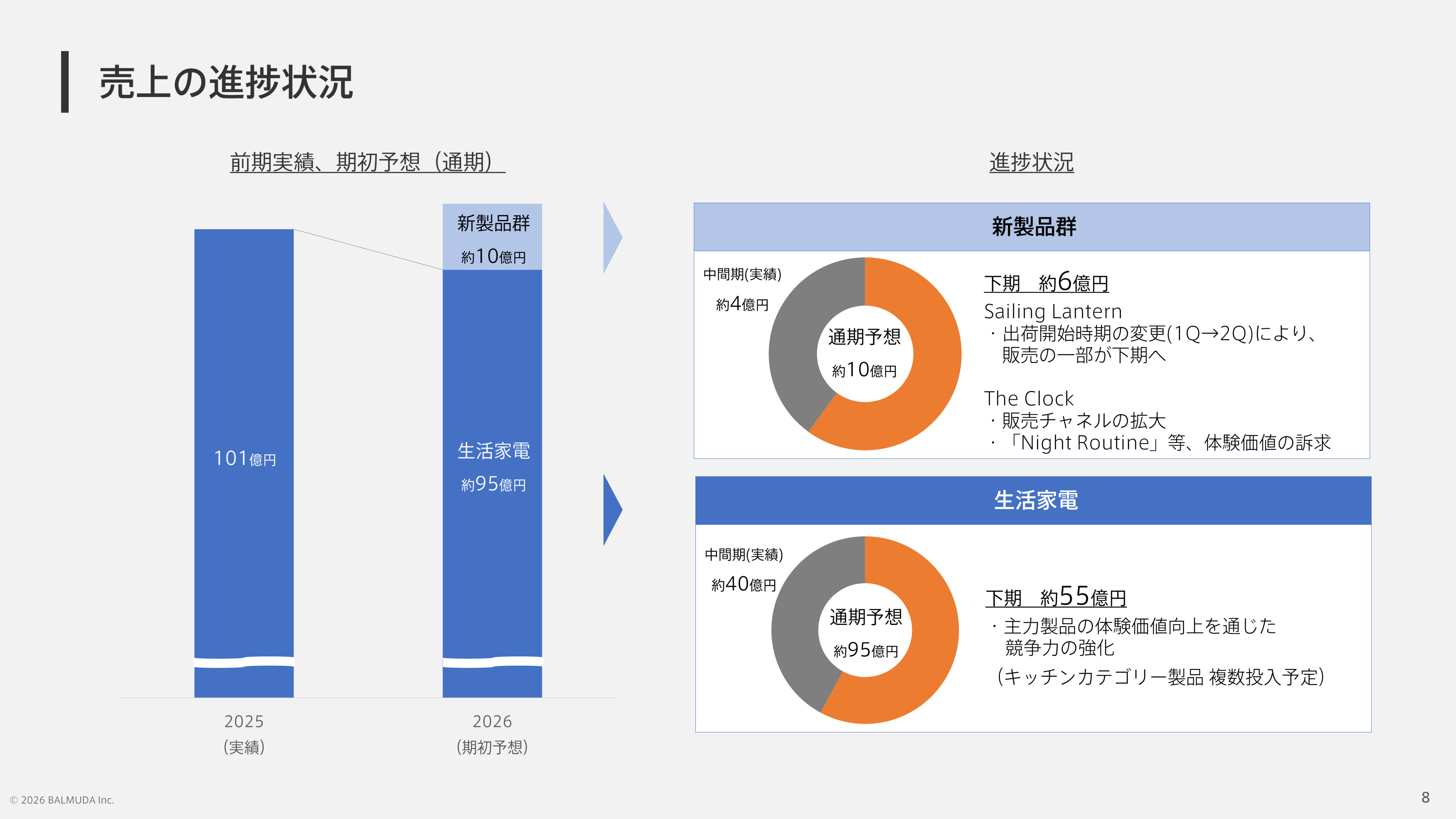
This slide visualizes the progress of H1 results against the full-year forecast. H1 revenue was approximately 4.4 billion yen, representing a progress rate of about 42%. However, the company has planned for a H2-weighted performance, anticipating approximately 6.1 billion yen in revenue in the second half .
The main reasons for this H2 weighting are:
- Shift in New Product Shipping Timing : The shipping start date for the "Sailing Lantern" was moved from Q1 to Q2, shifting most sales to the second half (H2 target: approx. 600 million yen).
- Expansion of Sales Channels : Expanding the deployment of "The Clock" to flagship home appliance retail stores and major e-commerce platforms.
- Launch of Multiple New Home Appliance Products : The company plans to launch several new products, primarily in the kitchen category, and enhance the experiential value of major products in the second half (H2 target: approx. 5.5 billion yen).
4. Quarterly Operating Profit Trends and the H2 Profitability Scenario
Looking at quarterly performance, the bottoming out of operating profit is becoming evident.
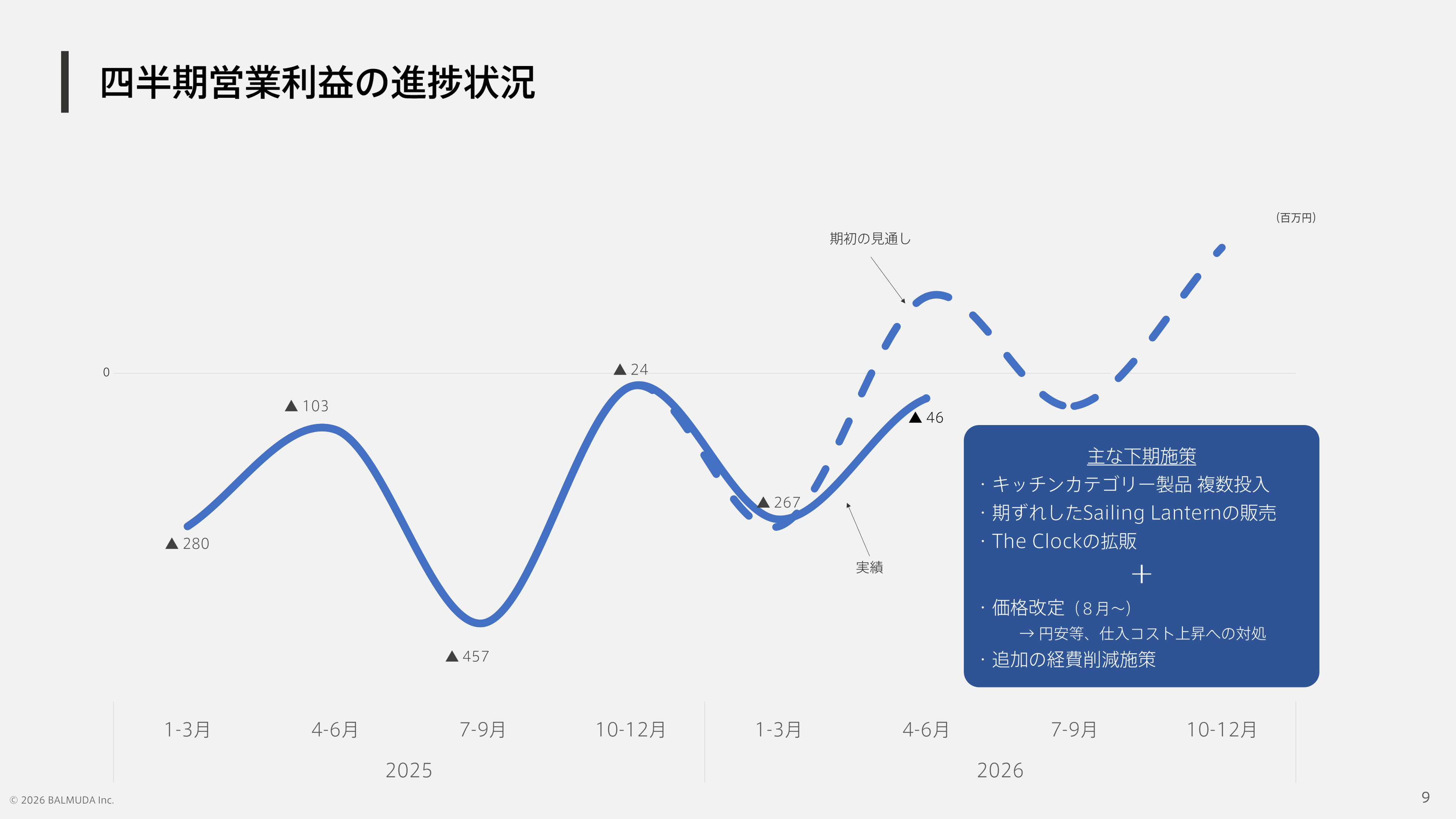
As the graph in the slide above shows, the operating loss in Q1 2026 (Jan–Mar) was 267 million yen, but in Q2 (Apr–Jun), the loss narrowed significantly to 46 million yen (an improvement of 57 million yen from the 103 million yen loss in the same period last year) .
For the second half (July–December), the company lists the following "Key H2 Measures" to rapidly recover and achieve profitability:
- Recovery of the top line through the launch of multiple kitchen category products
- Full-scale sales of the delayed Sailing Lantern and expansion of sales channels for The Clock
- Price revisions (increases) from August onwards : Measures to address the weak yen and rising procurement costs
- Additional cost-cutting measures : Further streamlining of fixed costs
5. Progress in Financial Structure Reform and Cost Optimization
Progress in balance sheet and fixed cost structure reforms is a key factor supporting the improvement in profitability.
- SG&A Control : SG&A expenses decreased from 1,062 million yen in Q2 2025 to 947 million yen in Q2 2026. Reductions were achieved year-on-year across personnel, advertising, and R&D expenses.
- Optimization of Headcount : The number of employees (including temporary and part-time staff) was optimized from 145 in Q1 2024 to 108 at the end of Q2 2026.
- Reduction of Inventory : Inventory peaked at 2,623 million yen in Q1 2024 and has been reduced to 911 million yen as of the end of Q2 2026, maintaining a healthy level.
- Balance Sheet (B/S) : Total assets are 4,001 million yen, net assets are 2,483 million yen, and the equity ratio remains high at approximately 62% , maintaining strong financial health.
6. Management Policy and Outlook for H2 2026 and Beyond
The company has set the following three pillars for its management policy from H2 2026 onwards:
- Maximization of Revenue
- Rapid renewal and model changes for flagship products in the kitchen and air conditioning categories
- Utilization of ODM (Original Design Manufacturing) methods to shorten development periods and enable speedy new product launches
- Appropriate price revisions for certain products to address rising costs
- Minimization of SG&A Expenses
- Execution of further, more in-depth cost structure reforms beyond simple organizational streamlining
- Creation of New Customers
- Expansion of brand experience through the establishment of new product categories and service groups (e.g., cultivating new customer segments through LoveFrom collaborations and The Clock)
Summary
Although BALMUDA's H1 FY2026 results showed a revenue decline due to sluggish domestic consumption, it was a period of strengthened profitability through improved gross profit margins (35.0%) and reduced SG&A expenses . In the second half, the company aims to achieve its full-year targets through the full-scale rollout of new products, the renewal of flagship home appliances, price revisions, and rapid product launches using ODM methods. The execution of these measures and the resulting performance will be closely watched.
This content is not intended as investment advice or a recommendation. Any opinions expressed are solely the personal views of each article.