


Toshiba Tec FY2026 Q1 Earnings Deep Dive: Drivers of the Sharp Turnaround and Progress in Growth Strategy

StockClub
Published: Aug 07, 2026, 11:39 AM
Sentiment Analysis

Toshiba Tec FY2026 Q1 Earnings Deep Dive Report
Toshiba Tec Corporation’s financial results for the first quarter (Q1) of fiscal year 2026 demonstrate a powerful recovery from the same period last year. Driven by the mitigation of U.S. tariff impacts, successful price revisions, and a recovery in customer investment within the overseas retail sector, the company significantly outperformed year-ago figures across all revenue and profit metrics. This report provides a comprehensive analysis of Q1 performance highlights, factors behind the operating profit variance, segment-specific performance, full-year outlook, and concrete initiatives in growth businesses.
1. FY2026 Q1 Performance Highlights and Overview
In the first quarter of FY2026, the company achieved year-on-year growth in both revenue and profit across all profit stages.
- Revenue : ¥148.9 billion (up ¥27.5 billion / +22.7% YoY)
- Operating Profit : ¥4.4 billion (a dramatic improvement of ¥6.5 billion from a ¥2.1 billion loss in the same period last year)
- Ordinary Profit : ¥4.3 billion (up ¥7.8 billion from a ¥3.5 billion loss in the same period last year)
- Net Profit Attributable to Owners of Parent : ¥2.0 billion (up ¥7.0 billion from a ¥5.0 billion loss in the same period last year)
Beyond the easing of U.S. tariff impacts—which acted as a major headwind last year—the company has achieved a dramatic V-shaped recovery, steadily reaping the benefits of structural reforms such as production site optimization and price revisions.
2. Operating Profit Variance Analysis: The Path to Profitability
The ¥6.5 billion V-shaped recovery in operating profit from a ¥2.1 billion loss to a ¥4.4 billion profit is attributed to both the recovery of the external environment and internal business efforts.
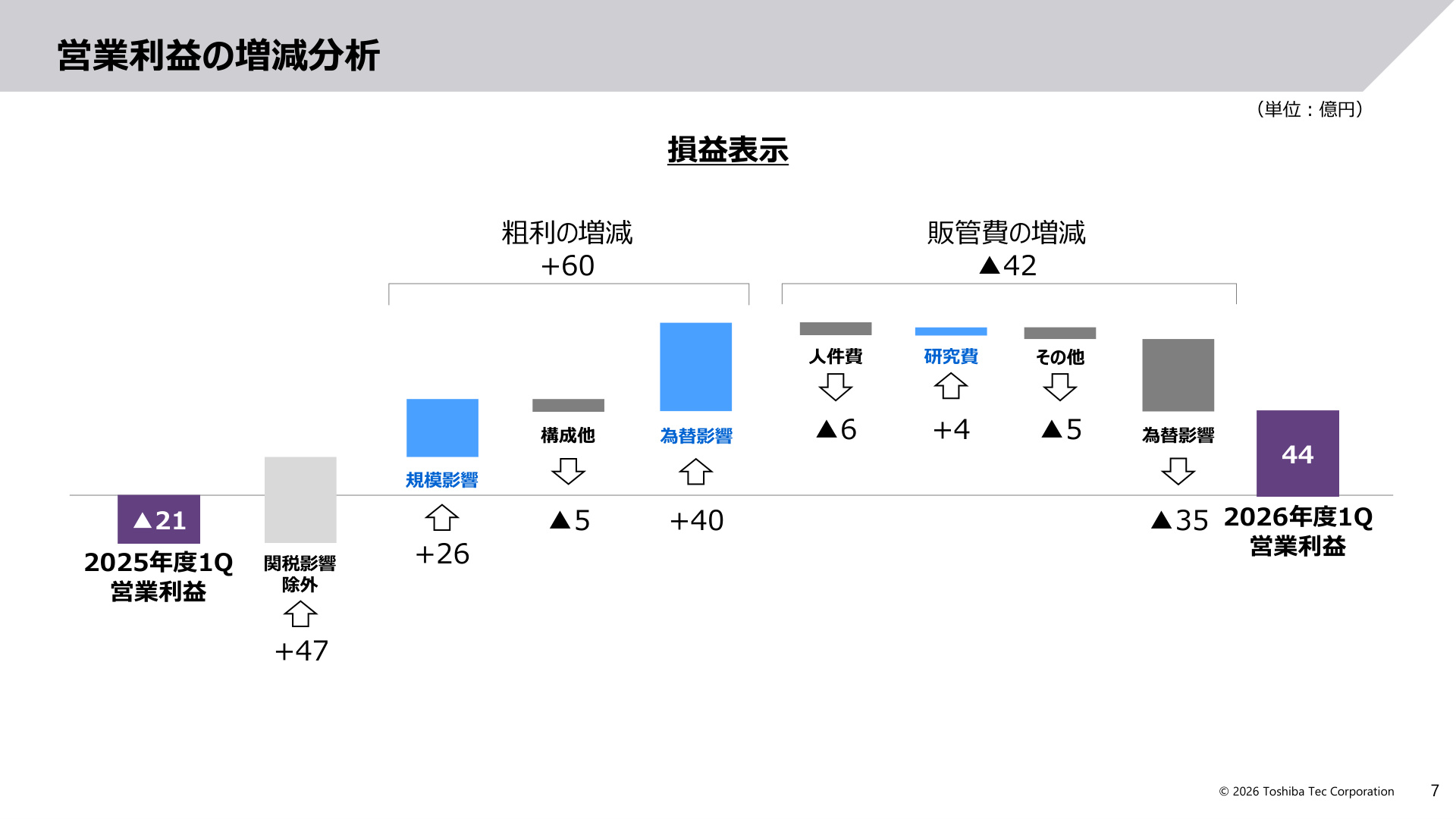
The slide above is a key chart visually explaining the factors behind the operating profit fluctuation from Q1 FY2025 to Q1 FY2026. The main takeaways from this analysis are as follows:
- Elimination of Tariff Impacts (+¥4.7 billion) : The removal of tariff-related costs, which were a significant burden in the previous year, effectively raised the starting baseline.
- Scale Effects from Revenue Growth (+¥2.6 billion) : Gross profit accumulated significantly alongside the recovery in shipments of retail and workplace equipment both domestically and internationally.
- Foreign Exchange Impact on Gross Profit (+¥4.0 billion) : The depreciation of the yen (US$ at ¥159.89, EUR at ¥185.50) contributed to an increase in translated gross profit.
- Increase in SG&A Expenses (-¥4.2 billion) : While SG&A expenses rose due to FX impacts (-¥3.5 billion) and higher labor costs (-¥0.6 billion), this was more than absorbed by the increase in gross profit (+¥6.0 billion).
The fundamental structure of this rapid return to profitability lies in overcoming the temporary external disruption of tariffs, combined with a recovery in core sales and cost optimization.
3. Segment Performance Analysis
(1) Retail Solutions Business
- Revenue : ¥92.3 billion (up ¥21.6 billion YoY)
- Operating Profit : ¥500 million (up ¥2.7 billion from a ¥2.2 billion loss YoY)
- Domestic Operating Profit : ¥1.5 billion (vs. ¥1.4 billion YoY)
- Overseas Operating Profit : -¥1.0 billion (vs. -¥3.6 billion YoY)
In the domestic market, the company secured ¥1.5 billion in operating profit backed by a stable, high market share. Notably, in overseas markets, customer capital investment—which had stagnated due to U.S. tariff issues and economic slowdown—recovered, narrowing the operating loss from ¥3.6 billion in the same period last year to ¥1.0 billion . By region, revenue in Japan reached ¥49.5 billion (vs. ¥43.0 billion YoY), while the Americas saw significant growth, reaching ¥28.7 billion (vs. ¥17.0 billion YoY).
(2) Workplace Solutions Business
- Revenue : ¥58.3 billion (up ¥6.3 billion YoY)
- Operating Profit : ¥3.9 billion (up ¥3.8 billion from ¥100 million YoY; 6.7% operating margin)
The workplace business, centered on Multi-Function Peripherals (MFPs), showed exceptional profit improvement. In addition to the successful implementation of price revisions, increased sales of Document Management Services (DMS) and cloud-integrated solutions improved gross margins. Revenue by region—Americas ¥27.0 billion, Europe ¥17.7 billion, and others ¥13.6 billion—surpassed year-ago results across all major regions.
4. FY2026 Full-Year Outlook and Growth Scenario
Following the strong Q1 performance, the company has revised its full-year consolidated revenue forecast upward.
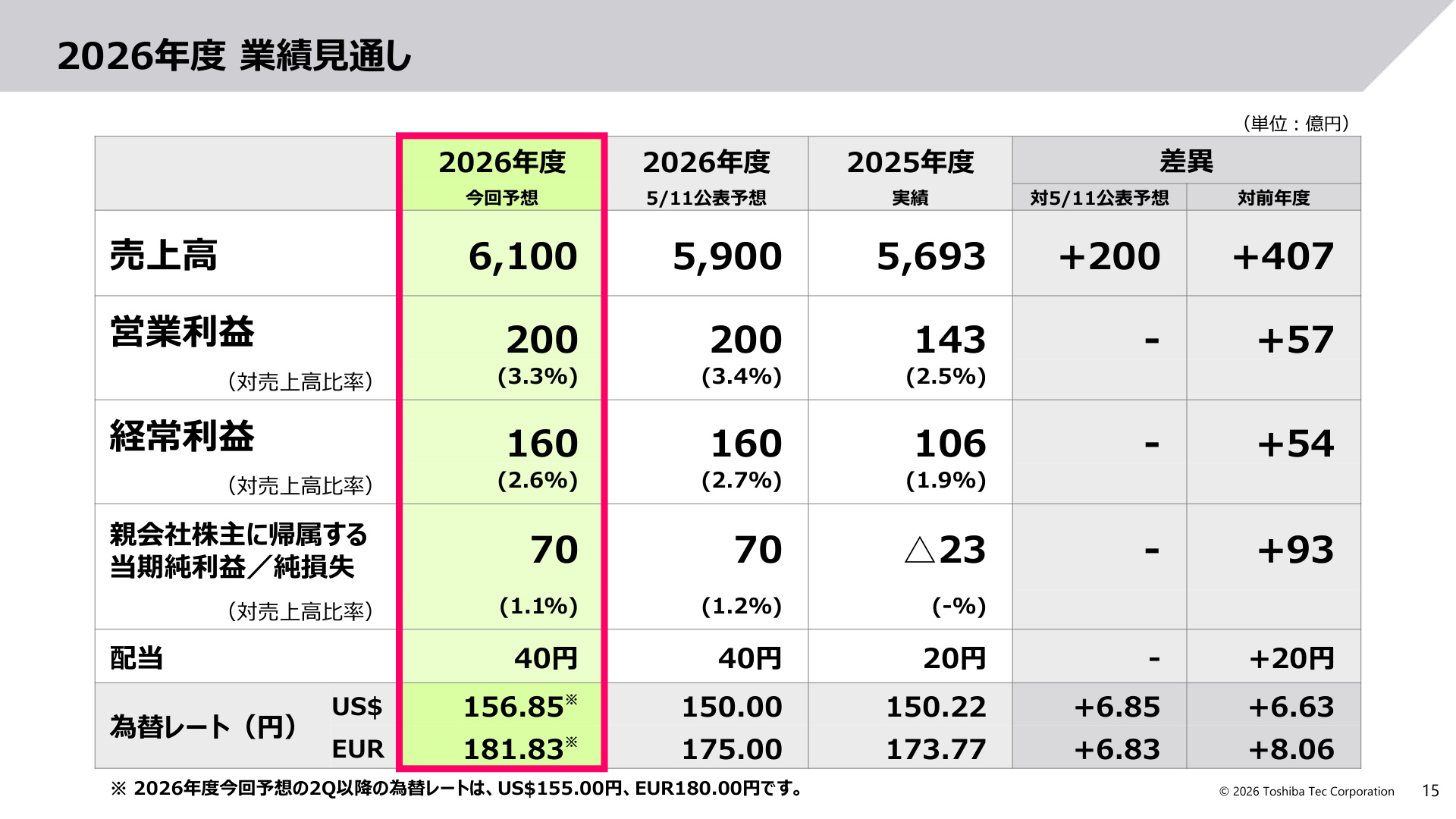
As shown in the outlook slide above, the revenue forecast has been raised by ¥20 billion from the initial projection of ¥590 billion to ¥610 billion (up ¥40.7 billion YoY). Meanwhile, profit forecasts remain unchanged.
- Revenue Forecast : ¥610 billion (up ¥20 billion from previous announcement)
- Operating Profit Forecast : ¥20 billion (unchanged / up ¥5.7 billion YoY)
- Ordinary Profit Forecast : ¥16 billion (unchanged / up ¥5.4 billion YoY)
- Net Profit Forecast : ¥7 billion (unchanged / up ¥9.3 billion YoY)
- Annual Dividend Forecast : ¥40 (planned increase of ¥20 from the previous year's ¥20)
The decision to maintain profit forecasts despite the revenue upgrade reflects a cautious stance toward rising raw material costs (semiconductors, crude oil, etc.) and global demand uncertainty, even as the company anticipates potential profit boosts from U.S. tariff refunds. The assumed exchange rates for Q2 and beyond are set at a conservative ¥155.00 per USD and ¥180.00 per EUR .
5. Business Topics Driving Mid- to Long-Term Growth
Toshiba Tec is aggressively shifting from a hardware-centric sales model to a high-value-added business model centered on software and DX solutions.
(1) Domestic Retail: Store DX Combining Security and Labor Savings
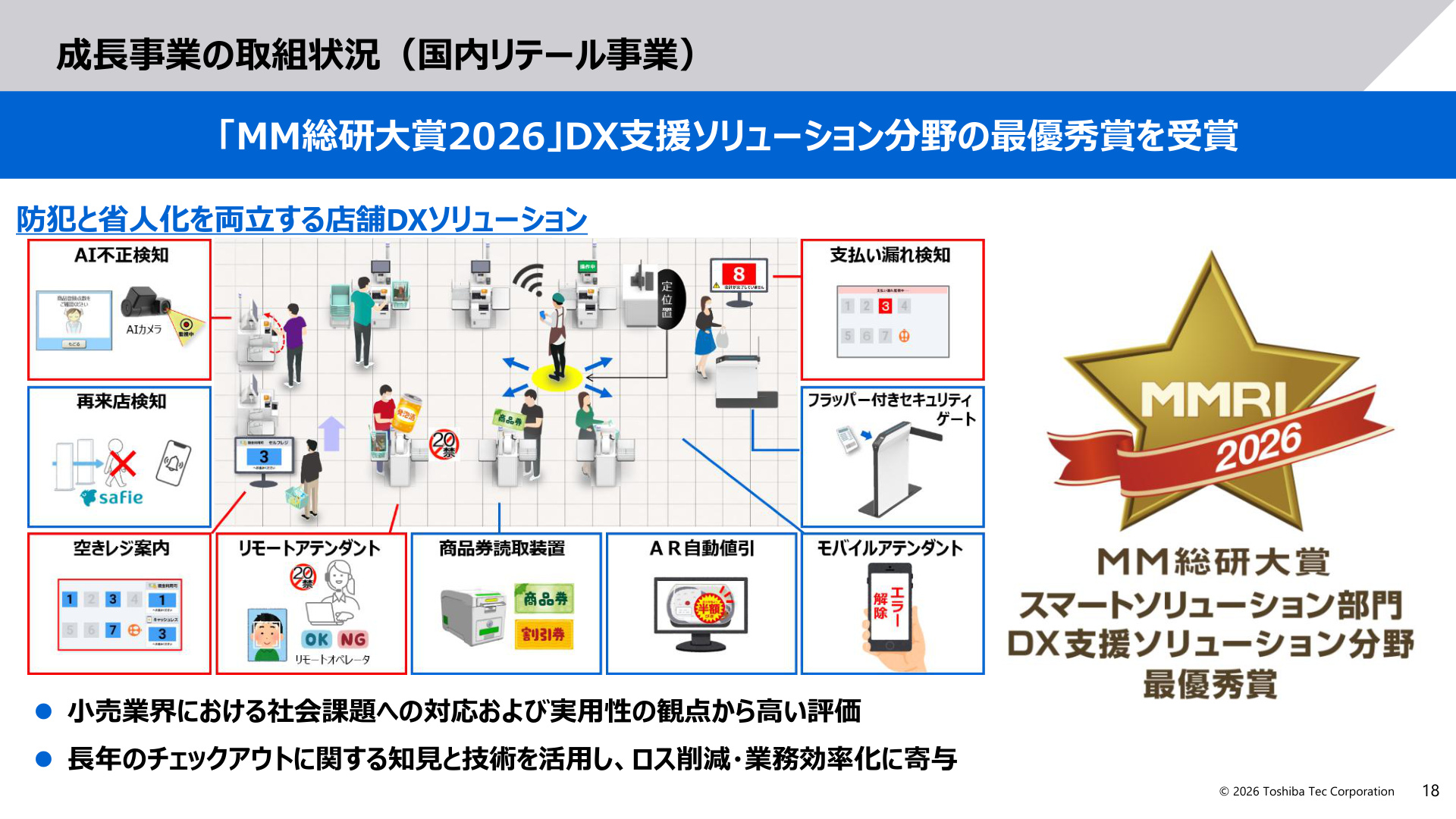
This slide highlights the high external recognition of the company's store DX solutions. In the domestic retail business, Toshiba Tec’s "Store DX Solution for Security and Labor Savings" won the Grand Prize in the DX Support Solution category at the "MM Research Institute Awards 2026."
To address labor shortages and store security challenges in the retail industry, the company provides a comprehensive suite of cutting-edge solutions:
- AI Fraud Detection / Payment Omission Detection : Automatically detects scanning errors or theft at self-checkout counters using AI cameras.
- Remote Attendant / Mobile Attendant : Supports customer service and error resolution remotely or via staff smartphones.
- AR Automatic Discounting / Voucher Reading Devices : Reduces checkout labor costs through automation.
These solutions simultaneously achieve loss reduction and operational efficiency, serving as a powerful differentiator for the company’s domestic retail business.
(2) Overseas Retail: Doubling the Global Platform "ELERA"
In the overseas retail market, the deployment of the microservices-based commerce platform "ELERA" is accelerating. In Q1 FY2026, ELERA revenue grew by approximately two-fold year-on-year on a local currency basis. Professional service orders are also strong, confirming the successful transformation from a hardware provider to a retail tech platform operator.
(3) Workplace: Progress in Solution Shift
In the workplace business, the company is moving away from reliance on standalone MFP sales and expanding into high-value-added areas such as DMS (Document Management) , cloud-integrated solutions , and Auto-ID solutions . Q1 solution revenue grew by over 15% year-on-year on a local currency basis, contributing significantly to the segment's improved profitability (6.7% operating margin).
6. Summary and Future Focus Points
Toshiba Tec’s Q1 FY2026 results mark a quarter of dramatic recovery , achieved by shedding the tariff burdens of the previous year and realizing the fruits of price revisions and structural reforms.
Key points to watch moving forward include:
- Cost Trends and Profit Margins : The extent to which the company can offset rising costs for semiconductors, raw materials, and logistics through further price revisions and production efficiency.
- Scaling Growth Businesses : Maintaining the pace of overseas "ELERA" deployment and the progress in expanding the number of stores adopting domestic store DX solutions.
- Achievement of Full-Year Targets : The pace of progress toward the ¥20 billion operating profit target from Q2 onwards and the timing of positive factors such as tariff refunds.
The primary focus for this fiscal year will be whether the company can establish a sustainable growth trajectory, armed with its solid customer base and advanced DX solution suite.
This content is not intended as investment advice or a recommendation. Any opinions expressed are solely the personal views of each article.