


Brother Industries Q1 FY2026 Earnings Analysis: Record-Breaking Q1 Performance and Upward Revision of Full-Year Forecasts

StockClub
Published: Aug 07, 2026, 11:37 AM
Sentiment Analysis
Brother Industries, Ltd. delivered an exceptionally strong performance in the first quarter of fiscal year 2026 (April–June 2025), with both revenue and various profit metrics reaching record highs for a first quarter . Driven by the recovery of its core Printing & Solutions (P&S) and Machinery businesses, combined with the effects of new consolidations and one-time profit-boosting factors, the company has revised its full-year earnings forecast upward.
This report extracts 10 key topics from the disclosed financial materials to provide a detailed overview of the company's performance and growth narrative.
1. Q1 FY2026 Consolidated Financial Highlights
In the first quarter, consolidated results showed significant growth in both revenue and profit: revenue reached ¥253.3 billion (+23.0% YoY) , business segment profit was ¥54.7 billion (+195.4% YoY) , operating profit stood at ¥54.6 billion (+250.1% YoY) , and profit attributable to owners of the parent company was ¥49.9 billion (+325.8% YoY) .
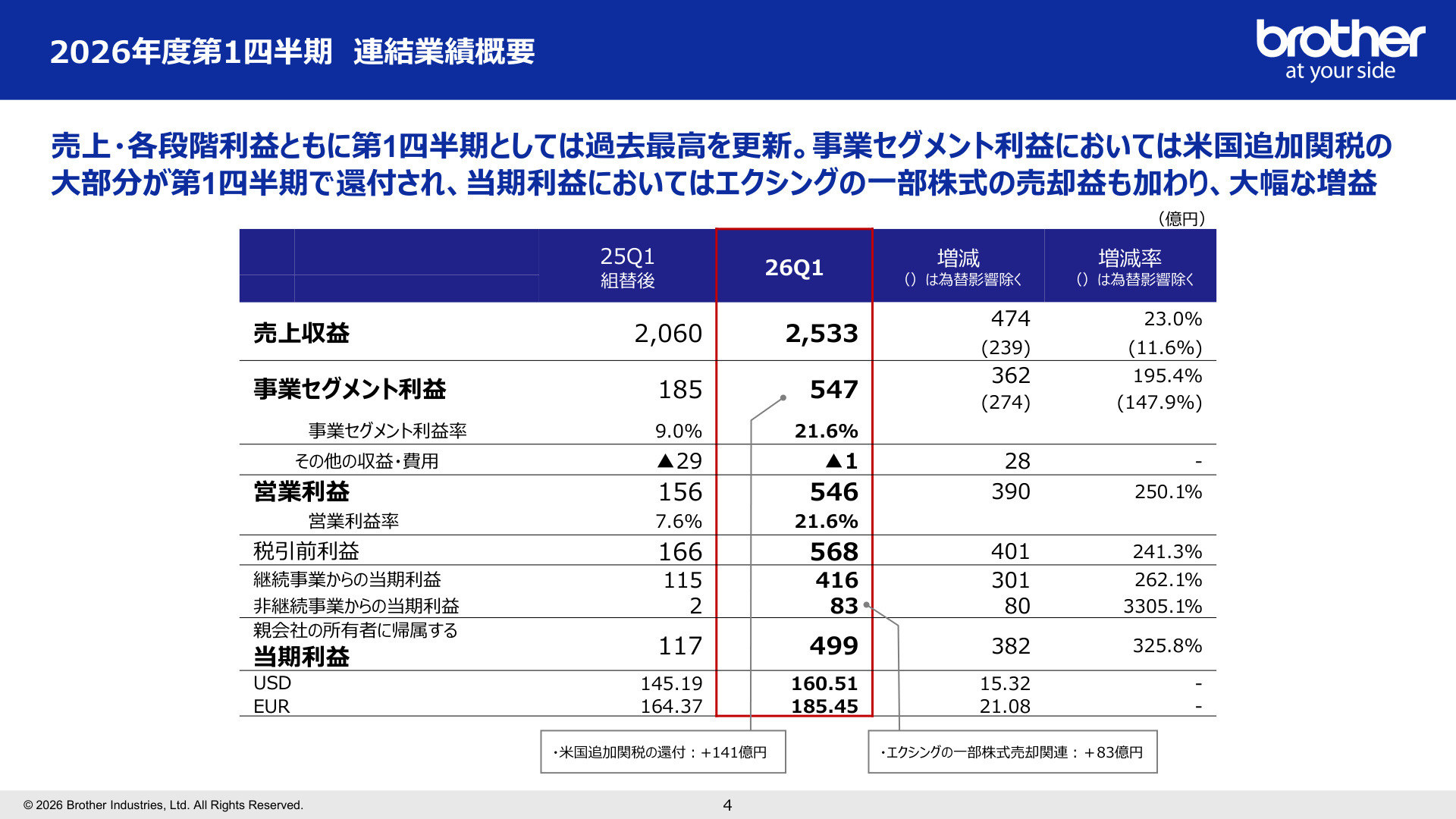
The slide above (PAGE_3) outlines the consolidated performance summary for Q1 FY2026. The most significant takeaway is not merely the three-to-fourfold surge in profit compared to the same period last year, but the underlying structure of these results.
The profit surge includes one-time factors such as a refund of U.S. additional tariffs (IEEPA tariffs, etc.) (+¥14.1 billion) and a gain on the partial sale of Xing shares due to business restructuring (+¥8.3 billion) . However, even on an underlying basis , excluding these special factors and foreign exchange effects (the depreciation of the yen against the USD and Euro), revenue increased by 11.6% YoY and business segment profit grew by 147.9% YoY , confirming a substantial strengthening of the company's core earning power.
2. Factors Behind Changes in Revenue and Business Segment Profit
The increase in revenue (+¥47.4 billion YoY) was driven by a positive foreign exchange impact of +¥23.5 billion , as well as organic growth across nearly all segments: +¥11.0 billion in the P&S business , +¥6.1 billion in the Industrial Printing (IP) business , and +¥7.3 billion in the Machinery business .
The increase in business segment profit (+¥36.2 billion YoY) was driven by a combination of the following factors:
- U.S. Tariff Refund : +¥14.1 billion profit boost
- Foreign Exchange Impact : +¥8.8 billion positive factor
- Sales Volume/Product Mix Changes : +¥13.7 billion (+¥7.7 billion in P&S, +¥3.3 billion in Machinery, +¥2.6 billion in IP)
- Pricing Adjustments : +¥7.3 billion (e.g., price revisions in the P&S business)
Although there were some increases in sales promotion expenses (-¥2.6 billion) and manufacturing costs (-¥2.4 billion), these were significantly outweighed by revenue growth, effective price pass-throughs, and the tariff refund.
3. Upward Revision of Full-Year Earnings Forecast
Following the strong performance in the first quarter, Brother Industries has revised its consolidated earnings forecast for the full fiscal year 2026 upward.
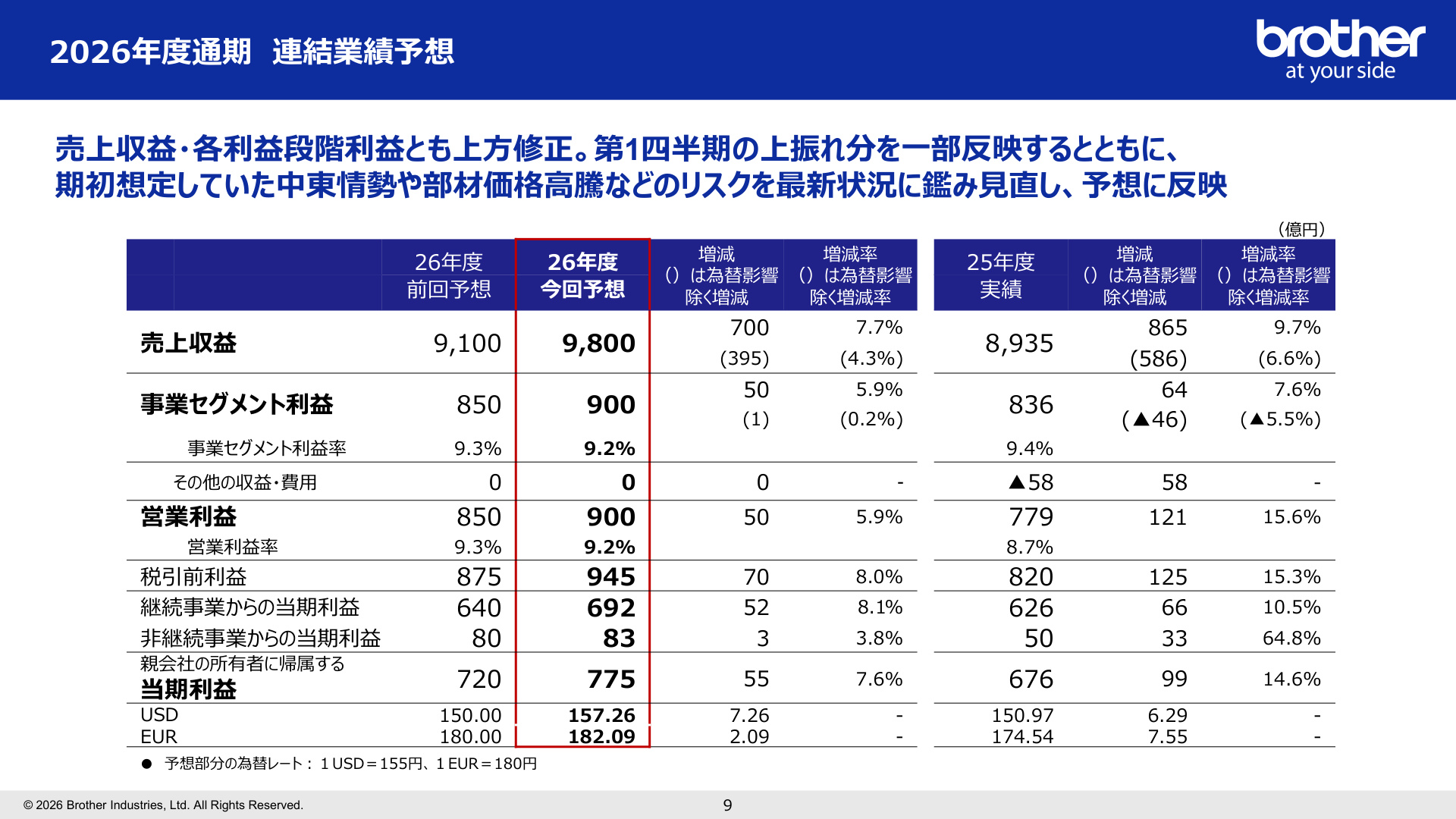
The slide above (PAGE_8) lists the revised full-year forecast for FY2026. Revenue has been raised by ¥70.0 billion to ¥980.0 billion (+9.7% YoY) , business segment profit by ¥5.0 billion to ¥90.0 billion (+7.6% YoY) , operating profit by ¥5.0 billion to ¥90.0 billion (+15.6% YoY) , and net profit by ¥5.5 billion to ¥77.5 billion (+14.6% YoY) .
This upward revision reflects the tariff refund and the outperformance of core businesses in Q1, while also accounting for a careful assessment of various risks and cost increases anticipated for the second half of the year.
4. Re-evaluation of Forecast Assumptions and Risk Factors
In revising the full-year forecast, the company has updated its assumptions regarding external uncertainties:
- Foreign Exchange Assumptions : The USD assumption has been revised from 150 JPY to 155 JPY (the 180 JPY assumption for the Euro remains unchanged).
- Rising Material Costs : Prices for materials such as memory and resins have surged significantly . Combined with increased logistics costs, this is expected to be a -¥29.0 billion profit-reducing factor (worsened from the previous forecast of -¥25.0 billion).
- Geopolitical Risks and Supply Chain : Risks related to production and shipment restrictions due to the situation in the Middle East, which were a concern at the start of the year, remain limited at this time and have contributed to increased sales volume in the P&S business.
- Tariffs and Risk Buffer : While incorporating a +¥19.0 billion positive impact from the IEEPA tariff refund, the company has set aside a -¥7.0 billion overall risk buffer to prepare for potential further increases in material costs and production constraints in industrial equipment.
5. Performance of the Printing & Solutions (P&S) Business
In the core P&S business, Q1 revenue was ¥159.7 billion (+20.7% YoY) , and business segment profit was ¥43.4 billion (+185.5% YoY) .
In the communications and printing equipment category, sales of laser printer hardware and consumables remained strong, particularly in the Americas and Europe. On a local currency basis, laser hardware sales grew 6% YoY , while consumables grew 14% . In the inkjet segment, consumables also grew by 14% , maintaining a high consumables ratio of 58% for the printer business as a whole, serving as a stable revenue source. The full-year revenue forecast for this segment has been revised upward by ¥66.0 billion to ¥606.9 billion .
6. Industrial Printing (IP) Business and Consolidation of MUTOH
The IP business achieved significant growth, with Q1 revenue of ¥41.7 billion (+29.2% YoY) and business segment profit of ¥3.2 billion (+239.2% YoY) .
In addition to the stable performance of the Domino coding and marking business in Europe and the Americas, the consolidation of MUTOH (MUTOH Industries Ltd.) as a subsidiary starting in FY2026 and the integration of its results into the industrial printer category contributed significantly to the increase in revenue and profit. The full-year revenue forecast has been revised upward to ¥168.3 billion , reflecting the expansion of the business scale in the industrial printing sector.
7. Recovery of the Machinery Business and Industrial Equipment Orders
The Machinery business saw a sharp recovery, with Q1 revenue of ¥27.4 billion (+51.6% YoY) and business segment profit of ¥4.4 billion (+241.1% YoY) .
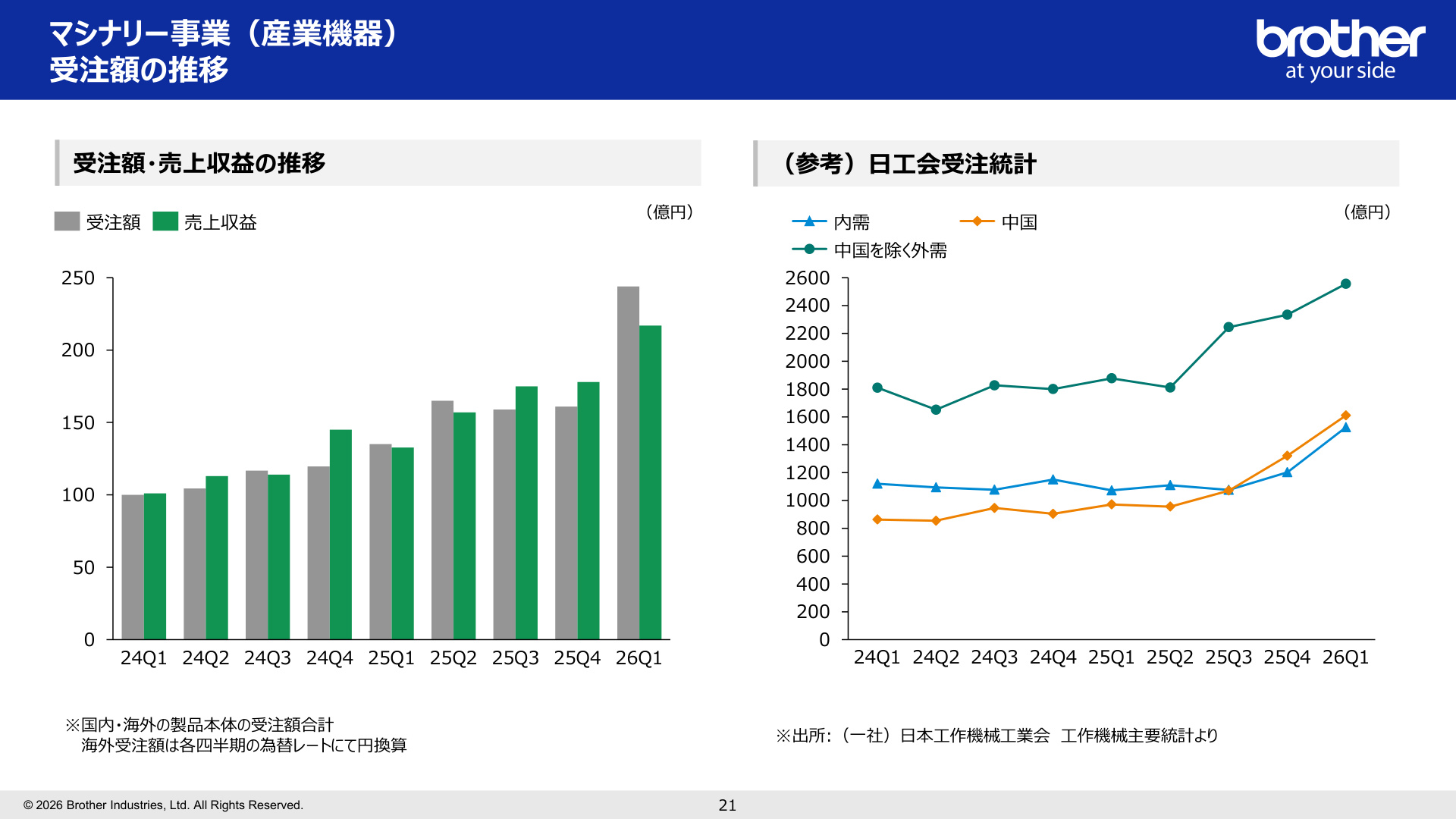
The slide above (PAGE_20) compares the quarterly order intake and revenue of industrial equipment (machine tools), the core of the Machinery business, with the order statistics from the Japan Machine Tool Builders' Association (JMTBA).
The importance of this slide lies in its indication that the company's performance has clearly entered a bottoming-out and recovery phase in the industrial equipment market cycle. After declining in FY2024, order intake began a steady upward trend from Q2 FY2025, and in Q1 FY2026, it recorded the highest level in several quarters (exceeding ¥25 billion) . The recovery in demand in the Asian region (including the Chinese market) is particularly notable, and this strong order performance serves as a powerful leading indicator for future revenue and profit growth in the Machinery business.
8. Status of Nissei and P&H Businesses
- Nissei Business : The Nissei business, which handles reducers and gears, showed signs of recovery with revenue of ¥6.3 billion (+25.6% YoY) and business segment profit of ¥0.9 billion (+386.7% YoY) . Demand for reducers is returning in line with the recovery of the industrial equipment market.
- P&H (Personal & Home) Business : The P&H business, which handles home sewing machines, reported revenue of ¥14.4 billion (+8.3% YoY) and business segment profit of ¥2.7 billion (+203.7% YoY) . Due to an improved sales mix of high-end embroidery machines and foreign exchange effects, the profit margin improved significantly from 6.8% in the same period last year to 19.0% .
9. Financial Soundness and Inventory Status
The financial position as of the end of June 2026 remains very robust. Total assets reached ¥1,054.9 billion (+¥36.1 billion from the end of the previous fiscal year) , and equity attributable to owners of the parent increased to ¥807.5 billion (+¥44.2 billion) . The equity ratio rose further to 76.5% (from 74.9% at the end of the previous fiscal year) , maintaining a sound state close to debt-free management.
Net cash, calculated by subtracting interest-bearing debt from cash and cash equivalents, reached ¥234.0 billion (+¥37.3 billion) . Inventories stood at ¥244.2 billion , with an inventory turnover period of 6.1 months , slightly up from the previous quarter-end (5.3 months). This is explained as being within the range of appropriate inventory control to accommodate future demand increases and shipment plans.
10. Capital Expenditure, R&D Plans, and Changes in Segment Disclosure
For the FY2026 annual plan, the company will continue to invest in growth areas:
- Capital Expenditure : Planned at ¥53.0 billion (compared to ¥44.9 billion in the previous year) . Of this, ¥14.5 billion will be allocated to the industrial domain (IP, Machinery, Nissei) to expand manufacturing capacity for the industrial market.
- R&D Expenses : Planned at ¥54.0 billion (compared to ¥50.8 billion in the previous year) , with ¥18.3 billion invested in the industrial domain.
Structural reforms are also underway regarding disclosure segments. The karaoke business, previously operated under the "N&C (Network & Contents) Business," has been classified as a discontinued operation following the partial sale of Xing shares. Furthermore, by integrating the performance of MUTOH, acquired through M&A, into the "Industrial Printer" sub-segment within the IP business, the company has enhanced business synergies and management transparency in the industrial printing field.
Conclusion
Brother Industries' Q1 FY2026 results demonstrate the strength of its business foundation, even when accounting for one-time profit factors such as the U.S. tariff refund. Key drivers included stable consumables revenue in the core P&S business, the recovery of orders in the Machinery business, and the consolidation effect of MUTOH in the IP business. While addressing the uncertainty of rising material costs through pricing adjustments and securing risk buffers, the company continues to operate steadily toward its full-year targets of ¥980 billion in revenue and ¥90 billion in operating profit.
This content is not intended as investment advice or a recommendation. Any opinions expressed are solely the personal views of each article.