


Optorun Q2 FY2026 Earnings Deep Dive: Surging Optical Communication Demand and the Roadmap to Becoming an 'Opto-Electronic Fusion' Enterprise

StockClub
Published: Aug 07, 2026, 11:28 AM
Sentiment Analysis
1. Earnings Overview and Recent Performance Highlights
Optorun Co., Ltd.'s consolidated financial results for the second quarter (April–June) of the fiscal year ending December 2026 showed orders received of 15.9 billion yen , a 80% increase year-on-year , exceeding the internal plan by over 5 billion yen . The order backlog reached 48 billion yen , up 84% year-on-year , signaling extremely strong growth in a key leading indicator. Quarterly orders have now recorded eight consecutive quarters of growth , further accelerating the company's momentum.
Consolidated quarterly net sales were 8.9 billion yen (up 49% YoY) , operating profit was 576 million yen (up 64% YoY) , and ordinary profit was 431 million yen (up 16% YoY) . However, net profit attributable to owners of the parent fell 78% YoY to 66 million yen . Factors weighing on profitability included impairment losses related to delays in collecting certain receivables and a decline in the gross profit margin to 32.3%. Nevertheless, the company expects to reverse these impairment losses as collections progress. Furthermore, profitability is expected to improve from Q3 onwards as Jingchi Optoelectronics, an equity-method affiliate, begins full-scale mass production of smartphone components.
The company has maintained its initial full-year consolidated guidance: net sales of 38.2 billion yen (up 13% YoY) , operating profit of 6.2 billion yen (up 86% YoY) , ordinary profit of 7.4 billion yen (up 131% YoY) , and net profit attributable to owners of the parent of 5.6 billion yen (up 89% YoY) .
2. Segment Trends: Dominance in Optical Communications and Structural Shifts in Key Markets
Optorun’s business is broadly categorized into AI smartphones , EV/connected cars , optical components (including optical communications) , and semiconductor-optical fusion/electronic devices . The second quarter of FY2026 saw distinct performance trends across these sectors.
Explosive Growth in Optical Communications and Components
The most significant growth was observed in the optical components segment (primarily for optical communications) . Q2 orders reached 9.7 billion yen, a 249% increase (approx. 3.5x) YoY , accounting for over 70% of total optical segment orders. This surge is driven by the rapid increase in inquiries from optical transceiver manufacturers as hyperscalers, primarily in the U.S., accelerate their AI investments. Consequently, the full-year order forecast for the optical communications segment, initially projected at 5 billion yen (a 40% increase YoY), has been significantly revised upward to 20 billion yen, more than five times the previous year's level .
Trends in AI Smartphones and Automotive (EV/Connected Cars)
- AI Smartphone Segment : While Q1 orders surged 263% YoY to 6.9 billion yen, Q2 saw a temporary slowdown, falling 26% YoY to 3.1 billion yen. This is attributed to limited investment appetite for existing equipment due to smartphone production cuts and sluggish sales caused by rising memory (DRAM, etc.) prices. The full-year order forecast has been revised from the initial 14 billion yen to approximately 12 billion yen (a 15% decrease YoY) . However, the importance of high-function thin-film deposition equipment remains high due to technological innovations in camera modules and the expanding demand for foldable smartphones.
- EV/Connected Car Segment : Q2 orders showed signs of recovery, rising 34% YoY to 900 million yen. However, due to intensifying price competition in the Chinese automotive market and adjustments in ADAS-related components, the cumulative total for the first half remained at a low level. The full-year order forecast has been revised to half of the initial 7 billion yen plan.
3. Deep Dive: The Wave of AI Optical Interconnects and Hyperscaler Investment
The most critical takeaway from these earnings is that the expansion of AI data center investment is directly driving demand for the company's thin-film deposition equipment.
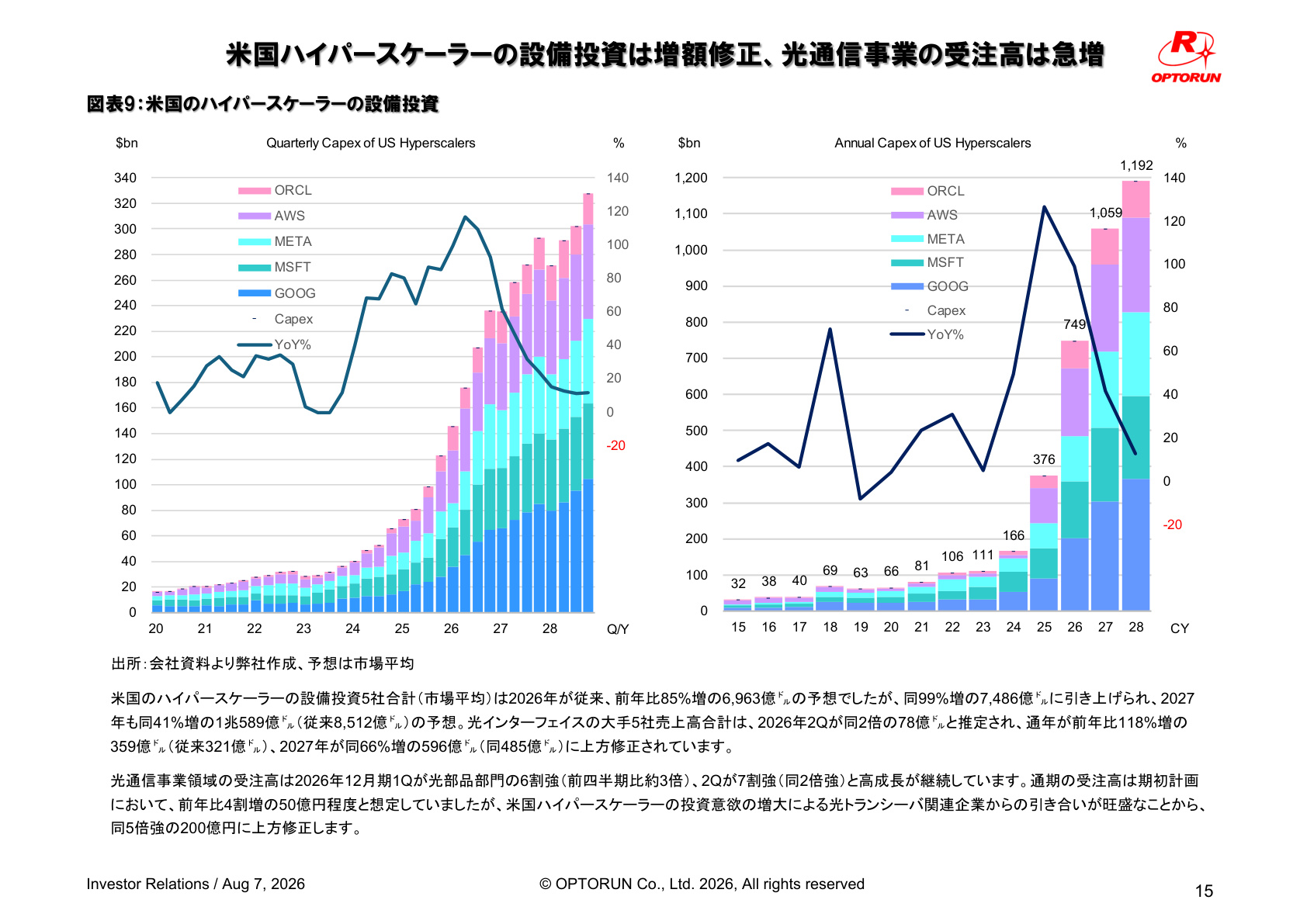
Significance and Background of the Slide (PAGE_14)
The slide above provides critical data showing the correlation between capital expenditure (CapEx) by major U.S. hyperscalers (Amazon, Microsoft, Google, Meta, Oracle, etc.) and Optorun's optical communication segment orders.
Total CapEx for the five major U.S. hyperscalers (based on market consensus) has been revised upward to $748.6 billion in 2026 (up 99% YoY) and is projected to reach $1.0589 trillion in 2027 . With the evolution of Large Language Models (LLMs) and generative AI, data transmission bandwidth within data centers is reaching its physical limits, making the transition from traditional electrical wiring to optical interconnects essential.
Against this backdrop, the combined sales of the top five optical transceiver manufacturers surged to $7.8 billion in Q2 2026, doubling year-on-year. Optorun’s orders for deposition and processing equipment have jumped in tandem. As shown in the line and bar charts, the increase in hyperscaler CapEx and the surge in Optorun’s optical communication orders are perfectly aligned, confirming that the company is embedded in the core supply chain of AI infrastructure expansion.
Furthermore, technological trends in the optical communications market are acting as a tailwind for the company.
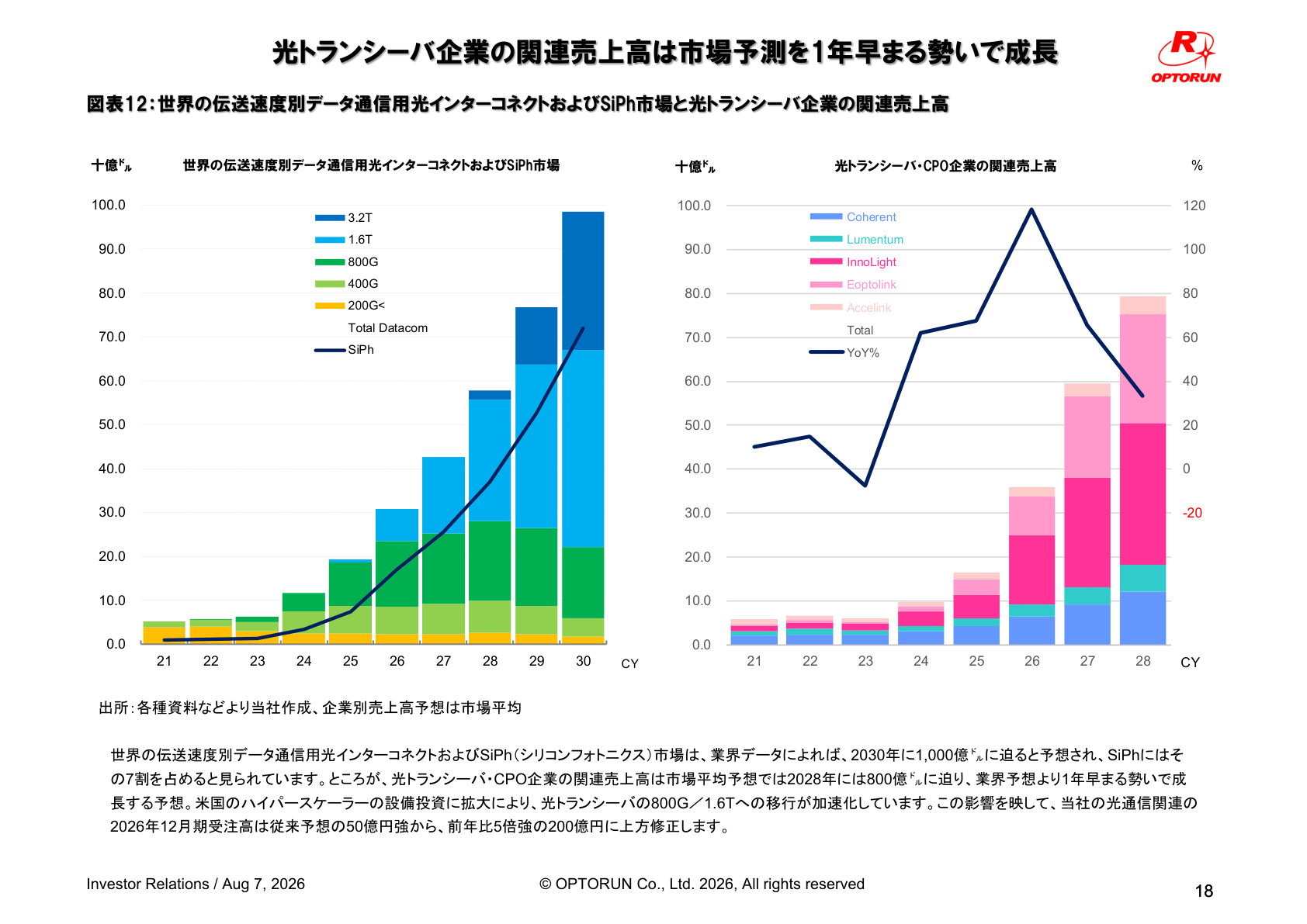
Significance and Background of the Slide (PAGE_17)
PAGE_17 presents future forecasts for the global data communication optical interconnect market by transmission speed and sales outlooks for optical transceiver/CPO (Co-Packaged Optics) related companies.
As data communication speeds increase, the industry is rapidly shifting from 400G to 800G and even 1.6T (terabits) . Achieving ultra-high-speed transmission requires nanometer-level precision in thin-film deposition for filters, chromatic dispersion compensation films, and silicon photonics (SiPh).
As the data indicates, the growth rate of the silicon photonics and optical transceiver market is accelerating, outpacing previous industry forecasts by a full year . With the market projected to approach $100 billion by 2030, it is clear that Optorun’s optical thin-film equipment and ultra-precision processing technologies (etching, GCIB, etc.) are becoming indispensable infrastructure for this technological innovation.
4. Mid-to-Long-Term Growth Strategy: The 'Second Founding' and Evolution into an Opto-Electronic Fusion Enterprise
Optorun has embarked on a 'Second Founding' phase, moving beyond its origins as an 'optical thin-film deposition equipment company' to pursue sustainable high growth and enhanced corporate value.
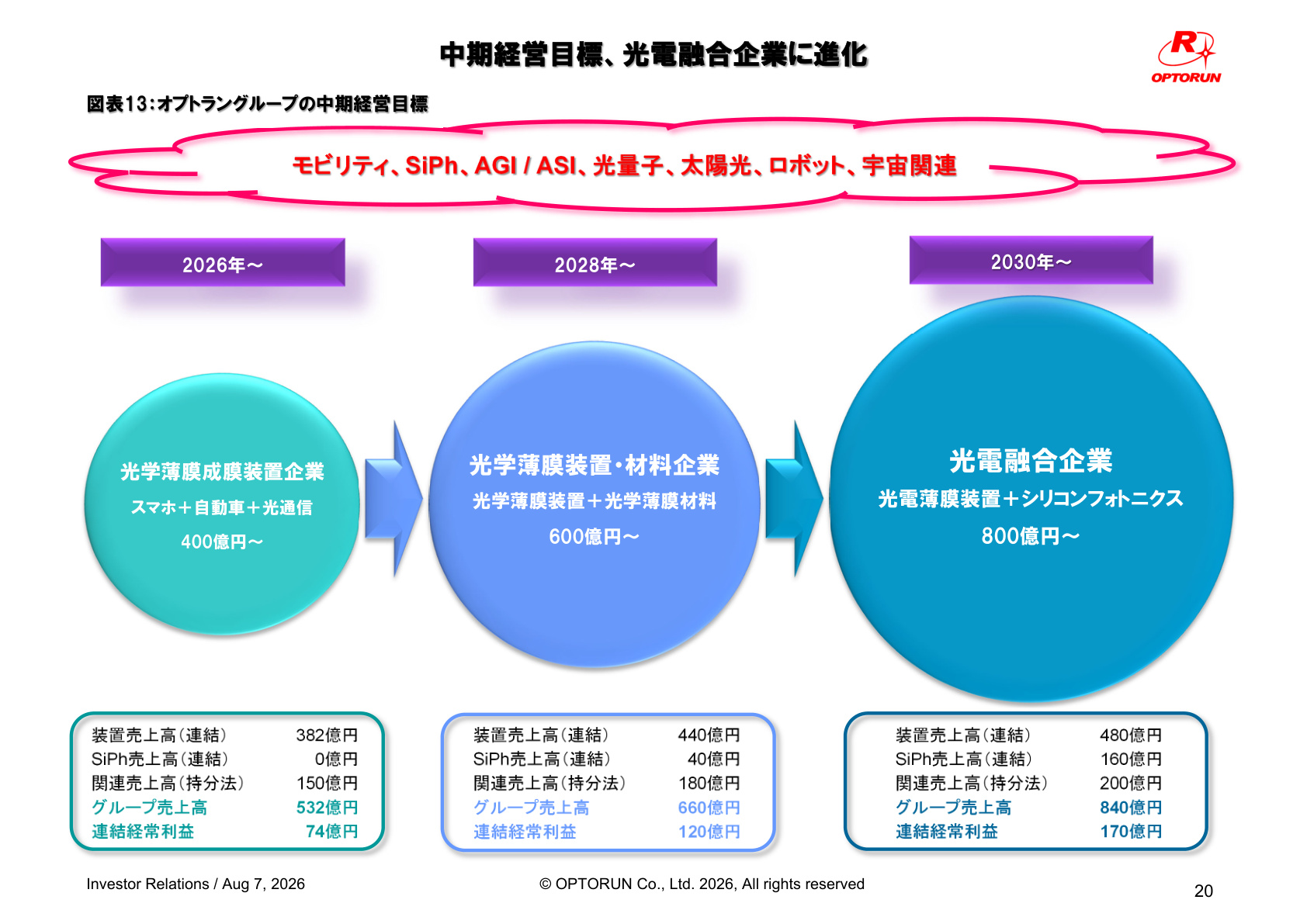
Significance and Background of the Slide (PAGE_19)
PAGE_19 provides a roadmap visualizing Optorun’s mid-term management vision and business portfolio transformation from 2026 through 2030 and beyond.
Historically, the company has built a track record as an 'optical thin-film deposition equipment company' (with sales around 40 billion yen) focused on smartphones and automotive applications. The company now plans to dramatically expand its business scope in three stages:
- 2026– (Current) : Commercializing the optical thin-film materials business alongside deposition equipment (Group sales target: 53.2 billion yen ; consolidated ordinary profit: 7.4 billion yen ).
- 2028– : Full-scale launch of the silicon photonics (SiPh) business as an optical thin-film equipment and materials company (Group sales target: 66 billion yen ; consolidated ordinary profit: 12 billion yen ).
- 2030– : Complete evolution into an 'Opto-Electronic Fusion Enterprise' that integrates deposition technology with silicon photonics (Group sales target: 84 billion yen ; consolidated ordinary profit: 17 billion yen ).
By moving beyond a mere equipment manufacturer and leveraging alliance strategies (investments and business partnerships) with materials, device modules, and partners (Jingchi Optoelectronics, AI Mechatech, etc.), the company is promoting vertical and horizontal integration of the value chain.
5. Cash Allocation and Financial/Shareholder Return Policy
To improve management efficiency and shareholder value, the company has established clear financial targets and cash allocation policies.
- Mid-to-Long-Term Management Goals :
- Net profit margin attributable to owners of the parent : 15% or higher
- ROE (Return on Equity) : 10% or higher
- Consolidated dividend payout ratio : 30% or higher
For the three-year period from 2025 to 2027, the company plans to utilize 25 billion yen in cash inflows (operating cash flow) and 31.4 billion yen in cash on hand to actively execute growth investments (12.3 billion yen in R&D, 3.1 billion yen in capital expenditure) and strategic investments (12 billion yen in M&A and business partnerships).
The company maintains a proactive stance on shareholder returns, planning consecutive dividend increases: 52 yen for FY2024 , 54 yen for FY2025 , and 56 yen for FY2026 (planned) . With a total return ratio exceeding 100% over the past two years, including dividends and share buybacks, the company is demonstrating a rigorous commitment to capital-efficient management.
6. Summary and Future Focus Points
Optorun’s Q2 FY2026 results demonstrated a dramatic expansion in demand within the optical communications sector , which more than compensated for the temporary decline in profit margins caused by short-term adjustments in the smartphone and automotive markets.
Key points to watch moving forward include:
- Progress in the delivery of equipment for 800G/1.6T optical transceivers for AI data centers and the achievement of the 20 billion yen order target for the optical communications business.
- Profit contributions from equity-method affiliates (Jingchi Optoelectronics, etc.) as they enter full-scale mass production from Q3 onwards, and the status of outstanding receivables collection.
- The pace of market penetration for new deposition and processing equipment , such as silicon photonics (SiPh), ALD, and etching.
- Execution of measures to improve liquidity and market capitalization in response to the Tokyo Stock Exchange (TOPIX) reforms.
As 'opto-electronic fusion' gains global attention as a technology to overcome the physical limits of AI infrastructure, the market will be closely watching Optorun’s role as a provider of essential technologies and the progress of its growth roadmap.
This content is not intended as investment advice or a recommendation. Any opinions expressed are solely the personal views of each article.