

Seibu Giken (6223) FY2026 Q2 Earnings Deep Dive: Mid-Term Growth Story Driven by Steady Progress in Large-Scale Projects and Accelerated Growth Investment

StockClub
Published: Aug 07, 2026, 11:16 AM
Sentiment Analysis
1. FY2026 Q2 Earnings Highlights
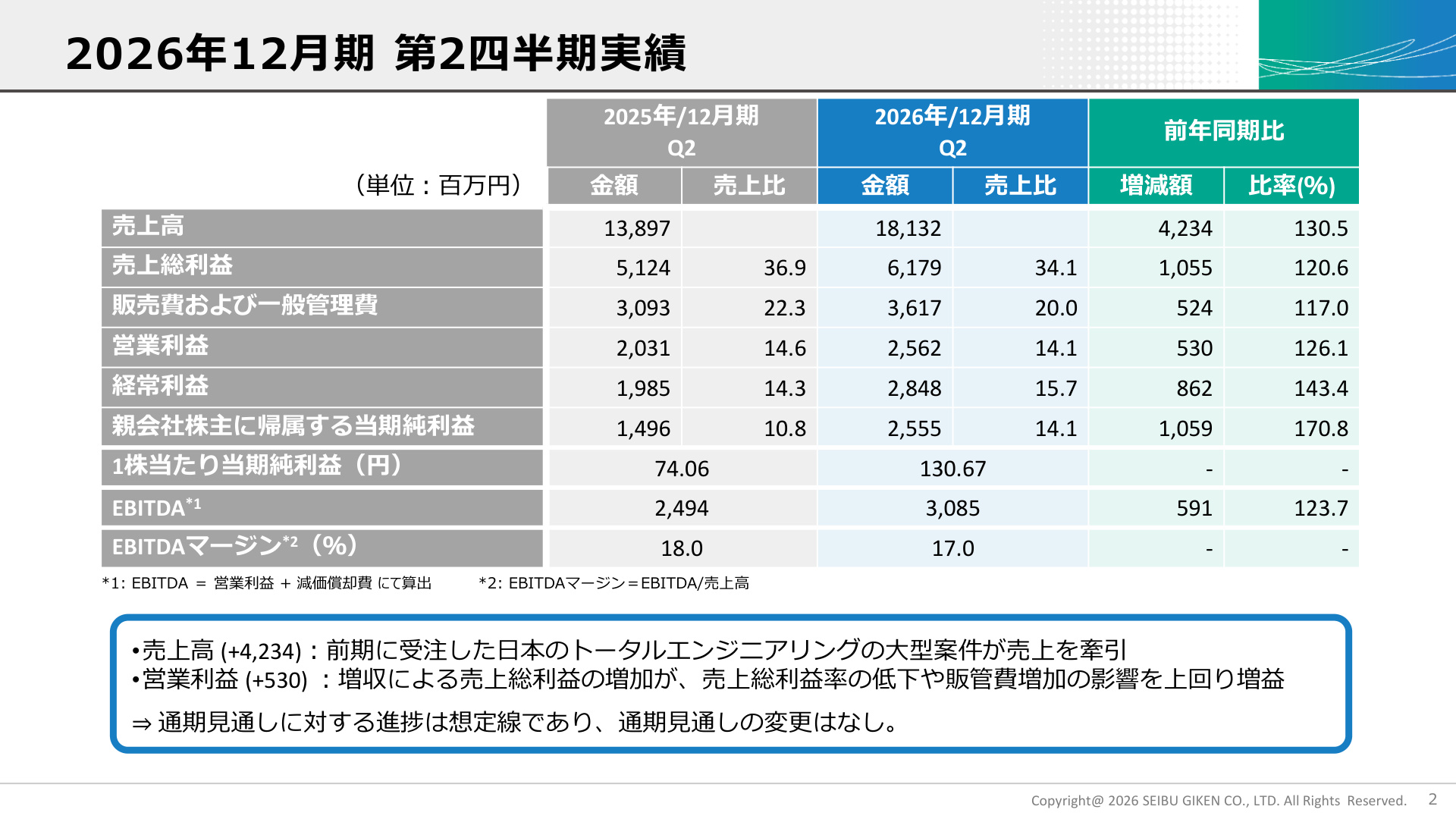
Seibu Giken Co., Ltd. achieved significant growth in both revenue and profit for the second quarter of the fiscal year ending December 2026, largely driven by the revenue contribution from large-scale total engineering projects in Japan. The performance summary for the first half of the fiscal year is as follows:
- Net Sales : ¥18.132 billion (+30.5% YoY)
- Gross Profit : ¥6.179 billion (+20.6% YoY)
- Operating Profit : ¥2.562 billion (+26.1% YoY)
- Ordinary Profit : ¥2.848 billion (+43.4% YoY)
- Profit Attributable to Owners of Parent : ¥2.555 billion (+70.8% YoY)
- EBITDA : ¥3.085 billion (+23.7% YoY)
[Commentary and Background Analysis of Slide 1]
Slide 1 (FY2026 Q2 Results) clearly illustrates the company's strong business performance this period. Net sales increased by ¥4.234 billion from ¥13.897 billion in the same period last year to reach ¥18.132 billion . This was primarily driven by the smooth revenue recognition of large-scale total engineering projects secured in Japan during the previous fiscal year.
Regarding profitability, despite changes in the sales mix, a slight decline in the gross profit margin (from 36.9% to 34.1%), and an increase in SG&A expenses, the absolute increase in gross profit (+¥1.055 billion) resulting from top-line expansion outweighed these factors. Consequently, operating profit rose 26.1% YoY to ¥2.562 billion . Furthermore, aided by a positive non-operating impact of approximately ¥200 million due to the weaker yen, profit attributable to owners of the parent recorded a remarkable 70.8% YoY increase . Progress against the full-year plan remains in line with company expectations, confirming a solid performance trajectory.
2. Analysis of Operating Profit Drivers and Segment/Regional Trends
Analysis of Operating Profit Fluctuations
The breakdown of the ¥530 million increase in operating profit (from ¥2.031 billion to ¥2.562 billion) reveals a very clear structure:
- Revenue Growth Effect : +¥3.518 billion (Driven by a significant increase in total engineering sales in Japan)
- Increase in Cost of Sales : -¥2.847 billion (Linked to the expansion of net sales)
- Increase in SG&A Expenses : -¥353 million (Higher personnel costs and computer/system-related expenses)
- Foreign Exchange Impact : +¥214 million (Positive effect from the weaker yen)
Sales Trends by Product and Business
By product, the flagship desiccant dehumidifiers grew dramatically by 88.7% YoY to ¥12.996 billion , strongly driving overall growth due to contributions from large-scale domestic projects. Conversely, VOC concentrators remained at ¥3.059 billion , a 43.2% YoY decline, impacted by lower sales in Japan, China, and other Asian regions. The "Others" segment grew 28.0% YoY to ¥2.076 billion , supported by the expansion of construction management services.
By business classification, the Core Business (Equipment/Devices) , which refers to traditional standalone equipment sales, remained steady at ¥9.842 billion (+3.4% YoY). Meanwhile, the Growth Business (Total Engineering) , which handles construction and engineering in an integrated manner, surged by 89.3% YoY to ¥8.289 billion , reflecting the successful capture of comprehensive demand in the Japanese energy device (e.g., storage battery) market.
Regional Sales Breakdown
Regionally, Japan reached ¥10.149 billion (+42.3% YoY), accounting for more than half of total sales. South Korea saw rapid growth, rising 198.6% YoY to ¥1.372 billion , supported by construction management for semiconductor materials. China also remained solid at ¥3.110 billion (+13.2% YoY), capturing demand for desiccant dehumidifiers for batteries. While the US and Europe maintained revenue growth, other Asian regions outside of China and South Korea saw a 31.2% YoY decline due to the reactionary effect of the previous year's performance.
3. Order Trends and Key Business Topics
Order Backlog and Large Overseas Orders
The order backlog at the end of FY2026 Q2 stood at ¥14.173 billion (compared to ¥24.636 billion at the end of the same period last year). Despite the reactionary impact of a concentration of orders in the previous year—including a super-large project of approximately ¥4.8 billion—and the cancellation of a ¥1 billion VOC recovery system order (booked in Q2 2025, reflected in Q2 2026), new orders excluding the cancellation remained at a high level of ¥16.632 billion .
Of particular note is the acquisition of large-scale projects in overseas markets :
- VOC Concentrators for a major Chinese shipyard : Secured an order of approx. ¥500 million in May 2026 (scheduled for delivery in Q3 2026), followed by an additional order of approx. ¥280 million in June.
- VOC Concentrators for a major Taiwanese foundry (semiconductor contract manufacturer) : Secured a large order of approx. ¥1.58 billion in June 2026 (delivery scheduled between Q3 2026 and Q4 2027). This serves as evidence that the company's advanced air treatment technology is highly regarded in the cutting-edge semiconductor sector.
Strategic Topics for Growth
- "C-SAVE Green" CO2 Concentration and Supply System for Greenhouse Cultivation : In February 2026, this product was certified as eligible for the investment promotion tax system under the "Strategy for Sustainable Food Systems (MIDORI)" promoted by the Ministry of Agriculture, Forestry and Fisheries. As an environmentally friendly product that recovers and concentrates atmospheric CO2 without using fossil fuels to increase yields, the company is advancing social implementation in agricultural innovation, including participation in the "Fukuoka Future-Oriented Horticulture Consortium" in June.
- Participation in the "Swiftfab" Battery Manufacturing Equipment Project : The company joined "Swiftfab," an industry-wide project involving nine member companies of the Battery Association for Supply Chain (BASC). In April 2026, it established a joint venture, " Swiftfab Energy Systems Co., Ltd. " In this initiative to build a standardized platform for battery production lines that integrates buildings, equipment, and production systems, Seibu Giken is leveraging its long-cultivated expertise in air quality control and energy control for dry environments .
4. FY2026 Full-Year Earnings Forecast, Growth Investment, and Shareholder Returns
Summary of Full-Year Earnings Forecast
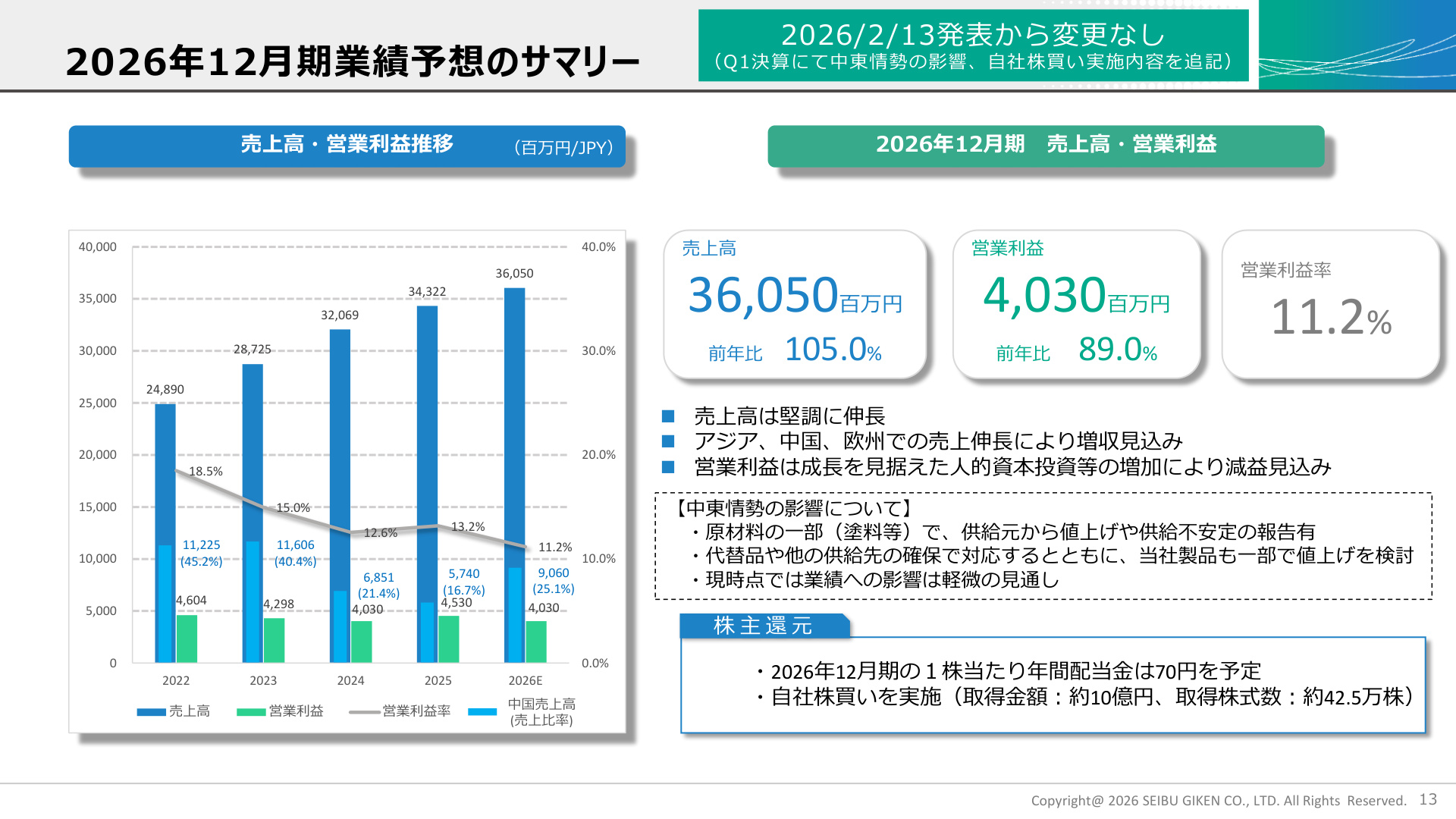
The full-year earnings forecast for FY2026 remains unchanged from the plan announced on February 13, 2026, anticipating solid revenue growth and a decline in profit due to aggressive investment for the future .
- Net Sales : ¥36.05 billion (+5.0% YoY)
- Operating Profit : ¥4.03 billion (-11.0% YoY)
- Ordinary Profit : ¥4.46 billion (-0.8% YoY)
- Profit Attributable to Owners of Parent : ¥3.87 billion (+12.0% YoY)
[Commentary and Background Analysis of Slide 12]
Slide 12 (Summary of FY2026 Earnings Forecast) clearly indicates the company's management strategy and the direction of its profit structure for the current fiscal year. The company aims for record-high net sales of ¥36.05 billion through growth in Japan, China, Asia, and Europe.
On the other hand, the primary reason for the projected decline in operating profit from ¥4.53 billion to ¥4.03 billion is the acceleration of growth investments aimed at sustainable future development. Specifically, the company is systematically incorporating increased expenses, including human capital investment (higher personnel costs) to secure talent for the total engineering business, IT investment (higher computer-related expenses) for maintenance of company-wide network equipment and AI implementation, and prototype testing costs associated with efforts to ensure a stable supply of storage batteries.
Regarding ordinary profit and net profit, the company expects to secure a YoY increase (+12.0%) at the bottom line, as it anticipates the recording of subsidy income (non-operating income) related to battery supply stability efforts and extraordinary income such as the "Growth Investment Subsidy for Small and Medium-sized Enterprises."
Shareholder Return Policy (Dividends and Share Buybacks)
The company has set a consolidated dividend payout ratio of 40% or more as a key target, while balancing stable dividend maintenance, financial soundness, and internal reserves.
- Annual Dividend Forecast : ¥70 per share (planned as a year-end dividend)
- Share Buybacks : Based on a Board of Directors resolution, the company has already completed a share buyback with a total acquisition value of approx. ¥1 billion (approx. 425,000 shares).
This demonstrates a commitment to executing clear and generous shareholder returns while prioritizing growth investment.
5. Progress of Mid-Term Management Plan 2024-2026 and Growth Strategy
Positioning and Vision of the Mid-Term Management Plan
Seibu Giken has set a 2030 vision: " To continue being an innovation leader in air treatment technology for the realization of a climate-neutral future. " The current Mid-Term Management Plan 2024-2026 is positioned as "Phase 1: Building the Foundation for Growth" toward 2030.
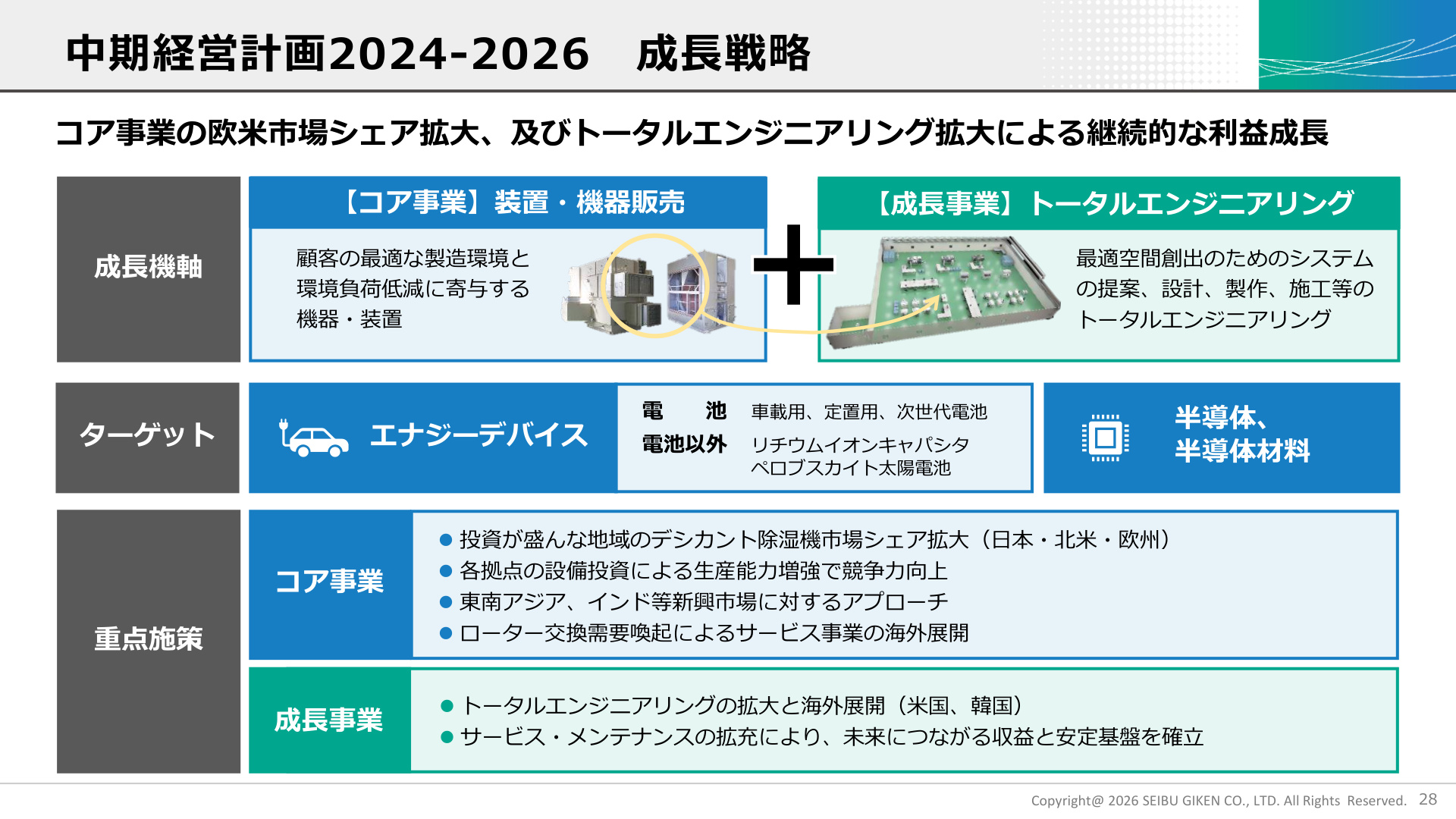
[Commentary and Background Analysis of Slide 27]
Slide 27 (Mid-Term Management Plan 2024-2026 Growth Strategy) is a crucial slide that encapsulates the overall picture of how Seibu Giken intends to achieve sustainable growth.
The company's growth mechanism is a dual-engine structure consisting of the " Core Business (Equipment/Device Sales) ," which sells equipment that contributes to optimizing customers' manufacturing environments, and the " Growth Business (Total Engineering) ," which encompasses system proposals, design, and construction for space creation.
Target markets are clearly focused on the energy device sector , including next-generation batteries such as automotive/stationary lithium-ion batteries, all-solid-state batteries, lithium-ion capacitors, and perovskite solar cells, as well as the semiconductor and semiconductor materials sector , which is benefiting from increased data center investment due to the spread of generative AI.
Key measures include expanding the global market share of desiccant dehumidifiers, increasing production capacity at each base, approaching emerging markets (Southeast Asia and India), and developing after-sales services such as rotor replacement in the Core Business. In the Growth Business, the company aims to expand total engineering overseas (US, South Korea, etc.) and enhance service and maintenance, shifting from mere "product sales" to "solution provision."
Trends in Key Financial KPIs
Key financial indicators under the Mid-Term Management Plan are as follows:
- Net Sales : FY2024 Actual ¥32.069 billion → FY2025 Actual ¥34.322 billion → FY2026 Forecast ¥36.05 billion (On track to achieve the mid-term target of ¥36 billion)
- Operating Profit Margin : FY2024 12.6% → FY2025 13.2% → FY2026 Forecast 11.2% (Temporary decline due to upfront investment, aiming for recovery from FY2027 onwards)
- ROE : FY2024 11.8% → FY2025 11.1% → FY2026 Forecast 11.8% (Progressing toward the mid-term target of 13%)
6. Comprehensive Summary and Future Focus Points
Seibu Giken's FY2026 Q2 earnings showed extremely strong performance , driven by the steady recognition of revenue from large-scale domestic projects and the rapid expansion of the Growth Business (Total Engineering).
Key focus points for monitoring future business trends are summarized in the following three areas:
- Reproducibility of Large Overseas Order Acquisitions : Trends in securing continuous, high-value-added orders in global industries such as semiconductors, EVs, and shipbuilding, backed by the high technical capabilities demonstrated with major Taiwanese foundries and Chinese shipyards.
- Realization of Upfront Investments : How the deployment of human capital investment, IT investment, and R&D/prototype testing costs will contribute to order expansion and profitability improvements in the total engineering business from the next fiscal year (FY2027 onwards).
- Progress in New Domains and Alliances : The speed of commercialization in non-industrial air treatment areas, such as the launch of a standardized platform for battery manufacturing equipment through "Swiftfab" and the "C-SAVE Green" CO2 concentration system for agriculture.
Attention is focused on the company's efforts to move from decorative growth to structural market share expansion, centered on its specialized air treatment technology.
This content is not intended as investment advice or a recommendation. Any opinions expressed are solely the personal views of each article.