


Nippon Insure (5843) Q3 FY2026 Earnings Deep Dive Report

StockClub
Published: Aug 07, 2026, 11:12 AM
Sentiment Analysis

Executive Summary
Nippon Insure Co., Ltd. (Securities Code: 5843) reported robust performance for the third quarter of the fiscal year ending September 2026, with significant year-on-year growth in both net sales and operating profit. The company’s stock-based revenue model, centered on its rent debt guarantee business, has further solidified, and operating margins have improved significantly alongside the expansion of top-line revenue.
In light of these strong results, the company has announced an upward revision to its full-year earnings forecast and year-end dividend forecast for the fiscal year ending September 2026 . This report provides a detailed analysis of the Q3 financial results, shifts in the revenue structure, trends in key performance indicators (KPIs), and an overview of the company's growth strategy.
1. Q3 Earnings Highlights: Significant Growth in Both Sales and Profit
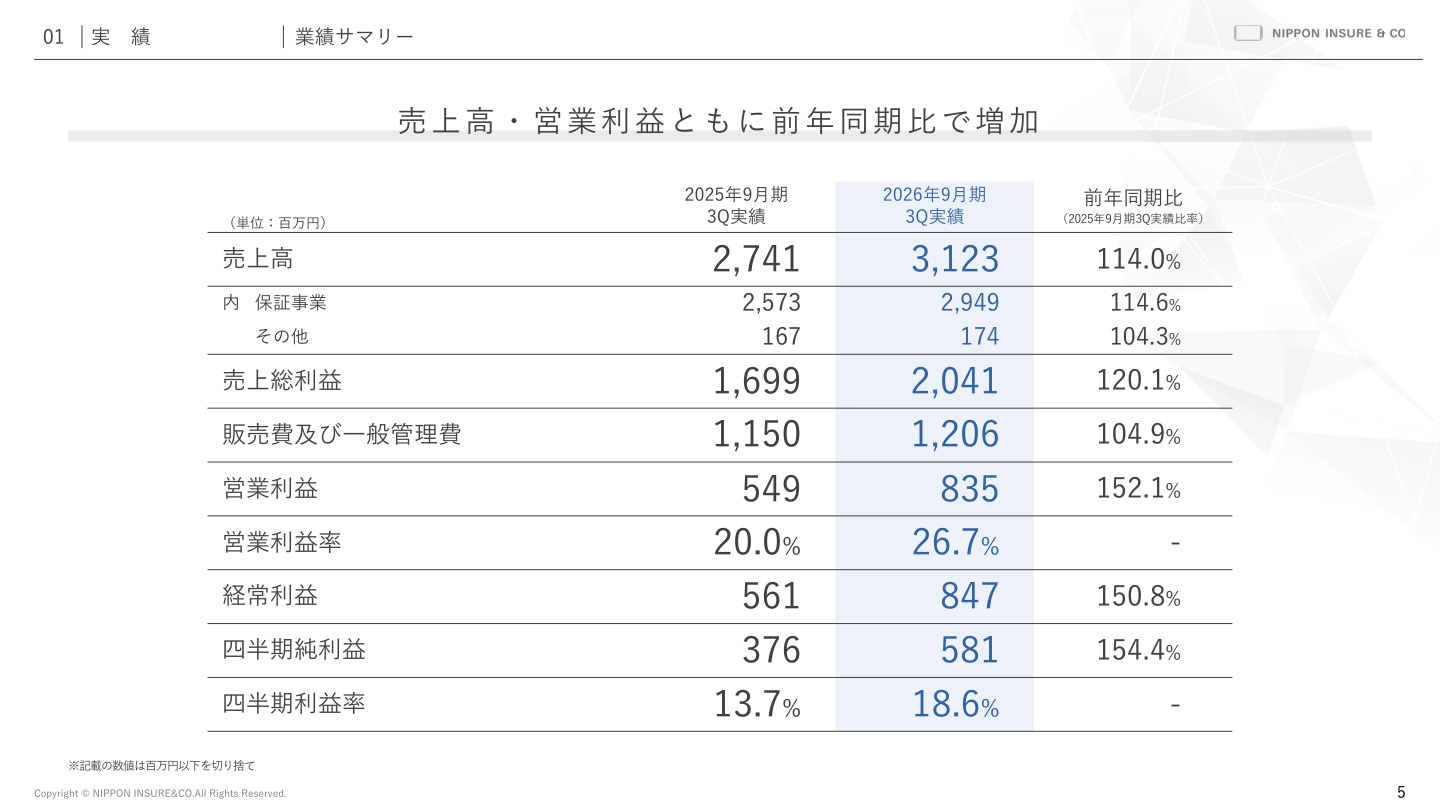
For the first nine months of the fiscal year ending September 2026, consolidated results were as follows: net sales of 3,123 million yen (up 114.0% YoY) , operating profit of 835 million yen (up 152.1% YoY) , ordinary profit of 847 million yen (up 150.8% YoY) , and quarterly net profit of 581 million yen (up 154.4% YoY) .
The core guarantee business drove overall performance with sales of 2,949 million yen (up 114.6% YoY). Meanwhile, selling, general, and administrative (SG&A) expenses were kept to a moderate 1,206 million yen (up 104.9% YoY) relative to revenue growth, resulting in a significant 6.7 percentage point improvement in the operating margin, rising from 20.0% in the same period last year to 26.7% .
Significance and Context of the Earnings Summary Slide
The slide above illustrates the extent of this period's growth compared to the previous year and how the profit structure has evolved:
- Strong Top-Line Growth : The core guarantee business grew by 14.6% YoY, demonstrating steady business scale expansion.
- Dramatic Expansion of Gross Profit : Gross profit reached 2,041 million yen (up 120.1% YoY), supported by effective cost-of-sales control.
- Surge in Operating Profit and 26.7% Margin : Because the growth rate of SG&A expenses was kept low relative to sales growth (+4.9% YoY), operating leverage was highly effective, causing operating profit to jump by more than 1.5 times. This confirms a rapid transition toward a high-profitability structure.
2. Deep Dive into Revenue Structure: Accumulation of Stock Revenue
Revenue from rent debt guarantee services is categorized into "initial guarantee fees" generated at the time of contract, and "renewal guarantee fees" and "monthly guarantee fees" generated periodically as contracts continue. The growth of the latter two, which are highly recurring in nature, is critical to evaluating the company's growth potential.
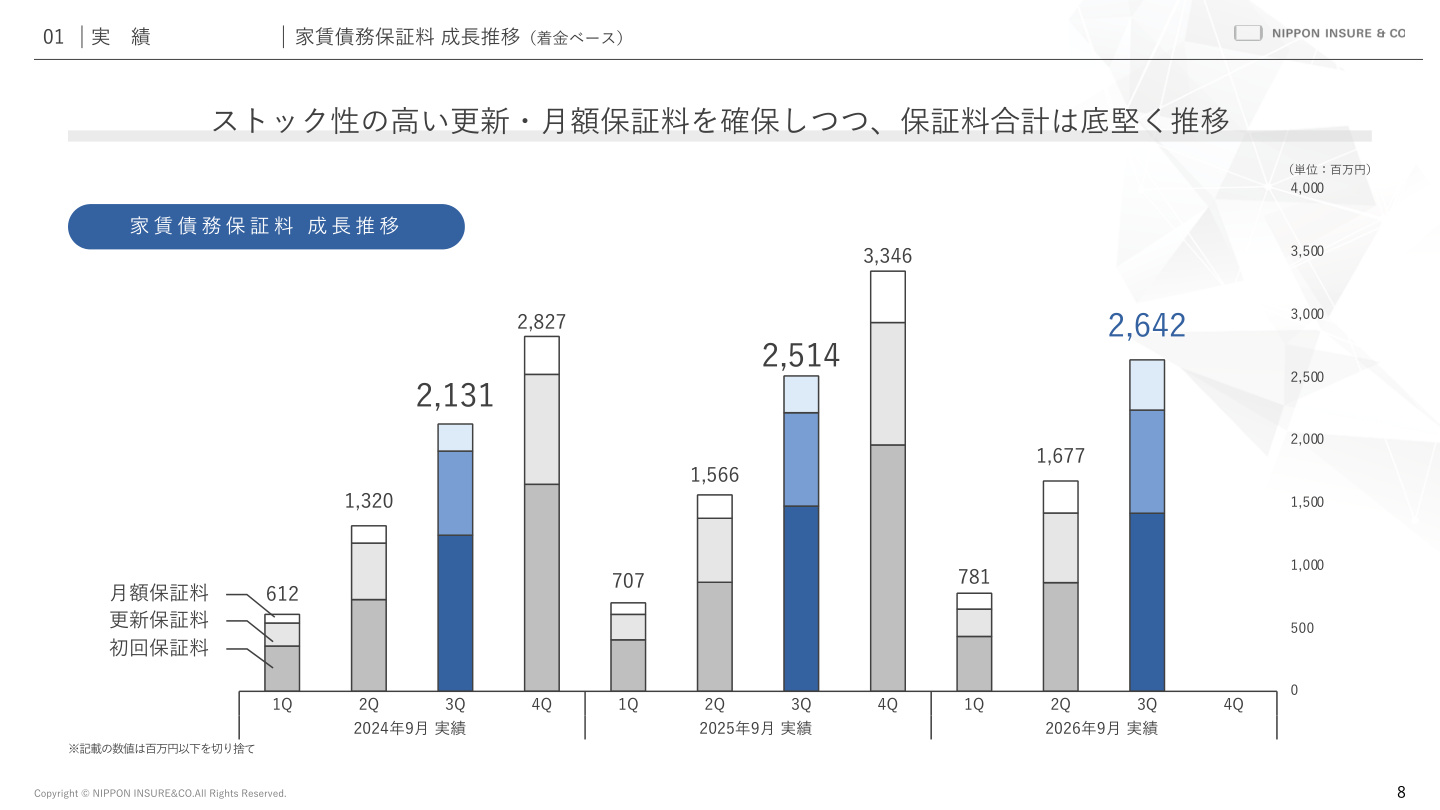
Looking at the cash-basis guarantee fee trends, the composition is as follows:
- Initial guarantee fees : 1,419 million yen (96.1% YoY)
- Renewal guarantee fees : 822 million yen (110.4% YoY)
- Monthly guarantee fees : 400 million yen (136.6% YoY)
While initial guarantee fees, which depend on new contracts, were slightly below the previous year, the accumulation of existing contracts led to a 10.4% increase in renewal fees and a 36.6% increase in monthly fees , indicating that the transition to a stable, stock-based revenue foundation is progressing smoothly.
Significance and Context of the Stock Revenue Growth Slide
The slide above, showing the quarterly trend of rent debt guarantee fees, visually proves that the company's business model is steadily shifting toward a stock-based model.
- Proof of Cumulative Effect : Since contracts acquired in the past generate continuous income unless cancelled, the structure shows a build-up over time: Q1 (781 million yen), Q2 (1,677 million yen), and Q3 cumulative (2,642 million yen).
- Qualitative Improvement in Revenue : While initial guarantee fees are susceptible to market conditions and seasonal moving trends, renewal and monthly guarantee fees have extremely high predictability . This provides a floor for the company's performance and ensures stable growth in net sales.
3. KPI Analysis: Proprietary Credit Assessment Balancing Quality and Quantity
The key KPIs supporting the company's growth and profitability are the number and unit price of initial guarantee contracts (which drive "sales growth" ) and the default occurrence rate and recovery rate (which drive "profitability" ).
KPI Results (Q3 FY2026 Average/Cumulative)
- Number of initial guarantee contracts : 26,583 (99.2% YoY)
- Unit price of initial guarantee contracts : 48,642 yen (97.7% YoY)
- Default occurrence rate : 6.2% (0.2 percentage point improvement YoY)
- Default recovery rate : 99.1% (0.3 percentage point improvement YoY)
While the number of contracts and unit prices remained steady at high levels, the default occurrence rate dropped to 6.2% , and the recovery rate rose to 99.1% . Amid social changes such as the increase in elderly individuals living alone and single-person households, the company's proprietary screening criteria, recovery processes, and data-driven risk mitigation models are functioning effectively, maintaining high recovery capabilities while suppressing credit risk.
4. Upward Revision of Full-Year Earnings and Dividend Forecasts for FY2026
Based on the strong performance through the third quarter, the company has upwardly revised its full-year earnings and dividend forecasts for the fiscal year ending September 2026 .
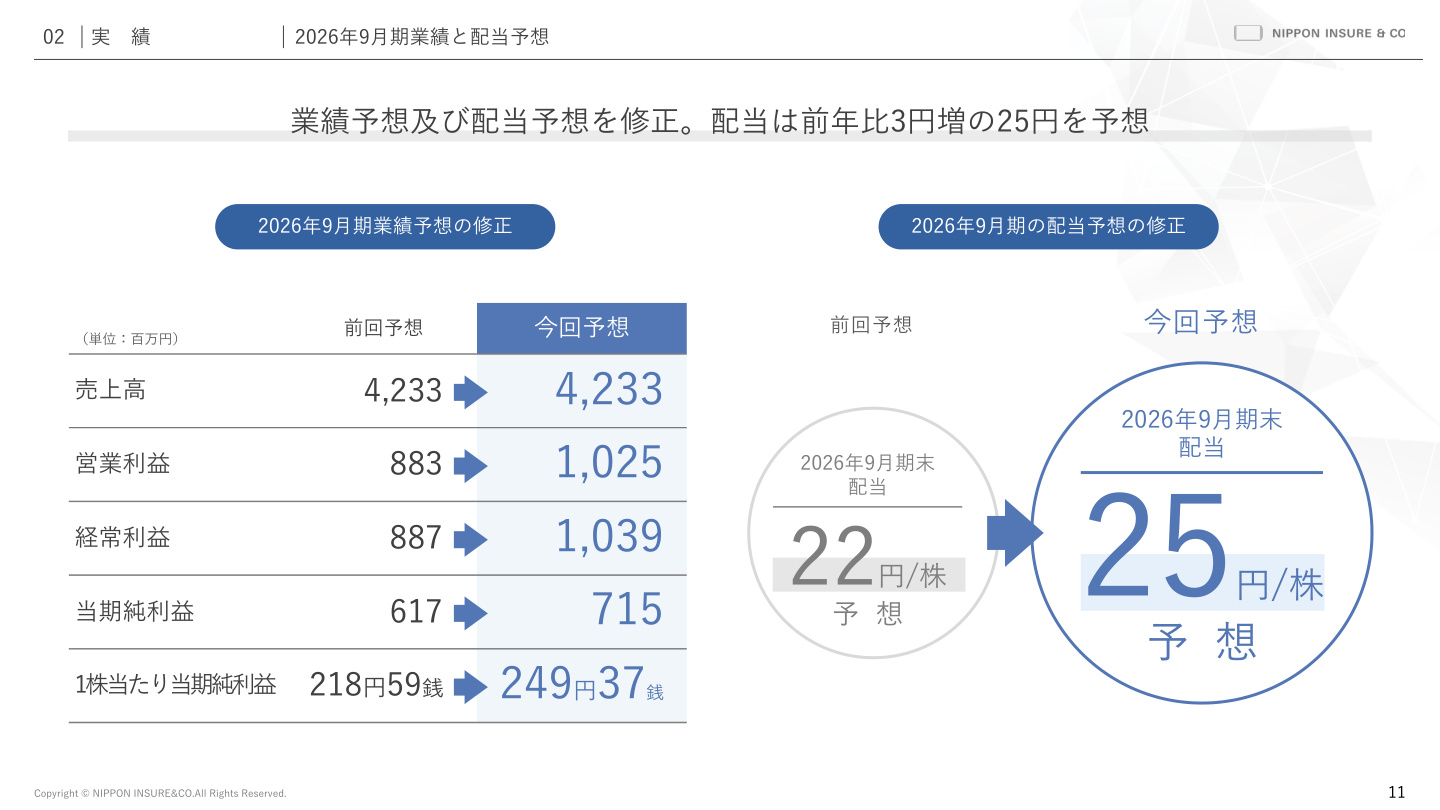
Revisions to Full-Year Earnings Forecast
- Net Sales : 4,233 million yen (unchanged from previous forecast)
- Operating Profit : Previous forecast 883 million yen → New forecast 1,025 million yen (+142 million yen / +16.1%)
- Ordinary Profit : Previous forecast 887 million yen → New forecast 1,039 million yen (+152 million yen / +17.1%)
- Net Profit : Previous forecast 617 million yen → New forecast 715 million yen (+98 million yen / +15.9%)
- Earnings Per Share (EPS) : 218.59 yen → 249.37 yen
Revisions to Dividend Forecast
- Year-end dividend per share : Previous forecast 22 yen → New forecast 25 yen (3 yen increase YoY)
Significance and Context of the Earnings/Dividend Revision Slide
The slide above is crucial as it indicates the outlook for the fiscal year-end and changes in shareholder return policy.
- Upward Profit Revision Despite Unchanged Sales : The fact that operating profit is expected to exceed 1 billion yen (1,025 million yen) without changing the sales forecast signifies that cost control and operational efficiency have progressed better than anticipated .
- Shareholder Return Stance : In line with the upward revision, the company has clearly signaled its intention to return profit growth to shareholders by increasing the year-end dividend to 25 yen.
5. Market Environment and Nippon Insure's Growth Strategy
The rent debt guarantee market has reached a market size of approximately 250 billion yen , with a 93.0% mandatory usage rate (as of 2023) , establishing it as essential social infrastructure. While demand remains firm due to the increase in single-person households and the revision of the Housing Safety Net Act (effective 2025), challenges such as an aging population and inflation persist.
In this environment, the company is pursuing the following three growth strategies :
- Business Expansion and Customized Proposals in Major Cities : Utilizing a seven-office network (Fukuoka, Tokyo, Kanagawa, Niigata, Osaka, Sendai, Nagoya) to capture high-value properties. By proposing customized products that address the diverse needs of real estate management companies, the company builds deep trust and referral networks.
- Building a Sustainable Revenue Structure through DX and AI : Strengthening external partnerships with online application services (Smart Application, ITANDI, Ii-Seikatsu Square, etc.). By introducing AI screening, RPA, AI-OCR, and AI operators, the company has improved processing speed and suppressed labor costs while handling an increasing number of contracts .
- Horizontal Expansion into Other Industries : Applying the screening and guarantee expertise cultivated in rent debt guarantees to healthcare and medical fields, such as "nursing care debt guarantees" and "hospitalization debt guarantees." The company is also developing businesses that contribute to local convenience, such as laundry and fitness businesses via franchise models.
6. Conclusion
Nippon Insure's Q3 FY2026 results demonstrate a significant increase in operating profit and improved margins, driven by the accumulation of stock revenue and a reduction in the SG&A ratio through digitalization and DX promotion.
The upward revision to an operating profit forecast exceeding 1 billion yen and the planned dividend increase to 25 yen highlight the robustness of the company's business model, its strong cash-generating ability, and its credit management capabilities. With a solid partnership with real estate management companies and an advanced system foundation, the company is well-positioned to continue establishing its presence in a market with sustained growth potential.
This content is not intended as investment advice or a recommendation. Any opinions expressed are solely the personal views of each article.