


DOWA Holdings Q1 FY2026 Earnings Analysis: Significant Revenue and Profit Growth Driven by Favorable Market Conditions and Electronic Materials Recovery

StockClub
Published: Aug 07, 2026, 11:10 AM
Sentiment Analysis
1. Q1 FY2026 Earnings Summary and Overview
DOWA Holdings achieved significant year-on-year growth in both revenue and profit across all stages for the first quarter (1Q) of fiscal year 2026. The strong performance was primarily driven by favorable metal prices and exchange rates in the core Smelting & Refining segment, alongside a recovery in demand within the Electronic Materials segment and gains from inventory valuation related to hedging transactions.
Key financial highlights are as follows:
- Net Sales : ¥253.3 billion (+58% YoY / +¥93.2 billion)
- Operating Profit : ¥24.7 billion (+281% YoY / +¥18.2 billion)
- Ordinary Profit : ¥32.5 billion (+278% YoY / +¥23.9 billion)
- Profit Attributable to Owners of Parent : ¥23.4 billion (+266% YoY / +¥17.0 billion)
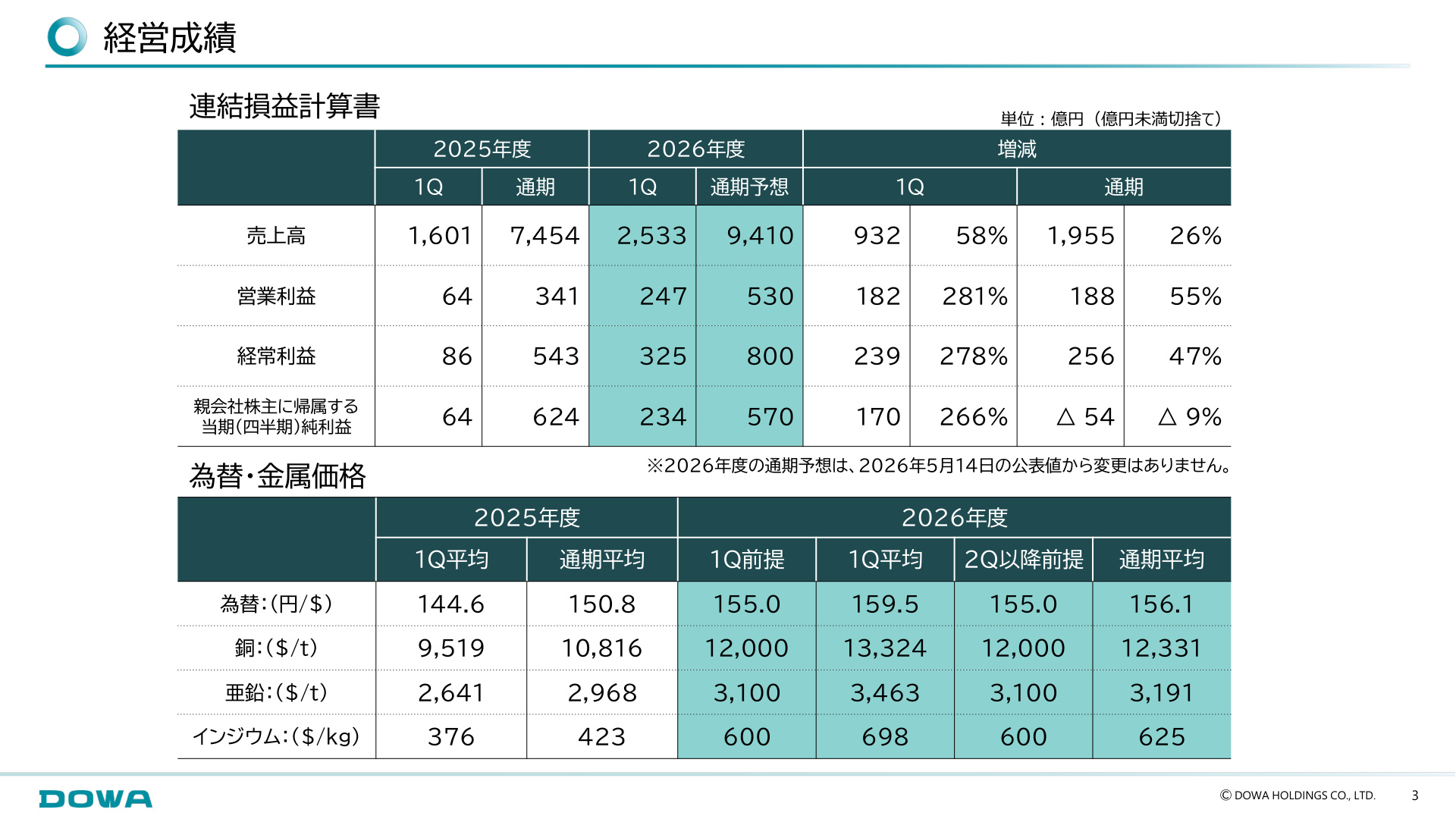
The slide below provides an overview of the Q1 FY2026 results compared to the previous year, along with full-year forecasts and underlying assumptions for exchange rates and metal prices.
Key Takeaways and Context
As indicated in the slide above (), the most critical takeaway is that profit progress at the 1Q mark is at a very high level relative to the full-year forecast. The achievement rate against the full-year plan stands at 46.6% for operating profit (¥24.7 billion / ¥53.0 billion) and 40.6% for ordinary profit (¥32.5 billion / ¥80.0 billion).
This performance is underpinned by a significant depreciation of the yen, with the exchange rate averaging ¥159.5/USD compared to ¥144.6/USD in the same period last year , as well as a sharp rise in base metal prices such as copper, zinc, and indium. For instance, the average copper price surged from $9,519/t to $13,324/t , and zinc rose from $2,641/t to $3,463/t . These increases contributed significantly to the expansion of spreads in the smelting business and higher profit contributions from mining affiliates.
2. Analysis of Segment Performance
The business environment in 1Q FY2026 varied by segment. Below is an analysis of the performance dynamics for each segment compared to the same period last year.
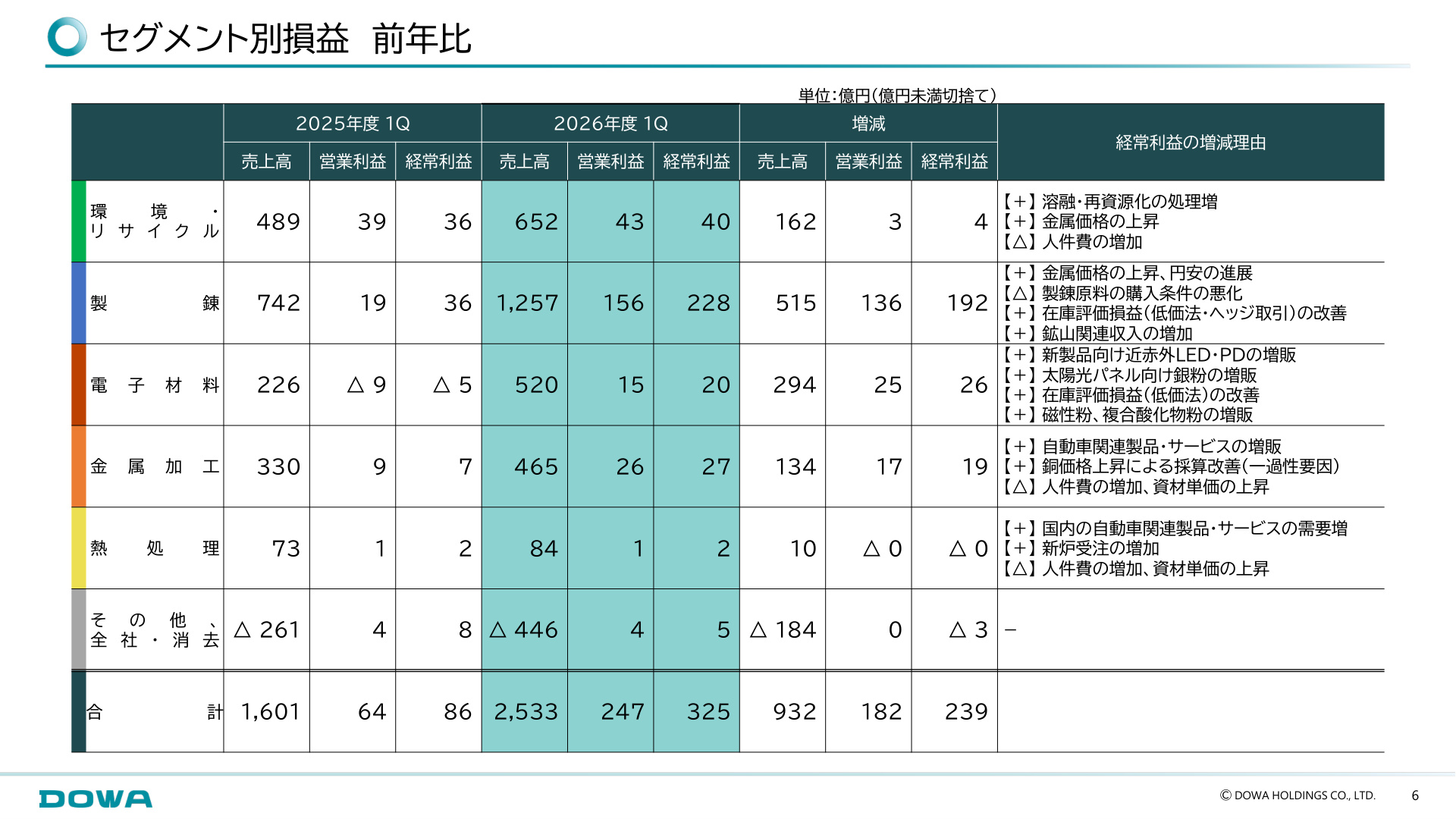
The slide below summarizes the year-on-year comparison of net sales, operating profit, and ordinary profit for each segment, along with the primary reasons for fluctuations.
Segment Details and Slide Commentary
As shown in the slide (), net sales increased across all segments, with the Smelting & Refining and Electronic Materials segments showing particularly dramatic profit improvements.
-
Environmental Management & Recycling
- Net Sales : ¥65.2 billion (+¥16.2 billion YoY)
- Ordinary Profit : ¥4.0 billion (+¥0.4 billion YoY)
- Commentary : While the volume of low-concentration PCB waste accepted in Japan is on a downward trend, this was offset by an increase in the processing of difficult-to-treat waste. Furthermore, the melting and recycling business performed steadily due to rising metal prices, and waste treatment contracts in Southeast Asia (e.g., Indonesia) continued to grow. The segment successfully covered rising labor costs through market price increases and higher processing volumes.
-
Smelting & Refining
- Net Sales : ¥125.7 billion (+¥51.5 billion YoY)
- Ordinary Profit : ¥22.8 billion (+¥19.2 billion YoY)
- Commentary : This was the primary profit driver for the quarter, benefiting significantly from rising metal prices and the weaker yen. Despite negative factors such as worsening purchase terms for mining raw materials (TC/RCs) and rising material costs, the Tizapa Mine maintained steady operations. Additionally, gains from hedging transactions—driven by factors such as the decline in silver prices—contributed significantly, resulting in an ordinary profit more than five times higher than the previous year.
-
Electronic Materials
- Net Sales : ¥52.0 billion (+¥29.4 billion YoY)
- Ordinary Profit : ¥2.0 billion (a turnaround from a loss of ¥0.5 billion in the same period last year)
- Commentary : Sales volume of silver powder for solar panels , which hit bottom in the previous year, saw a V-shaped recovery. Furthermore, growth in near-infrared LEDs/PDs for new products, increased demand for complex oxide powders for AI data centers (e.g., fuel cells) , and improvements in inventory valuation (reversal of lower-of-cost-or-market write-downs) led to a substantial improvement in performance.
-
Metal Processing
- Net Sales : ¥46.5 billion (+¥13.4 billion YoY)
- Ordinary Profit : ¥2.7 billion (+¥1.9 billion YoY)
- Commentary : Demand for automotive applications remained generally firm, and sales volumes of copper products were stable. Additionally, profit was boosted by sales price revisions following the rise in copper prices—the primary raw material—and temporary improvements in profitability.
-
Heat Treatment
- Net Sales : ¥8.4 billion (+¥1.0 billion YoY)
- Ordinary Profit : ¥0.2 billion (flat YoY)
- Commentary : While orders for new furnaces and contract processing sales increased in line with the recovery in domestic automotive production, rising labor and material costs pressured margins, keeping profit levels on par with the previous year.
3. Analysis of Ordinary Profit Fluctuations (Breakdown by Factor)
We analyze the mechanism behind the significant +¥23.9 billion year-on-year increase in ordinary profit by breaking down the contributing factors.
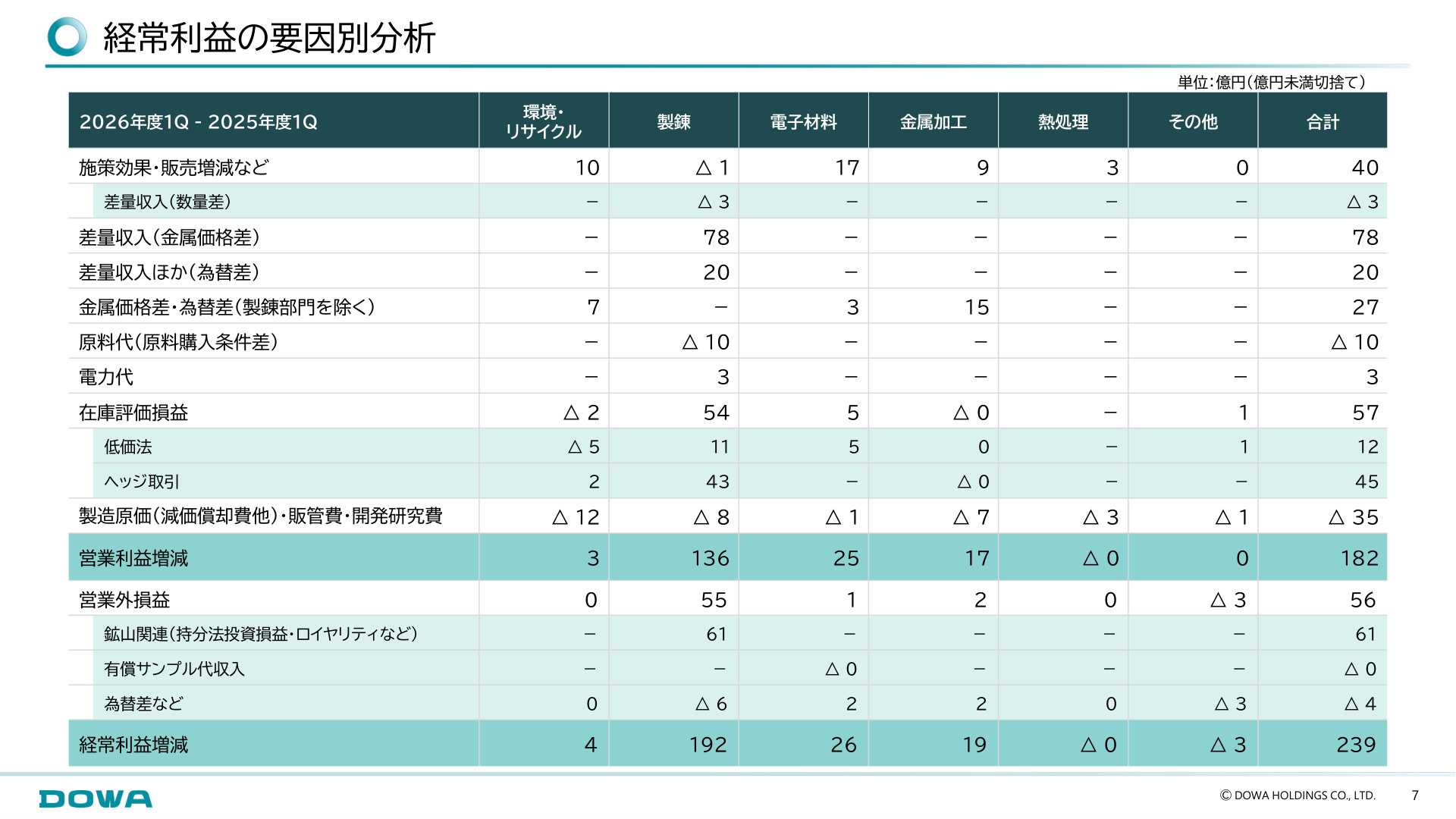
The slide below provides a detailed analysis of profit-increasing and profit-decreasing factors by category.
Key Points of Factor Analysis (Commentary on Slide )
The breakdown of the profit increase (+¥23.9 billion) shows that the company benefited from both the external environment (market conditions) and internal initiatives/volume effects.
- Initiatives & Sales Volume (+¥4.0 billion) : Recovery in actual volumes contributed steadily to profit, including increased silver powder sales in Electronic Materials (+¥1.7 billion), higher processing volumes in Environmental Management & Recycling (+¥1.0 billion), and increased demand in Metal Processing (+¥0.9 billion).
- Metal Price & Exchange Rate Effects (+¥12.5 billion) : The primary driver of the profit increase. Market-related gains, centered on metal price differentials (+¥7.8 billion) and exchange rate effects (+¥2.0 billion) in the Smelting & Refining segment, added a total of ¥12.5 billion .
- Inventory Valuation (+¥5.7 billion) : Improvements in lower-of-cost-or-market valuation (+¥1.2 billion) and hedging transaction gains (+¥4.5 billion) contributed significantly. The company utilizes hedging to mitigate price volatility risks for precious metals; the decline in silver prices toward the end of 1Q resulted in valuation gains based on mark-to-market accounting.
- Manufacturing Costs, SG&A, Labor, and Material Costs (-¥3.5 billion) : Profit-decreasing factors included rising labor costs due to base pay increases and higher bonuses, soaring material prices due to the Middle East situation, and worsening raw material purchase terms (-¥1.0 billion).
- Non-Operating Income & Equity-Method Mining Interests (+¥5.6 billion) : Investment income and royalty revenue from mining affiliates, such as the Tizapa Mine (+¥3.5 billion) and Los Gatos Mine (+¥3.4 billion) , increased by ¥6.1 billion , significantly boosting non-operating income.
4. Full-Year Forecasts and Outlook
Decision to Maintain Full-Year Forecasts
Despite the very high profit progress in 1Q, DOWA Holdings has maintained its full-year earnings forecast for FY2026 as originally announced.
Full-year plan figures are as follows:
- Net Sales : ¥941.0 billion (+26% YoY)
- Operating Profit : ¥53.0 billion (+55% YoY)
- Ordinary Profit : ¥80.0 billion (+47% YoY)
- Profit Attributable to Owners of Parent : ¥57.0 billion (-9% YoY)
Background and Risk Factors
The company has taken a cautious stance due to several uncertainties regarding the business environment from the second quarter (2Q) onward:
- Downward Trend in Precious Metal Prices : Prices for gold, silver, and platinum have been trending downward since the latter half of 1Q, raising concerns about a reversal of hedging gains and deteriorating sales margins.
- Uncertainty in Demand Trends : Concerns include a potential slowdown in automotive-related demand and sluggish growth in general information and communication equipment components (excluding AI-related products) due to thinner product designs reducing material usage.
- Continued Cost Burdens : The company anticipates that rising material unit prices, energy price volatility, and increased labor costs will exert full-scale pressure on profits in the second half.
Assumptions and Sensitivity Analysis
The market data underlying the full-year forecast and the sensitivity of operating profit (annual impact) are set as follows:
- Exchange Rate Assumption : ¥155.0/USD (for 2Q and beyond)
- Exchange Rate Sensitivity : ±¥1/USD = ±¥630 million/year (Smelting: ¥550 million, Electronic Materials: ¥70 million)
- Copper Price Assumption : $12,000/t (for 2Q and beyond)
- Copper Sensitivity : ±$100/t = ±¥30 million/year
- Zinc Price Assumption : $3,100/t (for 2Q and beyond)
- Zinc Sensitivity : ±$100/t = ±¥460 million/year
- Indium Price Assumption : $600/kg (for 2Q and beyond)
- Indium Sensitivity : ±$10/kg = ±¥70 million/year
Since the actual 1Q exchange rate (¥159.5/USD) and zinc prices ($3,463/t) were more favorable than the assumptions, there is potential for both upside and downside depending on future market trends. However, a neutral outlook is currently maintained to prepare for sudden changes in the macro environment.
5. Conclusion
DOWA Holdings' Q1 FY2026 results represent a very strong start, driven by a combination of favorable market conditions (weaker yen and high metal prices), a recovery in demand for electronic materials, and steady operations at its own mines. Structural growth factors, such as capturing new demand in Environmental Management & Recycling and Electronic Materials (e.g., for AI data centers), were also confirmed.
Moving forward, the focus will be on how the company manages challenges such as volatility in metal markets from 2Q onward and the surge in labor and material costs. Investors should closely monitor future metal price trends and actual demand in the automotive and electronic materials sectors.
This content is not intended as investment advice or a recommendation. Any opinions expressed are solely the personal views of each article.