


Earnings Deep Dive: GENOVA (5570) Q3 FY2026 Results – A Growth Story Driven by High-Margin Subscription Models and Solutions to Social Challenges

StockClub
Published: Aug 07, 2026, 11:07 AM
Sentiment Analysis

This report provides a comprehensive analysis of the Q3 FY2026 earnings results for GENOVA, Inc. (Securities Code: 5570), based on their supplementary financial materials. We examine the company's performance highlights, revenue structure, full-year outlook, and mid-to-long-term growth strategy.
1. Performance Highlights: Record-Breaking Q3 Across All Profit Metrics
GENOVA’s cumulative Q3 FY2026 results show that the company has achieved record highs across all major profit indicators —net sales, operating profit, ordinary profit, and quarterly net profit—demonstrating a trajectory that is well ahead of its initial plans.
- Net Sales : 1,057 million JPY (+4.1% YoY)
- Gross Profit : 847 million JPY (+1.5% YoY, 80.1% gross margin)
- Operating Profit : 586 million JPY (+2.9% YoY, 55.5% operating margin)
- Ordinary Profit : 597 million JPY (+3.8% YoY, 56.5% ordinary margin)
- Quarterly Net Profit : 413 million JPY (+3.6% YoY, 39.1% net margin)
- Earnings Per Share (EPS) : 31.27 JPY (Record high for a cumulative Q3)
The slide below clearly illustrates the cumulative performance for the current period and the progress against the full-year plan.
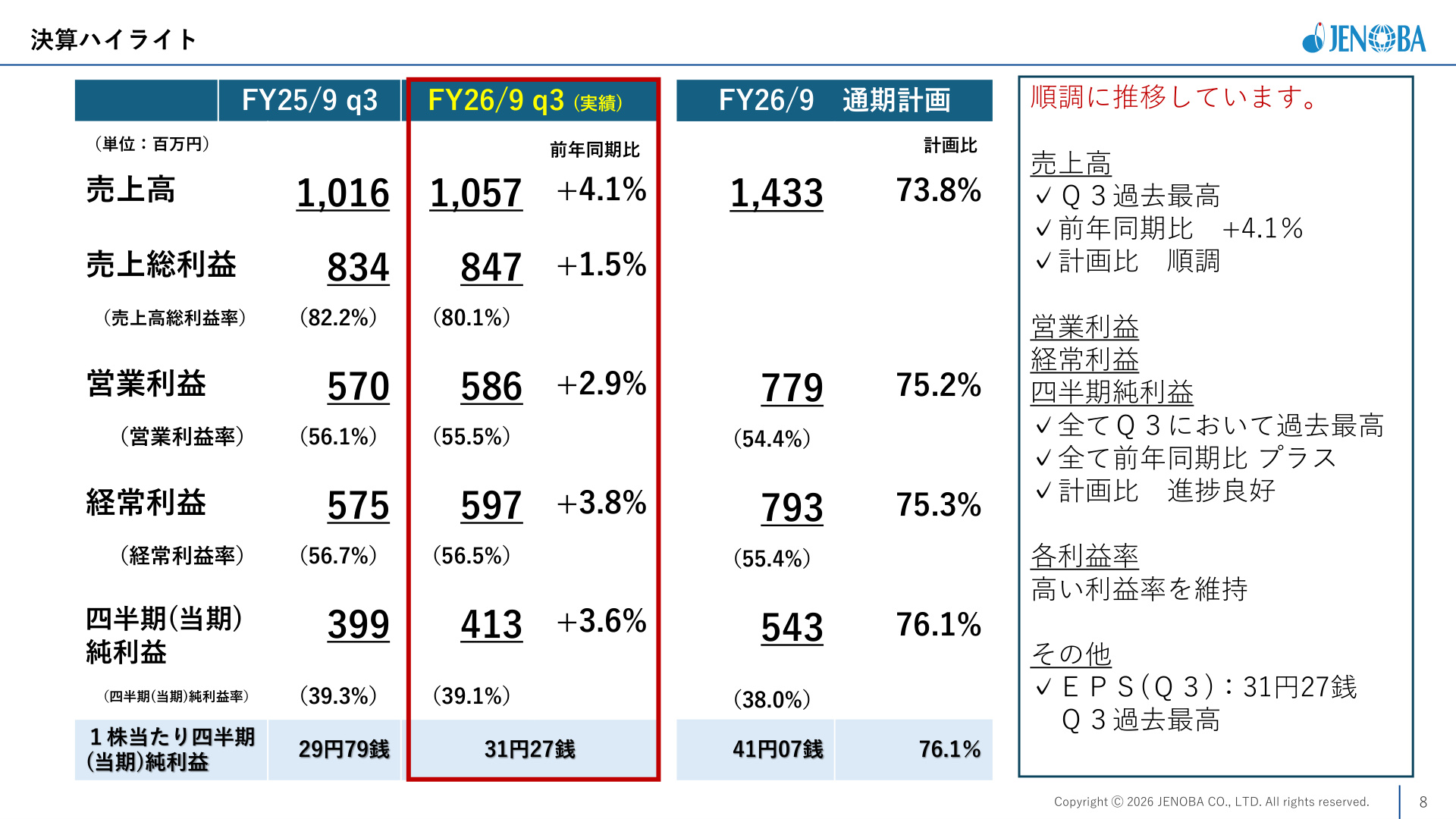
[Slide Commentary: Q3 Earnings Highlights]
This slide symbolizes GENOVA’s overwhelming profitability. Progress against the full-year plan (Net Sales: 1,433 million JPY, Operating Profit: 779 million JPY) has reached 73.8% for net sales , 75.2% for operating profit , 75.3% for ordinary profit , and 76.1% for net profit , indicating that the company is steadily exceeding its targets as of the third quarter. Of particular note is the 55.5% operating margin , which underscores a high-profit structure where revenue growth translates efficiently into bottom-line earnings.
2. Revenue Structure and Cost Analysis: A High-Leverage Model Decoupled from Revenue Growth
The most critical point in understanding GENOVA’s performance is its subscription-based business model, where “cost of sales and SG&A expenses do not increase proportionally with rising net sales.”
Trends in Contract Numbers and Seasonality
Contract numbers have steadily increased from 9,348 at the end of the same period last year to 9,599 . While there was a temporary dip in the second quarter, this was due to seasonal factors in the smart agriculture (IT agriculture) sector—the transition from the off-season to the busy farming season—and numbers have shown strong accumulation again with the start of the usage season.
Characteristics of Cost Structure (Cost of Sales and SG&A)
Quarterly cost of sales has remained extremely stable in the low 70 million JPY range (74 million JPY in Q3 alone). The primary components include product costs, labor costs, payment commissions, depreciation, and data communication fees. Excluding periods of capital investment in servers and equipment, there is almost no cost inflation associated with revenue growth.
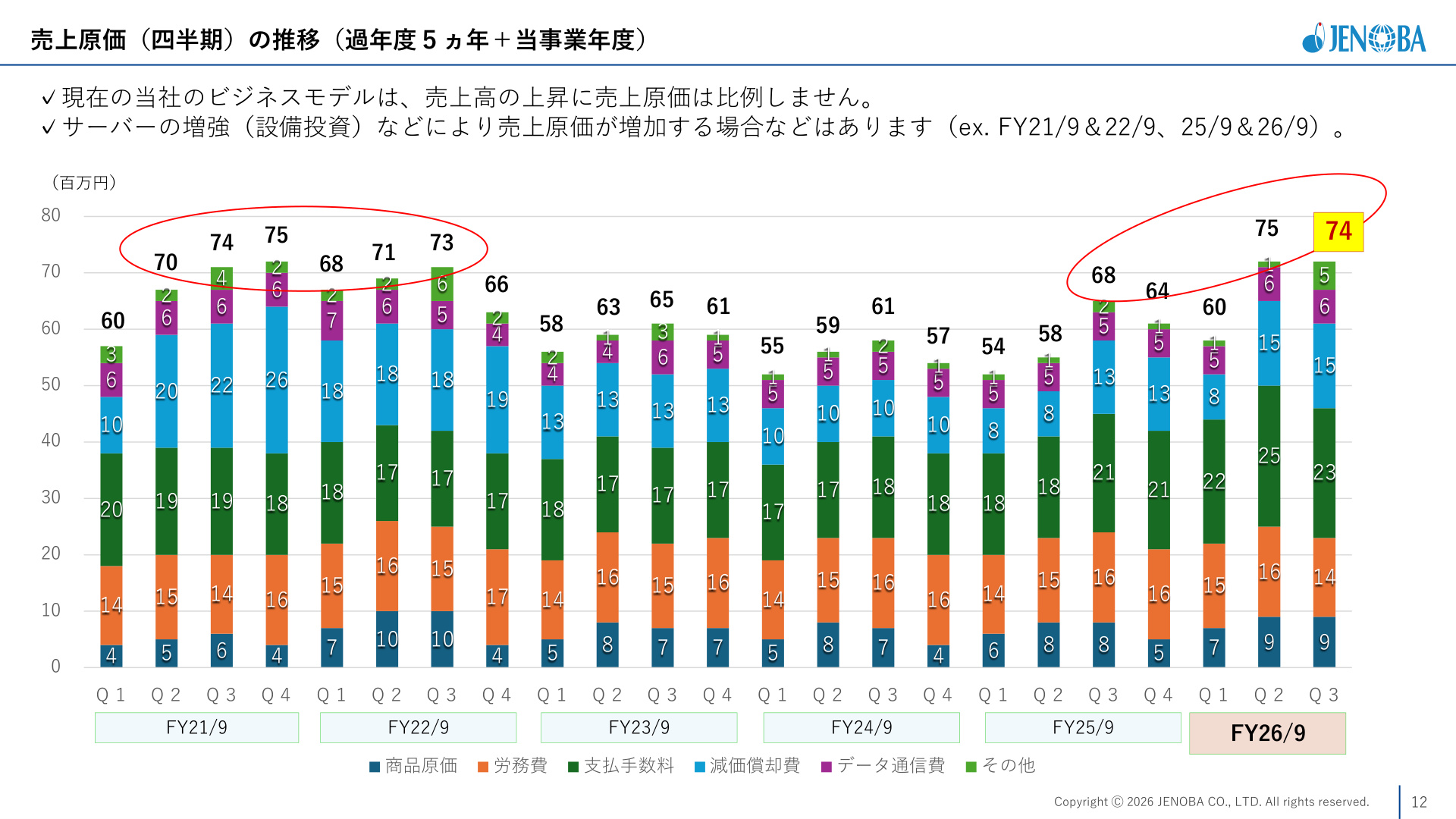
[Slide Commentary: Quarterly Cost of Sales Trends]
The slide above highlights the greatest strength of GENOVA’s cost structure. As is evident from the five-year trend, despite significant quarterly revenue growth, the cost of sales has remained largely flat. While temporary increases occur during quarters involving capital investment (such as server upgrades in FY21/9, FY22/9, FY25/9, and FY26/9), costs are kept at extremely low levels during other periods. This low break-even point and high ratio of fixed costs are the sources of the company’s high marginal profit ratio.
Furthermore, through rigorous cost management, SG&A expenses—including personnel costs—have been maintained at levels nearly identical to the previous year (86 million JPY in Q3 alone). Providing high-value-added services with a small team (17 employees) supports the company’s high productivity and profit margins.
3. Financial Foundation and Stability: Equity Ratio of 90.3%
Financially, the company has built an extremely sound and robust balance sheet.
- Total Assets : 4,051 million JPY (including 3,174 million JPY in cash and deposits)
- Total Liabilities : 394 million JPY
- Total Net Assets : 3,656 million JPY
- Equity Ratio : 90.3% (up from 88.2% at the end of the previous fiscal year)
While continuing to invest in equipment, acquire investment securities, and pay dividends, the company has established a revenue model that generates reliable and abundant cash flow from operating activities, maintaining a debt-free, highly secure management profile.
4. FY2026 Full-Year Earnings Forecast and Dividend Policy
The full-year earnings forecast for FY2026 remains unchanged from the initial plan, with the company aiming to set new record highs across all categories.
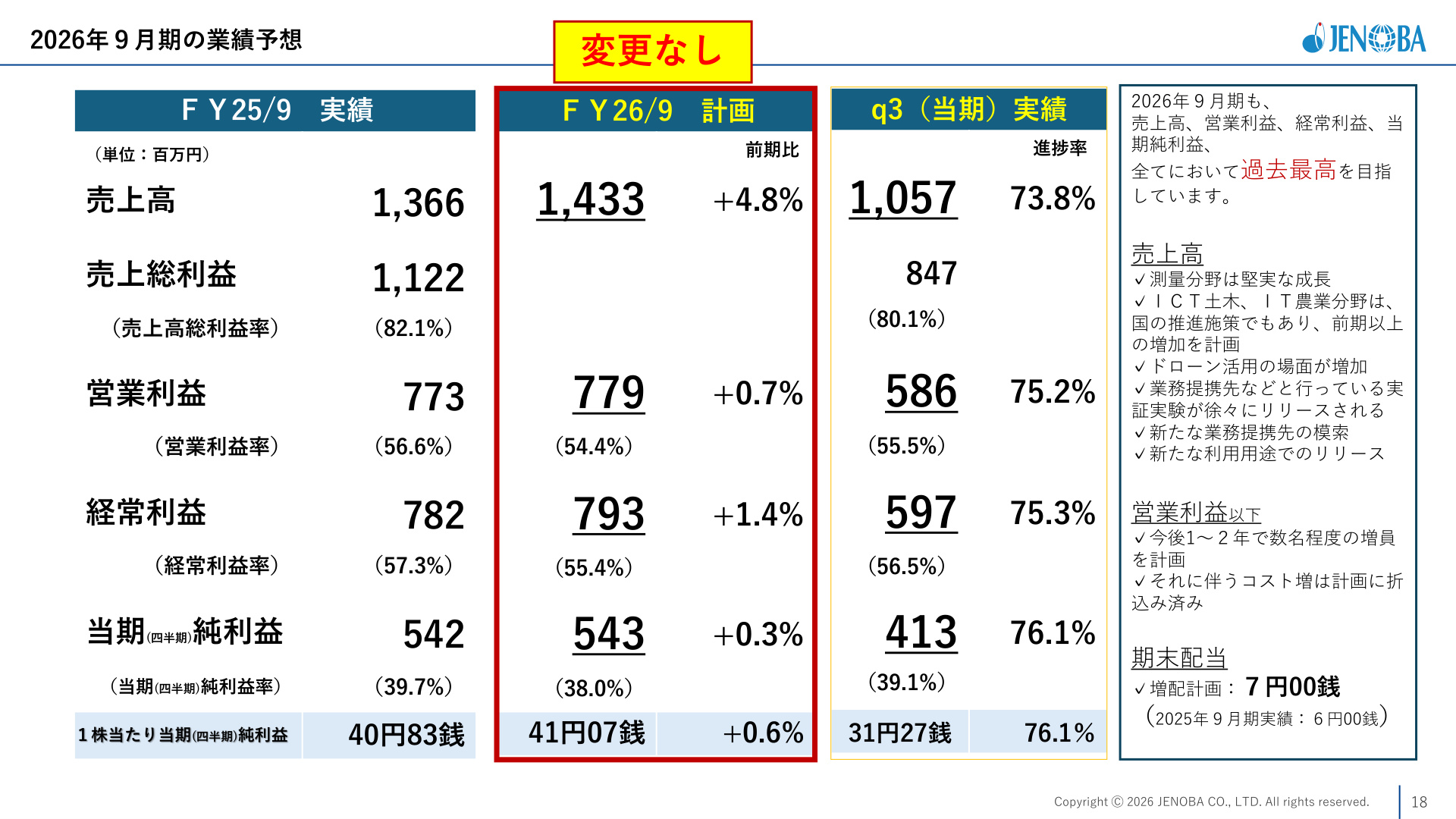
[Slide Commentary: Full-Year Earnings Forecast]
The full-year plan anticipates Net Sales of 1,433 million JPY (+4.8% YoY) , Operating Profit of 779 million JPY (+0.7% YoY) , Ordinary Profit of 793 million JPY (+1.4% YoY) , and Net Profit of 543 million JPY (+0.3% YoY) . Given that progress for all profit categories exceeded 75% by Q3, the probability of achieving these targets is extremely high.
Additionally, as part of its shareholder return policy, the company plans an annual dividend of 7.00 JPY per share (an increase of 1.00 JPY from the previous year’s 6.00 JPY), demonstrating a commitment to returning value to shareholders in line with earnings growth.
5. Business Environment and Growth Strategy: Rising Demand for High-Precision Positioning Driven by Social Challenges
GENOVA’s “GNSS (Global Navigation Satellite System) High-Precision Correction Information Distribution Service” goes beyond simple location data; it has become an essential solution for Japan’s critical structural issues, such as declining labor populations and aging infrastructure .
Technical Strengths (Network-based RTK / VRS)
While standard GPS positioning typically involves errors of several meters, GENOVA’s “Network-based RTK (VRS)” technology enables the acquisition of centimeter-level (approx. 2cm) high-precision, real-time location data . By utilizing data from electronic reference points nationwide, the service eliminates the need for users to install and manage their own reference points, significantly improving operational efficiency.
Expansion of Application Areas and Use Cases
In addition to the traditional core sector of “surveying,” the materials highlight diverse growth areas:
- ICT Civil Engineering & Construction Machinery Automation/Remote Control : Infrastructure DX and unmanned/remote construction promoted by the Ministry of Land, Infrastructure, Transport and Tourism (Machine Guidance/Machine Control).
- Smart Agriculture (IT Agriculture) : Automated steering for tractors and efficiency improvements in grassland development and improvement work.
- Infrastructure Inspection & Surveying DX : Land surveys using SLAM technology (Simultaneous Localization and Mapping) and 3D data conversion for archaeological excavations.
- Mobility, Robotics, and New Frontiers : Logistics and inspection via drones, marine surveys (dredging work), and even “high-precision GNSS automatic audio guides” for tourists, expanding into entertainment and new industrial sectors.
6. Summary of Comprehensive Analysis (10 Key Points)
The following 10 points summarize the key takeaways from GENOVA’s earnings materials:
- Steady Performance : Record highs achieved across all major profit items in cumulative Q3.
- Extremely High Progress Rate : Over 75% progress against full-year profit targets.
- Maintenance of High Profit Margins : High profitability with a 55.5% operating margin and 39.1% net margin.
- Subscription Business Model : Stable revenue structure driven by the accumulation of contracts (9,599).
- High Marginal Profit Ratio : Cost structure where costs and SG&A do not fluctuate significantly with revenue growth.
- Robust Financial Health : 90.3% equity ratio and strong cash and deposit levels.
- Enhanced Shareholder Returns : Dividend increase to 7 JPY per share, supported by the outlook for achieving full-year targets.
- Strong Macro Tailwinds : National policy trends such as national resilience, infrastructure DX, and smart agriculture.
- Technical Differentiation : Operational know-how in network-based RTK that achieves centimeter-level error correction.
- Potential for Market Expansion : A vast potential market extending from construction and agriculture to robotics, drones, and tourism DX.
GENOVA is a company supporting the digitalization of social infrastructure as a provider of high-precision positioning infrastructure. We will continue to monitor its business development and expansion into new fields.
This content is not intended as investment advice or a recommendation. Any opinions expressed are solely the personal views of each article.