

Idemitsu Kosan Q1 FY2026 Earnings Deep Dive: Significant Profit Growth Driven by Time-Lag Effects and Overseas Trading, with Steady Progress on Mid-Term Strategy

StockClub
Published: Aug 07, 2026, 11:01 AM
Sentiment Analysis
Idemitsu Kosan Q1 FY2026 Earnings Deep Dive Report
1. Earnings Overview: Substantial Revenue and Profit Growth
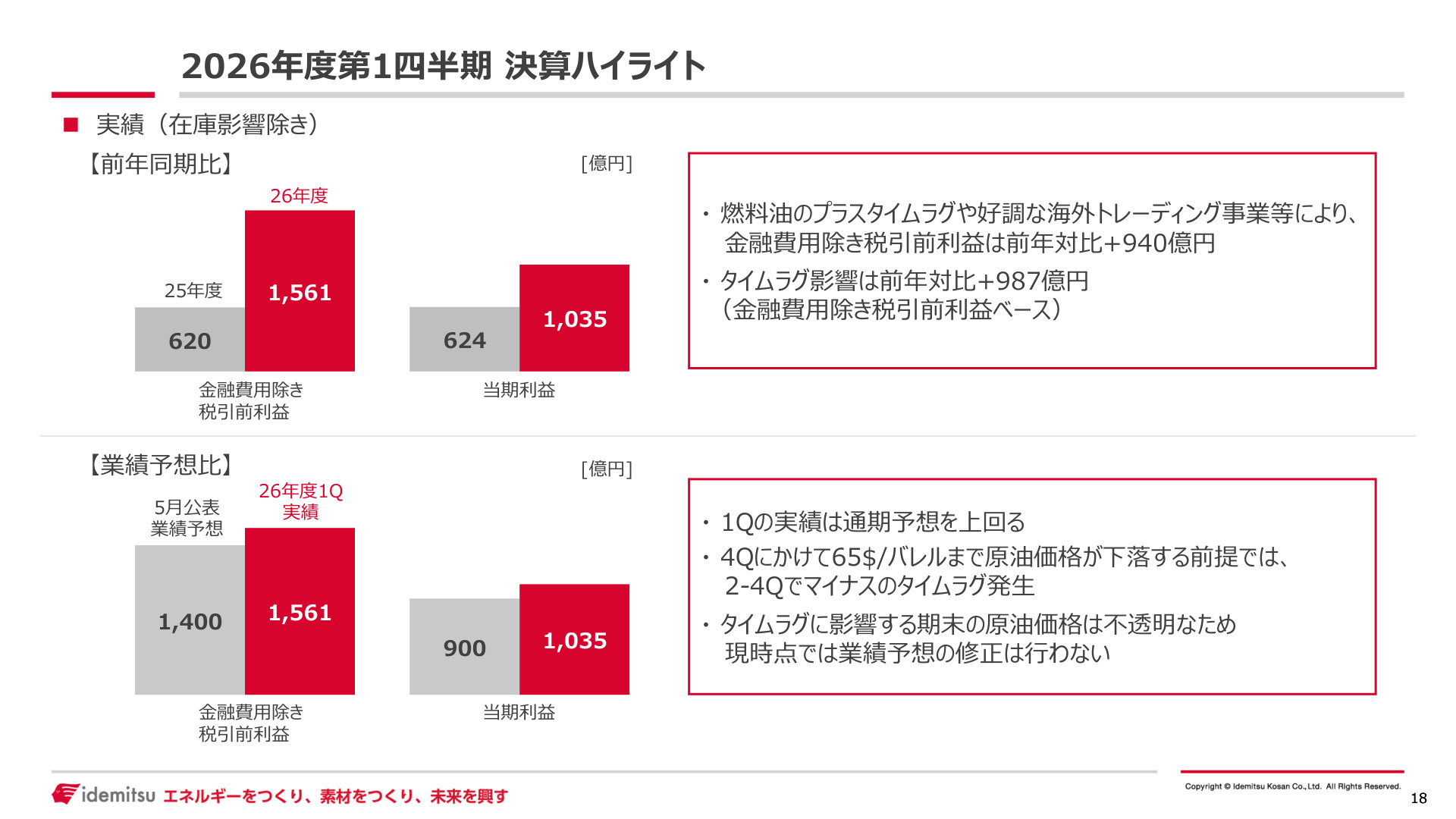
Idemitsu Kosan reported strong results for the first quarter of FY2026. Revenue increased by 23.8% year-on-year to ¥2.2718 trillion , while operating profit reached ¥307.5 billion (compared to a ¥4 billion loss in the same period last year). Profit before income taxes (excluding inventory effects and financial costs) rose by 151.6% year-on-year (+¥94 billion) to ¥156.1 billion , and net profit (excluding inventory effects) increased by 66.0% (+¥41.2 billion) to ¥103.5 billion , marking a significant improvement in both revenue and profit.
Background and Significance of the Earnings Highlights Slide
This slide is a critical document illustrating the impact of Idemitsu Kosan's performance in Q1 FY2026 and its progress toward the full-year plan. The achievement of ¥156.1 billion in profit before income taxes (excluding inventory effects and financial costs) was driven by a positive time-lag effect in fuel oil (+¥98.7 billion year-on-year) and strong earnings contributions from the overseas trading business .
Furthermore, the company has already exceeded its full-year guidance (profit before income taxes excluding financial costs of ¥140 billion; net profit of ¥90 billion) in the first quarter alone. However, the company maintains a cautious stance, keeping its full-year earnings forecast unchanged . This is due to the anticipated negative time-lag effects from the second quarter onward, based on the assumption that crude oil prices will decline to $65 per barrel, as well as uncertainties regarding year-end crude oil prices.
2. External Environment and Key Indicators
The assumptions for the first quarter reflect significant volatility in energy markets and foreign exchange rates:
- Dubai Crude Oil Price : Rose significantly from $66.9/bbl in the same period last year to $96.1/bbl (+43.6%).
- Australian Thermal Coal Spot Price : Increased from $104.6/ton in the same period last year to $119.6/ton (+14.3%).
- Exchange Rate (USD/JPY) : Experienced a notable depreciation of the yen, moving from 144.6 to 159.5 (+10.3%).
These increases in crude oil prices and the weaker yen served as a major tailwind, boosting profits through the time-lag effect (the approximately one-month gap between crude oil procurement and refining/sales).
3. Detailed Segment Analysis
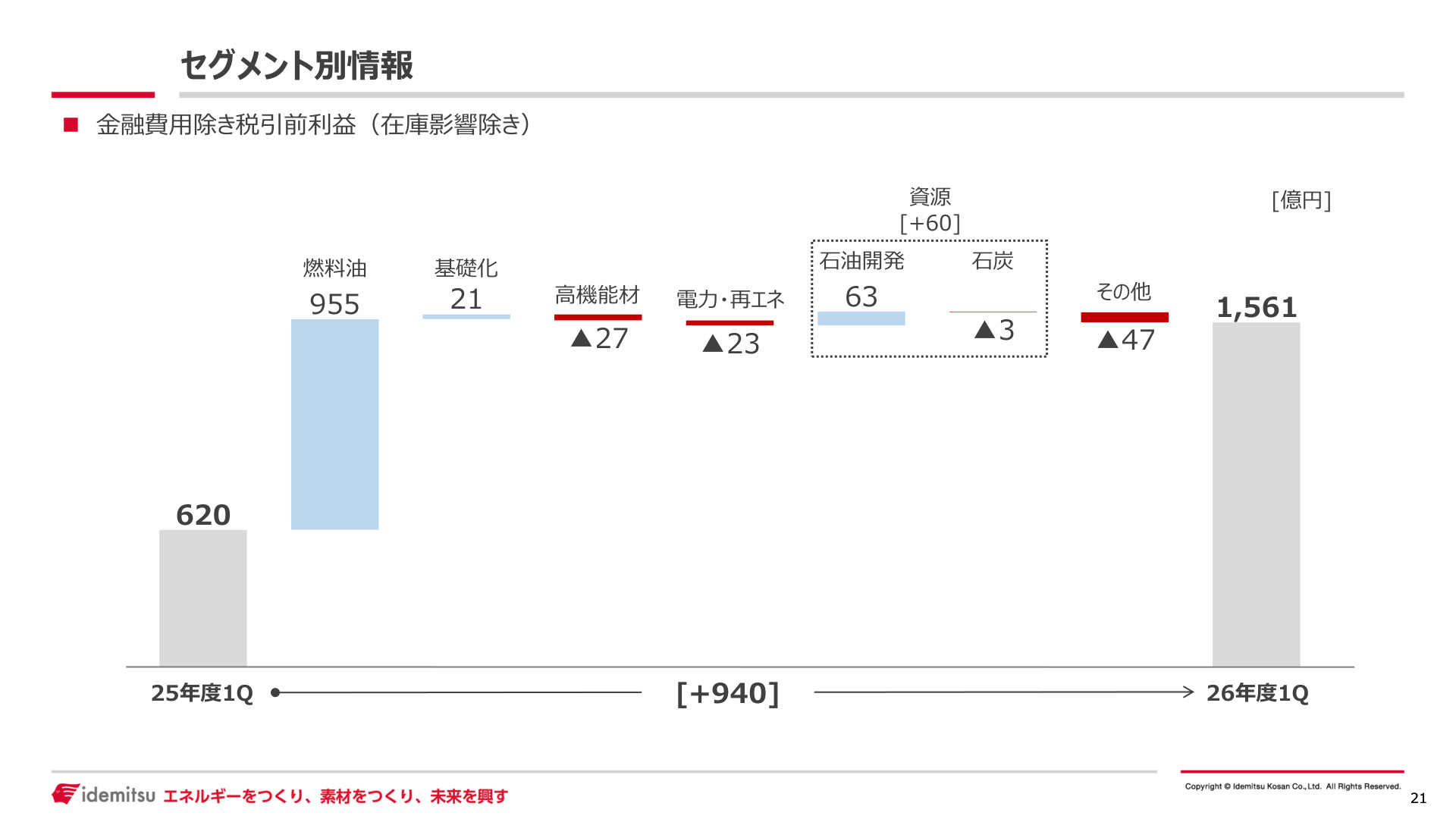
The breakdown of Q1 segment performance (profit before income taxes excluding inventory effects and financial costs) is as follows:
Background and Significance of the Segment Information Slide
This slide clearly identifies which parts of the company's business portfolio are driving profits and which are acting as drags. The Fuel Oil segment (+¥95.5 billion increase) accounts for the majority of the ¥94 billion year-on-year profit growth, demonstrating that this segment is the primary engine of the consolidated results.
Details by segment are as follows:
① Fuel Oil Segment (¥127.2 billion / +¥95.5 billion YoY)
Achieved a significant profit increase from ¥31.7 billion in the same period last year. Key factors include:
- Time-lag effect : Shifted from -¥28 billion in the previous year to +¥70.7 billion, resulting in a +¥98.7 billion profit boost .
- Trading business : Successful transactions capturing global market distortions contributed +¥15.8 billion .
- Product imports/exports (including sales linked to overseas market prices) : +¥13.2 billion increase .
- Negative factors : Despite declines in domestic fuel oil sales volume (-¥5.7 billion), lower main fuel margins (-¥5.5 billion), and increased internal fuel costs (-¥21 billion), the positive impacts of the time-lag and trading significantly outweighed these headwinds.
② Basic Chemicals Segment (¥0.1 billion / +¥2.1 billion YoY)
Returned to profitability from a -¥2 billion loss in the same period last year. Despite lower sales volumes (-¥7.3 billion), performance remained solid due to improved product margins (+¥2 billion) and inventory effects (+¥6.6 billion).
③ Functional Materials Segment (¥14.5 billion / -¥2.7 billion YoY)
Profit declined due to the sale of low-cost inventory in functional chemicals and the reactionary effect of one-time gains from step acquisitions in the lubricants business recorded in the previous year.
④ Power & Renewable Energy Segment (-¥1.3 billion / -¥2.3 billion YoY)
Fell into a loss due to periodic maintenance at Toa Oil and power plant issues, which offset derivative gains from biomass fuel procurement (+¥1.7 billion).
⑤ Resources Segment (¥18.9 billion / +¥6 billion YoY)
- Oil Exploration : Significant profit increase to ¥11.6 billion (+¥6.3 billion YoY) due to increased condensate production in Vietnam.
- Coal : Despite higher sales volumes (+¥2.9 billion) and price increases (+¥1.1 billion), profit saw a slight decline to ¥7.4 billion (-¥0.3 billion YoY) due to exchange rate impacts (-¥2.1 billion) and increased costs.
4. Strategic Growth Drivers and Mid-Term Management Plan Progress
Idemitsu Kosan is driving business structural reform through three pillars: GRIT (deepening existing businesses), GROWTH (creating growth businesses), and CNX (challenging low/decarbonized businesses).
Strengthening Existing Businesses (GRIT) and Improving Refinery Utilization
The primary theme for the core fuel oil business is maintaining safe, stable operations and high utilization rates (over 90% on a BSD basis) . Increased utilization leads to higher production volumes, which the company expects to contribute ¥20-30 billion in profit by FY2030 through expanded export surpluses or reduced import requirements. The company is promoting advanced measures such as AI-based image diagnostics and equipment management tools.
Further Strengthening Global Fuel Oil Trading
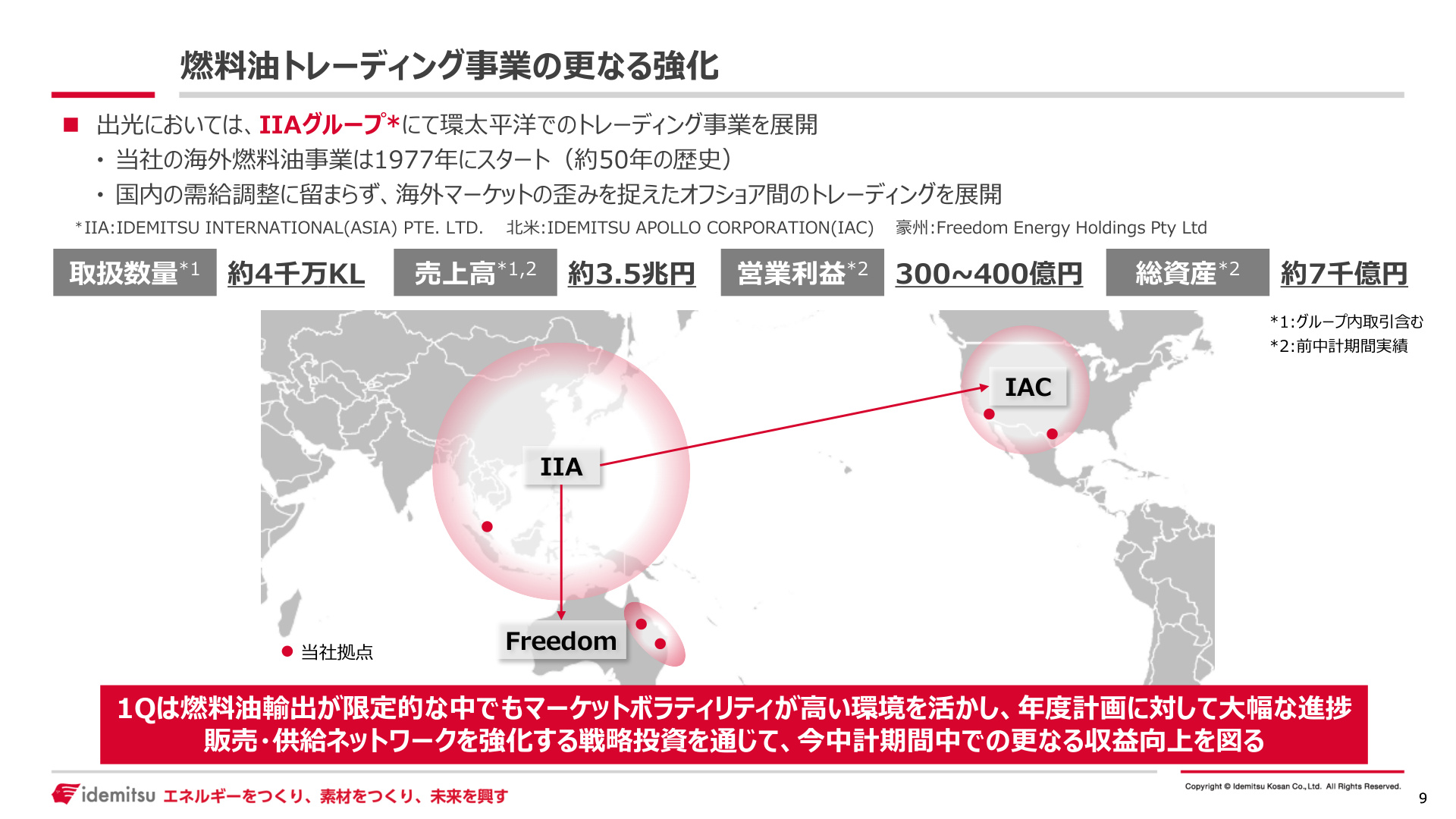
The expansion of the overseas fuel oil trading business (IIA Group) is a core pillar of the GROWTH strategy.
Background and Significance of the Fuel Oil Trading Business Slide
This slide demonstrates that Idemitsu Kosan is transforming from a domestic refiner into a global energy trading company with a Pan-Pacific reach . By leveraging its network built over 50 years across Singapore (IIA), North America (IAC), and Australia (Freedom), the company conducts offshore trading. It possesses a massive business foundation with a trading volume of approx. 40 million KL , revenue of approx. ¥3.5 trillion , and an operating profit target of ¥30-40 billion during the mid-term plan period. In Q1, the company successfully captured market volatility caused by Middle Eastern tensions, achieving a ¥15.8 billion year-on-year profit increase even in an environment where domestic exports were limited.
5. Progress in Overseas and New Business Areas (GROWTH & CNX)
To achieve long-term growth, the company is accelerating investment and entry into the following areas:
- IMEA (India, Middle East, Africa) Expansion : Positioned as a new growth driver, the company established the "IMEA Business Promotion Office." It plans to allocate 38% of its global investment budget ( ¥350 billion total ) to reach a profit scale of ¥10 billion by FY2030 .
- LNG Business Structuring : Anticipating increased power demand from AI and data centers, the company invested $500 million in MidOcean Energy to establish an LNG value chain from upstream interests to marketing and transport, targeting over ¥10 billion in profit by FY2030 .
- Next-Generation Technologies (Solid Electrolytes, Space Solar Cells, Chemical Recycling) :
- Solid Electrolytes : Construction of lithium sulfide production facilities and large-scale pilot plants is underway, with progress on track for commercialization in 2027-2028 . Expansion into non-automotive sectors (drones, robots) is under consideration.
- Space CGS Solar Cells : Awarded a subsidy of up to ¥3 billion from JAXA's "Space Strategy Fund."
- Chemical Recycling : Following the commercial operation of the first unit at the Ichihara plant, basic design for the second unit has commenced.
6. Improvement Trends in Challenging Businesses and Risk Factors
Structural Reform of Challenging Businesses
- Nghi Son Refinery (NSRP), Vietnam : Maintained high utilization rates by securing crude oil from outside the Strait of Hormuz and benefiting from strong overseas market conditions, achieving a net profit in Q1 . The company is implementing measures to reduce interest burdens, such as converting subordinated loans to simple interest, and expects to record equity-method investment gains (reversal of provisions) during FY2026 as senior loans are repaid.
- Basic Chemicals Restructuring : The company is steadily executing business integrations, including the consolidation of the Chiba ethylene plant into Mitsui Chemicals (July 2027) and the integration of PP/LLDPE businesses with Sumitomo Chemical via Prime Polymer (April 2027).
Response to Middle Eastern Tensions and Earnings Sensitivity
In response to the deteriorating situation in the Middle East, the company has secured alternative crude oil sources outside the Strait of Hormuz, maintaining a stable supply system. While Q1 saw positive impacts from prolonged time-lags due to shipping delays, negative time-lag effects are expected from Q2 onward due to the assumption of declining crude oil prices.
[Earnings Sensitivity (Annual Impact)]
- Crude Oil Price : A +$10/bbl change results in a +¥20 billion increase in profit before taxes (excluding inventory effects; +¥105 billion including inventory effects).
- Exchange Rate : A +¥5/USD change (weaker yen) results in a +¥4 billion profit fluctuation (excluding inventory effects; +¥20 billion total including time-lags).
7. Conclusion
Idemitsu Kosan's Q1 FY2026 results reached exceptionally high profit levels, driven by the tailwinds of high crude oil prices and a weak yen , alongside the robust earnings power of the overseas trading business . Simultaneously, the company is making strategic progress in line with its mid-term management plan across all areas: safe and stable refinery operations (GRIT), growth areas such as IMEA, LNG, and all-solid-state batteries (GROWTH/CNX), and structural reforms of challenging businesses, including the return to profitability of the Nghi Son refinery.
This content is not intended as investment advice or a recommendation. Any opinions expressed are solely the personal views of each article.